- What Drives Wholesale Bag Prices
- Wholesale Price Ranges by Bag Type
- Material Grades and Their Price Impact
- How Order Quantity Changes the Price
- Reading Supplier Quotes: What to Compare
- Hidden Costs: From FOB to Landed
- Negotiating Wholesale Prices with Evidence
- Price Benchmarks: What Is Reasonable
- When Cheap Is Expensive
- FAQ
What Drives Wholesale Bag Prices
Wholesale prices are not random numbers; they are the sum of visible costs and invisible decisions. Understanding the drivers lets a buyer read any quote, compare suppliers fairly, and negotiate with facts instead of guesses. The drivers sit in four layers, and the price difference between two suppliers almost always traces back to one of them.
The first layer is the bill of materials: what the bag is actually made of. The outer material, the lining, the hardware, the zipper, the webbing, the thread, the labels and the packaging each carry a cost, and the material choices dominate the price range. A bag built with premium microfiber leather, branded hardware and a cotton lining costs materially more than an identical silhouette built with standard PU, unbranded hardware and a polyester lining — the difference can reach 30-50 percent on the same design. The buyer who compares prices without comparing the bill of materials is comparing apples to oranges.
The second layer is labor and construction. More pieces, more seams, more pockets, lining, piping, binding and finishing operations mean more sewing minutes per bag, and labor is priced per minute. A simple tote might carry 15-20 minutes of sewing labor; a structured handbag with lining, pockets and hardware can carry 40-60 minutes. The third layer is quantity: fixed costs — patterns, cutting, line setup, sampling — amortize over the order size, which is why unit prices fall as quantities rise. The fourth layer is the supplier’s own position: their overhead, their margin, their capacity utilization and their market — a factory running at full capacity quotes differently from one seeking orders, and a brand working through a distributor pays the distributor’s margin on top.
The practical takeaway: when two quotes differ, ask which driver explains the difference before assuming either supplier is right or wrong. The cheapest quote may be built on thinner materials, simpler construction or a distributor-free structure — and each explanation has different consequences for your product.
Wholesale Price Ranges by Bag Type
Wholesale prices cluster in recognizable ranges by bag type, reflecting construction complexity and material consumption. The ranges below are indicative for standard wholesale orders from a Chinese manufacturer — they vary with materials, hardware, finishing and destination — but they calibrate expectations before the first quote arrives.
| Bag type | Typical FOB range (USD) | Complexity drivers |
|---|---|---|
| Simple totes and shoppers | 2.50 – 5.00 | One main panel, minimal hardware, no lining or simple lining |
| Pouches and small accessories | 1.50 – 4.00 | Small material use, zipper, simple construction |
| Backpacks (basic) | 6.00 – 12.00 | Padding, multiple compartments, straps, buckles |
| Handbags and shoulder bags | 5.00 – 15.00 | Structured panels, hardware, lining, finishing |
| Wallets and small leather goods | 1.50 – 5.00 | Small pieces, many operations per unit |
| Laptop and travel bags | 10.00 – 25.00 | Padding, compartments, heavy hardware, testing |
| Premium/designer-grade handbags | 15.00 – 40.00+ | Premium materials, complex construction, finishing |
The ranges overlap because the real determinant is the specification, not the category: the same handbag silhouette spans from budget PU at 5 dollars to premium construction at 25 dollars depending on the materials and the detail level. Use the range as a sanity check, not a price list — a quote far below the range signals thin materials or skipped processes, and a quote far above it signals either premium positioning or an uncompetitive structure. The benchmark conversation happens after the specification is fixed, because that is when the price becomes comparable.

Material Grades and Their Price Impact
Materials are the largest price driver and the least visible one — two bags that look identical in a photo can differ by half in wholesale price because of what they are made of. Learning to read the material story in a quote is the single most valuable skill for a wholesale buyer.
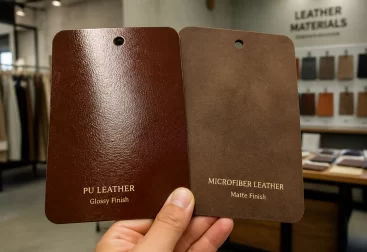
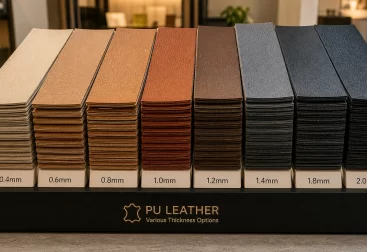
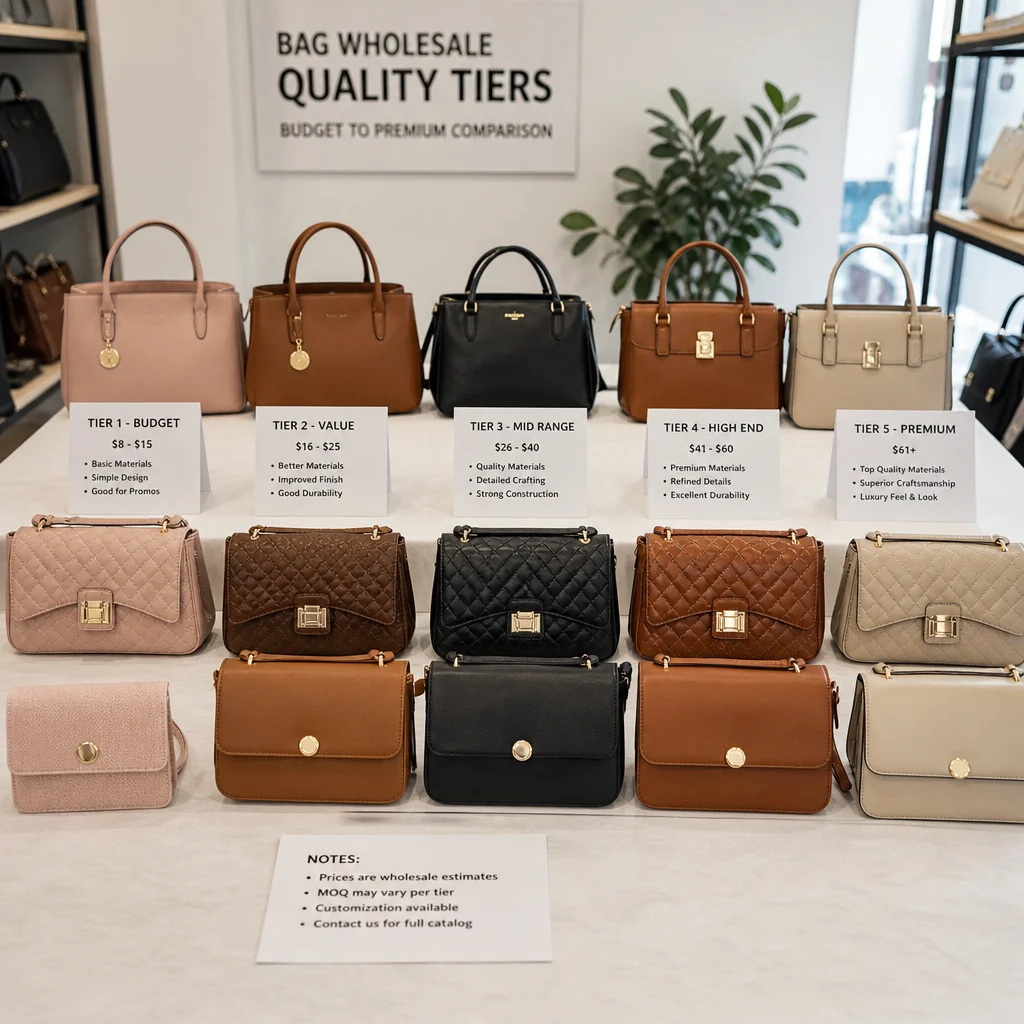
The outer material tier determines the base. Standard PU leather — the workhorse of the budget and mid market — prices by thickness, base fabric and surface finish; premium PU with a softer hand, better abrasion resistance and a more leather-like surface costs more. Microfiber leather, with its higher durability and more natural hand, typically prices 30-80 percent above standard PU. The price ladder continues through genuine leather splits, bonded leather and full-grain hides, where the material alone can exceed the total cost of a budget PU bag. The same logic runs through every component: the lining (polyester at the bottom, cotton and premium fabrics above), the zipper (standard metal, branded, YKK-grade), the hardware (zinc alloy, die-cast, plated finishes) and the webbing.
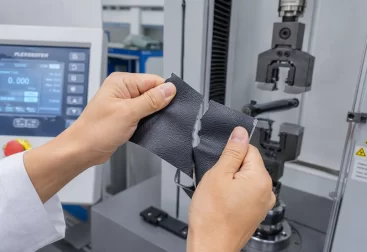
Material certification adds another cost layer that serious buyers should welcome: chemical compliance testing (REACH, CPSIA), color fastness reports, and abrasion or strength certifications each carry a laboratory fee, and the certified material costs more than the uncertified equivalent. The premium is small per unit and large in protection — it converts the material risk into a documented fact.
The buying rule that follows: always request the material specification with the quote — the outer material grade and thickness, the lining, the hardware finish, the zipper brand — and compare quotes on the same specification. When a supplier cannot or will not state the materials, that is the answer to your question about the price.
How Order Quantity Changes the Price
The quantity is a price variable, and the relationship is not linear: unit price falls as quantity rises, but the drops happen at tiers where the supplier’s fixed costs are absorbed. Understanding the tiers turns the quantity decision into a cost decision.
The fixed costs behind the tiers: pattern making, cutting markers, line setup, sampling, and the administrative overhead of the order. These costs are roughly the same whether the order is 300 pieces or 3,000, so doubling the quantity does not double the cost — it spreads the fixed cost over more units, which is why the second thousand pieces always costs less per unit than the first. Material purchasing adds a second curve: at certain volumes, the material supplier gives a better price, and the factory passes part of it through.
The practical tier pattern for bags from a factory: the base price at the MOQ (often 300-1,000 pieces), a meaningful break around 2,000-3,000 pieces where the material purchase improves, another around 5,000-10,000 where the line runs more efficiently, and sometimes a larger step at full-container volume. The professional move is to ask for the price at your quantity and at the next two tiers, then run the simple math: if ordering 2,000 instead of 1,000 saves 8 percent per unit, the saving on 2,000 units is 160 units of value — compare that against the carrying cost of the extra 1,000 pieces in your warehouse, and the tier decision answers itself.

Reading Supplier Quotes: What to Compare
Supplier quotes arrive in different formats with different levels of detail, and the comparison is only meaningful when the quotes are normalized to the same specification, the same terms and the same scope. The professional comparison checks seven fields before the price per unit.
The first field is the specification: confirm that both quotes cover the same materials, construction and hardware — or adjust the prices for the differences. The second is the scope: does the price include inner packaging, dust bags, hang tags and cartons, or are they quoted separately? Packaging alone can move a quote by 3-8 percent. The third is the term: FOB which port, CIF where, DDP to where — the term changes who pays the freight, and the price must be compared at the same point in the chain. The fourth is the MOQ: at what quantity does the quoted price apply, and what is the price at your actual quantity?
The fifth field is the lead time: the price is only comparable with the schedule — a factory quoting a lower price with a longer lead time may miss your launch. The sixth is the exclusions: tooling, molds, sampling fees and testing fees are often excluded and must be added to the comparison. The seventh is the payment terms: a 30-70 structure and a 50-50 structure have different cash-flow and risk profiles even at the same unit price.
One practical habit normalizes the comparison: ask every supplier to quote on your specification sheet, with your packaging list, at your quantity and your incoterm — and ask each to list the exclusions explicitly. The quote that comes back complete is the quote you can compare; the quote that dodges the fields is the quote you should treat with suspicion.
Hidden Costs: From FOB to Landed
The quoted FOB price is the beginning of your cost, not the end — and the costs between FOB and the shelf are where wholesale buyers most often miscalculate their margin. The landed cost is the number that matters, and it deserves a written calculation before any order.
The chain from FOB to landed has five links. Ocean freight — by far the largest addition for volume orders: a 20-foot container from Asia to the US or Europe typically costs between 1,000 and 3,000 USD depending on the route and the season, and the freight per unit is the container cost divided by the pieces it holds. Insurance — a small percentage of the goods value, often bundled into the freight quote. Duties and taxes — the import tariff for bags by HS code, which varies by country and by material (leather and synthetic bags often sit in different tariff lines), plus the local VAT or sales tax. Port and clearance charges — the terminal handling, the customs brokerage, and the documentary fees, which can be a surprising flat cost on small shipments. Inland delivery — the truck from the port to your warehouse.
A working rule for planning: the landed cost of bags is typically 15-35 percent above FOB, with freight dominating for small orders and duties mattering most for large ones. The percentages are route- and country-specific, which is why the professional buyer builds the calculation into every sourcing decision — the margin analysis runs on landed cost, never on FOB. When the landed cost leaves a thinner margin than the FOB price suggested, that is the moment to revisit the quantity tier, the freight terms or the packaging weight, not the moment to discover the problem after the goods arrive.
Negotiating Wholesale Prices with Evidence
Price negotiation with a factory is a technical conversation, not a tug of war — and the buyer with evidence negotiates better than the buyer with pressure. The factory’s price has a cost floor; the negotiation moves the price toward the floor by changing what the floor is made of.
The most effective lever is specification adjustment. If the price is too high, ask what changes in the bill of materials would bring it down: a standard zipper instead of branded, a polyester lining instead of cotton, a simpler hardware finish, a smaller dust bag. Each change names a real saving, and the buyer chooses which savings to accept against the product impact — the negotiation becomes a menu instead of a confrontation. The second lever is quantity structure: offering a larger order, a mixed-style order on the same materials, or a repeat-order commitment moves the price through the tiers the factory already knows. The third lever is timing: ordering in the factory’s slow season, or accepting a longer lead time, gives the factory scheduling flexibility worth a price concession.
Comparative quotes are the fourth lever, used honestly: sharing that another factory quoted the same specification lower — with the specification attached — asks the factory to explain the difference or match it. The honest version works because factories know their own cost structures; the dishonest version (inventing a phantom quote) destroys trust and poisons the relationship. The fifth lever is the relationship itself: payment reliability, clear specifications, timely decisions and repeat orders all reduce the factory’s cost of doing business with you, and factories price those relationships accordingly.
The discipline in negotiation is to separate price from everything else: settle the specification, the quantity, the terms and the schedule first, then negotiate the price on the agreed basis. Negotiating price on a moving specification produces a lower number that means nothing — and the factory recovers the concession on the changes.
The best wholesale price is not the lowest number on the quote; it is the lowest price at which the specification, the quality and the delivery all hold. Negotiate the number, but verify the package it buys.
Price Benchmarks: What Is Reasonable
Beyond the range tables, three benchmark signals tell a buyer whether a specific quote is reasonable for the specification. The benchmarks are quick checks, not precision tools, and they catch the outliers before the deep analysis.
The first signal is the material share: in a properly built quote, materials account for roughly half of the FOB price — 45-60 percent for most bags. When the material share is far below half, the factory may be using thinner or lower-grade materials than the spec claims; when it is far above, the design may be material-heavy or the construction quoted too cheaply to be credible. Asking the factory for the material cost breakdown tests both the price and its honesty. The second signal is the labor share: construction labor at 20-30 percent of FOB is the normal band; a quote with labor far below the band deserves a question about the process — fewer operations, thinner stitching or skipped finishing all show up here.
The third signal is comparability across suppliers on the same specification. When three factories quote the same spec within 10 percent, the market has spoken and the differences are overhead and margin; when one quote is 30 percent below the others, the specification is not the same — thinner materials, simpler hardware or excluded costs explain the gap, and the buyer should find out which. The benchmark habit — material share, labor share, cross-supplier spread — is a three-minute calculation that prevents the two expensive mistakes: paying premium prices for standard goods, and ordering standard goods at prices that cannot cover the specification.
When Cheap Is Expensive
Every wholesale buyer is tempted by the quote below the market, and every experienced buyer has a story about the order that cost more than it saved. The cheap quote is not always a trap — sometimes it is a genuinely efficient factory — but the reasons a quote can sit far below the market are worth knowing before you order.
The first reason is thinner materials: the same silhouette produced in thinner PU, lighter hardware or a cheaper zipper looks identical in the sales photo and fails differently in use. The saving is real at the factory and invisible at the showroom; the customer discovers it in the first month of wear. The second reason is process savings with quality consequences: skipped reinforcement, lighter stitching, simpler finishing. The third reason is scope gaps: the low price excludes the packaging, the testing, the tooling or the compliance documents that the higher quote includes — the “savings” reappear as separate invoices. The fourth reason is the supplier’s situation: a factory desperate for orders may price below cost to fill the line, then recover the margin through changes, delays or substitutions once the order is locked.
The protection is verification, not cynicism. Order samples from the low-priced supplier and compare them against the higher-priced samples — material hand, construction, hardware function — on the same table. Request the specification in writing and check the low quote against the material share benchmark. Run the trial order at a quantity where a problem is a lesson rather than a loss. And keep the quality gate in place: the inspection report does not care how good the price looked.
The pattern to remember: price is the visible part of a package whose invisible parts — materials, construction, scope, supplier stability — determine the real cost. The wholesale buyer who compares packages, not just prices, buys well at any price level.
Seasonality and Timing: When Prices Move
Wholesale prices are not static through the year — they move with material markets, factory capacity and the order calendar, and the buyer who understands the timing buys at better prices without sacrificing quality. The movements are not dramatic, but on volume orders they are real.
The material market is the first seasonal factor. PU leather and its feedstocks track oil and chemical prices, and the synthetic leather market moves with supply conditions and currency; genuine leather moves with hide supply cycles. The price at the start of the year is not guaranteed in the third quarter, which is why suppliers quote with a validity period and why the professional buyer locks material prices with the order rather than assuming the quote holds. Asking “how long is this price valid?” is not negotiating — it is planning.
The factory calendar is the second factor. Chinese factories slow down around the Lunar New Year (typically January-February) and run at full capacity in the export seasons that precede Western retail peaks — the third-quarter rush for holiday goods, the first-quarter build for spring collections. Capacity full means two things: less scheduling flexibility for new orders and firmer prices, because the factory does not need to discount for volume. Ordering in the shoulder periods — after the holiday rush, before the next peak — finds factories with open capacity, faster lead times and more room to negotiate scheduling.
The buyer’s timing toolkit has three habits. First, plan the order calendar backward from your launch dates so the orders land in the factory’s shoulder seasons where possible. Second, ask suppliers about their current capacity and the price validity when requesting quotes — the answers calibrate your expectations. Third, for repeat products, consider buying through the slower seasons or committing to a rolling schedule, which trades a little inventory for better prices and guaranteed capacity. The timing discipline is worth a few percent on every order — the same order of magnitude as a negotiated discount, earned without a confrontation.
FAQ
What is a realistic wholesale price for a PU leather handbag?
For standard wholesale orders from a Chinese manufacturer, a PU handbag typically ranges from 5 to 15 USD FOB depending on the construction, hardware and finishing; simple totes start lower and premium or complex designs move above the range. The material specification and construction detail determine where a specific quote falls.
Why do factories quote different prices for the same bag?
The usual reasons are specification differences (thinner materials, simpler hardware), scope differences (packaging and testing excluded), quantity tiers, and the supplier’s own cost position. Compare quotes on the same written specification, the same scope and the same incoterm before judging the difference.
How much should I add to FOB for the landed cost?
As a planning rule, 15-35 percent above FOB covers freight, insurance, duties and clearance for most bag imports, with freight dominating small orders and duties mattering most at volume. Build the exact calculation for your route and your tariff code before committing to a margin plan.
How much can I negotiate off a factory quote?
Negotiation moves prices through specification adjustments, quantity structure and timing rather than flat discounts — realistic outcomes are a few percent on the same specification, and more when you change the spec, raise the quantity or commit to repeat orders. A factory that slashes 30 percent on the same spec is telling you something about its margins.
What is the cheapest way to test a new supplier’s pricing?
Request a quote on your written specification with the packaging and exclusions listed, order samples and compare them against another supplier’s samples on the same table, then place a small trial order at the quantity where a problem is a lesson. The trial order is the only price test that includes delivery and quality.
Do higher prices guarantee better quality?
No — price correlates with the specification, not with honesty. A premium price on a standard specification is overpaying, and a low price on a premium specification is a red flag. Verify with samples, material specifications and inspections, and let the evidence judge the price.
Should I buy from the lowest-priced supplier?
Only after verifying that the package is the same: materials, construction, scope, terms and supplier stability. The lowest price on an identical package is a genuine win; the lowest price on a thinner package is the most expensive option available.
How do material choices affect the wholesale price?
Materials are the largest price driver: premium PU and microfiber leather cost 30-80 percent more than standard PU, and the lining, zipper, hardware and webbing each add their own tier. On the same design, material choices alone can move the price by 30-50 percent.
What should a factory quote include as standard?
A complete quote names the specification basis, the packaging scope, the incoterm, the MOQ, the price at your quantity, the lead time and the exclusions (tooling, sampling, testing). If the quote omits these fields, ask for them before comparing — the missing fields are where the real price hides.
How long is a factory quote usually valid?
Most quotes carry a validity of 15-30 days, after which material prices or capacity may change it. Confirm the validity when the quote arrives and lock the price in writing if you plan to order later — a verbal price is a starting point, not a contract.
Is it cheaper to order during the Chinese New Year period?
Usually not — the market shuts down for weeks around the holiday, lead times stretch and post-holiday capacity is tight as orders queue up. The cheaper windows are the shoulder seasons between the export peaks, when factories have open capacity and schedule flexibility.
Next Steps: Price with Facts, Buy with Evidence
Wholesale pricing stops being a mystery the moment it becomes a calculation: fix the specification, calibrate the range by bag type, check the material and labor shares, add the landed cost, and compare the packages behind the numbers. Run the calculation on every order and the pricing mistakes disappear from your business — the benchmark habit is a three-minute check that compounds.
A manufacturer that quotes transparently — specification attached, scope stated, exclusions listed — makes the calculation easy to run. That is how we quote at our factory: send us your specification and we will show you the breakdown behind the price, so you can compare with confidence.
Need a transparent bulk price for your bag design? Contact our team at info@gionar.com for a detailed quotation on your specification.
Related reading: our custom bag manufacturing portfolio shows the production quality behind our wholesale pricing.