Ask ten buyers what “good PU leather” means and you will get ten answers built on the same three words: thickness, grade, durability. Yet these words are used loosely across the industry — a supplier’s “premium grade” may be another’s “standard,” and “1.0 mm” can describe materials that behave completely differently. For a brand planning a bag line, this vagueness is expensive: it makes material selection feel like a lottery and turns price comparison into guesswork.
This guide puts concrete meaning behind the three terms, from a manufacturer’s point of view. You will learn what thickness actually measures and which ranges suit which products, how grade tiers are defined in practice and what they predict, and what really drives durability in a coated material. You will also get the specification language to use in OEM orders — so that when your factory quotes “PU leather,” both sides are talking about the same material.
How PU Leather Thickness Works
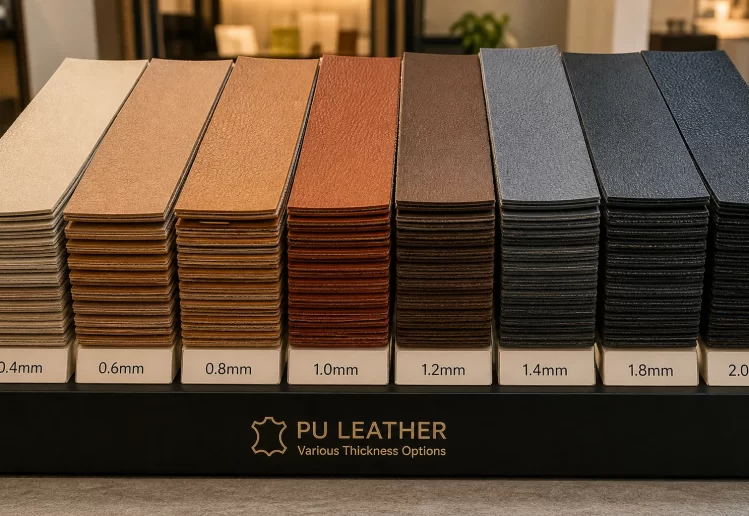
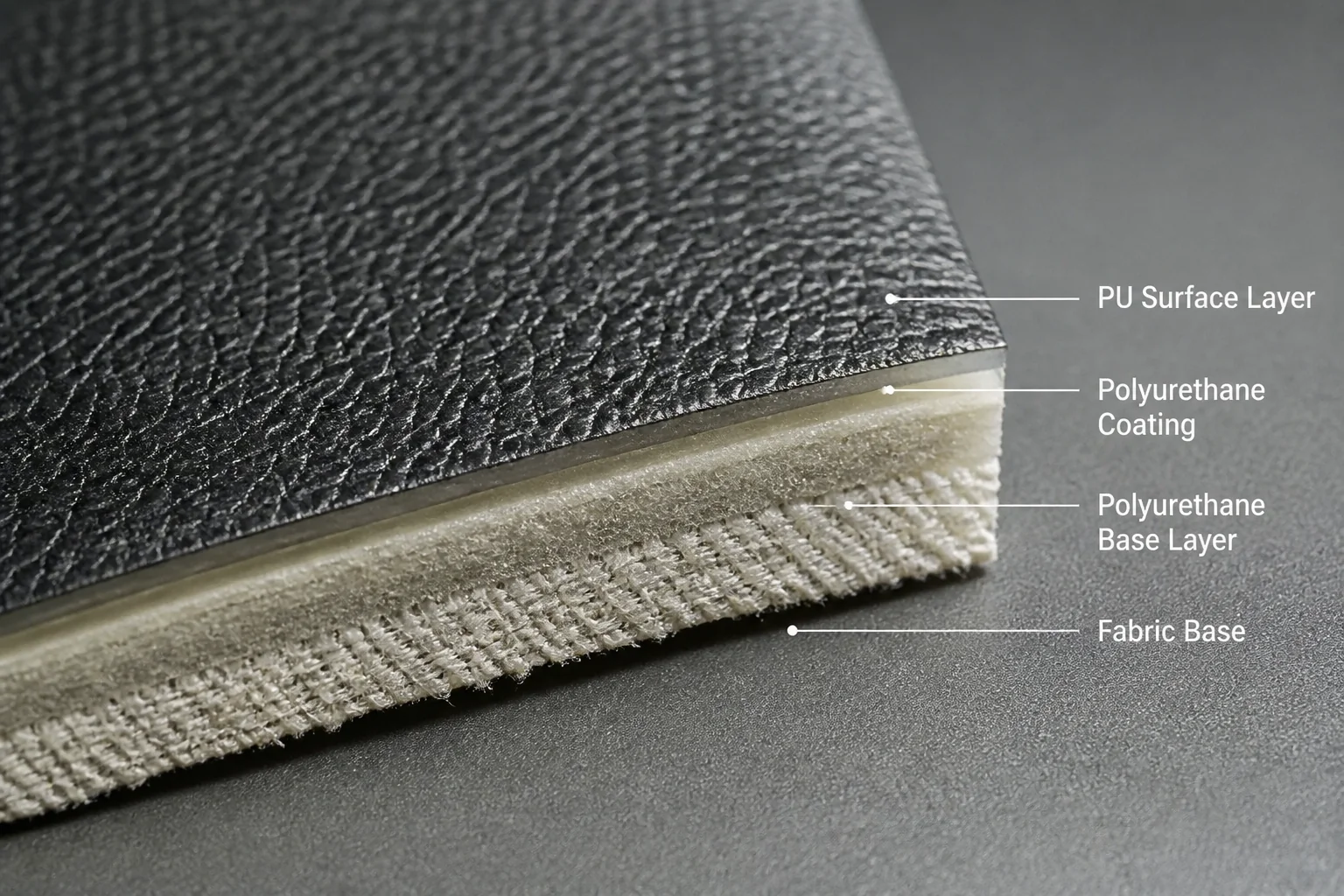
PU leather thickness is the total depth of the material — the fabric base plus the polyurethane coating — measured in millimeters. A standard dial gauge or digital micrometer measures it at multiple points across the roll: edges, center and mid-points, on the first and last meters. The number matters because it determines structure, drape, hardware fit and cost.
The two layers play different roles. The base fabric provides tear strength, flexing behavior and dimensional stability; the coating provides surface appearance, abrasion resistance and water shedding. A thick coating on a thin base gives a smooth surface that can fail structurally under load. A dense base with a thin coating tears less but wears faster on the surface. This is why thickness alone never tells the whole story — it must be read together with the construction.
Thickness also interacts with every downstream decision. Hardware — zippers, buckles, rivets — is sized for a material range; stitching density and thread weight are chosen for the material’s thickness and strength; and the pattern engineer adjusts seam allowances and edge treatments accordingly. A change of 0.2 mm between specification and delivery can produce bags that feel different in the hand, sit differently on shelves and behave differently at stress points. Measuring incoming material is not bureaucracy; it is the first quality gate in production.
Common Thickness Ranges and What They’re For
Commercial PU leather is produced in a practical range, and each band suits particular products. The table below is the starting point a manufacturer uses when discussing thickness with a buyer.
| Thickness range | Character | Typical applications | Notes |
|---|---|---|---|
| 0.6–0.8 mm | Light, flexible, drapes well | Light handbags, pouches, accessories, linings | Lower durability; needs careful construction at stress points |
| 0.8–1.0 mm | Balanced standard | Most fashion handbags, crossbody bags, totes | The most common specification in the category |
| 1.0–1.2 mm | Structured, supportive | Structured handbags, business bags, medium backpacks | Holds shape well; stiffer drape |
| 1.2–1.5 mm | Heavy duty | Backpacks, travel bags, laptop carriers, work bags | High durability; heavier and less flexible |
| 1.5 mm+ | Specialty | Industrial, furniture trim, specialty products | Uncommon in fashion bags; higher cost |
Two practical points about the table. First, thickness ranges overlap because construction matters as much as the number — a 1.0 mm material with a dense base outperforms a 1.2 mm material with a loose base in tear resistance. Second, thicker is not automatically better: a structured handbag benefits from 1.0–1.2 mm, but a soft slouchy silhouette made from the same thickness will fight its own design. Choose the thinnest material that meets your durability and structure requirements — it costs less, drapes better and reduces weight.
Understanding Grades: What the Tier Labels Actually Mean
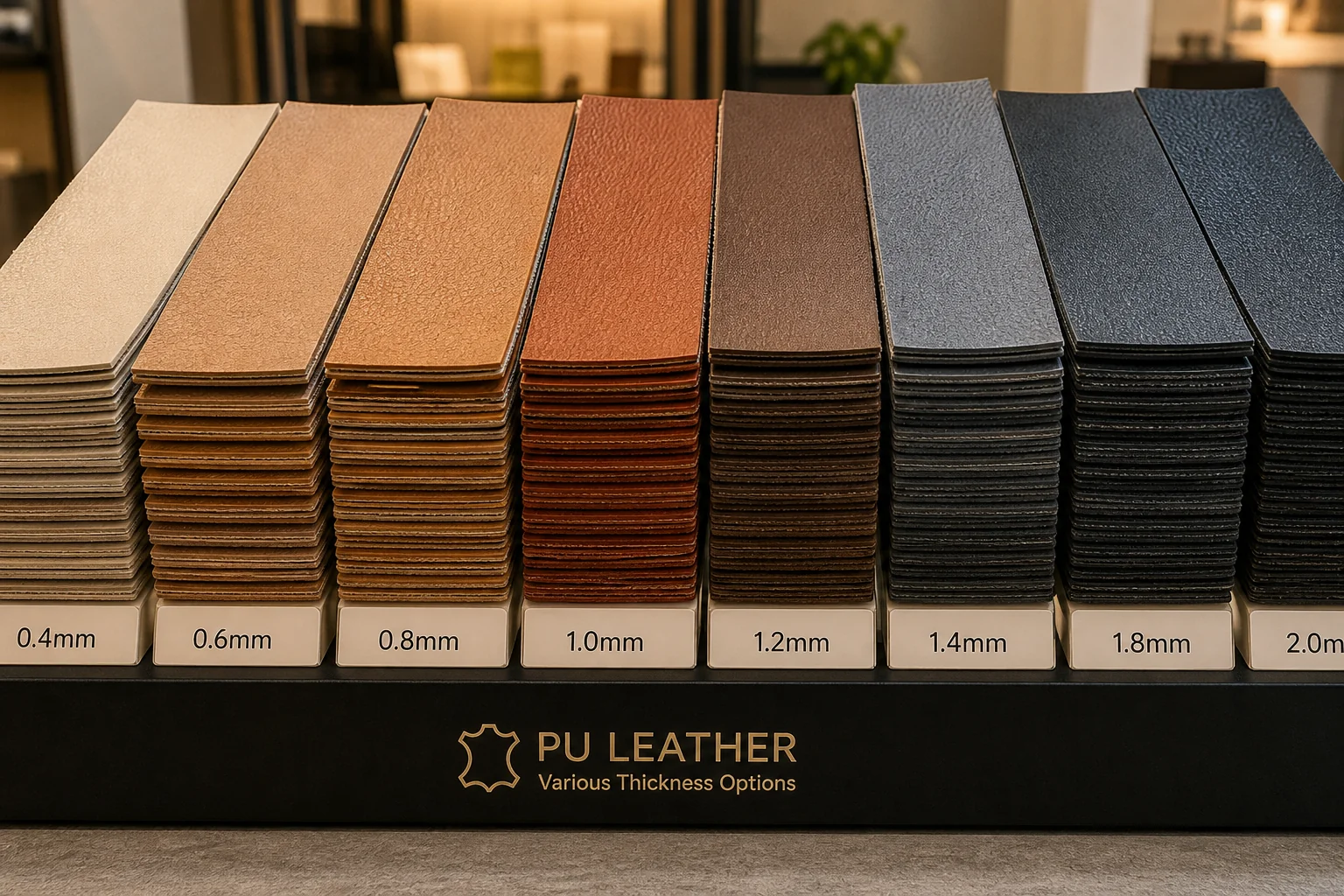
“Grade” is the supplier’s quality tier, and unlike thickness it has no universal standard — every mill defines its own. Understanding what the tiers are built on lets you evaluate any supplier’s grade claims against the same underlying factors.
In practice, grade differences in PU leather come down to four measurable things:
- Base fabric density and type — a dense knitted or woven base with controlled construction costs more and performs better than a loose, light base. This is the single biggest driver of tear strength and shape retention.
- Coating thickness and formulation — premium grades carry a heavier, better-formulated PU layer that resists abrasion and flexing; economy grades use thinner coatings that wear and crack sooner.
- Adhesion quality — how firmly the coating bonds to the base determines peel resistance. Premium production controls this process tightly; economy production often skips the checks.
- Surface finishing — grain depth, gloss uniformity, embossing consistency and defect control separate premium rolls from seconds. A “grade” label without defect limits is marketing, not specification.
| Tier (typical) | Base fabric | Coating | Typical abrasion | Best for |
|---|---|---|---|---|
| Economy | Light knit | Thin, simple | Below 15k cycles | Promo items, budget lines |
| Standard | Standard knit/woven | Moderate | 15k–30k cycles | Mainstream fashion bags |
| Premium | Dense, controlled | Heavier, better formulation | 30k–60k+ cycles | Mid-to-premium handbags, backpacks |
| Microfiber-based | Microfiber non-woven | PU impregnation + finish | 60k–100k+ cycles | Premium daily-use, travel, work |
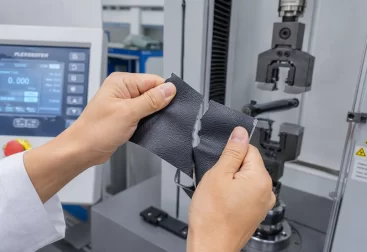
The reliable way to compare grades is not the label but the numbers: abrasion cycles, peel strength, tear strength and defect tolerance. Ask for test data, then judge the tier claim against it. A supplier who can show you measured performance for each grade tier is giving you a specification; one who offers only adjectives is giving you a hope.
Durability: What Makes PU Leather Last or Fail
Durability is not a single property — it is the sum of how a material resists the ways bags actually fail. The five failure modes below are the ones a manufacturer watches, and each maps to a specific cause in the material.
Peeling and delamination
The coating lifts from the base — the most common and most damaging failure. Cause: weak adhesion, often from rushed production or a contaminated base. Prevention: specify a minimum peel strength and verify it on production material, not just samples.
Surface wear and color loss
Abrasion thins the coating until the color wears through or the base shows. Cause: thin coating or soft formulation. Prevention: set a Martindale minimum appropriate to your product and confirm the grade delivers it.
Cracking at creases and folds
Repeated flexing at corners, flaps and handles cracks the coating. Cold makes it worse. Cause: coating brittleness, especially in cold conditions or thin coatings. Prevention: flex and cold crack tests at the temperature your market actually experiences.
Edge fraying and seam failure
Cut edges of the base fabric fray, and seams tear under load. Cause: light base fabric and insufficient edge treatment or reinforcement. Prevention: denser base grades, edge painting or binding, and reinforced stitching at load points.
Color fading and transfer
UV fades the surface; rubbing transfers dye to clothing. Cause: pigment and dyestuff quality. Prevention: lightfastness and rubbing fastness specifications verified per batch.
The practical conclusion: durability is specified, not hoped for. A bag built from a standard grade with tested construction will outlast a “premium” grade built without specification — because durability lives at the intersection of material and construction, and both must be controlled.
Matching Thickness and Grade to Your Product
With thickness and grade understood, selection becomes a decision matrix rather than a guess. The table below combines both dimensions for the main bag categories.
| Product | Recommended thickness | Recommended grade | Reason |
|---|---|---|---|
| Light fashion handbag | 0.8–1.0 mm | Standard | Balance of drape, cost and adequate durability |
| Structured handbag | 1.0–1.2 mm | Premium | Shape retention under structure and hardware |
| Crossbody bag | 0.8–1.0 mm | Standard–premium | Moderate wear; grade depends on price point |
| Tote (loaded) | 1.0–1.2 mm | Premium | Tear strength at handles and base corners |
| School / laptop backpack | 1.0–1.4 mm | Premium or microfiber | Daily abrasion, loads, flexing |
| Travel bag | 1.2–1.5 mm | Premium or microfiber | Heavy handling and long service life |
Two principles guide every row. First, decide the service life your customer expects, then select the grade that delivers it — a premium grade is wasted on a seasonal trend piece, and a standard grade is a liability on a daily-use backpack. Second, validate with a prototype: the sample bag reveals how thickness and grade behave in your construction, which is where the real answer lives.
Specifying Thickness and Grade in OEM Orders
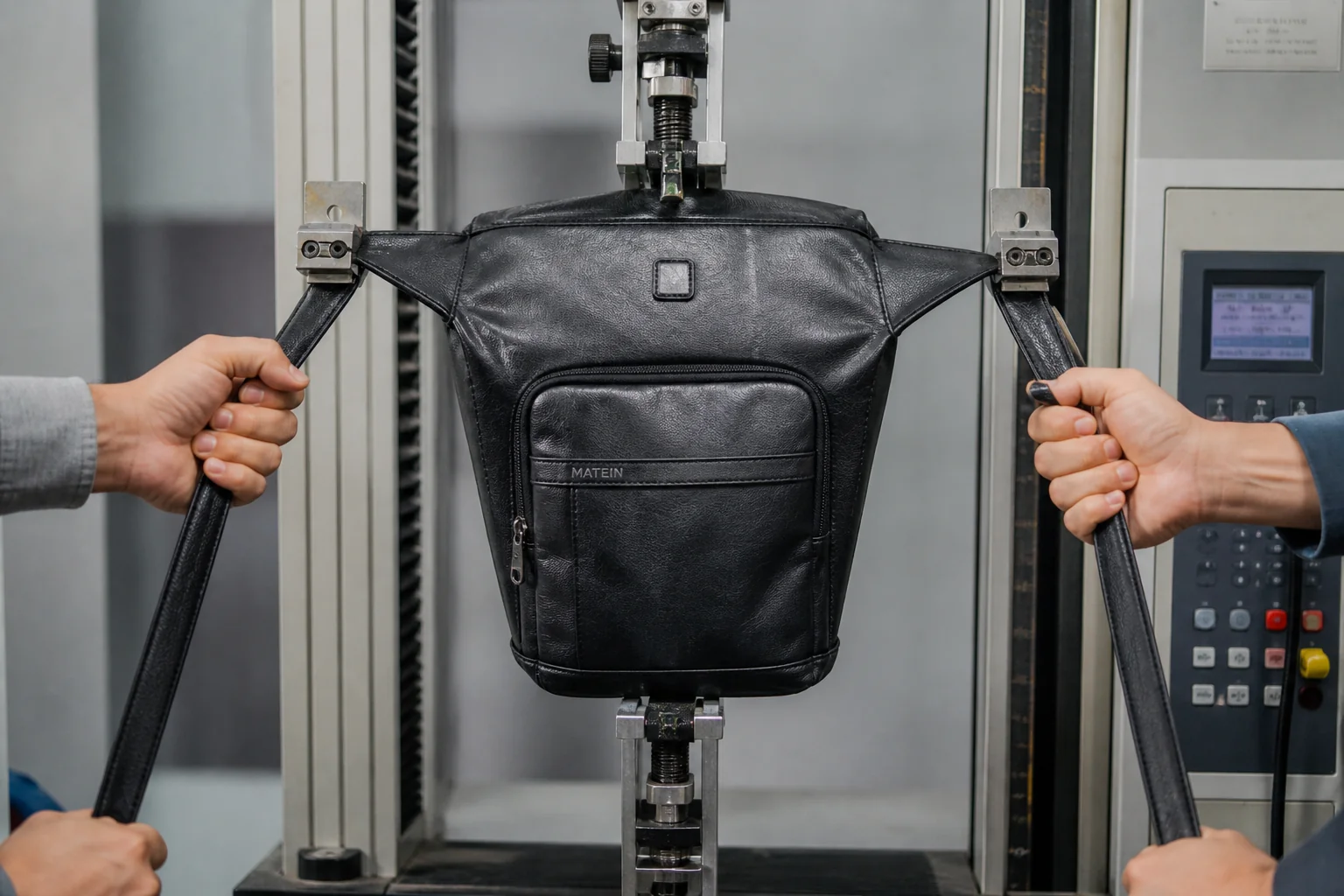
An OEM order is only as precise as its specification document. The four clauses below turn “PU leather” into a measurable requirement.
- Thickness: “PU leather, 1.0 mm ±0.05 mm, measured at five points across the width.” The tolerance turns a description into a checkable number.
- Construction: “Dense knitted base; coating thickness ≥0.25 mm; total weight 500–550 g/m².” Describing construction prevents the supplier from meeting thickness with a thick, loose base.
- Performance: “Martindale ≥30,000 cycles; peel strength ≥8 N/50mm; cold crack pass at −10°C; color fastness to rubbing ≥4 dry / 3 wet.” These are the measurable proxies for the grade tier you are paying for.
- Consistency: “Batch-to-batch: sealed reference sample; certificate with each shipment; variance within stated tolerances.” This clause is what keeps order two identical to order one.
Write the specification before sampling, attach it to the order, and verify against it at incoming inspection. This is the discipline that separates professional sourcing from supplier roulette — and it costs nothing but a page of writing.
How Durability Pays for Itself Across Price Points
Grade selection is ultimately an economic decision, and the economics are less obvious than they first appear. A standard-grade material at a lower price looks like the cheaper option; the arithmetic changes when you include the cost of failure.
Consider two versions of the same tote. Version A uses standard-grade 0.9 mm material at a modest material cost; Version B uses a premium grade with roughly 30–50 percent higher material cost per unit. If Version A’s coating begins wearing at the corners after eight months of daily use, the brand absorbs returns, exchanges and negative reviews — each return costing several times the material saving. Version B, carrying a premium grade and a slightly higher retail price, avoids the failure pattern entirely and earns repeat purchases. For a small brand, a single return wave from a material failure can erase a season’s margin.
The same logic applies within a line. A seasonal trend piece with a short fashion life does not need a premium grade — the customer will replace it by design, and the standard grade keeps the price competitive. A signature product that defines the brand does. The rule of thumb: match the grade to the intended service life and the brand’s risk tolerance, and price accordingly. Durability is not a cost — it is a choice about where the risk sits.
Common Misconceptions About Thickness and Grade
Misunderstandings about these three terms circulate through sourcing conversations every week. Four myths cause most of the confusion.
Myth 1 — “Thicker means better quality”
Thickness is a dimension, not a quality score. A thick material built on a loose base tears and creases more than a thinner material on a dense base. Evaluate thickness against the product’s structural needs, and grade against the performance tests.
Myth 2 — “Grade labels are standardized across suppliers”
They are not. “Premium” at one mill can be “standard” at another. Always translate a grade label into measured numbers — abrasion, peel, tear, defect tolerance — before comparing quotes, or you are comparing adjectives.
Myth 3 — “You can judge PU leather quality by touch”
Hand feel reveals surface finish, nothing more. Two materials can feel identical and differ threefold in abrasion resistance or peel strength. The feel sells the bag in the store; the tests determine whether it survives the customer’s first year.
Myth 4 — “All PU leather is basically the same”
PU leather spans a performance range wider than the price difference suggests. The gap between an economy coating and a premium construction is not a minor difference — it is the difference between a six-month product and a five-year product. That is why the specification, not the category name, is what you actually buy.
Keep these four myths in mind during your next material review. Every time a supplier answer sounds like an adjective, ask for the number behind it — and if no number exists, treat the claim as unverified.
How to Read a Material Datasheet
Every serious PU leather supplier publishes a datasheet, and most buyers skim it. Reading it properly takes five minutes and prevents most specification errors.
- Check the identity block first. The datasheet must name the material code, construction, color range and production date. A datasheet without these describes a category, not your material — the same problem as a grade label without numbers.
- Find thickness and weight together. They should be stated with tolerances (for example, 1.0 mm ±0.05 mm, 520 g/m² ±20). Ranges without tolerances are intentions, not specifications.
- Read the abrasion and peel numbers in context. Note the test method next to the value — Martindale cycles under one standard are not comparable to cycles under another, and peel force depends on the test width. Record both the number and the method in your order file.
- Look for the cold crack and flex data if your market is cold. A datasheet aimed at warm markets may omit them; if your bags ship north, ask explicitly.
- Compare the datasheet to the actual sample. Measure the physical swatch against the sheet’s claims. Suppliers who keep their datasheets honest make this comparison effortless; suppliers who do not become obvious the moment you measure.
Adopt the habit of attaching the datasheet — with the sample identity noted — to every material approval. A year later, when you reorder the same material, the datasheet is what tells you whether you are getting the same thing or a different product wearing the same name.
FAQ
What is the best PU leather thickness for a handbag?
For most fashion handbags, 0.8–1.0 mm balances drape and durability; structured silhouettes benefit from 1.0–1.2 mm. Confirm with a prototype, since hardware and stitching must match the chosen thickness.
Does thicker PU leather always mean better quality?
No. Durability depends on base fabric density, coating quality and adhesion, not thickness alone. A well-made 0.9 mm material can outperform a poorly made 1.2 mm material.
How do I compare grades between different suppliers?
Ignore the adjectives and compare numbers: abrasion cycles, peel strength, tear strength, defect tolerance and base fabric density. Ask for test reports and judge the grade claim against the data.
What Martindale rating should my bags meet?
Mainstream fashion bags: at least 15,000–30,000 cycles. Daily-use backpacks and totes: 30,000+. Premium and microfiber materials: 60,000+.
Can I specify my own grade if the supplier has none?
Yes — you can define your own tier by writing the performance numbers (abrasion, peel, tear, color fastness) into the specification. That becomes your grade, regardless of the supplier’s labels.
Why does the same material feel different between batches?
Production runs vary within tolerances: base fabric rolls differ, coating formulation shifts, finishing conditions change. The sealed reference sample and batch certificates are how you detect and control that drift.
Is microfiber leather a “grade” of PU leather?
Technically no — microfiber leather is a different construction (PU-impregnated microfiber non-woven) rather than a coated fabric. It behaves like a premium tier in durability, which is why it is often described as a step above standard PU grades.
How do I check the thickness of incoming material quickly?
Use a dial gauge or digital micrometer at five points across the roll width — edges, center and mid-points — on the first and last meters. Compare against your specified tolerance (typically ±0.05 mm) and hold any roll that drifts beyond it before cutting begins.
Next Steps: Specify Before You Sample
Start with the material, not the price list, and let the specification lead every conversation with your factory.
Thickness, grade and durability stop being vague when they become numbers in a specification. The cost of writing those numbers is minutes; the cost of discovering a material mismatch after production is weeks and money. Bring a written specification to your manufacturer, ask for the test data behind every grade claim, and verify the first production batch against your reference sample.
Planning a PU leather bag order and want help choosing the right thickness and grade for your market? Contact info@gionar.com for a free material specification consultation and quotation. See our custom bag manufacturing services and laptop backpack manufacturing to see how we build material specifications into every project.