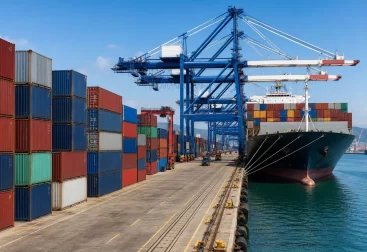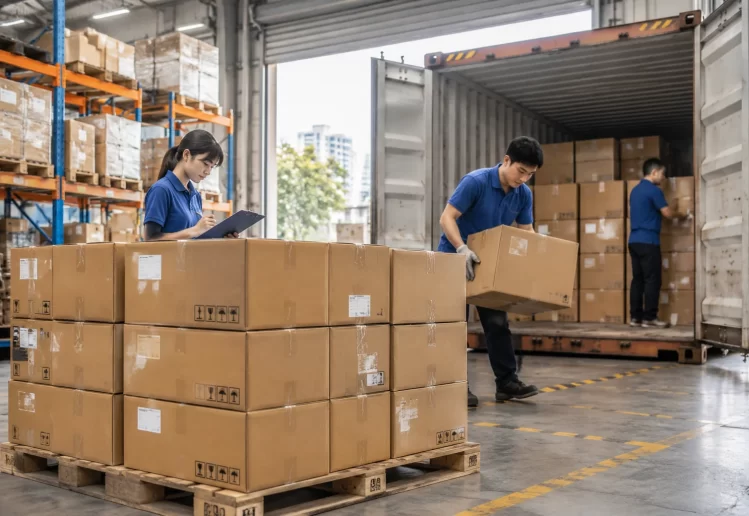
What Really Changes When You Import Bags by LCL Instead of FCL?
Two hundred and forty cartons of PU leather totes are packed, photographed and sealed in a Guangzhou workshop. The order is worth roughly USD 19,000 FOB. It is nowhere near enough to justify a 40HQ to Rotterdam, but it comfortably fills a third of a 20GP. The forwarder quotes LCL, and the first number looks harmless: a rate per cubic metre plus origin charges.
The invoices keep arriving for the next six weeks. There is a consolidation fee at origin, a documentation fee, a destination handling fee that was not on the original quote, a storage charge for two days while the co-loaded container waited for a release, and a delivery order fee that only appears once the cargo has arrived. The cartons themselves are fine. The freight cost per bag is not.
That pattern is the single most common surprise in bag importing. LCL is not “FCL, but smaller”. It is a different operating model with a different cost architecture, a different schedule, a different damage profile and a different paperwork chain. A buyer who compares only the headline freight rate will usually conclude that LCL is cheap, and will usually be wrong by the time the last invoice lands.
PU leather bags make this worse than most products. They are light, voluminous and cosmetically fragile: a carton that weighs fourteen kilograms can occupy nearly a tenth of a cubic metre, so freight is charged on space rather than weight. They scuff, crease and absorb odour. And they carry a high labour content, which means a damaged carton is rarely a total loss and rarely a clean claim.
What this guide covers
Eleven sections plus an FAQ, in the order the money and risk appear: the mechanics of both models, the per-bag cost structure, transit and schedule, handling and damage, where LCL genuinely wins, customs and documents, insurance, MOQ and reorder maths, stowage and contamination, destination charges, and a decision framework you can apply before the next booking. Every section carries working numbers you can adapt to your own carton dimensions.
| Dimension | LCL (less than container load) | FCL (full container load) |
|---|---|---|
| Who else is in the box | Five to twenty shippers, co-loaded by a consolidator | Your cargo only |
| How freight is charged | Per revenue ton (W/M), plus fixed fees per shipment | Per container, flat |
| Minimum billable quantity | Usually 1 CBM, sometimes 2 CBM on some lanes | One container |
| Typical departure frequency | Weekly consolidation, fixed cut-off | Any sailing with space |
| Handling events per carton | Seven to nine | Three to four |
| Who controls stowage | The consolidator | You and the loader |
| Damage claim route | Often shared or contested with co-loaders | Clean, single-shipper record |
| Best fit for bags | 1–15 CBM, test runs, split colourways | 18+ CBM, repeat programmes |
What LCL and FCL Actually Mean for a Bag Order
The definitions are simple; the consequences are not. FCL means you buy the whole box, and everything inside it — stowage, seal number, loading sequence, ventilation — is your responsibility and your record. LCL means you buy a slice of a shared box, and the consolidator owns every decision except the contents of your cartons.
The container maths behind the choice
Start with cubic capacity, not weight. A 20GP holds about 33 CBM of usable space and a 40HQ about 76 CBM, though real loading efficiency for cartons sits nearer 85–90 percent of those figures because corners, doorways and dunnage consume volume. A standard PU leather handbag carton measuring 60 × 45 × 35 cm occupies 0.0945 CBM, so a clean 40HQ carries roughly 700–760 of them and a 20GP roughly 300–320.
At twelve to sixteen bags per carton, that is 4,500–12,000 bags in a 40HQ. Most first orders are a fraction of that, which is precisely why LCL exists.
How LCL freight is priced
LCL uses revenue tons: one cubic metre or 1,000 kilograms, whichever produces the higher charge. PU leather bags almost always price on volume. A carton at 0.0945 CBM weighing 14 kg works out to roughly 148 kg per cubic metre, far below the 1,000 kg break-even, so the cubic metre drives the invoice entirely.
The crossover point for PU leather bags
On most China–Europe and China–US trade lanes in 2026, LCL all-in cost — origin charges, ocean freight, destination handling and delivery order — commonly lands between USD 110 and USD 180 per CBM for a normal commercial address.
A 20GP on the same lane might be USD 1,900–2,900 all-in for 33 CBM, or roughly USD 58–88 per CBM. The crossover therefore sits around 18–22 CBM, earlier if your destination charges are punitive, later if you are shipping to a port city with cheap local delivery.
Treat those as planning ranges, not quotes. What matters is the method: divide total landed freight by CBM for both options at your actual volume, and include every fixed fee. When the two lines converge within about 15 percent, choose FCL for the control and the cleaner claim record, even if LCL is marginally cheaper on paper.
| Order size | Volume | Mode | Freight (USD) | Per bag (USD) |
|---|---|---|---|---|
| 120 cartons | 11.3 CBM | LCL | 1,700 | 1.18 |
| 180 cartons | 17.0 CBM | LCL | 2,480 | 1.15 |
| 240 cartons | 22.7 CBM | LCL | 3,180 | 1.10 |
| 300 cartons | 28.4 CBM | 20GP | 2,400 | 0.67 |
| 700 cartons | 66.2 CBM | 40HQ | 3,600 | 0.43 |
Read the last two rows carefully. At 22.7 CBM the importer is paying USD 0.42 more per bag than necessary, which on a 2,880-bag order is USD 1,210 — roughly the cost of upgrading every carton to a heavier board grade, or the tooling for a custom metal plate. Freight is not a rounding error in a bag programme; it is frequently the second-largest line after material.
How the Cost Structure Changes Per Bag
The headline rate is the least informative number on an LCL quote. What changes the total is the layer of fixed charges that exist because your cargo shares a box with strangers, and those charges do not scale down with volume.
Minimum charges and the small-shipment penalty
Every LCL shipment carries a set of per-shipment fees: documentation, export declaration, consolidation, terminal handling at both ends, release, and often a delivery order fee. Together these typically add USD 250–600 regardless of whether you ship 3 CBM or 15 CBM. On a 15 CBM shipment that is USD 17–40 per CBM. On a 3 CBM trial it can be USD 80–200 per CBM — more than the ocean freight itself.
Charges that only appear on an LCL invoice
Compare any two quotes line by line and the divergence is usually in these items: CFS (container freight station) receiving and loading at origin; CFS handling and devanning at destination; a bill of lading or house bill fee; and a destination documentation fee.
Then add the delivery order fee, which is the release document you need before the terminal will hand over cargo. Add storage if your container waits for a co-loader’s release, and demurrage if the box overstays at the terminal.
None of these are illegitimate. The problem is that they are frequently quoted “excluded” and land on the importer’s account weeks later, after pricing has been set on a landed-cost model that never included them. Ask every forwarder for a fully inclusive door-to-door figure at a stated address, in writing, with the exclusions named.
A worked landed-cost comparison
Take a 240-carton order of PU leather crossbody bags, 12 pieces per carton, 0.0945 CBM each, 22.7 CBM total, destination a European inland warehouse. FCL is not available at this size, but the comparison matters because it shows where the money goes and what a second order should change.
| Cost line | Basis | Amount (USD) | Per bag (USD) |
|---|---|---|---|
| Ocean freight | 22.7 CBM × 78 | 1,770 | 0.61 |
| Origin CFS and consolidation | 22.7 CBM × 18 | 409 | 0.14 |
| Documentation and export declaration | Per shipment | 145 | 0.05 |
| Destination CFS handling | 22.7 CBM × 26 | 590 | 0.20 |
| Delivery order and release | Per shipment | 95 | 0.03 |
| Destination delivery | Fixed, inland | 320 | 0.11 |
| Marine insurance | 0.35% of CIF | 78 | 0.03 |
| Total | 3,407 | 1.18 |
The ocean leg is barely half the invoice. Fixed and destination charges account for USD 1,560 — more than the water freight — and they would have been identical if the order had been 60 percent smaller. That asymmetry is the whole economic story of LCL: variable cost is reasonable, fixed cost is brutal at small volume.
Does Transit Time Really Change With LCL?
Yes, and by more than most buyers expect. The ocean crossing itself is the same. Everything around it is slower, in four distinct places, and each has a name you can ask about.
Consolidation consumes days before departure
An FCL booking closes a few days before sailing. An LCL booking closes when the consolidator’s container is full or the cut-off arrives, whichever comes first. Your cartons must be delivered to the CFS before that cut-off, then wait while the remaining co-loaders deliver theirs, then be loaded. Plan on three to seven extra days at origin, occasionally ten when a consolidator is short of volume and holds the box hoping for more cargo.
Transhipment and the deconsolidation tail
LCL boxes are far more likely to be transhipped than FCL, because consolidation hubs are fewer than direct port pairs. A Guangzhou–Hamburg LCL move may route through Singapore or Port Klang, adding a week and a second handling cycle. At destination, devanning happens after the container is discharged and moved to a CFS, then your cartons wait for a delivery order, then for a slot on a delivery truck.
The tail is where schedules break. A realistic door-to-door planning basis is 32–40 days to Northern Europe by LCL against 26–32 days by FCL, and 26–34 days to US East Coast against 22–28. Add two weeks for a peak-season build-up and one week for any customs query on HS classification, which is common on first shipments of a new bag style.
Planning a retail window around LCL
Work backwards from the delivery date rather than forwards from the order date. A retail launch on the first of the month needs cargo in the warehouse ten days earlier for receiving, quality check and allocation. That means the ship must arrive twelve days before the launch, the vessel must sail five weeks before that, and the CFS cut-off must be four days before sailing.
| Stage | LCL to Rotterdam | FCL to Rotterdam | LCL to New York |
|---|---|---|---|
| Production complete to CFS or port | 3–5 days | 2–3 days | 3–5 days |
| Consolidation wait | 3–7 days | 0 days | 3–7 days |
| Ocean transit | 30–38 days | 28–34 days | 24–30 days |
| Devanning and release | 4–7 days | 2–3 days | 4–7 days |
| Inland delivery | 2–4 days | 2–4 days | 2–3 days |
| Realistic door-to-door | 42–61 days | 34–46 days | 36–52 days |
What Happens to Damage Risk in a Shared Container
Soft goods in a shared box get handled more, stacked with strangers and inspected more often. Each of those is a chance for a carton to be dropped, compressed or left in a damp corner. The effect is measurable in retail returns, not only in visible transit damage.
Counting the touches per carton
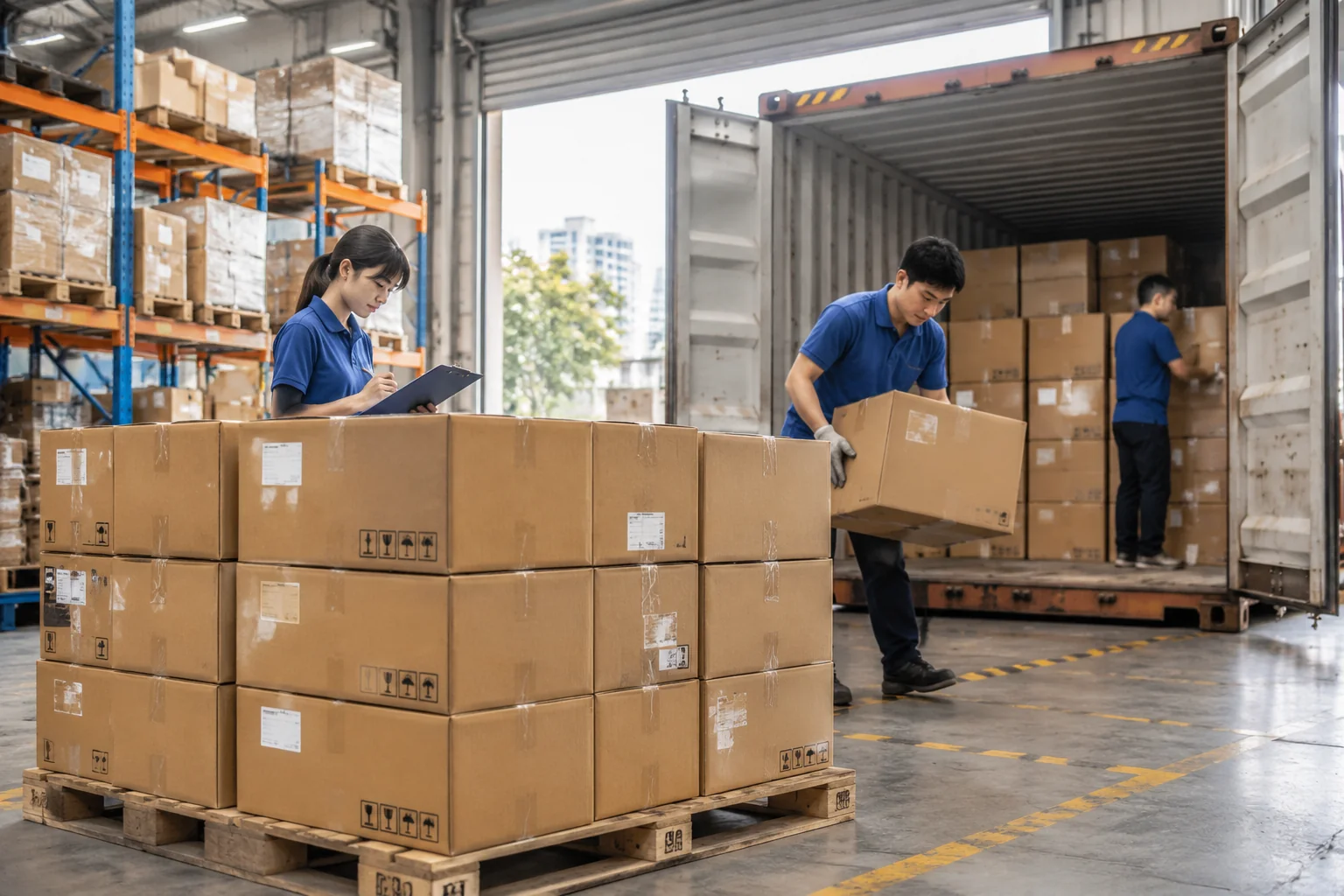
An FCL carton is typically touched at packing, at loading, at discharge and at delivery: four events. An LCL carton adds CFS receiving, CFS loading into the consolidated box, devanning at destination, sorting on the CFS floor and re-palletising: seven to nine events. Every additional touch is a lift, and every lift of a 14 kg carton is a chance to land it on a corner.
What fails first on soft goods
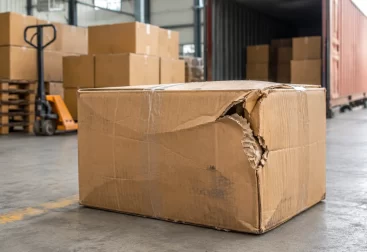
Three failure modes dominate. Corner crush, where a dropped carton deforms the bags beneath it and leaves a crease across the front panel of a PU tote that no amount of steaming will remove.
Surface scuffing comes next: cartons rub against each other or against pallet edges, and the finish — particularly a matte or soft-touch finish — picks up a grey burnish. Then moisture, where a container sitting on a wharf in monsoon conditions condenses on the roof and drips onto the top layer.
PU leather is more sensitive to the third than most materials. It is a coated fabric over a knit or woven backing, and prolonged damp at the cut edges of lining and backing can produce a musty smell that survives drying. A bag that smells wrong is unsellable regardless of how good the stitching is.
Packaging upgrades that pay for themselves
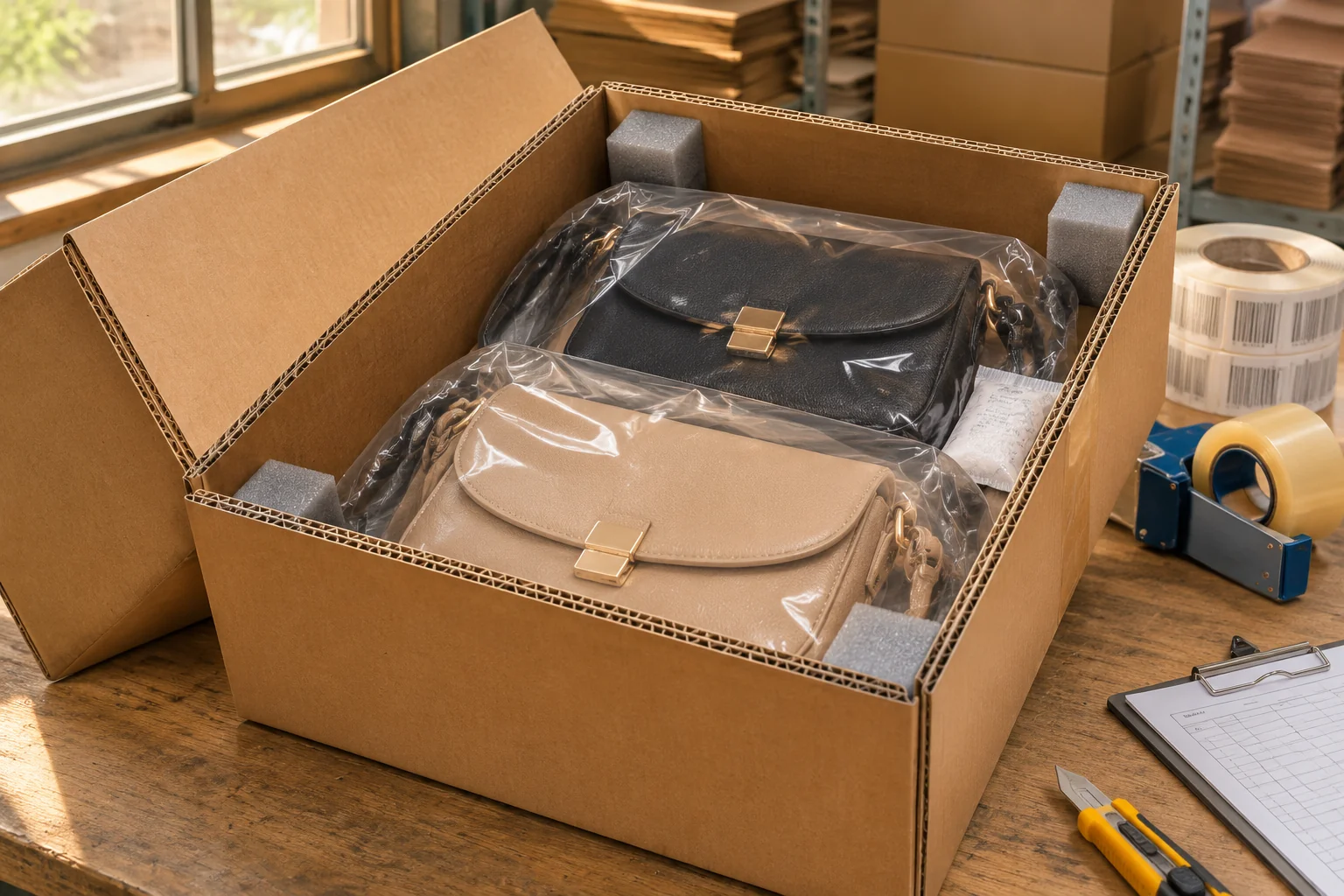
For LCL shipments, three relatively cheap changes address most of the risk. First, upgrade to a five-ply board with a higher edge crush test value; the difference on a carton is typically USD 0.15–0.35 and it is the single most effective defence against compression.
Second, add a polybag per bag and a desiccant sachet per carton; the combined cost is usually under USD 0.10 per unit. Third, use corner protectors or a full-height inner divider so bags do not migrate inside the carton.
The payback is arithmetic: one damaged carton at 12 pieces, 8 percent of them unsellable at full price, on a USD 22 bag, costs more than upgrading 240 cartons. Damage is not an insurance problem first; it is a packaging specification problem.
Where LCL Genuinely Wins
It would be a mistake to read the previous sections as an argument for FCL. For a large share of bag importers, especially in their first two years, LCL is the correct choice — just an expensive one that needs to be managed.
Launching a range without committing to volume
A new brand testing four styles at 300 pieces each is not going to fill a container, and should not try. Ordering 3,000 pieces to fill a 20GP converts a manageable test into an inventory bet, ties up working capital for a year and risks a colour decision that looked good in a showroom. LCL lets the range be tested at a realistic size, and the freight penalty per bag — often USD 0.40–0.70 — is cheaper than the cost of dead stock.
Splitting colourways across sailings
Production rarely finishes all colourways on the same day. A factory running black, cognac and a seasonal olive may finish black in week six and olive in week nine. An LCL booking per colourway keeps stock moving and cash flowing, whereas waiting for a full container holds everything until the last colour is packed.
The economics favour this when the second shipment is at least 5 CBM, so the fixed fee load stays under about USD 100 per CBM. Below that, hold and consolidate. Above about 12 CBM per sailing, price a 20GP before defaulting to LCL.
Co-loading several factories
Buyers sourcing totes from one factory and backpacks from another frequently consolidate both into one LCL shipment at a Guangzhou or Shenzhen CFS. This works well when the cartons are dimensionally compatible and the paperwork is clean, and it fails when one supplier’s cargo arrives late and the whole booking slides.
The rule that keeps it workable: agree a single shipper on the bill of lading, with each factory delivering against a written CFS cut-off and a carton-level packing list. Mixed-supplier LCL with three shippers on the paperwork is the most reliable way to produce a customs query and a demurrage charge in the same week.
What Changes in Customs and Documentation?
Less than most buyers fear, and more than most expect. The classification, duty rate and origin rules are identical; the document chain and the clearance choreography are not.
What stays exactly the same
Your HS code does not change because the cargo shares a box. PU leather handbags, whether of plastic sheeting construction or textile-backed coated fabric, classify on the outer surface material and are typically entered under 4202 headings, with duty rates driven by destination and material rather than by shipping mode. Origin is unchanged. The customs value is built from the transaction the same way.
What changes on paper
You will usually receive a house bill of lading from the consolidator rather than a carrier master bill, and the container number on your documents belongs to a box that also carries other shippers’ cargo. That has two consequences: the packing list must be carton-accurate and separated from other co-loaders’ cargo, and the delivery order is issued against the house bill, not the master.
Keep four documents together and consistent: commercial invoice, packing list, house bill, and the certificate of origin if you are claiming preference. Mark the cartons with your own shipping marks so the CFS can segregate them at devanning. Where two co-loaders’ cartons look alike, segregation errors happen, and recovering misrouted cartons from another consignee is slow.
Clearance timing and destination storage
In FCL you can clear while the container is still on the water and take delivery shortly after discharge. In LCL the cargo must first be devanned, and the CFS will not release until the delivery order is issued and charges are settled. If your broker receives documents late, the cargo sits — and CFS storage typically accrues per CBM per day after a short free period of two to five days.
Send documents before the vessel sails, not after. The single cheapest improvement available to an LCL importer is a document pack that is complete and issued at origin within 72 hours of departure.
| Item | LCL | FCL |
|---|---|---|
| Bill of lading | House bill from consolidator | Master bill from carrier |
| Container ownership | Shared; seal is the consolidator’s | Yours; seal recorded at loading |
| Carton marking | Essential for segregation | Helpful |
| Release mechanism | Delivery order against house bill | Bill of lading release |
| Free time at destination | 2–5 days storage at CFS | 5–10 days demurrage at terminal |
| Examination risk | Higher: co-loaded cargo attracts queries | Lower on clean records |
| Who can inspect your cargo | Consolidator, CFS, customs, co-loaders | Customs only |
How Does Insurance Work in a Shared Container?
Marine cargo insurance is written on your goods, not on the box, so cover transfers cleanly. What changes is the difficulty of proving what happened and who caused it.
Package limits bite harder
Carrier liability under Hague-Visby style regimes is capped per package or per kilogram. For light, high-value cartons of bags, the per-package cap usually produces a payout far below the invoice value — often 5–15 percent of it. That gap is why all-risk cargo insurance exists, and why relying on carrier liability for a bag shipment is not a plan.
In LCL the cap arithmetic is unchanged, but the practical recovery is lower because proving the damage happened during ocean carriage rather than during CFS handling requires a clean pre-shipment condition record. Photograph cartons at the factory, at the CFS gate and on arrival. Three sets of images, timestamped, settle most arguments before they start.
Co-mingling and the argument about cause
When a consolidated container arrives with damage confined to one sector, the natural inference is a stow or handling event. When damage is scattered across several shippers’ cargo, the inference shifts to container conditions — condensation, a leaking roof, a wet floor. The second pattern is common in LCL and is exactly what insurance is for, provided your policy covers water damage and you can show the goods were dry when packed.
Cover that fits an LCL shipment
Buy all-risk, warehouse-to-warehouse cover, with a deductible you have actually read. Check three specifics: whether cover includes CFS storage and devanning (usually yes under warehouse-to-warehouse wording), whether it responds to odour and contamination (often excluded unless noted), and whether it pays on partial damage rather than only total loss.
Premiums for bag cargo typically sit around 0.25–0.45 percent of CIF value, which on a USD 19,000 order is under USD 90 — less than a single damaged carton of premium bags.
How Should MOQ and Reorders Be Planned Around LCL?
LCL changes the shape of a sensible order quantity, because freight has a fixed component that punishes small shipments and a variable component that rewards low volume per Unit.
The minimum viable shipment for bags
Below about 5 CBM, fixed charges dominate and per-bag freight climbs steeply. For a standard carton of 0.0945 CBM, 5 CBM is 53 cartons — roughly 640 bags at 12 per carton. That is a realistic minimum for a commercially sane LCL shipment to a distant market. Below it, air freight for a genuine sample order, or waiting to consolidate, usually beats LCL.
Above about 15 CBM, always price a 20GP before booking. The gap widens quickly: at 20 CBM the LCL per-bag cost is often 40–60 percent higher than the container equivalent.
The reorder maths
For repeat programmes, compute the freight delta per unit rather than the freight total. At 120 cartons and 11.3 CBM with 1,440 bags, freight of USD 1,700 works out at about USD 1.18 per bag. The same product at 300 cartons in a 20GP runs near USD 0.67 per bag. That USD 0.51 delta is your budget for holding stock, or for accepting a slightly higher unit price to reach container volume.
That is the decision every reorder cycle presents: pay the LCL premium, or invest the difference in inventory. The right answer depends on sell-through velocity. If a style turns over in twelve weeks, holding six months of it is not efficiency, it is a warehouse.
When to move to FCL
Move when three conditions hold at once: a repeat order exceeds roughly 18 CBM, the styles have a stable sell-through record, and the cash position allows the extra inventory. Moving earlier converts freight savings into stock risk, and the savings are rarely large enough to justify it.
| Cartons | CBM | Bags (12/ctn) | Freight per bag | Recommended mode |
|---|---|---|---|---|
| 20 | 1.9 | 240 | 2.40–3.10 | Air or consolidate |
| 53 | 5.0 | 636 | 1.55–1.90 | LCL minimum |
| 120 | 11.3 | 1,440 | 1.10–1.35 | LCL |
| 180 | 17.0 | 2,160 | 1.05–1.30 | LCL, price a 20GP |
| 240 | 22.7 | 2,880 | 1.00–1.25 | 20GP usually wins |
| 320 | 30.2 | 3,840 | 0.60–0.80 | 20GP |
What About Stowage, Contamination and Odour?
This is the risk LCL importers of bags underestimate most often, because it produces no visible damage and no clean insurance claim. Your cartons are freight, and freight has neighbours.
Who decides where your cartons sit
The consolidator’s loading supervisor, working to a stow plan built for cubic utilisation. You have no seat at that table. What you can do is write constraints on the booking: keep away from wet cargo, no top-loading above two pallets, no stow adjacent to chemicals, rubber, foodstuffs or dyestuffs. Consolidators do not guarantee these, but they do record them, and a recorded instruction changes how a dispute is settled.
Why PU leather is sensitive to its neighbours
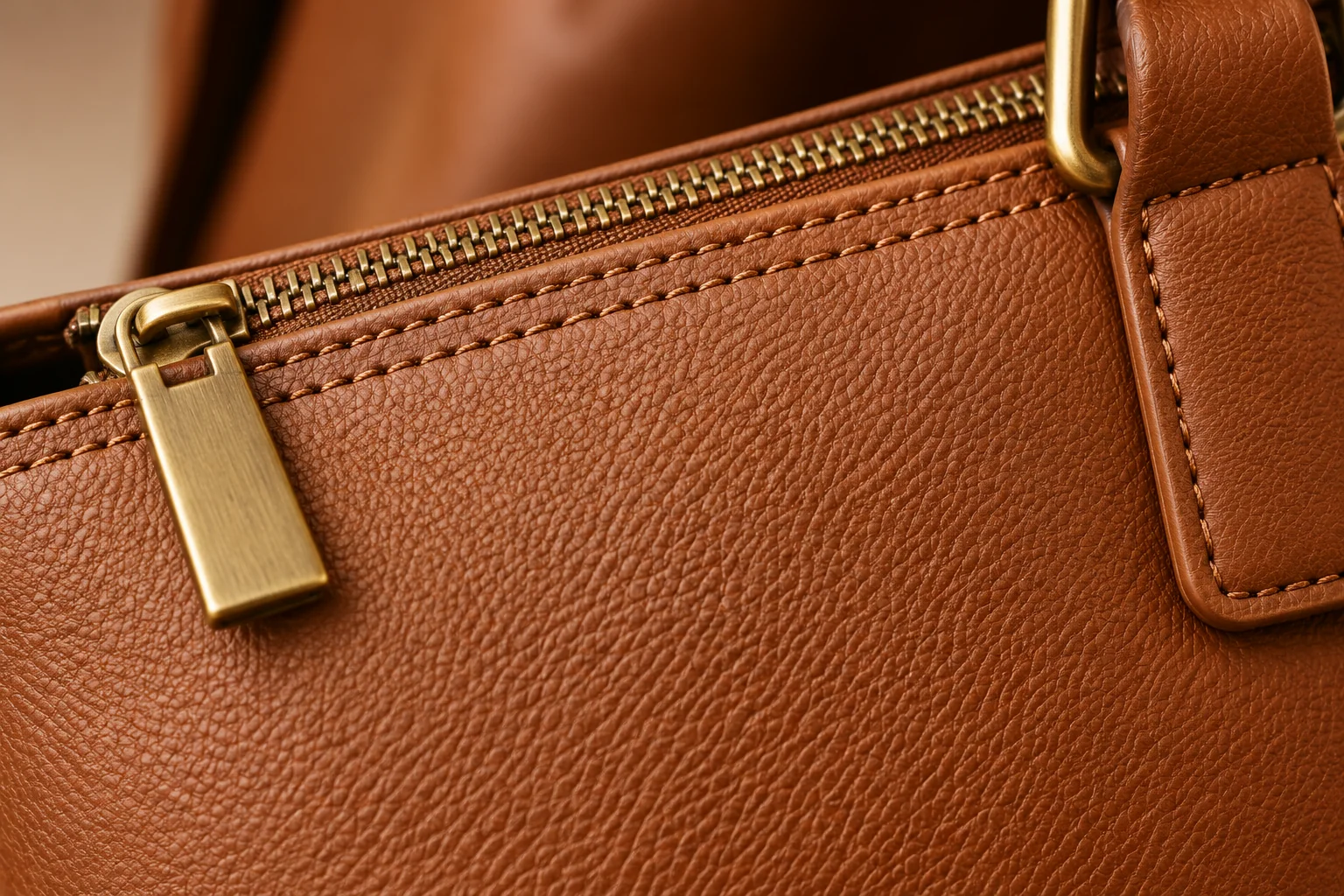
PU leather is a coated fabric: a polyurethane skin over a knit or non-woven backing, often with a solvent-based adhesive holding the layers together. Freshly produced material continues to release trace volatiles for days or weeks. In a sealed container, those volatiles are absorbed by anything porous nearby — and by your own lining fabric if ventilation is poor.
The practical risk is a co-loader shipping paint, solvent-based adhesives, rubber goods, agricultural products or dyestuffs. The result is a bag that smells of something else on arrival. Retailers reject it, end customers return it, and no lab can undo it. Ask for the container number and check whether the consolidator will disclose the co-loaded commodity mix; better ones will confirm “general merchandise, no chemicals”.
The photographs worth requesting
Ask for four images before the box is sealed: your cartons stacked in the CFS, the container doors with the first rows visible, the seal number close-up, and the seal applied. These cost nothing and convert a later argument about whether your cargo was ever actually loaded as described into a factual check.
Which Destination Charges Catch LCL Importers Out?
The destination invoice is where LCL budgets usually fail. It arrives after delivery, covers services you did not know existed, and is payable before the cargo leaves the CFS.
Reading the destination invoice
Four lines account for most of the surprise: destination CFS handling, charged per CBM; a delivery order fee, charged per house bill; a documentation or amendment fee if any data changed after the bill was issued; and storage, charged per CBM per day beyond free time. On a 22 CBM shipment these can total USD 600–900 at European ports and USD 500–800 at US ports.
Before booking, ask for the destination charge schedule in writing, itemised, with currency. A forwarder quoting “destination charges at cost” has told you nothing. One that lists devanning, THC, DO, and storage rates per CBM has told you everything you need to build a landed cost.
Free time and the CFS clock
Free time in LCL is short because CFS space is rented by the square metre. Two to five days from devanning is typical. The clock starts when the container is devanned, not when your broker is ready, and it does not pause for a customs query you could have avoided with a better description.
Book the delivery slot before the vessel arrives. The single most reliable way to avoid CFS storage is to have a truck slot, a cleared entry and a settled invoice waiting on the day of devanning.
Demurrage when the container is shared
Demurrage arises when a container overstays at the terminal. In FCL that is your problem to control. In LCL the container may be held because one co-loader’s paperwork is incomplete or one consignee has not paid, and the resulting terminal charges are distributed or absorbed depending on the consolidator’s terms. Read those terms. Some consolidate fairly; some pass the whole charge to whoever is easiest to bill.
A Decision Framework You Can Apply Today
Four questions, answered in order, resolve the choice for almost any bag order. They take ten minutes with a carton dimension and two quotes.
The four-question test
One: is total volume above 18 CBM? If yes, price FCL and expect it to win. Two: is any single style expected to sell through in under sixteen weeks? If yes, favour the smaller shipment and LCL, because inventory risk outweighs freight savings.
Three: does the order contain multiple colourways finishing on different dates? If yes, split, and use LCL for the later elements. Four: is destination delivery inland, more than 300 km from a port? If yes, add the inland leg to both options — it shifts the crossover more than people expect on US lanes.
Volume thresholds by bag type
Handbag cartons are dense in value and moderate in volume, so the crossover arrives around 20–22 CBM. Backpacks pack slightly flatter and often run 15–18 bags per carton, so the crossover arrives at about 18 CBM. Totes and shoppers, frequently flat-packed, can reach 25–35 units per carton, which pushes the crossover higher, to roughly 24 CBM, because a carton holds more sales value per cubic metre.
Hybrid: one container and one consolidated shipment
For a mid-sized brand, the most efficient pattern is a 20GP of the proven core styles plus a 6–10 CBM LCL of the experimental ones. The container absorbs the volume of the range that is certain to sell; the LCL lets a new shape or colour enter without doubling the inventory commitment. Two shipments, two booking fees, and a materially better risk profile than either extreme.
| Situation | Volume | Recommended | Reason |
|---|---|---|---|
| First trial of a new range | 5–12 CBM | LCL | Inventory risk dominates freight cost |
| Restock of proven styles | 12–18 CBM | LCL or hybrid | Price both; check sell-through |
| Seasonal programme | 18–30 CBM | 20GP | Crossover has passed |
| Multi-style annual contract | 30+ CBM | 20GP or 40HQ | Control stowage and claim record |
| Urgent colour extension | 2–5 CBM | LCL or air | Air if retail window is tight |
| Sample and pre-production sets | <1 CBM | Courier or air | LCL minimums make it uneconomic |
The cheapest fix sits at the manufacturing end, before anyone books space. Put carton grade, inner protection, carton marks, packing list format and the CFS cut-off in the purchase order. A factory that packs to a written specification produces cargo that survives a shared container; one working from an email thread produces cartons that arrive as a negotiation.
If you are building that specification for the first time, our guide to custom bag manufacturing sets out what a complete pack specification contains, and we are glad to review yours before the first booking.
Freight decisions in bag importing are rarely about the cheapest rate. They are about which cost you would rather carry: a predictable per-unit freight premium, or an unpredictable inventory position and a shared-container damage record.
FAQ
Is LCL cheaper than FCL for a small bag order?
Per bag, usually yes — up to the crossover point of roughly 18–22 CBM. Below about 5 CBM the fixed charges make LCL expensive relative to the goods, and below about 2 CBM a courier or air freight is often cheaper than a minimum-volume LCL booking.
How much longer does LCL take door to door?
Plan on six to ten extra days compared with FCL on the same lane: three to seven at origin for consolidation, and three to five at destination for devanning and release. A realistic basis is 42–61 days from factory door to a European inland warehouse.
Who pays for CFS handling at destination?
Usually the consignee, unless the quote was door-to-door inclusive. Destination CFS handling is charged per CBM and typically runs USD 20–35 per CBM at European ports. Get the schedule in writing before booking so it appears in your landed cost from day one.
Does LCL increase the risk of damage to bags?
Yes. Cartons are handled seven to nine times instead of three to four, and they are stacked with other shippers’ cargo. The increased risk is manageable with a five-ply carton, per-bag polybags, desiccants and a written stow instruction, at a cost usually under USD 0.50 per carton.
What is the minimum LCL volume worth shipping?
Around 5 CBM, or roughly 53 standard bag cartons. Below that the fixed per-shipment charges push the cost above USD 100 per CBM and the per-bag freight becomes disproportionate to the goods value.
How do I avoid CFS storage charges?
Have three things ready before devanning: documents issued and received, the customs entry pre-cleared, and a delivery slot booked. Free time is typically two to five days and the clock starts at devanning, not when your broker is ready.
Can I consolidate cartons from two factories into one LCL booking?
Yes, and it usually pays. Keep one shipper on the house bill, give both factories the same CFS cut-off in writing, and require a carton-level packing list from each. Mixed shippers on one house bill is the most common cause of customs queries on consolidated bag cargo.
When should I stop using LCL for bag imports?
When a repeat order passes about 18 CBM, sell-through is proven and cash allows the inventory. At that point the container saves roughly 30–45 percent of freight per bag, and the stowage control and clean claim record are worth as much as the rate.
Planning a first or repeat order and unsure whether to book LCL or a container?
Send your carton dimensions, styles and target quantities to info@gionar.com. We will return a quotation with packed carton volumes, carton grade options and a packing specification built for whichever mode you choose — so the freight invoice is the only surprise left, and it will not be one.