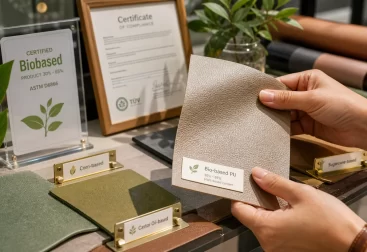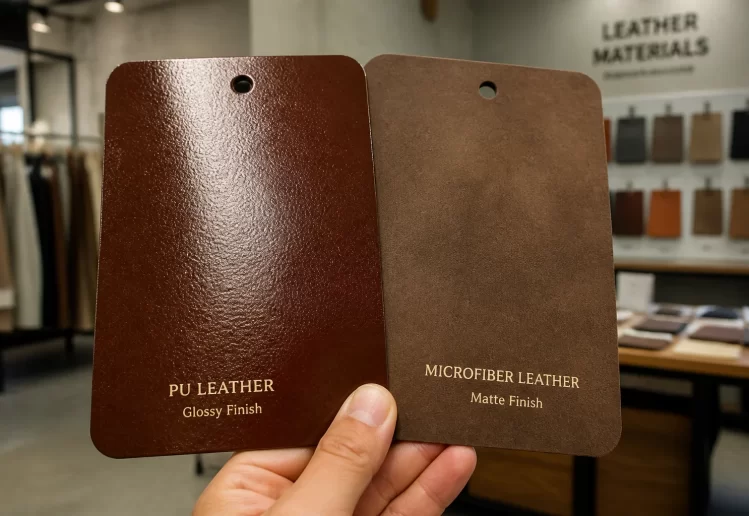
When a bag brand moves from concept to production, few decisions carry more weight than the material choice. Between the two dominant synthetic leathers — microfiber leather and PU leather — buyers often assume they are interchangeable. In daily trade they are not. They are built differently, priced differently, and they fail differently in the field. Getting the distinction right at the sourcing stage is the difference between a bag line that holds its shape and finish for years and one that generates returns within months.
This guide approaches the question from a manufacturer’s perspective — the same lens a bag factory uses when quoting, sampling and producing your order. You will learn exactly what each material is, how it is manufactured, how the two compare across the properties that matter in real use, and how to specify thickness, grades and test standards when you brief an OEM factory. By the end, you will know which material fits your product line, your price point and your customers’ expectations — and how to communicate that choice to a factory so the finished goods match your intent.
What Is Microfiber Leather?
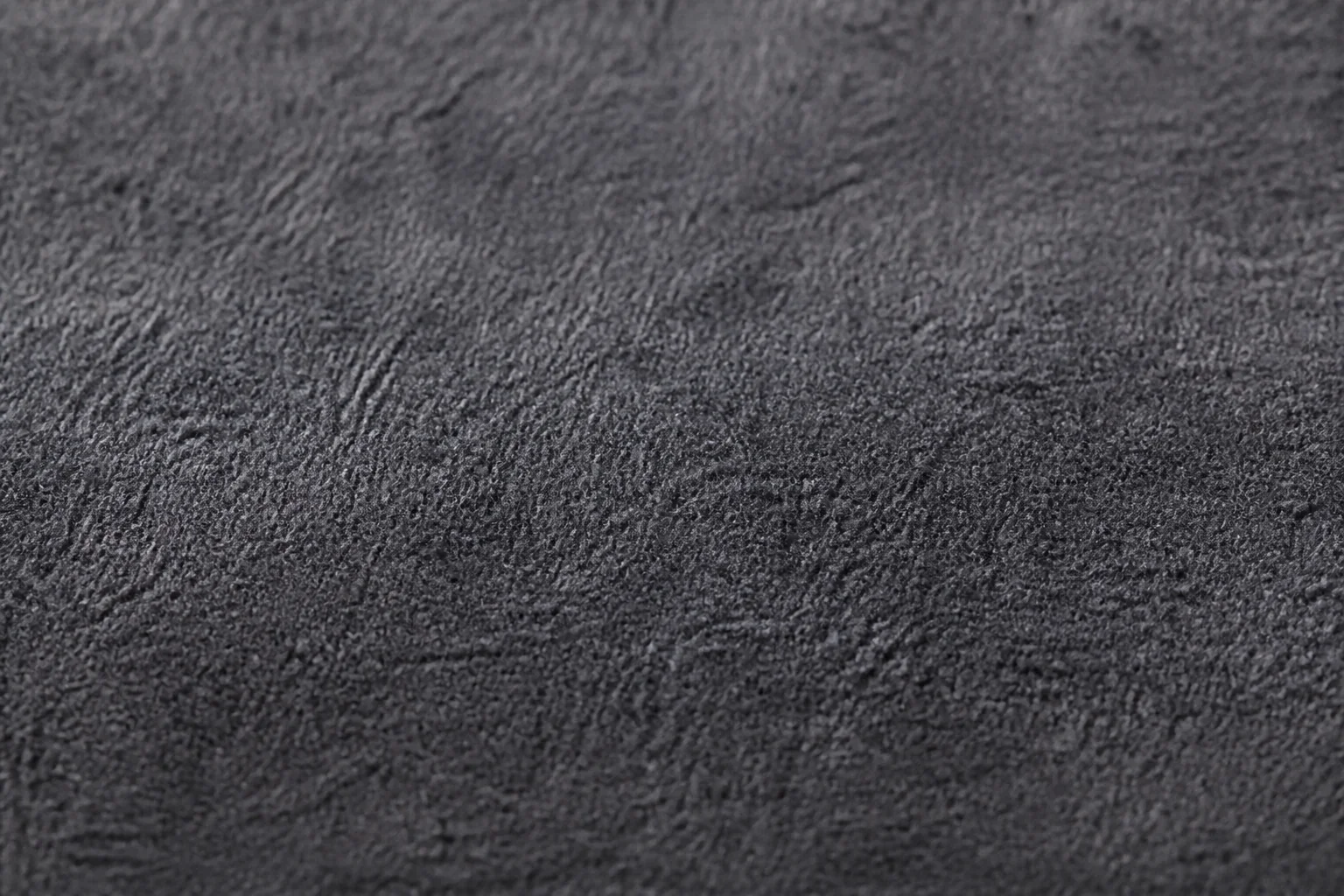
Microfiber leather, often written as microfiber PU or microfibre leather, is a premium synthetic leather built around an ultra-fine fiber base. Its name comes from the fibers themselves: each strand is typically below 1 denier — roughly one hundredth the diameter of a human hair. These microfibers, usually a blend of polyester and nylon, are carded and needle-punched into a dense non-woven fabric that mimics the fibrous structure of natural leather. That base is then impregnated with polyurethane, which binds the fibers together and gives the material body, and finished with a surface coating that carries the grain, color and texture.
The result is a material with three distinct layers: the microfiber non-woven core, the polyurethane impregnation layer, and the surface finish. This construction is the reason microfiber leather behaves so differently from a simple coated fabric. Because the base is a dense three-dimensional fiber network rather than a flat textile, microfiber leather has genuine tensile strength, tear resistance and a soft, suede-like hand feel that coated fabrics struggle to replicate.
In the supply chain, microfiber leather sits a clear step above ordinary PU. It is the standard material for premium footwear uppers, automotive interiors, sports equipment and high-end bags — categories where abrasion, flexing and long service life are non-negotiable. When a buyer asks for a bag that will survive daily commuting for several seasons, microfiber is usually the answer.
What Is PU Leather?
PU leather, short for polyurethane leather, is the workhorse of the synthetic leather industry. Its construction is simpler: a woven or knitted base fabric — typically polyester, cotton or a blend — is coated with a layer of polyurethane resin. The coating is applied as a liquid by knife or roller, cured in an oven, and then embossed or finished to create a grain pattern that imitates leather.
Because the process is fast, flexible and inexpensive, PU leather dominates fashion bags, apparel trims, furniture and promotional goods. It comes in an almost unlimited range of colors, textures and embossing patterns, which makes it the first choice for fast-moving fashion lines where seasonal colorways matter more than decades of service life.
The key limitation of PU leather follows directly from its structure. The polyurethane coating sits on top of a flat textile. Under repeated flexing, abrasion and temperature stress, the coating can crack, peel or delaminate from the base — the classic failure mode of budget synthetic bags. Quality varies enormously between mills: a well-made 1.0 mm PU with a dense knitted base and a thick top coat will outlast a thin 0.6 mm coating by many times. For this reason, when a manufacturer evaluates PU, the grade and construction matter as much as the label.
Microfiber Leather vs PU Leather: Key Differences at a Glance
The table below summarizes the differences a bag manufacturer weighs before recommending a material. These are practical, production-floor comparisons, not marketing claims.
| Property | Microfiber Leather | PU Leather |
|---|---|---|
| Base structure | Needle-punched microfiber non-woven, PU-impregnated | Woven/knitted fabric with PU coating |
| Hand feel | Soft, supple, suede-like, leather-like drape | Smooth and uniform; varies with coating quality |
| Abrasion resistance | Excellent (high Martindale cycles) | Moderate; coating wears with friction |
| Tensile & tear strength | High, from the fiber network | Limited by base fabric |
| Flexing / crack resistance | Very good; resists cracking | Coating can crack at creases over time |
| Breathability | Good — porous fiber structure | Poor — coating is a continuous film |
| Water resistance | Good with surface finish | Good; surface sheds water |
| Relative cost | 2–4x PU (per meter) | Low to moderate |
| Typical applications | Premium bags, footwear, automotive, sport | Fashion bags, accessories, furniture, promo |
| Production lead time | Longer (multi-stage process) | Shorter (single coating line) |
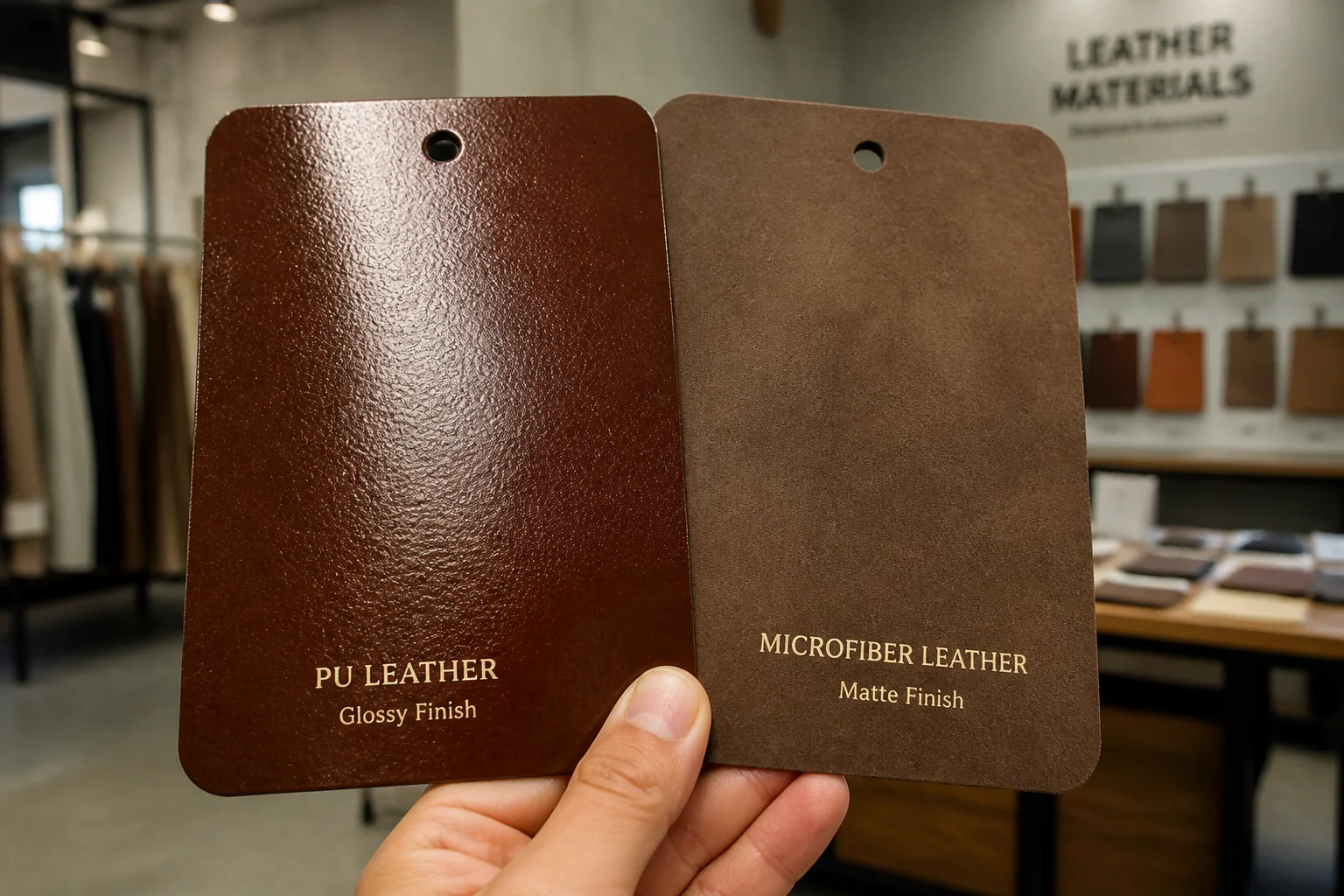
Read the table in the context of your product. If your brand sells daily-use bags at a mid-to-premium price point, the durability and feel of microfiber justify its cost. If you sell fast-fashion accessories where the silhouette and color drive the purchase, PU delivers the look at a fraction of the material cost. Neither is “better” in the abstract — each is better for a defined job.
How Each Material Is Manufactured
Understanding the manufacturing process is the fastest way to understand why microfiber leather costs more — and why that cost buys measurable performance. The two processes differ in length, equipment and control requirements.
Microfiber leather production
Microfiber leather is produced in a multi-stage line. First, polyester and nylon microfibers are blended, carded into a web, and needle-punched to form a dense non-woven felt. This felt is the structural heart of the material. Next, the felt is impregnated with liquid polyurethane in either a wet or dry process. In the wet process, the felt passes through a PU bath and is coagulated in water, creating a porous, leather-like internal structure; in the dry process, PU is applied and cured in stages. The impregnated base is then surface-coated with a finish layer, embossed with grain, and finally tumbled or brushed to adjust hand feel.
Every stage demands precision. Fiber density controls strength; impregnation depth controls body and flexing; coating thickness controls abrasion performance. Mills that produce consistent microfiber leather invest in controlled environments, regular lab testing and tight batch tracking. This is why reputable microfiber suppliers quote longer lead times — typically two to four weeks for standard production, longer for custom colors or finishes.
PU leather production
PU leather production is comparatively short. A roll of base fabric is unrolled onto a coating line, where a knife or roller applies a metered layer of PU resin. The coated fabric passes through drying ovens to cure the resin, then through an embossing station where the grain pattern is pressed into the surface using release paper or engraved rollers. The material is cooled, inspected and wound.
The entire cycle from fabric to finished roll can take less than a day per batch. That speed gives PU leather its flexibility: small runs, fast color matching and rapid iteration are all practical. For a factory, this means PU orders can be quoted quickly, sampled quickly and produced quickly — an advantage when your launch calendar is tight.
Choosing Material by Bag Type and Use Case
Material selection should start from the product, not from the price list. Here is how a factory typically matches material to bag type.
Handbags
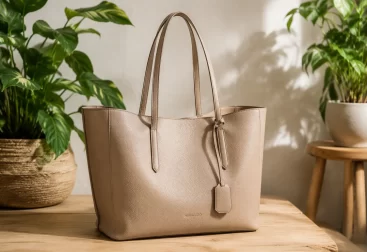
Fashion handbags are a split decision. For seasonal styles driven by color and silhouette, PU leather offers the widest palette and the fastest turnaround — ideal for fast-fashion drops. For signature bags that must hold their shape, stitching and finish across years of daily use, microfiber leather is the safer engineering choice: it flexes without cracking, resists edge wear, and keeps its surface appearance far longer.
Backpacks
Backpacks are the strongest argument for microfiber. A backpack is subjected to constant abrasion against clothing and floors, heavy loads that stress seams and panels, and repeated flexing at the base and straps. Microfiber’s fiber-network construction handles all three. School backpacks, laptop backpacks and travel packs specified in microfiber consistently outlast PU equivalents by several seasons. If durability is your selling point, this is the material to lead with.
Crossbody bags and totes
These categories sit in the middle. A crossbody bag carried close to the body faces moderate abrasion; quality PU with a dense base and thick coating performs acceptably at a lower price. Totes that carry heavy loads benefit from the tear strength of microfiber, especially at the handles and base corners where stress concentrates.
A practical decision matrix
| Bag type | Recommended material | Reason |
|---|---|---|
| Premium handbag / signature line | Microfiber leather | Shape retention, feel, longevity |
| Backpack (school, laptop, travel) | Microfiber leather | Abrasion and tear resistance, flexing |
| Fast-fashion handbag | PU leather | Cost, color range, fast sampling |
| Crossbody / casual tote | Quality PU or microfiber | Balances cost and service life |
| Promotional / giveaway bags | PU leather | Lowest material cost |
The common mistake is choosing by price alone and discovering the durability gap only after the first return wave. A factory that asks about your market, price point and expected service life before recommending a material is doing its job — and protecting your margin in the long run.
Thickness, Grades and Specifications for OEM Orders
When you brief an OEM factory, material selection is incomplete without specifications. Three parameters matter most: thickness, grade and test performance.
Thickness
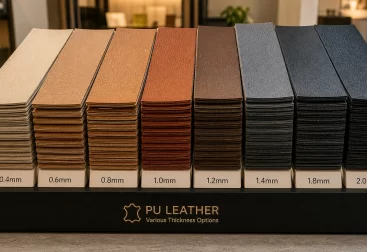
Thickness is measured in millimeters and refers to the total material — base plus coating. Common commercial ranges are roughly 0.6–1.2 mm for PU leather and 0.8–1.5 mm for microfiber leather, though both can be made thinner or thicker on request. Thickness choice should follow the product’s structural needs: a structured handbag benefits from 1.0–1.2 mm for shape retention; a soft, slouchy silhouette works with 0.7–0.9 mm; backpack panels that carry weight are often specified at 1.0–1.4 mm. Thickness also affects hardware and stitching — heavier material requires stronger thread, denser stitching and appropriately rated zippers and buckles, so the specification must be locked before tooling is finalized.
Grades
Grade is the mill’s internal quality tier. For microfiber leather, grades differ by fiber density, impregnation depth and surface finish quality; for PU leather, grades differ by base fabric density, coating thickness and grain quality. A higher grade is not a marketing label — it changes measurable performance. Specify the grade you tested, not “the same material as last time,” and record it in the order contract so later batches can be verified.
Test standards to specify
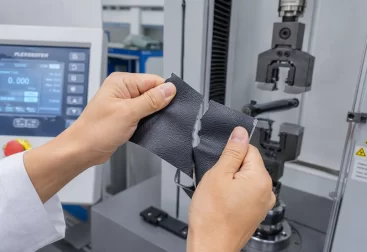
- Abrasion (Martindale): cycles to visible wear. Microfiber typically achieves tens of thousands of cycles; specify a minimum that fits your category.
- Tear and tensile strength: critical for backpacks and totes under load.
- Color fastness: to light, rubbing and water — non-negotiable for fashion goods.
- Cold crack resistance: the temperature at which the coating cracks under flex, commonly tested at −10°C or −20°C for winter markets.
- Adhesion / peel strength: how firmly the coating bonds to the base — the direct predictor of peeling and delamination failures.
Ask the factory or material supplier for test reports before bulk production and for batch certificates with each shipment. This is standard practice with reputable mills and a red flag when it is refused.
Cost, MOQ and Sourcing Considerations
On a per-meter basis, microfiber leather typically costs two to four times as much as standard PU. The gap is driven by the longer process, specialized equipment and higher raw material content — not by margin games. Before you recoil at the number, run the math on total cost. A bag in premium microfiber that survives three years without returns can be cheaper per unit of customer lifetime than a PU bag that fails in eight months and generates refunds, negative reviews and brand damage. For DTC brands, the return rate is often the difference between profit and loss on a SKU.
MOQ behavior also differs. PU leather is produced in flexible batches, so factories can quote low minimums and short runs — useful for testing a design before committing. Microfiber leather, with its multi-stage line, carries higher practical minimums and longer lead times; plan your first order accordingly and carry the material specification forward across seasons so reorders stay consistent.
Sourcing channels matter too. If you are a brand working through a bag factory, let the factory source and qualify the material — established factories hold swatch libraries, maintain mill relationships and have already vetted the suppliers whose materials they trust. If you source material yourself, request physical swatches, run your own abrasion and color-fastness checks, and keep a sealed reference sample that future batches must match.
How to Work with a Factory on Material Selection
A good factory partnership turns material selection from a gamble into a process. Here is the workflow a professional manufacturer will propose, and that you should expect.
Step 1 — Brief the end use
Describe the market, the customer, the price point and the expected service life. “A laptop backpack for working professionals at $80 retail” tells the factory more than “a backpack.” These details drive the material recommendation.
Step 2 — Review swatches together
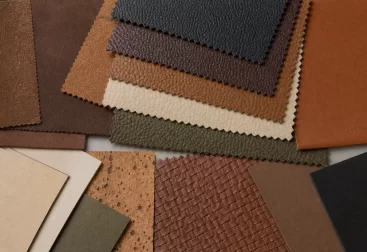
Compare physical swatches of shortlisted materials. Check hand feel, drape, color and embossing under real light. What looks good in a photo can feel cheap in the hand — the swatch review is where most material mistakes are caught.
Step 3 — Sample before bulk
Confirm the chosen material in a prototype bag before committing to production. The prototype reveals how the material behaves with your stitching, hardware, lining and structure — creasing at the corners, stress at the handles, stretch at the seams.
Step 4 — Lock the specification
Agree thickness, grade, color reference, test standards and acceptable tolerances in writing. This document is the baseline for QC on every future order.
Step 5 — Inspect during and after production
Verify incoming material against the reference, and inspect finished goods against the locked specification. Inline checks during production catch drift before it becomes a whole-batch problem.
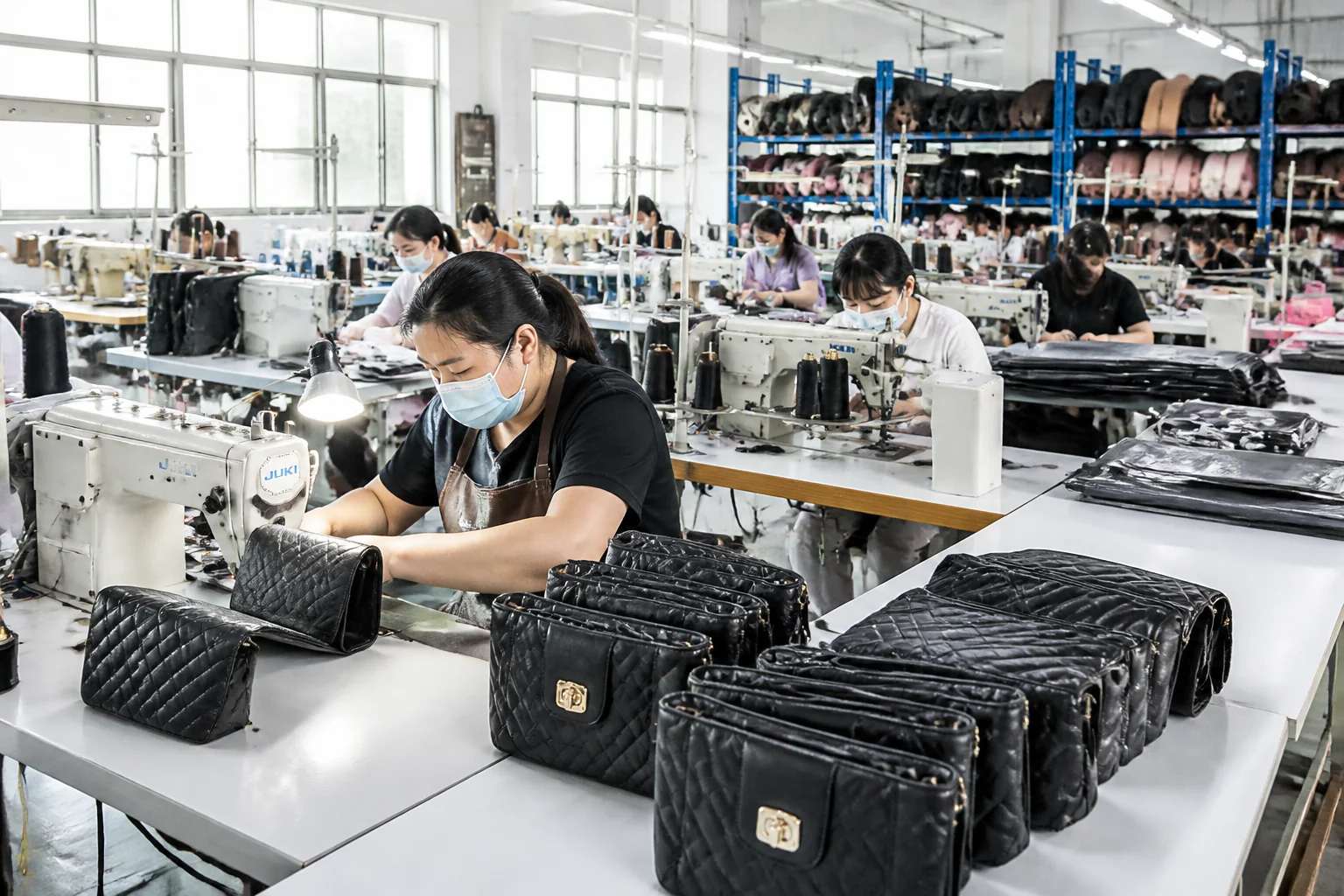
At PUBagFactory, a Guangzhou-based PU leather bag manufacturer, this is exactly how we work with brands on OEM and ODM projects: material review, prototyping, locked specifications and staged quality control. Whether your line is built around microfiber durability or PU-driven fashion, we help you choose, sample and produce the right material for the job.
FAQ
Is microfiber leather better than PU leather?
For durability, abrasion resistance and leather-like feel, yes — microfiber leather outperforms PU in most bag applications. For cost and design flexibility, PU is better. The right choice depends on your product category and price point.
Is microfiber leather waterproof?
With a finished surface, microfiber leather resists water well and dries without damage, though it is not fully waterproof at seams and cut edges. PU leather has similar water resistance from its continuous coating.
What is the difference between microfiber leather and genuine leather?
Microfiber leather is fully synthetic — no animal hide — but its fiber-network structure is engineered to mimic genuine leather’s strength and hand feel. It is more consistent, more affordable and animal-free, while genuine leather offers natural grain and aging characteristics some customers prefer.
How long does microfiber leather last?
In normal daily use, a well-made microfiber leather bag typically lasts several years before showing significant wear — commonly outperforming PU bags by two to three times in service life.
Can PU leather look like microfiber?
Finishes can imitate the surface appearance, but PU cannot replicate microfiber’s softness, breathability and long-term flexing behavior, because the underlying structure is fundamentally different.
Which is more eco-friendly, microfiber or PU leather?
Both are synthetic. Microfiber’s longer service life reduces replacement frequency, and water-based PU processes are increasingly available. The most sustainable choice is usually the material that lasts longest in your product’s real use case.
What thickness should I choose for a backpack?
For most backpacks, 1.0–1.4 mm material balances structure, weight and durability. Confirm the exact specification with your factory after testing prototypes, since hardware and stitching must be matched to the chosen thickness.
Common Failure Modes and How to Avoid Them
Knowing how synthetic leathers fail helps you specify materials that will not come back as returns. Four failure modes account for the majority of complaints on synthetic leather bags, and each can be prevented at the specification stage.
Peeling and delamination
Peeling happens when the surface coating separates from the base — the coating lifts, bubbles or flakes at edges and seams. It is far more common in PU leather, because the coating is a distinct layer bonded to a flat textile. The root causes are low coating adhesion, a thin or low-grade coating, or stress concentration at folds and seams. Prevention is straightforward: specify a minimum peel strength, choose a denser base fabric, and avoid very thin coatings on panels that will flex constantly. A simple peel test on a production sample catches this failure before it reaches the market.
Cracking at creases
Repeated folding and flexing — at bag corners, handles and closure flaps — stresses the coating until it cracks. Temperature makes it worse: coatings that flex fine at 20°C become brittle at −10°C or −20°C. If your market includes cold winters, specify a cold crack test at the temperature your customers will actually experience. For high-flex products such as backpacks and foldable totes, microfiber leather is the safer choice because its fiber network distributes flexing stress instead of concentrating it in one coating film.
Edge wear and seam stress
Cut edges of PU leather expose the base fabric, which frays and discolors with use. Seams — especially at handles, straps and bottom corners — carry the heaviest loads and show wear first. Prevention involves construction as much as material: edge painting or binding protects cut edges; reinforced stitching and webbing inserts spread stress at load points; and a dense base fabric resists fraying far longer than a loose knit. Specify edge treatment and stitch reinforcement in the construction drawing, not as an afterthought.
Color fading
Synthetic leathers fade under prolonged UV exposure, with reds and dark shades fading fastest. If your line sits in storefronts, is carried in strong sunlight, or ships to high-UV markets, specify a lightfastness grade and verify it with a test report. Fading also becomes a consistency problem across batches — which is why the sealed reference sample and batch certificates discussed earlier matter. A material that matches in the swatch book but fades differently in production is a brand problem you will discover only in the field, when it is expensive to fix.
Each of these failures is preventable, measurable and cheap to test before bulk production. A factory that volunteers these tests is protecting your product; one that resists them is asking you to accept the risk.
Next Steps for Your Bag Project
The material decision does not have to be made alone. A factory with real production experience can translate your product brief into a material specification, sample it, and test it before you commit to a single bulk meter. If you are planning a bag line — handbags, backpacks, crossbody or tote — and want a clear recommendation between microfiber and PU for your market, start the conversation with samples and a brief.
Contact info@gionar.com for a free material consultation and quotation. You can also explore our custom bag manufacturing services and wholesale backpack manufacturing to see how we build bags around the right material choices.