- Why Wholesale Selling Is Different
- Building the Line Sheet That Sells
- Pricing for the Wholesale Market
- Finding Retail Accounts
- The Sales Meeting Playbook
- Trade Shows: Selling at Scale
- Wholesale Platforms and Digital Selling
- Managing Orders and Reorders
- Measuring Wholesale Success
- Common Wholesale Selling Mistakes
- FAQ
Why Wholesale Selling Is Different
Selling bags wholesale is not consumer marketing with bigger boxes. The person across the table is a buyer who places orders for other people’s money, carries inventory risk and answers to a margin target. Every part of your pitch has to respect that reality.
The buyer’s mindset
A retail buyer thinks in sell-through, margin and risk. Will this bag move off the shelf at its price point? Does it leave enough margin after the markdowns? What happens if it does not sell — who carries the loss?
Your job is to answer those three questions before they are asked. Show the sell-through story of similar styles, prove the margin works at your price, and offer terms that reduce the buyer’s downside. Buyers order from brands that make the decision easy.
Trade selling versus consumer marketing
Consumer marketing persuades one shopper to buy one bag. Wholesale selling persuades one buyer to stock a hundred bags across a season — a decision made once and reviewed on reorder data for months after.
That changes the pitch. Emotional appeals matter less than evidence: sell-through records, materials specs, delivery reliability and margin math. The buyer’s reorder depends on what happens after the first order, so your credibility with the end customer matters as much as your presentation.
Consumers buy a bag. Buyers buy a bet they can sell the bag. Sell the bet, and the bags follow.
Building the Line Sheet That Sells
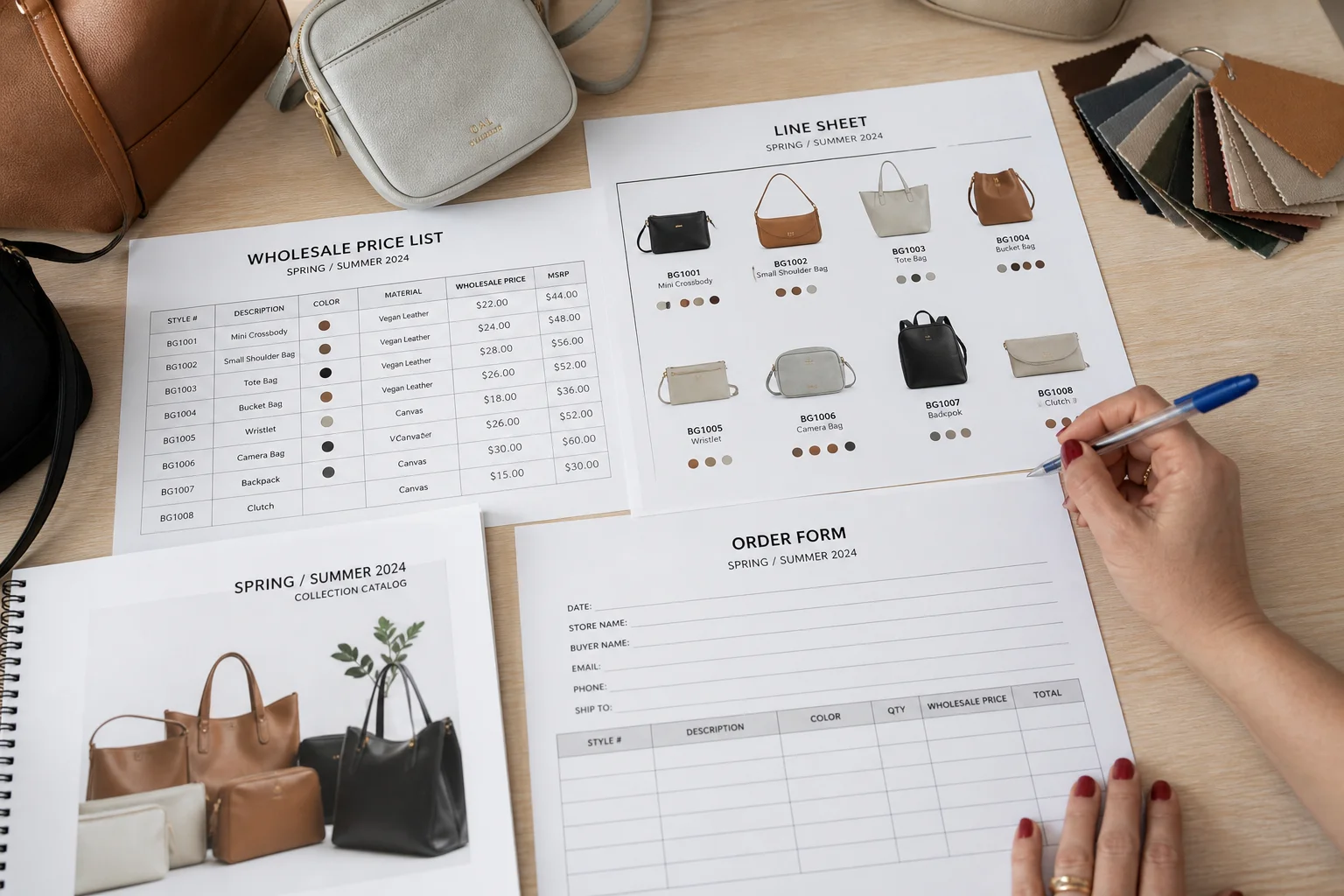
The line sheet is your product’s first salesperson. Buyers scan it for seconds before deciding whether to meet you, and its job is to make the range understandable at a glance: what it is, what it costs and why it will sell.
What buyers scan first
Buyers look for four things in order: the product image, the wholesale price, the minimum order and the delivery date. If any of the four is unclear, the line sheet goes into the no pile regardless of how good the design is.
Keep the sheet clean and consistent. One style per row or card, clear photography on a neutral background, prices in the buyer’s currency, and honest minimums. A line sheet that respects the buyer’s time respects the buyer.
The anatomy of a working line sheet
| Element | What it must show | Common mistake |
|---|---|---|
| Product image | Front view, true color | Stylized shots hiding the product |
| Style name and code | Clear, reorderable code | Vague names, no code |
| Wholesale price | Exact, per unit | Price ranges without terms |
| Minimum order | Per style or mixed | Hidden until asked |
| Materials and sizes | Specs in plain language | Missing or assumed |
| Delivery window | Weeks from order | Vague “call for lead time” |
Update the line sheet every season and keep the file easy to share. The brands that win wholesale are rarely the most creative; they are the ones whose line sheets make ordering feel simple and safe.
Pricing for the Wholesale Market
Wholesale pricing is a system, not a number. It starts from your costs, respects the retail chain and protects the brand’s value through a minimum advertised price. Getting it right makes every other part of selling easier.
Setting the wholesale price
Build the price from your landed cost — factory price, freight, duties and fees — then add the margin your business needs. Compare the result against the market: if your wholesale price sits above comparable brands, the product story must justify it; if below, check your costs.
The common wholesale structure gives the retailer a 50-55% margin: a bag wholesaling at 20 dollars retails near 40 to 45 dollars. Price bands that respect this math sell through; bands that break it sit on shelves until markdown.
Protecting the brand with MAP
A minimum advertised price policy stops retailers from discounting your bags into commodity territory. It is not price fixing — it limits the advertised price, not the actual sale price, and it protects the brand’s perceived value for every retailer in the network.
Enforce the policy consistently or drop it. A MAP that applies to some retailers and not others destroys trust faster than no policy at all, and the discounting it fails to stop will erode your wholesale margins.

Finding Retail Accounts
Great products do not sell themselves in wholesale; they need accounts. The accounts that fit your brand — the boutiques, chains and online retailers whose customers match your range — are found through research, referrals and a disciplined outreach rhythm.
Who to approach first
Start with independent boutiques and regional chains whose price points and style match your line. They decide faster than big chains, take smaller minimums and give you sell-through data you can use to approach larger accounts later.
Compile a target list of fifty to a hundred accounts ranked by fit. Rank by store size, price alignment, category overlap and geography, then work the list from the top. A ranked list beats random outreach because every meeting builds a case for the next one.
Outreach that earns a meeting
Cold outreach works when it is specific. Name the store, explain why your bags fit its customers and offer something concrete: a sample, a first-order incentive or a visit during its buying window. Generic mass emails train buyers to delete yours.
Follow up with persistence and respect. Buyers plan purchases around seasonal calendars, so a brand that contacts them in their buying window — weeks before the season they stock — gets the meeting that a well-timed note earns.
The Sales Meeting Playbook
The meeting is where wholesale deals are won, and it follows a structure that experienced sellers use every time: prepare, present, handle objections, close and follow up. Each step has its own discipline.
Preparing for the appointment
Research the account before you arrive: its price points, its current bag brands, its store traffic and its buying patterns. Know which of your styles fit its shelves and prepare a suggested opening order for its store size.
Bring the physical samples of the styles you recommend, not the entire line. A buyer facing thirty bags makes no decision; a buyer facing five well-chosen styles makes one. Edit the presentation before you present.
Presenting the line with evidence
Open with the styles that answer the buyer’s need, then support each one with evidence: the material story, the sell-through of similar styles in comparable stores, the margin math at your price and the delivery date you can guarantee.
Demonstrate the product rather than describing it. Show the interior organization, the zipper action and the weight. Wholesale buyers have seen every pitch; the ones who touch and test your product are the ones who remember it.
Handling the common objections
| Objection | What the buyer means | A response that works |
|---|---|---|
| “Price is too high” | Value is not proven yet | Show margin, materials, sell-through evidence |
| “We already carry bags” | No reason to switch yet | Show the gap: price band, style, material story |
| “Can you do better terms?” | Risk reduction needed | Offer trial order or dating, not discounting |
| “We will think about it” | Decision is not urgent | Create urgency: season window, limited styles |
Objections are buying signals; silence is the real problem. Answer each one with evidence rather than price cuts, and ask for the decision at the natural moment. The seller who asks for the order gets more orders.
Trade Shows: Selling at Scale
Trade shows compress a season of selling into a few days. The brands that profit from shows treat them as a system — choosing the right show, building a booth that sells and following up before the memory fades.
Choosing the right show
The right show matches your price tier and your buyer. Regional and niche shows cost less and attract buyers closer to your brand; mega-shows cost more but concentrate the biggest accounts. Start with the show your target buyers actually attend.
Visit a show as a buyer before exhibiting. Walk the aisles, count the bag exhibitors, watch the traffic and talk to exhibitors about results. One research visit saves the cost of a wrong booth decision.
A booth that sells, not just displays
The booth’s job is to start conversations with the right buyers. Display a focused selection — your strongest styles at your target price bands — with clear signage, and keep samples touchable so buyers test the quality themselves.
Train whoever staffs the booth to qualify buyers fast: ask who they buy for, at what price points and in what volume. A qualified conversation that ends in a sample request is worth more than a hundred brochure handouts.
The follow-up that closes
The show closes nothing; the follow-up does. Within forty-eight hours, send every qualified contact a personalized note with the line sheet, the samples they requested and the next step — a call, a meeting or a trial order.
Log every lead with its status and work the list until each one has an outcome. Shows reward the sellers who treat the lead list as the real deliverable of the event.
Wholesale Platforms and Digital Selling
Online wholesale platforms extend your reach between shows and beyond your geography. They work best as part of the system — discovery, qualification and reorder infrastructure — rather than as a replacement for relationships.
Listing on wholesale marketplaces
Platforms connect you to independent retailers actively looking for lines like yours. A strong listing carries clean photography, honest specs, wholesale pricing and minimums, and a reorder-friendly structure that keeps the account active after the first order.
Review listing analytics monthly. The data shows which styles draw views and which convert, and it feeds the same intelligence you get from sell-through reports — use it to refine both the listing and the line.
Running the digital catalog well
Keep every channel current: the line sheet, the platform listing and any B2B ordering page must show the same products, prices and lead times. A buyer who sees conflicting information loses confidence in the brand behind it.
Use the digital channels to shorten the sales cycle. Buyers who can reorder online without a call reorder more often, and the sellers who make reordering effortless capture the repeat business that pays the bills.

Managing Orders and Reorders
The first order is the beginning of the relationship, and the reorder is where wholesale profitability actually lives. Brands that sell the first order and neglect the process lose the repeat business that their margin structure depends on.
Order terms that protect you
Set the terms before the orders flow: deposits on new accounts, net terms only after a payment history, clear cancellation windows and a written confirmation for every order. The paperwork protects the partnership when something goes wrong.
Confirm every order in writing with the price, quantity, delivery date and terms restated. Misunderstandings about any of the four become disputes later; a written confirmation prevents most of them at the start.
Delivering reliability that earns reorders
Ship on time, every time, and communicate early when a date slips. Retailers forgive one late season from a brand that told them early; they drop a brand that ships late without warning, because their own customers feel the failure.
Keep the reorder path simple. Tell the buyer the minimum reorder quantity, the reorder lead time and the styles available for reorder — and make the process as easy as the first order was.
The reorder engine
Watch sell-through after every shipment and contact the account at the natural reorder moment: when the first order is 60-80% sold. The proactive call at the right moment converts satisfied buyers into reorders before they shop elsewhere.
Track reorder rate per account and per style. The data shows which accounts deserve your attention and which styles carry the line, and it turns selling from guesswork into a managed system.
Measuring Wholesale Success
Wholesale selling produces numbers that tell you what is working months before opinions could. A small set of indicators, reviewed monthly, keeps the selling system honest and directs effort to where it pays.
The numbers that matter
| Metric | What it tells you | Healthy range |
|---|---|---|
| Account conversion rate | Pitch effectiveness | 15-30% of serious prospects |
| Average order value | Order size quality | Grows with account fit |
| Reorder rate | Product-market fit | 30-50% of accounts reorder |
| Sell-through at retail | End demand | 60-80% per season |
| Gross margin | Business health | 40-60% wholesale |
Pick the five, track them monthly and review them quarterly against the plan. Numbers that move tell you which decision caused the move — and the review habit is what turns data into better selling.
Using the numbers to improve
When conversion is low, fix the pitch or the prospect list; when order value is low, recommend deeper opening orders; when reorders stall, examine the sell-through and the delivery experience. Each number points to a different fix.
Share the sell-through story with your manufacturing partner. The factory that sees which styles move can prioritize reorders, adjust materials and plan capacity around your actual winners — a partnership advantage your competitors do not have.
Common Wholesale Selling Mistakes
Wholesale mistakes are expensive because they repeat across accounts. The patterns below are the ones experienced sellers recognize first, and each one has a straightforward fix.
Selling to everyone. Taking any account regardless of fit spreads your stock and your brand across stores that cannot sell it. Qualify accounts by price tier and customer match, and let the wrong ones go to competitors.
Discounting instead of selling. A price cut is the seller’s surrender to every objection. Respond with evidence — margin math, sell-through, materials — and reserve discounts for volume or early payment, not for hesitation.
Weak follow-up. Most wholesale deals die in the follow-up, not the pitch. Set the follow-up rhythm before the meeting, log every lead and work each one to an outcome within days, not weeks.
Ignoring the reorder. The first order covers costs; reorders make profit. Brands that move on to new accounts while existing accounts sit unreordered leave their most profitable business on the table.
Inconsistent branding. A buyer who sees different prices, stories or imagery across channels loses confidence in the brand. Keep the line sheet, the platform listing and the pitch telling the same story.
Opening Orders and Account Onboarding
The first order sets the tone for the relationship, and how you handle it decides whether the account becomes a reorder engine or a one-time sale. Onboarding is the process of turning a signed order into a reliable account.
Structuring the opening order
Recommend an opening order sized to the account: enough to test the line properly, small enough to feel safe. A boutique’s sensible opening order is often 12-24 pieces across three to five styles, while a chain may open with hundreds.
Set the opening order terms clearly — the deposit, the balance, the delivery date and the reorder minimum. The opening order should prove the product works in the account, so resist the temptation to push volume before the sell-through exists.
Making the first delivery flawless
The first delivery is your quality promise in physical form. Ship it on time, packed correctly, labeled clearly and matching the samples the buyer approved. A flawless first delivery converts a cautious buyer into a confident one.
Include the paperwork the retailer needs: the packing list, the invoice, the care instructions and any compliance documents for the market. Small administrative slips in the first order cost more trust than they should.
Checking in after delivery
Contact the account two to three weeks after delivery to ask how the bags are selling and whether anything needs attention. The check-in surfaces problems early and signals that your brand stands behind its product.
Log what the buyer reports. The retail feedback — which styles move, which colors stall, which objections customers raise — is the freshest market research you will ever receive, and it arrives free with every account.
Building the Wholesale Marketing Kit
Your retail accounts sell your bags to their customers, and the tools you give them decide how well they tell your story. A complete marketing kit makes selling easy for the retailer and keeps your brand consistent across every store.
What the kit contains
The kit carries five pieces: high-resolution product photography, lifestyle images showing the bags in use, concise product descriptions with materials and dimensions, suggested retail copy for online listings, and social media assets for the retailer’s channels.
Add a one-page brand story that the retailer can understand and repeat — who makes the bags, from what materials, with what quality standard. Buyers sell stories as much as products, and a clear one travels further than a vague one.
Keeping the kit current
Refresh the kit every season with the new line, and keep the digital assets in one place that accounts can access anytime. A retailer that can pull fresh photography and copy without asking will feature your bags more often.
Track which accounts actually use the kit. Retailers who feature your products well sell them better, so reward the active accounts with early access to new styles and deeper support — the kit is a tool for building the account list you want.
Using retailer content as social proof
Collect the best retailer photography and customer feedback with permission, and use them in your own marketing. Real store images and real customer words carry more weight than any brand-produced content.
The loop feeds itself: good kits produce good retailer content, good content attracts better accounts, and better accounts sell more bags. Start the loop by building the kit properly the first time.
Seasonal Planning and Buying Deadlines
Wholesale runs on deadlines that arrive months before the consumer season. The brands that respect the buying calendar ship into demand; the ones that miss it sell into markdown season at a discount.
The wholesale buying calendar
Retailers buy spring in January, fall in June and holiday stock by September — and the deadlines move earlier for department stores and larger chains. Your sales push, samples and capacity must be ready before each window opens.
Map your own calendar backward from those windows: line sheet ready, samples produced, production scheduled and delivery dates promised. A calendar shared with accounts builds their trust in your planning discipline.
Aligning production with the calendar
Production needs the same lead-time discipline as selling. Place material orders, reserve factory capacity and schedule shipments so that goods arrive in the retailer’s warehouse before its selling season, not during it.
Share the production calendar with your manufacturing partner early. A factory that sees your seasonal plan can lock capacity, order materials and flag conflicts in advance — turning the calendar from a hope into a schedule.
Building the reorder window into the plan
Every season produces a reorder window: the weeks after launch when the winners are clear and the stock runs low. Reserve capacity for that window, because reorders shipped in weeks capture the season’s upside that competitors cannot match.
Tell accounts about the reorder window and its deadline. Retailers who know they can reorder the winners mid-season order deeper at launch — the reserve capacity pays for itself in both ways.
FAQ
How do I find wholesale buyers for my bags?
Rank and approach independent boutiques and regional chains that match your price tier, use wholesale marketplaces, and exhibit at the trade shows your target buyers attend. Qualify accounts by fit before investing in the pitch.
What margin should I set on wholesale orders?
Wholesale margins of 40-60% are the common healthy range for bag brands, set from your landed cost upward. Retailers then apply their own 50-55% margin, so check that your wholesale price leaves room for the full retail chain.
How do I set the retail price for wholesale bags?
Work backward: decide the retail band your market accepts, subtract the retailer’s 50-55% margin, and the result is your wholesale price. Price to the band before production so the product is engineered to its retail position.
How many styles should I present to a buyer?
Fewer than you think. Edit the line to the styles that fit the account — often five to eight — and support each with evidence. Buyers facing too many options make no decision at all.
Are trade shows worth the cost for a small brand?
Yes, when chosen well: visit the show as a buyer first, exhibit only at shows your target buyers attend, and work the lead list within 48 hours. The cost is justified by qualified accounts, not by foot traffic.
What is a MAP policy and why do I need one?
A minimum advertised price policy limits the price retailers may advertise, protecting your brand’s perceived value and every retailer’s margin. Enforce it consistently — selective enforcement destroys trust faster than no policy.
How do I get reorders instead of one-time orders?
Deliver reliably, track sell-through and contact accounts at the 60-80% sold moment. Keep the reorder path simple with clear minimums and lead times, and track your reorder rate per account to manage the engine.
Should I use wholesale platforms or sell direct?
Use both deliberately. Platforms handle discovery, qualification and easy reorders between shows; direct relationships carry the deep accounts and the brand control. Let the data — conversion, order value, reorder rate — allocate your effort.
How large should a boutique’s opening order be?
A sensible opening order for a boutique is often 12-24 pieces across three to five styles — enough to test the line and dress the store, small enough to feel safe. Size the order to the account and prove the product through sell-through before pushing volume.
What goes into a wholesale marketing kit?
Product photography, lifestyle images, descriptions with materials and dimensions, retail-ready copy, social assets and a one-page brand story. Refresh it every season, keep it accessible, and use the best retailer content back in your own marketing.
Next Steps: Sell Wholesale as a System
Wholesale selling rewards the systematic: a line sheet that sells at a glance, prices that protect the chain, accounts ranked by fit, meetings run on evidence and reorders managed like an engine. Build the system once and every season gets easier.
None of it works without a product that ships on time at consistent quality — which is what manufacturing partners provide. The brands that pair a disciplined selling system with a reliable factory compound their advantage with every season.
Every account won, every reorder earned and every season shipped on time compounds into a wholesale business that runs itself. Start with the system, and let each season refine it.
Ready to build a wholesale line with dependable production behind it? Contact our team at info@gionar.com to plan your program.
Related reading: our custom bag manufacturing portfolio shows the production quality that keeps wholesale buyers reordering.