Export packing does two jobs at once, and they pull in opposite directions. It has to protect the product so that it arrives in sellable condition, and it has to occupy as little space as possible so that freight does not consume the margin. Every packing decision is a trade between those two objectives.
The reason packing deserves attention beyond the factory floor is that its effect is financial and multiplied. Carton dimensions determine how many bags fit in a container, and the container cost is divided across those units. Because freight also forms part of the customs value on which import duty is calculated, a reduction in packed volume lowers both the shipping cost and the duty base.
For PU leather bags the challenge is specific. The material is flexible and light, which makes it easy to flatten, but the same flexibility means that uncontrolled compression leaves creases and marks that cannot be removed. Hardware is the other exposure: handles, buckles and zips can press into the material of the bag next to them if packing is careless.
Protection is not only about the bag. Cartons move through several handling stages, are stacked under load, and may sit in humid conditions at a port. A carton that collapses or takes on moisture damages the contents and may cause the whole shipment to be refused.
This guide sets out a practical packing specification for PU leather bags: the inner packaging that protects the product, the carton specification that survives the journey, the loading plan that maximises container utilisation, the documentation that must match the physical packing, and the checks that should be completed before the container is sealed.
Protecting the Product Inside the Carton
Inner packaging determines whether the bag arrives in sellable condition. Its cost is small relative to the value it protects, and the specification should be explicit rather than left to the packer’s judgement.
Individual protection
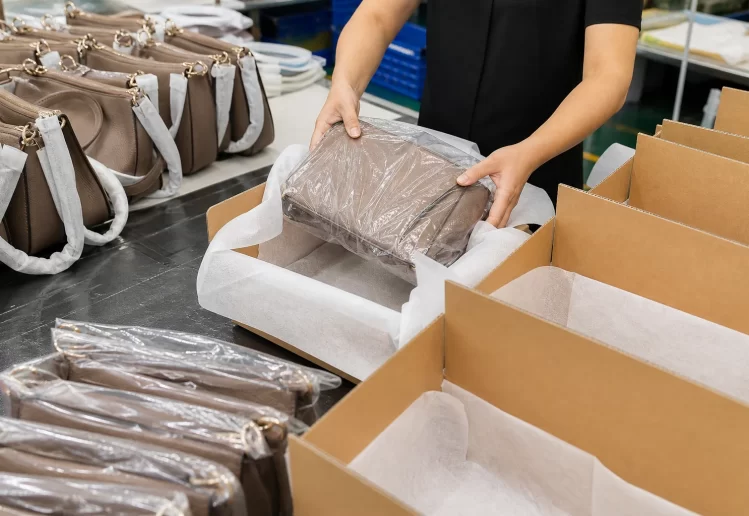
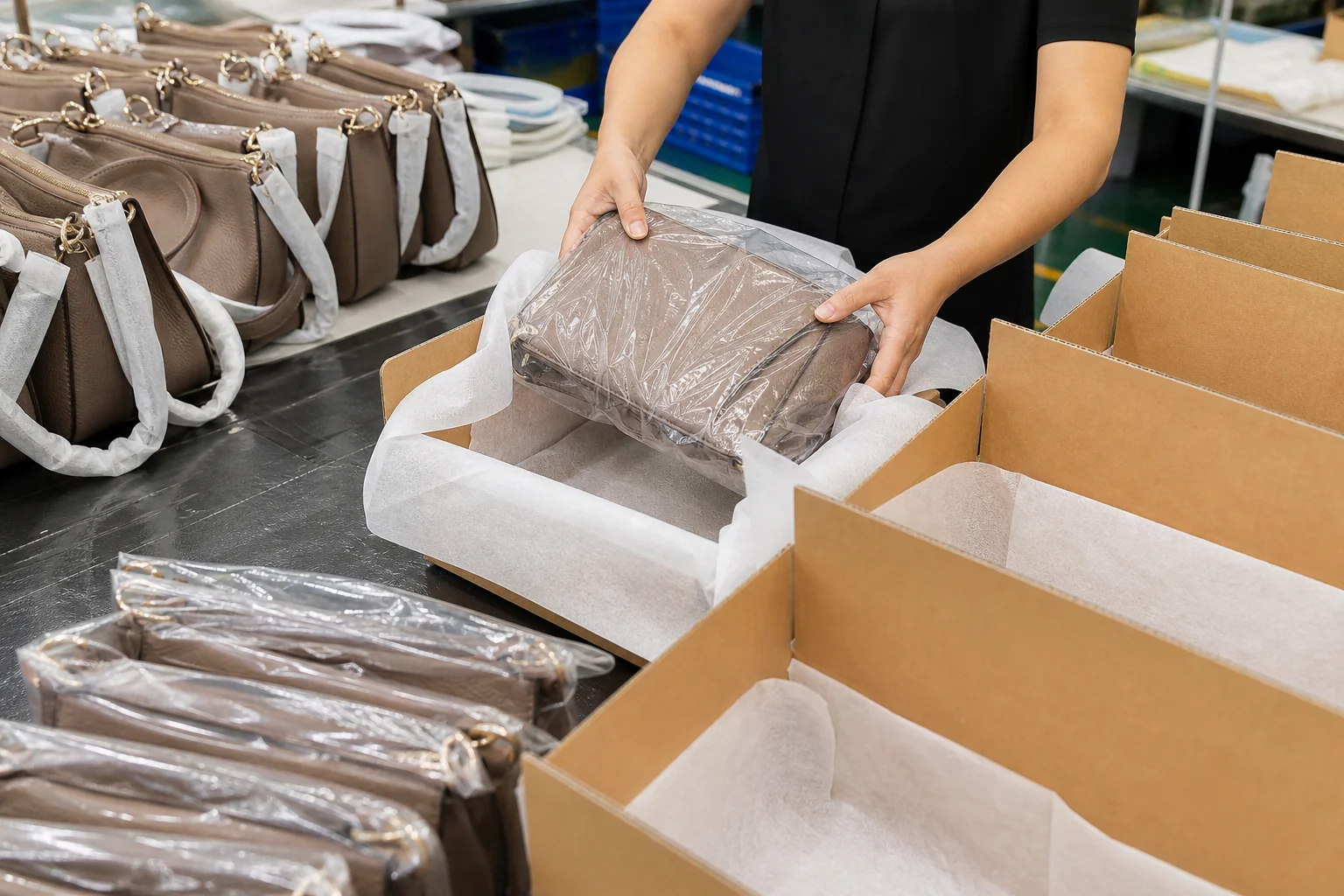
Each bag should be enclosed in its own protection so that bags cannot touch each other. For PU leather the standard approach is a poly bag, sized so the bag is not compressed, with the air expelled but not vacuumed.
Where the material has a high-gloss finish or a soft hand feel, a tissue or non-woven layer between the bag and the poly bag prevents surface marking. This matters most where two bags of different colours are packed in the same carton.
Shape control
Bags lose shape if they are packed under load, but they also crease if they are over-filled for shipping. The aim is to hold the structure without force: light filling in the body where the design needs to hold shape, and no filling where the bag is designed to be folded.
Hardware should be wrapped or positioned so that it does not press against material. A buckle that sits against the panel of the bag beside it will leave a mark that becomes permanent under container temperatures.
Colour and style separation
Light-coloured PU leather picks up dye from darker material in contact with it, particularly in humid conditions and over long transit times. Separating colours within the carton removes the risk entirely.
Style separation matters for a different reason: where a carton contains assorted styles, the packer must count carefully, and an error becomes a problem at the destination warehouse rather than at the factory. Keeping cartons single-style, or clearly marked with the assortment, reduces the risk.
| Inner layer | Purpose | Notes |
|---|---|---|
| Poly bag per unit | Protects from dust and contact | Must carry the required warning where applicable |
| Tissue or non-woven wrap | Prevents surface marking | Essential for glossy finishes |
| Hardware protection | Prevents pressure marks | Wrap or reposition buckles and zips |
| Shape filling | Holds structure | Only where the design requires it |
| Colour separation | Prevents dye transfer | Separate light colours from dark |
| Dust bag | Retail presentation | Adds volume; specify deliberately |
When retail packaging is required
Where the destination channel requires retail boxes, the packing specification changes substantially, because individual boxes consume far more volume than poly bags. The landed cost rises accordingly and should be built into the quotation rather than discovered later.
Retail packaging also changes the carton specification, since each unit is more rigid and less compressible. The carton must be sized to the box rather than to the bag, and the container plan should be built around the box dimensions.
Testing the inner pack
A simple transit test — packing a carton, subjecting it to the handling it will receive, and inspecting the contents — reveals most inner packing problems before an order ships. The cost of the test is trivial relative to the cost of a rejected shipment.
The test should include the conditions the shipment will actually meet: stacking load, vibration, and the humidity of the destination. A packing that survives a dry warehouse may fail after a humid voyage.
Specifying the Export Carton
The carton is the structural element of the shipment. It carries the stacking load, resists moisture and holds its shape through handling, and its dimensions determine the freight cost.
Board grade and strength
Export cartons are specified by board grade, which describes the number of corrugated layers and the paper weights used. A higher grade carries more stacking load and resists crushing better, at a higher material cost.
The choice should follow the stacking height in the container and the duration of the journey. Cartons that will be stacked five or six high for a month require a stronger board than cartons that travel at floor level.
Dimensions and internal fit
Carton dimensions should be set by the internal fit and then rounded to a size that divides efficiently into the container. A carton that fits the product perfectly but leaves unusable space in the container is an expensive choice.
The practical approach is to work from two directions. First establish the internal dimensions the product requires, then adjust the external dimensions to the container plan within the tolerance the product allows.
| Carton factor | Why it matters |
|---|---|
| Board grade | Stacking strength and moisture resistance |
| Internal dimensions | Product fit without compression |
| External dimensions | Container utilisation |
| Flute direction | Vertical flutes carry more stacking load |
| Sealing method | Tape quality and tape coverage |
| Puncture resistance | Protects against handling damage |
| Printing and marking | Identification and compliance |
Flute direction and stacking
Corrugated board is strongest when the flutes run vertically in the carton as stacked. A carton whose flutes run horizontally offers much less resistance to stacking load, and the difference is not visible from the outside.
This is a specification point worth stating explicitly, because suppliers sometimes optimise material use without considering how the carton will be stacked. The check is simple: confirm flute direction in the specification and verify it on a sample.
Sealing and reinforcement
Cartons should be sealed with tape of adequate width across all open seams, and where the load is heavy, strapped or banded. Sealing is the most common point of failure in transit, because a seam that opens allows the contents to escape and the carton to collapse.
Reinforcement is warranted where the carton weight is high or where the shipment will be handled many times. Corner protection and edge boards add cost but prevent the crushing that damages the product at the top and bottom of each stack.
Carton Marking and Labels
Carton marking is how a shipment is identified at every stage from the factory to the destination warehouse. It is also a compliance requirement, and incorrect marking can hold goods at the port.
Shipping marks
Shipping marks identify the consignee, the purchase order and the carton number within the shipment. They are normally printed on two adjacent sides so that the carton can be identified whichever way it is loaded.
The carton numbering should run as a sequence across the whole shipment — one of a total — so that a missing or misrouted carton is immediately visible. A carton marked without its sequence is difficult to trace once the shipment is split.
Handling and warning symbols
Standard handling symbols indicate that the carton must be kept dry, handled with care, or kept upright. They are useful signals to handlers but they are not a substitute for a specification that survives the journey.
Where a carton must not be stacked, that should be stated clearly, because stacking is the default in most handling environments. A carton that cannot be stacked will be stacked unless the requirement is marked and communicated.
| Marking element | Purpose | Common failure |
|---|---|---|
| Consignee identification | Routes the carton | Ambiguous or abbreviated names |
| Purchase order reference | Links to the order | Missing on cartons packed later |
| Carton sequence | Reveals shortages | Restarts numbering per style |
| Style and colour | Enables selective unpacking | Omitted on assorted cartons |
| Quantity per carton | Reconciliation at receiving | Incorrect after a packing change |
| Handling symbols | Influences handling | Treated as decoration |
| Country of origin | Compliance requirement | Missing or incorrectly placed |
Consistency with documents
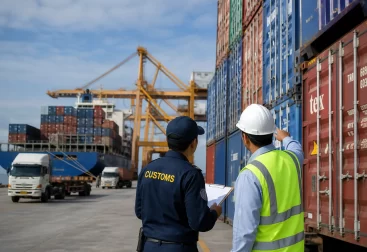
The marking on the carton must match the packing list exactly. Where the packing list says forty cartons and the cartons are numbered to forty-two, the discrepancy is treated as a compliance problem and the whole shipment may be examined.
This is why the packing list should be produced from the actual packing record rather than prepared in advance and left unchanged. The document must describe what was packed, not what was planned.
Labels that the destination requires
Some destinations require specific labels on the carton or on the individual product, covering origin, material content or recycling information. These requirements are set by the destination and should be confirmed before packing begins.
Where a label is applied incorrectly, relabelling at the destination is far more expensive than applying it correctly at the factory. The specification should include a sample of every label, approved before the packing run starts.
Loading a Container Efficiently
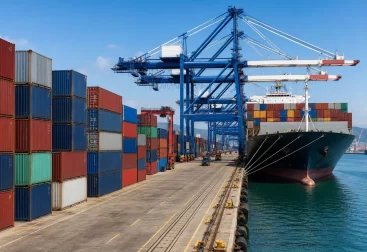
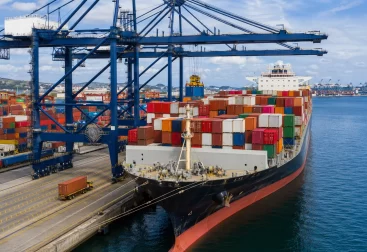
Container utilisation is where packing decisions convert into money. The difference between a well-planned and a careless load can be ten to twenty per cent of the usable volume.
Understanding the space
A container’s nominal internal dimensions are not entirely usable. The door opening is slightly smaller than the interior, and the last row must fit through the door. Palletised cargo loses further volume to the pallets themselves.
Planning against the usable interior volume, minus the door constraint, produces a realistic unit count. Planning against the nominal figure produces an optimistic one that cannot be loaded.
Floor pattern and stacking height
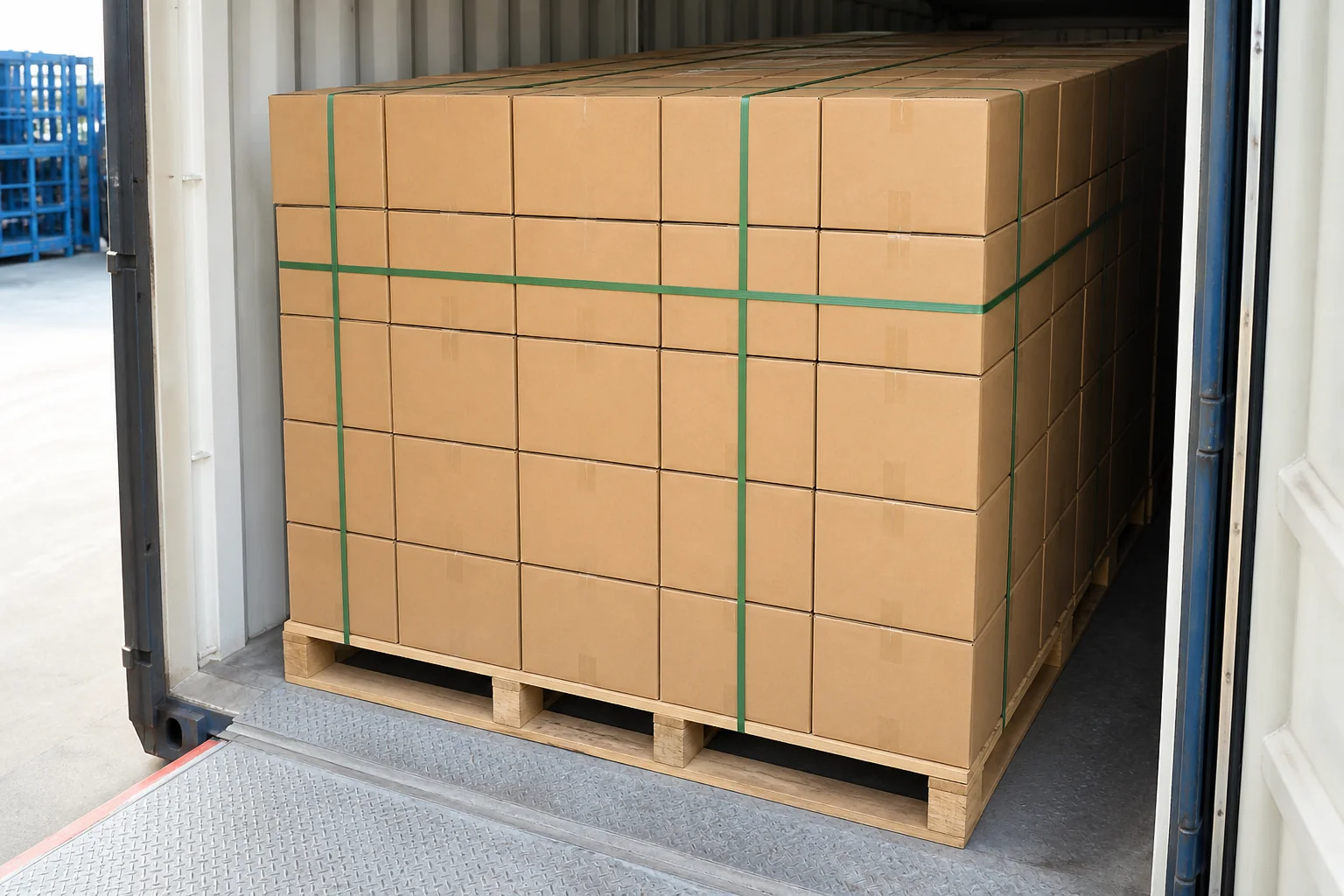
The loading plan should specify the floor pattern and the number of tiers. A pattern that fills the floor edge to edge with no wasted strips usually beats a pattern that uses larger cartons with a tidier appearance.
Mixing carton sizes in one container is possible but reduces utilisation, because the irregular spaces between sizes are difficult to fill. Where a shipment contains several carton sizes, the larger ones should be loaded first and the gaps filled with the smaller.
Palletised versus floor loaded
Floor loading uses more of the container volume because no space is lost to pallets, and it is common for bag shipments. Palletised loading is faster to handle at the destination and may be required where the receiving warehouse cannot handle loose cartons.
The choice affects the landed cost on both sides: floor loading reduces freight per unit, while palletised loading may reduce destination handling charges. The correct answer depends on the destination, which is why it should be decided deliberately rather than by default.
| Loading approach | Volume used | Handling at destination |
|---|---|---|
| Floor loaded, hand stacked | Highest | Slower, labour intensive |
| Floor loaded, machine stacked | High | Slower unless equipment available |
| Palletised, standard pallets | Lower | Fast with forklift |
| Palletised, custom pallet size | Higher than standard | Fast with forklift |
| Mixed carton sizes | Lower unless planned | More sorting |
| Single carton size | Highest | Simplest to receive |
Weight distribution and axle limits
Container weight is distributed across the floor and, on the road journey, across the vehicle axles. Bags are light, so weight limits are rarely the binding constraint, but an unevenly loaded container can still cause handling problems.
Heavier cartons should be placed low and distributed rather than concentrated at one end. Where the shipment includes heavy hardware or accessories, the loading plan should account for them explicitly.
Protecting the load in transit
Cartons shift during a sea voyage, and the movement damages both the cartons and their contents. Blocking and bracing, or filling the void at the end of the container, prevents the load from moving.
Air bags or dunnage are commonly used to fill the remaining space. The cost is small relative to the damage that shifting causes, and the protection should be part of the loading specification rather than an afterthought.
Moisture, Mould and Transit Conditions
Humidity is the most underrated packing risk for leather-look products. A shipment that leaves the factory in perfect condition can arrive with mould or marking after weeks in a humid container.
Why containers are humid
Containers experience large temperature swings between day and night during a voyage, and this causes moisture to condense on the interior surfaces and on the cargo. The effect is strongest on routes that cross climatic zones.
The moisture comes from the cargo itself as well as the air. Cartons and packing materials hold water, and wood pallets hold considerably more. All of it is available to condense onto the product.
Desiccants and moisture control
Desiccant bags absorb moisture from the air inside the container and reduce the risk of condensation. Their quantity should be calculated from the cargo volume and the route rather than estimated.
Desiccants are most effective when the packing itself is dry. Sealing a carton with damp packing material defeats the purpose, because the moisture is already inside the enclosed volume.
| Measure | Effect | Notes |
|---|---|---|
| Dry packing materials | Removes the main moisture source | Foundation of all other measures |
| Desiccant bags | Absorbs residual moisture | Quantity calculated by volume |
| Container liner | Reduces condensation on cargo | Higher cost, strong protection |
| Moisture barrier wrap | Isolates product from air | Useful for high-value lines |
| Avoiding wood pallets | Removes a major moisture source | Also avoids fumigation requirements |
| Avoiding wet loading | Prevents moisture entering at origin | Weather check before loading |
Mould prevention
Mould develops where moisture, warmth and organic material coincide. PU leather is less susceptible than genuine leather, but the fabric backing and the packing materials can support growth.
Prevention is easier than remedy: keep the packing dry, control the enclosed volume with desiccants, and avoid loading in rain or immediately after cleaning. A container loaded with damp packing has a problem that no desiccant can fully solve.
Inspection on arrival
The receiving inspection should include a moisture and condition check, performed before the cartons are opened and again as they are unpacked. The sequence matters, because moisture damage is often visible at carton level before it is visible on the product.
The findings should be recorded against the shipment. Where a moisture problem appears, the record identifies whether it originated at packing, in transit or at the terminal, which determines who bears the cost.
Pre-Shipment Packing Checks
The checks below are the ones that prevent the expensive problems. They should be completed and recorded before the container is sealed, because the cost of a correction rises sharply once the shipment has sailed.
Carton count and marking
Count the cartons physically and reconcile against the packing list. Then verify the marking on a sample of cartons against the specification, including the sequence numbering and the product details.
Counting is worth doing twice, by different people where possible. A carton shortage discovered at the destination cannot be resolved, whereas one discovered before sealing can be corrected within hours.
Sample opening
Open a sample of cartons — one per style, and more where the shipment is large — and inspect the contents. Check for correct quantity, correct colour, correct hardware, and for surface condition.
The sample should include cartons from the top, the middle and the bottom of the stack, because the packing and the risk differ by position. The bottom cartons carry the load and are the ones most likely to show damage.
Weight and dimension verification
Weigh a sample carton and confirm the figure against the packing list. Weights that differ from the record suggest either a packing error or a content error, and both are worth resolving before the shipment leaves.
Measure a sample carton as well. A carton larger than specified can prevent the planned container pattern from fitting, and the discovery at the container is too late to change the cartons.
| Check | Method | When |
|---|---|---|
| Carton count | Physical count against packing list | Before sealing |
| Marking accuracy | Sample against specification | After packing, before sealing |
| Contents sample | Open cartons from top, middle, bottom | During packing |
| Carton weight | Weigh a sample | At packing |
| Carton dimensions | Measure a sample | During carton production |
| Sealing quality | Visual inspection of all cartons | Before loading |
| Container condition | Inspect for holes, moisture, odour | Before loading |
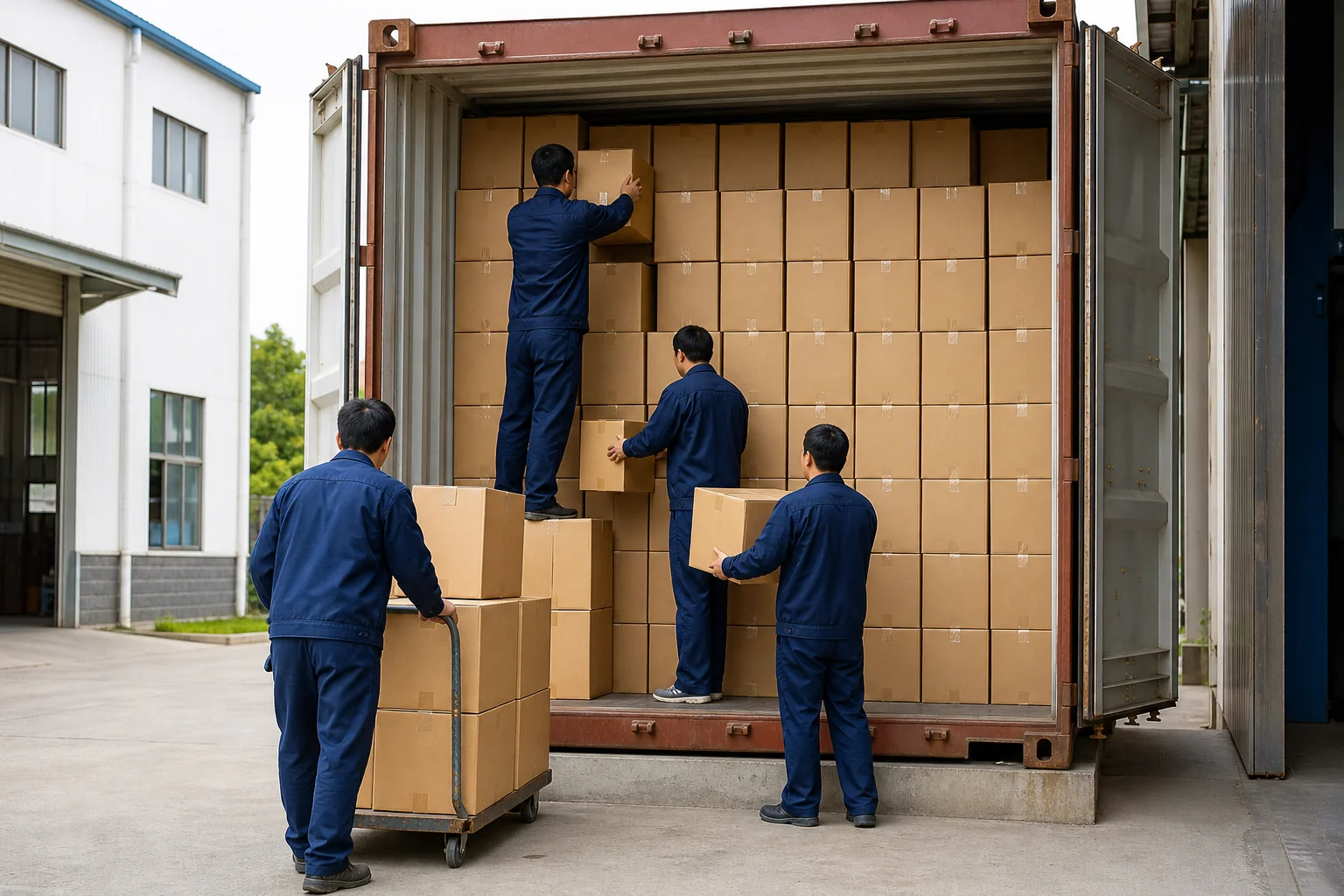
| Loading pattern | Compare to the plan | During loading |
Container inspection before loading
The container itself should be inspected before any cargo goes in. Check for holes, for evidence of previous moisture, and for odour, which can indicate contamination from a previous cargo.
A container that fails inspection should be rejected rather than used. The delay from requesting a replacement is measured in hours, while the damage from a leaking container is measured in a damaged shipment.
Recording the checks
The results should be recorded with photographs. The record supports the packing list and provides the evidence base if a problem emerges later, which converts a dispute about causes into a review of facts.
Photographs of the loaded container, taken from the door before closing, are particularly useful. They show the loading pattern and the bracing as actually executed, not as planned.
Common Packing Mistakes
The mistakes below appear repeatedly in shipments and most of them are avoidable at the specification stage.
Optimising cost without testing
The most frequent mistake is reducing carton board grade or inner protection to save material cost, without testing whether the result survives transit. The saving is visible immediately and the cost appears weeks later.
A transit test resolves this cheaply. Where the test has not been performed, the specification should err towards protection, because a damaged shipment costs far more than the board grade difference.
Cartons designed without a loading plan
A carton that fits the product perfectly can still be wrong if it does not divide efficiently into the container. The error is invisible at the packing bench and obvious only when the container will not close.
The carton dimensions and the loading plan should be developed together. Where they are developed separately, the container ends up with unusable space that is paid for as if it were cargo.
| Mistake | Consequence | Prevention |
|---|---|---|
| Board grade reduced without testing | Crushed cartons, damaged goods | Transit test before approving |
| Cartons sized without a container plan | Unused container volume | Plan dimensions and loading together |
| Inadequate inner protection | Surface marking and creasing | Specify wrap and hardware protection |
| Mixing colours in one carton | Dye transfer on light material | Separate colours at packing |
| Marking inconsistent with the packing list | Customs examination, delay | Produce documents from packing records |
| No moisture control | Mould on arrival | Dry packing plus desiccants |
| Void space left unbraced | Load shifts, carton damage | Dunnage or air bags |
| Checks skipped before sealing | Errors found at destination | Recorded pre-shipment checks |
Assuming the destination can fix problems
Relabelling, repacking and sorting at the destination cost several times what they cost at the factory, and the delay may also cost the selling season. Problems that could have been solved at packing should not be deferred.
The same logic applies to shortages and errors. A carton shortfall identified at the factory is a packing correction; identified at the destination it is a claim, a delay and a dissatisfied customer.
Leaving packing to the last stage
Packing is often treated as the step that happens after everything else, with the specification settled in the final week. That is when compromises are made under time pressure, and when the resulting problems are hardest to correct.
Settling the packing specification at the same time as the product specification removes the pressure. It also allows the carton production lead time to be planned, since cartons are themselves a manufactured item with a lead time.
Ignoring the destination’s handling environment
A packing that works for a modern automated warehouse may fail at a facility that receives loose cartons by hand. The destination’s handling capability should be part of the specification input.
Where the destination is unknown at the time of packing, the specification should assume manual handling. That is the more demanding case, and it is safer to over-protect than to assume equipment that may not exist.
Writing a Packing Specification
A packing specification turns decisions into instructions that can be followed and checked. Without one, the packing standard drifts between production runs.
What the document should contain
The specification should state the inner packaging per unit, the carton board grade and dimensions, the units per carton, the marking content and placement, the moisture measures, and the loading plan. Each element should be specific enough to verify.
Where an element is left as a preference rather than a requirement, it should be labelled as such. Ambiguity in a packing specification is resolved differently by each packer, which is how standards drift.
Agreeing it with the factory
The specification should be agreed in writing before the packing run, with an approved sample carton retained as the reference. The sample resolves disputes about grade and dimensions more reliably than a written description.
The factory should also confirm the carton lead time, because carton production is a separate process and a late carton delays the whole shipment. Where the carton is a custom size, that lead time is longer.
| Specification element | What to state |
|---|---|
| Inner packaging | Poly bag, wrap, hardware protection, filling |
| Carton board grade | Corrugated layers and paper weights |
| Carton dimensions | Internal and external, with tolerance |
| Units per carton | Exact count and arrangement |
| Marking | Content, placement, language |
| Moisture control | Desiccant quantity and placement |
| Loading plan | Floor pattern, tiers, bracing |
| Pre-shipment checks | What is checked, by whom, recorded how |
Checking before every shipment
The specification should be verified at each production run, not assumed to hold because it was correct the first time. Carton suppliers change, packing staff change, and small deviations accumulate.
A short verification against the approved sample before each packing run is sufficient. The check is quick, and it catches the drift that gradually erodes a good specification.
Costing the packing properly
The packing cost should be quoted as a line item, so that the effect of changing a specification is visible. Where packing is bundled into the unit price, reductions and upgrades cannot be evaluated.
The comparison that matters is the total landed cost, not the packing cost alone. A stronger carton that prevents damage, or a tighter pack that fits more units per container, can cost more at the factory and less in total.
Pack for the journey the shipment will take, not for the day it leaves. The container will be stacked, dropped, humid and slow, and the carton is the only thing standing in the way.
FAQ
How should PU leather bags be packed for export?
Each bag should be enclosed individually, normally in a poly bag with tissue or non-woven wrap where the surface requires it, with hardware protected from pressing into material. Colours should be separated to prevent dye transfer. Bags are then packed into corrugated export cartons of a board grade suited to the stacking load and journey duration.
How many bags fit in a container?
It depends entirely on the carton dimensions and the loading pattern, because bags are light and the constraint is volume rather than weight. Work from the usable interior volume minus the door constraint, then divide by carton volume. The well-planned and careless figures for the same carton can differ by ten to twenty per cent.
What board grade should export cartons use?
The grade should follow the stacking height in the container and the length of the journey. Cartons stacked five or six high for a month need a stronger board than cartons travelling at floor level. The check is simple: ask for the board grade, confirm the flute direction, and test a packed carton under the conditions it will meet.
Why does flute direction matter on a carton?
Corrugated board is strongest when the flutes run vertically in the carton as stacked. A carton whose flutes run horizontally offers much less resistance to stacking load, and the difference cannot be seen from outside. It is worth stating explicitly in the specification and verifying on a sample.
Should bags be floor loaded or palletised?
Floor loading uses more of the container volume because no space is lost to pallets, which suits bag shipments. Palletised loading is faster to handle at the destination and may be required where the receiving facility cannot handle loose cartons. Decide deliberately, because the choice affects freight on one side and handling cost on the other.
How do I prevent mould during shipping?
Keep the packing dry, use desiccant bags sized to the cargo volume, and inspect the container before loading. Where the route crosses climatic zones, a container liner or moisture barrier wrap adds further protection. Moisture already inside a sealed carton cannot be removed by desiccants, so dry packing material is the foundation.
What should be marked on export cartons?
Consignee identification, purchase order reference, carton sequence number out of the total, style and colour where relevant, quantity per carton, and the country of origin. Handling symbols indicate requirements such as keeping the carton dry or upright. The marking must match the packing list exactly, because inconsistency triggers examination.
Why must the packing list match the carton marking?
Because a discrepancy is treated as a compliance problem rather than a clerical one, and the shipment may be examined as a result. The packing list should be produced from the actual packing record, not prepared in advance and left unchanged. The document must describe what was packed.
Do I need desiccant bags in every shipment?
Not always, but the routes with large temperature swings between day and night are the ones where condensation causes damage. The quantity should be calculated from the cargo volume and route rather than estimated. On long sea routes crossing climatic zones, desiccants are cheap insurance against a shipment of mould-marked bags.
How much void space is acceptable in a container?
As little as possible, but any remaining void must be braced so the load cannot shift. Bags are light, so shifting rather than weight is the risk, and movement damages both cartons and contents. Air bags or dunnage fill the space inexpensively and should be part of the loading specification.
What checks should be done before sealing the container?
Count the cartons against the packing list, verify marking on a sample, open cartons from the top, middle and bottom of the stack to inspect contents, weigh and measure a sample, check sealing quality on every carton, inspect the container itself for holes and moisture, and photograph the loaded container before closing.
Does packing affect import duty?
Yes, indirectly. Freight forms part of the customs value on which duty is calculated, so reducing packed volume lowers the duty base as well as the freight cost. This is why packing efficiency has a financial effect beyond the transport invoice, and why carton dimensions deserve attention from the buying side.
Specifying export packing for your next bag order?
We manufacture PU leather bags in Guangzhou and pack to your destination’s requirements, with carton specifications, units per container and loading plans confirmed before production so your freight and landed cost are predictable. Send your specification and destination to info@gionar.com, or review our custom bag manufacturing capabilities.