- Why Wholesale Buying Works — and When It Does Not
- Wholesale Pricing Structures Explained
- MOQ and Order Quantities: The Wholesale Math
- Choosing Wholesale Suppliers: Factory vs Distributor
- Building the Product Mix: What to Buy First
- Order Management: From PO to Delivery
- Quality and Compliance in Bulk Orders
- Scaling Up: From Trial Order to Repeat Buying
- FAQ
Why Wholesale Buying Works — and When It Does Not
Wholesale buying is how retailers, distributors and brands turn a product into a business: purchase at volume prices, resell at retail margins, and let the difference pay the rent. The model works because both sides of the table get something the other cannot provide alone — the buyer gets a cost structure that makes resale profitable, and the manufacturer gets the production volumes that make their lines efficient. But wholesale also has rules, and the first rule is knowing when it is the right channel for your business.
Wholesale makes sense when you have a place to sell and a way to move volume: a store, an online shop with real traffic, a distribution network, or a direct-sales channel. It stops making sense when the volume is hypothetical — when the “bulk” is an aspiration rather than a plan. The industry failure mode is the first-time buyer who orders two thousand bags because the unit price looks irresistible, then discovers the cash is tied up, the storage is full and the sell-through is slow. The quantity decision is the whole game: wholesale is profitable at the quantity your channel can absorb, and ruinous at the quantity it cannot.
The second rule is that wholesale margins live or die in the details that beginners skip: freight and duties that quietly add 15-30 percent to the landed cost, quality problems that turn savings into losses, and the working capital that sits in inventory between order and sell-through. This guide walks through the complete wholesale purchase for bags — pricing, quantities, suppliers, product mix, orders, quality and scaling — from the manufacturer’s side of the table, so you know not only what to do but what the supplier is actually doing behind the price.
Wholesale Pricing Structures Explained
Before ordering anything, understand what the price you are quoted actually contains. Wholesale pricing is not one number; it is a structure, and the structure explains why the same bag can be quoted at three different prices by three different suppliers.
| Price component | What it covers | Typical share of FOB |
|---|---|---|
| Materials | Outer fabric, lining, hardware, zippers, webbing | 45-60% |
| Labor | Cutting, sewing, assembly, finishing, packaging | 20-30% |
| Overhead and margin | Factory costs, QC, management, profit | 10-20% |
| Accessories | Tags, dust bags, inner packaging, cartons | 3-8% |
The quoted price is almost always FOB (Free On Board): the goods delivered to the port, including everything up to the ship — but not the ocean freight, the insurance, the duties or the inland delivery after arrival. The buyer’s real cost is the landed cost: FOB plus freight plus insurance plus duties plus local delivery plus the import compliance work. The landed cost is what your retail margin must beat, and it is the number the professional buyer calculates before signing anything.
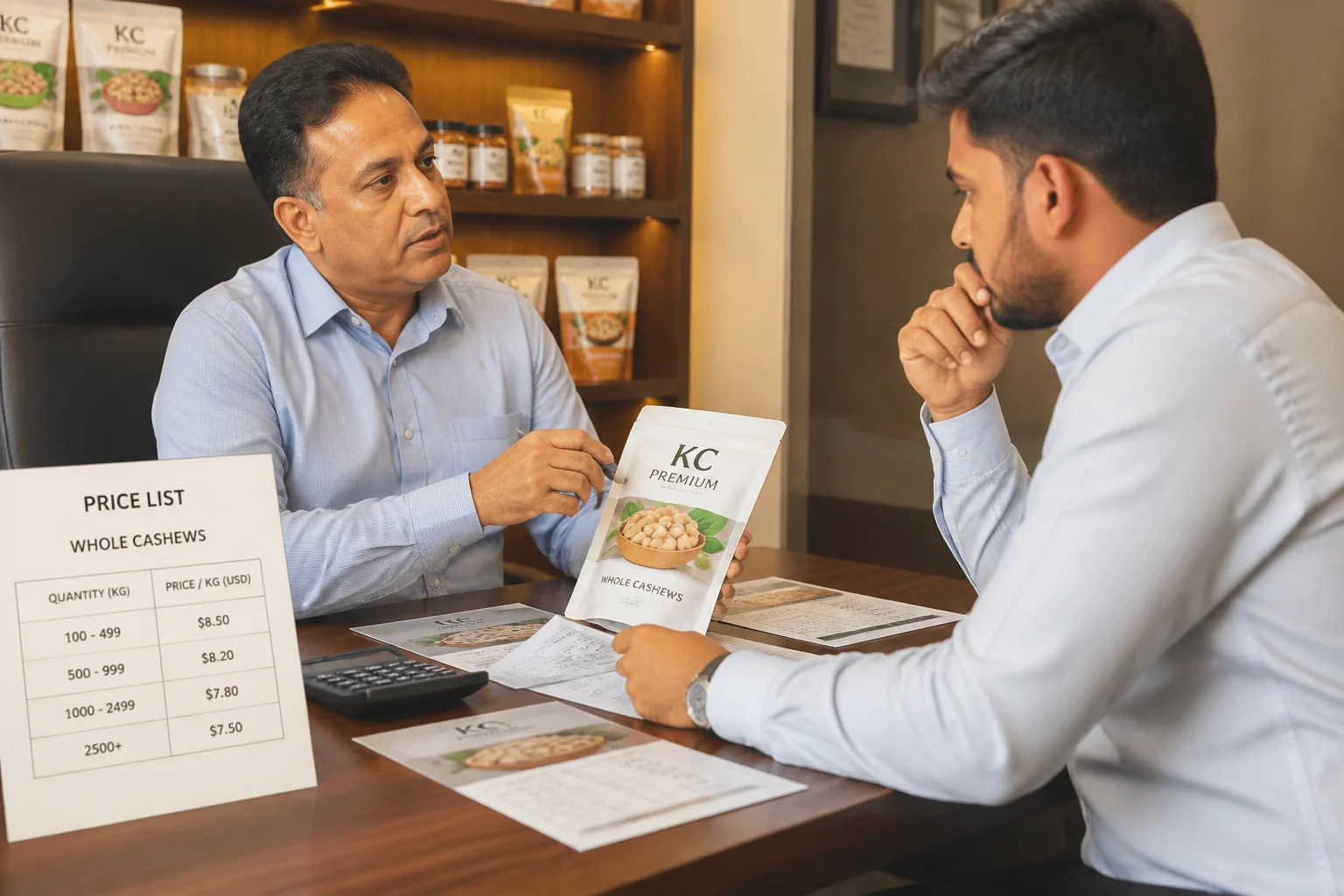
Pricing also scales with quantity through tiered breaks. The typical pattern for bags: the base price at the MOQ, a discount tier around double the MOQ, another around five times the MOQ, and sometimes a larger break for full-container orders. The tiers exist because setup and material costs amortize over more units. The practical implication is that the quantity decision is also a price decision — the buyer who orders 1,500 pieces at the MOQ price may find that 2,000 pieces drop the unit cost by 5-8 percent, which can be worth more than the extra cash it ties up.
Finally, ask what is excluded and what is variable. Exclusions to check: mold or tooling costs for custom hardware, sampling costs, testing costs, and special packaging. Variables to understand: material price fluctuation (PU leather prices move with oil and supply), currency effects, and seasonal factory capacity. A quote that lists the exclusions is honest; a quote that hides them is a surprise waiting for your P&L.
MOQ and Order Quantities: The Wholesale Math
Every wholesale order begins with a number: the minimum quantity the supplier will produce, and the quantity you decide to order above it. Both numbers deserve real calculation, because both hide the margin.
The supplier’s MOQ is set by its cost structure — material minimums, line setup, labor allocation — and it varies by product type and customization. A standard in-stock wholesale line may have an MOQ of 50-200 pieces per style; a custom OEM line typically starts at 300-1,000 pieces. The MOQ is negotiable in components: the supplier may split the MOQ across colors, across styles in the same material, or across a trial order plus a follow-up. The professional approach is not to ask “can you lower the MOQ?” but “what combination of styles, colors and order structure reaches your minimum?”
Your own order quantity should be a calculation, not a round number. The formula every wholesale buyer should run before ordering:
- Forecast demand for the next 90 days: units you can realistically sell through your channels, using your traffic, conversion rate and average basket — not your hope.
- Calculate landed cost per unit: FOB plus freight and duties divided by units, which tells you the true margin at your retail price.
- Test the tier breaks: compare unit cost at your forecast quantity against the next price tier; if the tier saves more than the inventory cost, order the tier.
- Add a reorder buffer: the quantity must cover the time between ordering and restocking — your reorder lead time in sales units — or you will sell out.
The most common quantity mistake is ordering to hit a price tier without the sell-through plan to support it; the second is under-ordering and running out during the lead time, which loses margin on the sales you could have made. Both are avoided by the same discipline: the quantity follows the forecast, and the price tier follows the quantity, never the reverse.
Choosing Wholesale Suppliers: Factory vs Distributor
Wholesale bags come from two kinds of sources, and the choice between them shapes your price, your flexibility and your risk. The factory manufactures; the distributor resells. Each has a place, and the professional buyer often uses both.

Factories sell at the lowest possible price, offer customization (your colors, your materials, your branding), and can build a private-label line that no distributor carries. The trade-offs: higher MOQs, longer lead times, and the need to manage sampling, production and quality yourself or through partners. Distributors and wholesale platforms offer ready stock, small order quantities, fast dispatch and established quality — at a higher unit price that reflects their margin, with limited customization and more competition on the same SKUs.
The decision rule is simple: stock and speed from distributors, cost and differentiation from factories. Many retailers buy their proven sellers from distributors for fast restocking and develop their exclusive styles with a factory for margin and brand identity. The two channels are complements, and the brands that understand the mix buy better than the brands that commit to one.
When you evaluate a wholesale supplier — factory or distributor — the shortlist checks are the same five: legal identity (business license, export capability), product fit (their category matches your line), quality evidence (samples, inspection history, QC process), capacity (can they deliver your quantity on your schedule), and communication (responses within a reasonable window, answers to specific questions). One trial order tests all five at once, which is why the trial order is the standard entry to every wholesale relationship.
Building the Product Mix: What to Buy First
The first wholesale order is a portfolio decision as much as a quantity decision: the mix of styles, colors and price points you carry determines how fast the stock moves. A mix that sells is the difference between repeat buying and a storage problem.
The professional approach to a first mix: one proven core style in two or three colors, one entry price point to attract traffic, one higher-margin style to build the basket, and no more than four to six SKUs total. The discipline behind the small mix is data — you do not yet know what your customers will buy, and a small bet in several directions tells you faster than a large bet in one. After the first sell-through, the winners get deeper orders and the losers are cut; the mix is a hypothesis that your sales data confirms or rejects.
Color strategy matters more than it appears: full-color runs multiply inventory risk, while a limited palette (two to three colors per style) keeps stock flexible and simplifies reorders. Best-sellers should be stocked in the colors that sell; experimental colors should be tested in small batches or through distributor stock first. The same logic applies to price points: the entry, mid and premium tiers of your mix should be populated deliberately, because the mix is what lets customers trade up and what gives your store its range.
The first wholesale order is not a bet on what will sell; it is a test designed to find out. Keep the test small, read the results, and let the data build the second order.
Order Management: From PO to Delivery
A wholesale order is a chain of documents and decisions, and each link has a failure mode. Managing the chain professionally is what separates buyers who get what they ordered from buyers who get surprises.
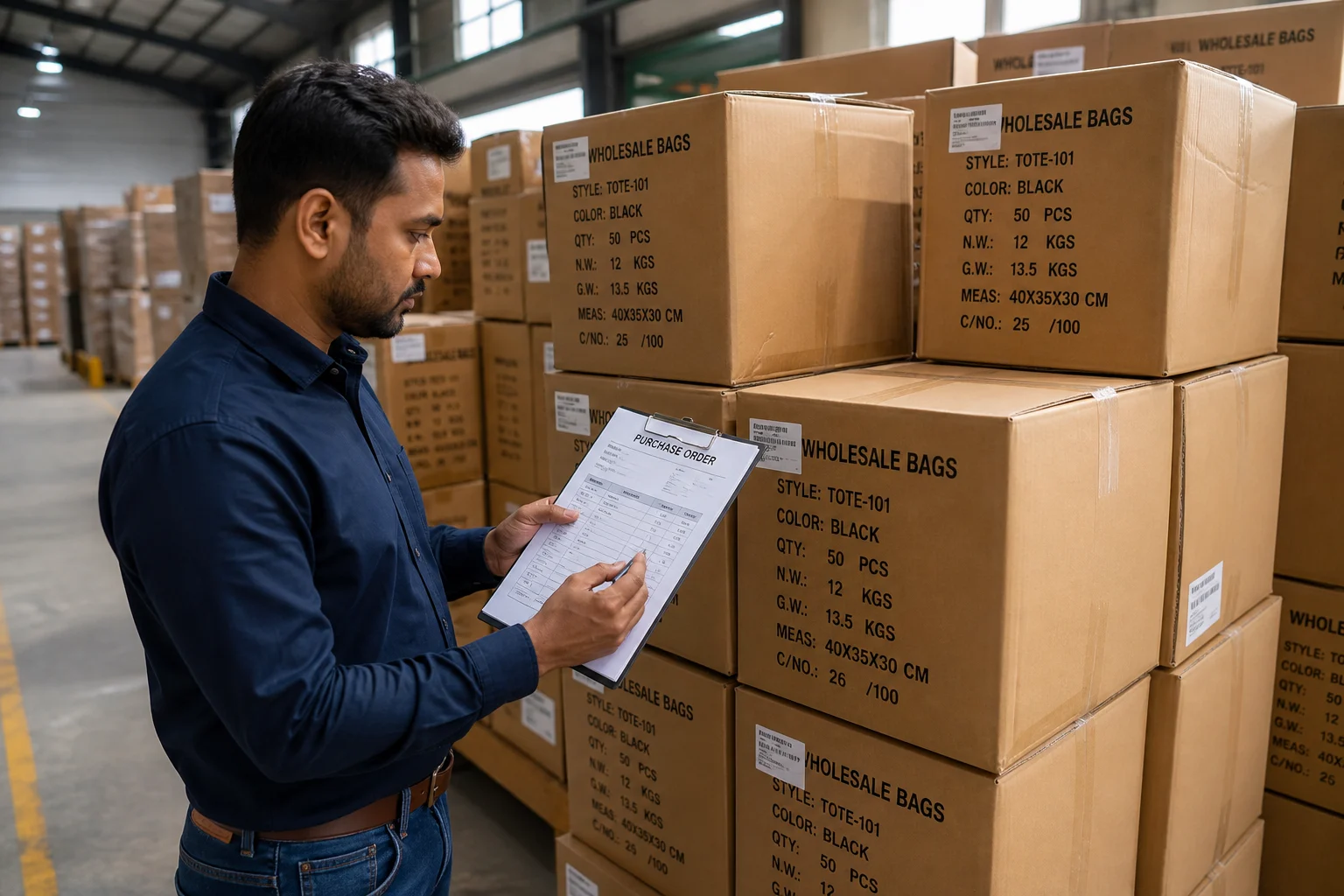
The chain starts with the purchase order: a written contract naming the styles, quantities, unit prices, delivery terms (FOB, CIF, DDP), payment terms, packaging, and the QC requirements. The PO is the reference for every dispute, so it must be complete and signed by both sides. Payment follows the industry pattern: a deposit (typically 30 percent) to confirm the order and fund materials, and the balance against the shipping documents or on delivery. The deposit is normal; the discipline is to ensure the balance is tied to a verifiable milestone — the inspection report, the shipping documents or the arrival — not to the factory’s word.
Production needs a schedule and checkpoints: the material confirmation date, the sample approval, the production start, the mid-production check, the final inspection and the ship date. Each checkpoint has a communication — a photo, a report, a confirmation — so the order has a visible pulse instead of silence until the deadline. Shipping is the next decision: the freight terms in the PO (who pays, who arranges), the consolidation (LCL) versus full container (FCL) choice, and the transit time for your route, which for bags from Asia typically runs 20-40 days by sea. The delivery buffer in your planning must cover the transit, the customs clearance and the inland leg — a launch date planned without the buffer is a stockout in waiting.
Quality and Compliance in Bulk Orders
Bulk orders multiply the consequences of quality problems: one defective piece is a return, a thousand defective pieces are a recall. Wholesale buyers need quality control scaled to the order, and compliance protection that travels with the goods.
The minimum quality package for a wholesale order is three checks. First, a pre-production check: the materials verified against the approved swatches and the test reports reviewed, before the line starts. Second, an inline or mid-production check: sewing, assembly and hardware sampled while correction is still cheap. Third, the final inspection: an AQL sampling of the finished, packed goods by a third-party inspector, with a report that releases the balance payment. The package costs a small fraction of the order value, and it converts “the factory said it’s fine” into an independent verdict.
Compliance is the second layer. Bags sold into retail markets carry regulatory obligations: chemical safety (REACH in the EU, CPSIA and Prop 65 in the US), and increasingly the due-diligence expectations of major retailers. The wholesale buyer should request the material test reports (color fastness, chemical content), verify the country-of-origin labeling and packaging compliance for the destination market, and keep the documents with the order file. The cost of a compliance failure — a held shipment, a recalled batch, a fine — dwarfs the cost of the tests, which is why professional buyers treat test reports as part of the purchase, not an optional extra.
Scaling Up: From Trial Order to Repeat Buying
Wholesale is a relationship business, and the relationship compounds: the second order from a supplier is cheaper to place, faster to produce and easier to manage than the first, because the standards, the contacts and the trust already exist. Scaling is the deliberate management of that compounding.
The scale path has four stages. Stage one is the trial order: small, standard or lightly customized, testing the supplier’s quality, communication and delivery against your expectations. Stage two is the repeat order: the same or similar SKUs, with the feedback from the trial incorporated — the defects named, the packaging adjusted, the lead time confirmed. Stage three is the private label: your branding, your colors, your exclusive styles, built on the relationship the first two stages established. Stage four is the partnership: seasonal planning, shared forecasts, reserved capacity and negotiated annual pricing — the supplier becomes a strategic resource rather than a vendor.
Two disciplines keep the scaling healthy. The first is the scorecard: after every order, rate the supplier on quality (defect rate), delivery (on-time performance), communication (response quality) and value (pricing versus market). The scorecard makes supplier decisions data-driven instead of anecdotal. The second is the backup: every supplier relationship should have a tested alternative, because capacity, pricing and quality shift over time, and the brand with options negotiates from strength. Scale the relationship that earns it, and keep the alternative warm — that is the wholesale buyer’s version of risk management.
Wholesale Packaging: What to Specify
Packaging is the quiet cost of every wholesale order — typically 3-8 percent of the FOB price — and the place where specifications save money or create surprises. The buyer who specifies packaging in the PO gets what they expect; the buyer who leaves it to the supplier gets the supplier’s convenience.
The packaging specification has five layers. The first is the inner protection: each bag in a polybag, or a dust bag for premium lines, protecting the surface and hardware during transit. The second is the carton: the corrugated grade (single or double wall), the carton dimensions, and the weight limit — a carton that exceeds 25-30 kilograms becomes a handling problem and a shipping cost problem. The third is the carton packing quantity: the standard is typically 5, 10 or 20 pieces per carton depending on the bag size, and the quantity should divide cleanly into your order so no carton ships half full. The fourth is the carton markings: the carton marks (importer name, style, quantity, carton number), the country of origin, and any handling symbols. The fifth is the retail-ready packaging if your channel needs it: hang tags, barcodes, branded boxes or polybags that go straight from carton to shelf.
Two packaging rules prevent most problems. First, request a packaging sample or photo with measurements before production — cartons that are too small crush the goods, and cartons that are too large inflate your freight. Second, specify the packaging in the PO and in the QC plan, so the final inspection verifies it: the inspector checks the carton condition, the markings and the packing quantity as part of the report. Packaging mistakes are the most common reason a good shipment arrives as a damaged shipment, and they are entirely preventable with five lines of specification.
Common Wholesale Buying Mistakes
Wholesale buyers make the same mistakes across markets and product categories, and each mistake has a predictable cost. Knowing the patterns is cheaper than learning them.
Mistake 1 — Buying the price, not the landed cost. Comparing FOB quotes without adding freight, duties and compliance misses the number that determines your margin. Two suppliers can quote the same FOB and differ by 20 percent on landed cost because of packaging, consolidation and testing requirements. Mistake 2 — Skipping the trial order. The first order should test the relationship — quality, communication, delivery — at a scale where problems are lessons, not losses. A buyer who commits the full quantity to an untested supplier is betting the inventory on an unknown. Mistake 3 — Over-ordering to the price tier. The tier discount is seductive, and the storage room fills with the units the channel cannot absorb. The tier is worth taking only when the saving beats the carrying cost, which the quantity math must show.
Mistake 4 — No inspection gate. Releasing the balance payment against the supplier’s word rather than an independent inspection report turns quality risk into a gamble. The inspection is the cheapest insurance in the order. Mistake 5 — One supplier, no backup. Capacity, pricing and quality shift; the buyer with one source has no negotiation and no fallback. A tested alternative supplier is the buyer’s safety net. Mistake 6 — Ignoring the reorder math. Selling out during the lead time loses margin twice: the sales you could not make and the rush-shipping premium you pay to restock. The reorder buffer in your order quantity is not optional — it is the operating rhythm of the business.
The common thread is the same one that runs through the whole wholesale system: decisions made on complete information — landed cost, trial data, inspection reports, buffer math — compound into a profitable business, while decisions made on price alone compound into a storage problem.
Shipping Terms Every Wholesale Buyer Should Know
The Incoterms written into your PO decide who pays for what, where the risk transfers, and how much the freight adds to your landed cost. Three terms cover most bag imports, and knowing the difference prevents the most common invoice surprises.
| Term | Supplier covers | Buyer covers | Best for |
|---|---|---|---|
| FOB | Goods to the port, loaded on the vessel | Freight, insurance, duties, inland delivery | Buyers with their own freight forwarder |
| CIF | Goods + insurance + freight to destination port | Duties, clearance, inland delivery | Simpler quotes, but check the freight included |
| DDP | Everything through delivery to your door, duties included | Almost nothing at the border | First-time importers who want one total price |
FOB is the industry default for bags and gives the buyer the most control over freight costs — your forwarder quotes the ocean leg, and the price is transparent. CIF bundles the freight into the unit price, which looks simpler but hides the freight component behind the supplier’s arrangement; it is worth comparing the CIF price against an FOB quote plus your own freight estimate. DDP moves the entire logistics burden to the supplier, which is attractive for first orders and small buyers, but the premium for the service is real and the buyer loses visibility into the cost breakdown.
Whichever term you choose, write it into the PO with the port or destination named, and confirm what each side provides at the border — clearance documents, duties payment, local delivery. The term is a contract, not a convention, and the contract is only as good as its specificity.
FAQ
What is the typical MOQ for wholesale bags?
It depends on the source and the customization. Ready-stock distributors may sell from 10-50 pieces per style; a factory’s standard wholesale line typically starts around 100-300 pieces; custom OEM production usually begins at 300-1,000 pieces. Ask each supplier for its minimums per style, per color and per mixed order before comparing.
How much cheaper is wholesale than retail?
Wholesale prices typically run 40-60 percent below the equivalent retail price, reflecting the distributor or factory margin structure. The meaningful comparison is your landed cost against your retail price: the margin you keep after freight, duties and compliance is the number that matters.
Should I buy from a factory or a distributor?
Distributors for speed, low minimums and ready stock; factories for price, customization and exclusive products. Most professional buyers use both: distributor stock for proven sellers and fast restocking, a factory for the private-label line that carries the brand margin.
How do I calculate a safe order quantity?
Forecast your realistic 90-day sell-through, add the units you will sell during the reorder lead time as a buffer, and compare the total against the price tiers. Order the tier only if the unit saving beats the cost of carrying the extra inventory; never order to a price tier without a sell-through plan.
What does FOB mean, and what does it not include?
FOB (Free On Board) means the supplier delivers the goods to the port and covers everything up to loading. It excludes ocean freight, insurance, import duties, inland delivery and compliance work — the buyer’s landed cost is FOB plus all of those, and the landed cost is what your margin must beat.
Do I need a third-party inspection on wholesale orders?
On a first order from a new supplier, absolutely — the report verifies the goods and releases your payment safely. On repeat orders from a proven supplier, you can move to random or periodic inspections guided by the defect history. Never skip inspection on a first order regardless of promises.
What compliance documents should I request?
At minimum: material test reports (color fastness, chemical content for your destination market, e.g. REACH or CPSIA), the country-of-origin certificate, and packaging compliance documents. Request them before production, and keep them in the order file — they are your protection at customs and in the market.
How long does a wholesale order take from order to delivery?
Ready-stock distributor orders typically ship within days. Factory production adds 2-6 weeks depending on quantity and customization, and sea freight from Asia to most destinations adds 20-40 days. Plan the full chain — production plus transit plus clearance — before committing to a launch date.
What is the standard payment structure for wholesale orders?
The industry norm is a 30 percent deposit to confirm the order and fund materials, with the balance released against the shipping documents or the inspection report. The deposit is standard; the discipline is tying the balance to a verifiable milestone rather than to the supplier’s word.
Next Steps: Buy Bulk with a System
Wholesale buying is a system, and the system is learnable in one order cycle: calculate the landed cost, choose the supplier mix, run the quantity math, write a complete PO, schedule the checkpoints, and inspect before you pay. Run the system once and the second order is faster, the third cheaper, and the relationship stronger each time.
A factory partner that publishes its standards, supports trial orders and welcomes inspections makes the system easy to run. That is the kind of partner we aim to be at our factory — talk to us about your wholesale requirements and we will show you the process before you commit.
Planning a bulk bag order? Contact our team at info@gionar.com for wholesale pricing, samples and production planning.
Related reading: our custom bag manufacturing portfolio shows the factory capability behind wholesale and private-label orders.