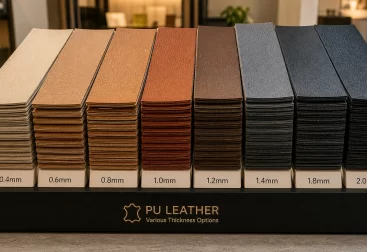
What Water Resistance Actually Means
“Waterproof” is one of the most loosely used words in bag marketing. In engineering terms the property is graded, and the grade determines what the bag will survive.
Three levels that are not interchangeable
Water-repellent means water beads and runs off the surface. Water-resistant means the material resists penetration for a limited time under moderate exposure. Waterproof means the construction keeps water out under defined conditions, including at seams and closures.
Most bags described as waterproof are water-resistant. That distinction is worth stating precisely, because a customer who trusts the wrong word will return a bag after a storm.
The three levels compared
| Level | Behaviour | Typical use |
|---|---|---|
| Water-repellent | Droplets bead and run off | Light rain, brief exposure |
| Water-resistant | Resists penetration for a limited period | Commuting, moderate rain |
| Waterproof | Sealed construction, no ingress under test conditions | Outdoor, marine, protective cases |
Where a customer needs genuine protection for electronics or documents, only the third level is appropriate, and it requires sealed seams and a closure that does not leak.
How performance is measured
Hydrostatic head measures the water pressure a fabric withstands before water passes through, and it is expressed in millimetres. Spray rating measures how well the surface repels water under a standard spray, expressed as a rating scale.
Both are useful, but neither describes the finished bag. A fabric with excellent hydrostatic head can still leak through stitch holes, an unsealed zip and a poorly covered flap.
What most buyers actually need
For urban and commuting use, protection against rain during a commute is usually sufficient. That is achievable with a coated outer, a covered zip and sound seam treatment, without the cost of a fully sealed construction.
Setting the requirement honestly at the beginning prevents overspecification, which raises cost, and underspecification, which raises returns.
Coatings and Finishes
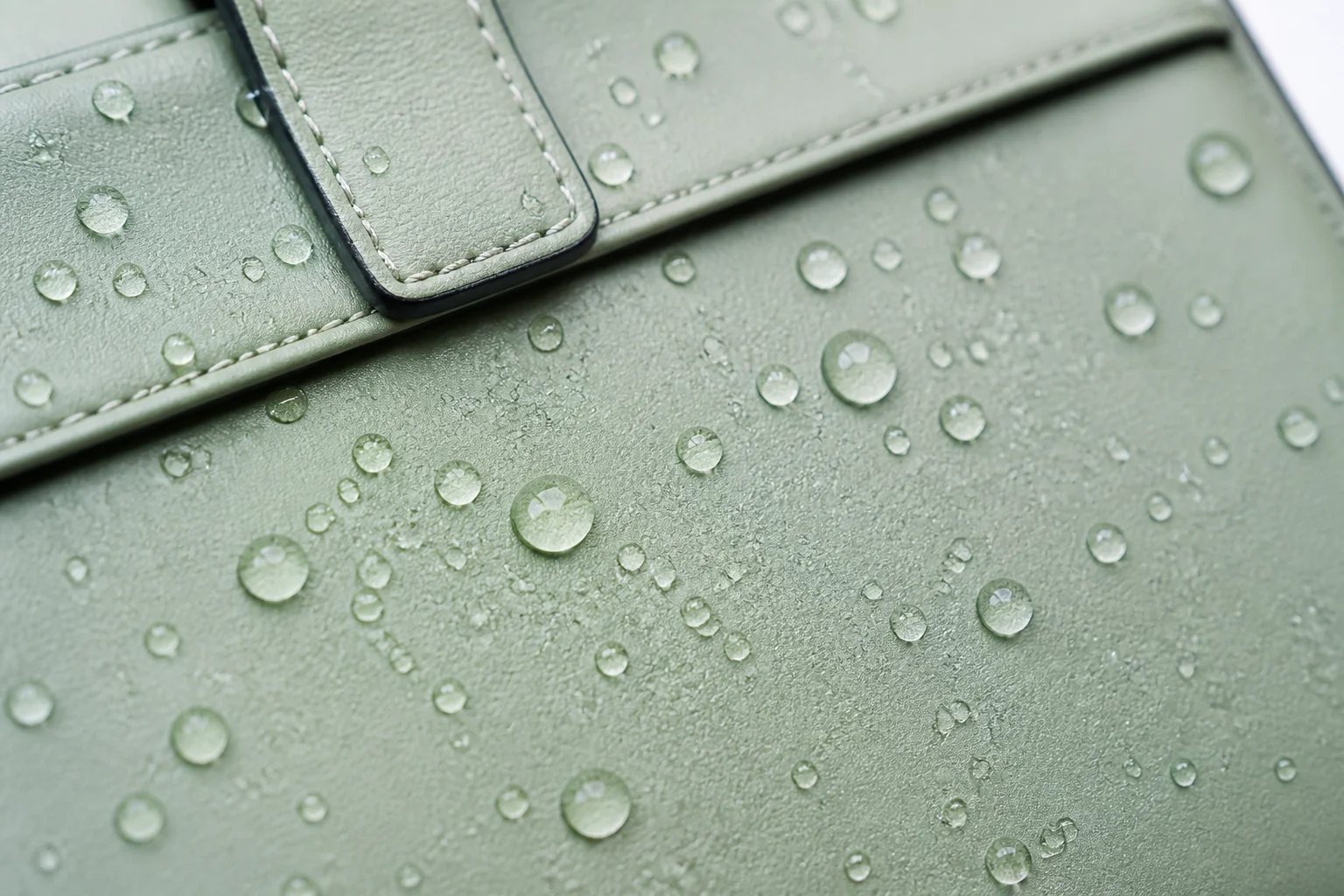
Water resistance on a bag comes mainly from the coating on the base material and from any finish applied to the surface. The coating type determines how well it performs and how long it lasts.
PU coating
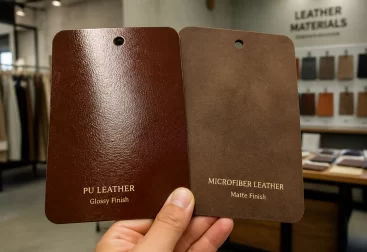
Polyurethane coating is the most common option on fashion and business bags. It provides a water-repellent surface with a soft hand, and it can be produced with matte, gloss or embossed finishes.
Its performance depends on the coating thickness and quality. A thin, low-grade PU coating can degrade relatively quickly, particularly with abrasion and repeated flexing.
PVC coating and TPU lamination
PVC coating is heavier and provides strong water resistance at low cost, but it is stiffer, less environmentally desirable and prone to plasticiser migration over time.
TPU lamination is a common choice where genuine water resistance is needed with better flexibility and durability than PVC, which is why it appears on technical and outdoor-oriented bags.
Durable water-repellent finishes
A DWR finish is applied to the face of a fabric to make water bead and run off. It is a surface treatment rather than a barrier, and it wears with use and abrasion.
DWR is what makes water bead in the shop and what fades after a season of handling, so care guidance and re-proofing advice matter where the finish is part of the product’s promise.
Coating options compared
| Coating | Water performance | Hand and weight | Durability | Cost |
|---|---|---|---|---|
| PU coating | Repellent to resistant | Soft, flexible | Moderate | Low–medium |
| PVC coating | Resistant | Stiff, heavier | Good | Low |
| TPU lamination | Resistant to waterproof | Flexible, slightly stiffer | Very good | Medium–high |
| DWR finish only | Repellent | Unchanged | Wears with use | Low |
| PU plus DWR | Repellent, improved runoff | Soft | Moderate to good | Low–medium |
| Silicone or wax finish | Repellent | Matte, natural | Needs re-treatment | Medium |
Coatings can also be combined: a PU-coated fabric with a DWR face finish gives both a barrier layer and improved surface runoff, which is a practical combination for urban bags.
What the coating does not solve
Coating protects the surface, not the construction. Water still enters through stitch holes, an uncovered zip, a seam that wicks and any opening where the bag is not closed.
That is why a bag with a premium coating can perform worse in rain than a simpler bag with covered closures. Water resistance is a system property.
Base Materials and Water Behaviour
The base material influences how the bag behaves when wet, independently of its coating: how much water it absorbs, how quickly it dries and whether it deforms.
Coated PU leather
Coated PU leather repels water on the face and does not absorb much, which makes it a good choice for rain-resistant fashion bags. The risk is at seams, edges and any uncoated reverse side.
Where the material is cut, the cut edge exposes the backing, which can wick water. Edge finishing or sealing addresses this specifically.
Coated canvas and woven materials
Coated canvas resists water well but is heavier and can stiffen when wet. Uncoated canvas absorbs water and becomes heavy, and the moisture can pass through to the interior over time.
Where a brand wants a natural look with water resistance, a coated canvas or a canvas with a DWR finish is usually the practical compromise.
Nylon and polyester
Woven synthetics absorb very little water and dry quickly, which is why they dominate technical bags. Their water resistance comes from the coating, the weave density and the finish rather than from the fibre alone.
A tight weave resists water better than a loose one, so construction details such as denier and weave count appear in the specification alongside the coating.
Material behaviour summary
| Base material | Water absorption | Drying | Notes |
|---|---|---|---|
| Coated PU leather | Very low | Fast | Cut edges need sealing |
| Coated canvas | Low on face | Moderate | Stiffens when wet |
| Uncoated canvas | High | Slow | Gets heavy, wicks |
| Nylon woven | Very low | Very fast | Performance depends on coating |
| Polyester woven | Very low | Fast | Good with tight weave |
| Microfibre PU | Low | Moderate | Surface can mark when wet |
| Genuine leather | Moderate | Slow | Needs conditioning, water marks |
Two materials with similar appearance can behave completely differently in rain, which is why the technical pack should name the base, the coating and the finish, not just the surface look.
Lining and interior exposure
Where water does enter, the lining determines what happens next. A synthetic lining dries quickly and resists staining; a cotton lining holds moisture and can develop odour or mould.
For bags intended for wet conditions, a synthetic lining is the sensible default, and a light colour helps the customer see whether water has reached the interior.
Seams: Where Water Gets In
A coating can be perfect and the bag can still leak within minutes, because every stitch creates a hole through the material and every seam is a path for water.
Why stitched seams leak
Needle perforations pass through the coating and the base material, and water travels along the thread and through the holes by capillary action. A dense stitch line leaks less than a loose one, but it still leaks.
Where a seam is also under tension, the holes open slightly and ingress increases. That is why shoulder straps and base seams are often the first places to let water through.
Seam treatment options
Seam sealing tape applied to the inside of the seam is the standard solution for genuinely waterproof construction. The tape is heat-bonded over the stitch line and blocks the path.
Welded or heat-bonded construction removes the stitching altogether, which is why it appears on waterproof cases and technical bags. Bound seams and folded seams reduce exposure without eliminating it.
Seam treatments compared
| Treatment | Water performance | Cost and process | Best suited to |
|---|---|---|---|
| Untreated stitched seam | Poor — water follows stitches | Standard assembly | Dry-use bags |
| Bound seam | Moderate — reduces wicking | Low additional cost | Interiors, light rain |
| Taped seam | Good — blocks the stitch line | Extra material and step | Rain-resistant bags |
| Welded seam | Very good | Machinery and tooling | Waterproof construction |
| Seam sealant applied | Good where applied correctly | Labour-intensive | Low-volume production |
| Folded and stitched | Moderate to good | Moderate | Base panels, flaps |
Where only moderate protection is required, taped seams at the most exposed locations — the base and the top — give most of the benefit at a fraction of the cost of full sealing.
Stitch and needle specification
Finer needles and a slightly tighter stitch reduce hole size. Thread type matters too: a synthetic thread with some elasticity seals better than a stiff one when the seam flexes.
Water-resistant thread finishes and lubricants are available, and they help the thread repel rather than transport water along its length.
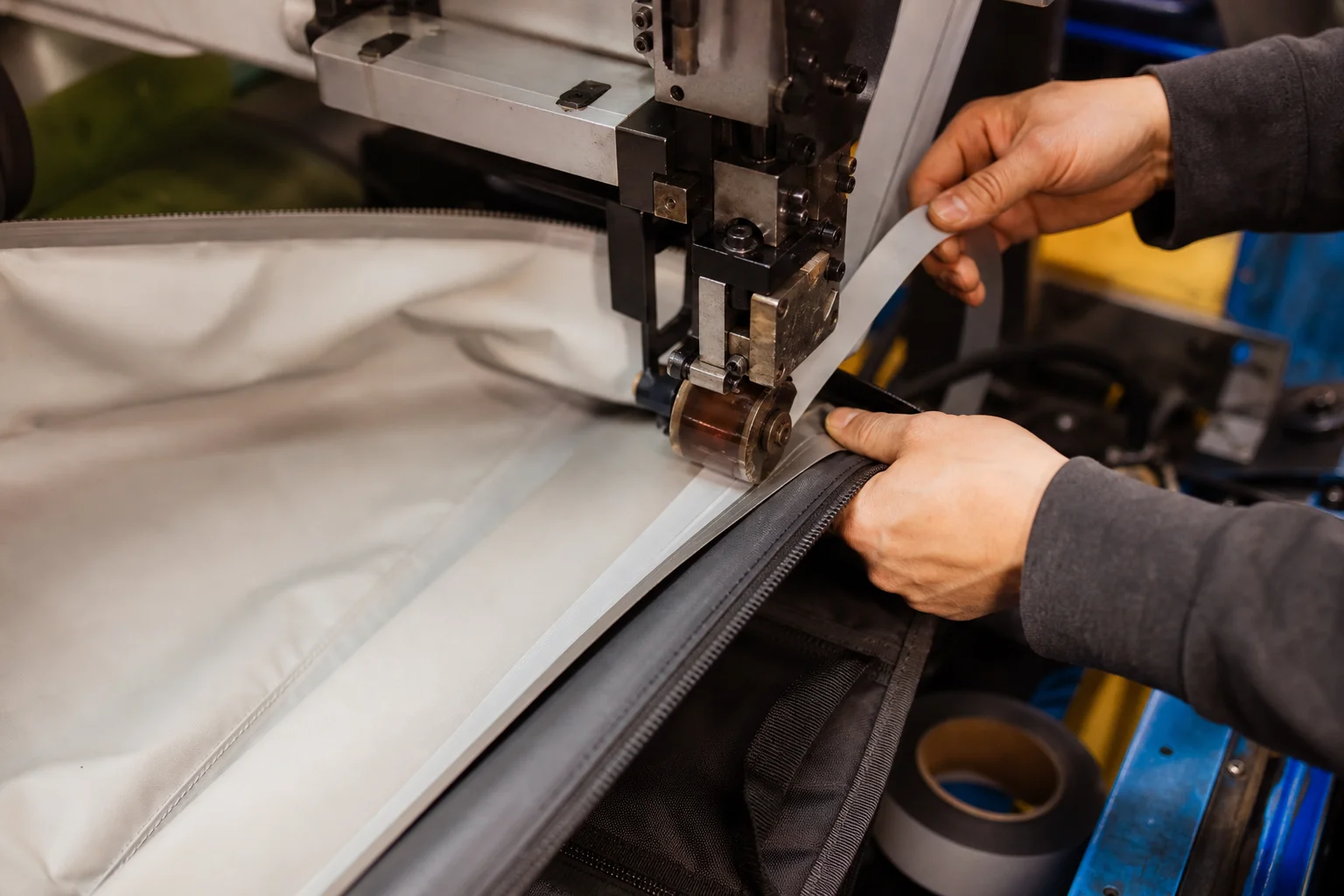
Edge and cut-face sealing
Where PU leather or coated fabric is cut, the exposed edge can wick moisture into the backing. Edge paint, folded edges and bound edges all address this, and the choice affects both appearance and performance.
Any surface presented to weather is worth specifying individually, rather than treating the bag’s material as a single uniform surface.
Zippers, Flaps and Closures
An opening is the most direct route for water, and a bag with excellent material can admit water straight through an unprotected zip.
Standard versus water-resistant zippers
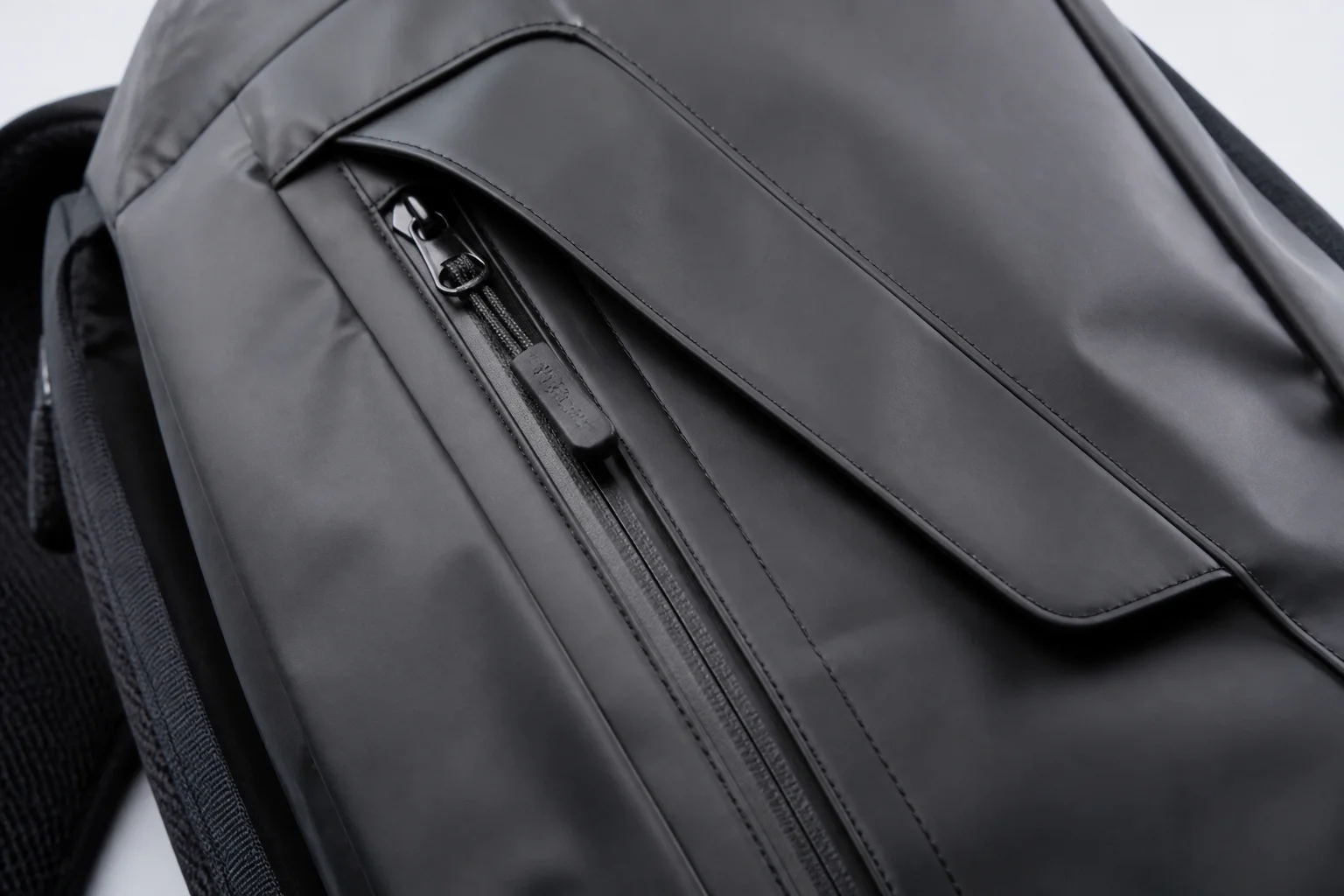
A standard coil or metal zip is not water-resistant: the teeth form a line of gaps and the tape absorbs water. A water-resistant zip uses a coated tape and a tighter construction, often with a polyurethane film behind the coil.
Water-resistant zips run more stiffly and cost more, and they still need a flap or cover where the exposure is significant.
Flaps, covers and closures
A storm flap over the zip, a fold-over top, a roll-top closure or a magnetic flap all keep water off the opening. The most effective designs combine a covered opening with a drainage path so that any water that enters can leave.
Where a bag has a top zip without a flap, water sitting on the zip can penetrate under sustained rain, which is a common cause of interior dampness.
Closure options compared
| Closure | Water protection | Trade-off |
|---|---|---|
| Standard zip, no flap | Low | Easy access, low cost |
| Standard zip with storm flap | Moderate to good | Extra material, slightly bulkier |
| Water-resistant zip | Good | Stiffer action, higher cost |
| Water-resistant zip plus flap | Very good | Cost and bulk |
| Roll-top closure | Very good | Less convenient access |
| Magnetic flap with gusset | Moderate | Elegant, less protective |
| Drawstring with cord lock | Low | Simple, minimal protection |
For business and fashion bags where appearance matters, a standard zip under a well-designed flap is a practical solution that keeps the silhouette clean while providing useful protection.
Hardware and attachment points
Hardware rarely leaks, but attachment points do: rivets, D-rings and strap anchors pass through the material and create openings. Where these sit on an exposed face, water can follow them inward.
Placing attachments under flaps or in less exposed positions reduces the risk, and it is a design decision rather than a material one.
Design Features That Manage Water
Water resistance is achieved in the design as much as in the material. A few structural decisions keep water away from the places it would otherwise collect.
Flaps, gussets and drainage
A flap that overhangs the opening sheds water away from the zip. A gusset keeps the opening off the ground when the bag is set down, and a small drainage path at the base prevents water pooling inside.
These features cost little and are visible in use, which makes them worth calling out in product descriptions to customers who compare bags on specification.
Interior and exterior pockets
Pockets placed on the outside of the bag are the most exposed to rain, and their flaps are often the first detail to fail. Where a bag is intended for regular rain use, sensitive contents belong in an interior pocket or in a separate protective sleeve.
Specifying which pockets are protected, and how, is more useful to a customer than a general claim that the whole bag is water-resistant.
Design features and their effect
| Feature | Effect on water |
|---|---|
| Overhanging flap | Deflects water from the opening |
| Gusset at the base | Keeps the opening clear of wet surfaces |
| Base panel with folded edge | Reduces wicking at the most exposed face |
| Drainage gap at base | Lets any ingress escape |
| Covered zip on top opening | Blocks direct water entry |
| Synthetic lining | Dries quickly, resists odour |
| Sealed interior pocket | Protects electronics and documents |
| Straps attached under flaps | Fewer exposed attachment points |
Individually these features look minor. Together they decide whether a customer experiences a bag that copes with rain or one that soaks through on the first wet commute.
Shape and the pooling problem
Flat-topped shapes collect water, and rounded or sloped tops shed it. Where the design calls for a flat top, a covered opening and a slight slope on the flap help water run off.
Volume also matters: a bag that stands open holds water in a way that a closed bag does not. That is a design decision made at the sketch stage, not a material choice made later.
Testing Water Resistance
Testing converts a claim into evidence. Where a brand intends to advertise water resistance, documented test results are the difference between a defensible claim and a risk.
Fabric-level tests
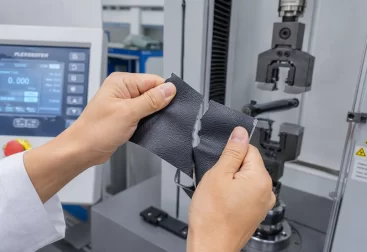
Hydrostatic head testing measures how much water pressure the fabric withstands before penetration. Spray rating testing measures surface repellency. Both are standard, repeatable and inexpensive.
These tests describe the material, so they must be paired with construction testing to describe the bag.
Finished-product testing
A rain test or shower test places the finished bag under simulated rainfall for a defined period, then inspects the interior. It is the closest available measure of real performance.
Where electronics protection is claimed, a more demanding test is appropriate, and the result should be recorded with the conditions used.
Test methods and what they show
| Test | Measures | Applies to |
|---|---|---|
| Spray rating | Surface repellency | Fabric and finish |
| Hydrostatic head | Resistance to water pressure | Fabric and coating |
| Rain chamber / shower test | Ingress on the finished bag | Complete product |
| Seam leakage test | Water passage at seam lines | Seam treatments |
| Wicking test | Water travel along material | Base material and edges |
| Repeat flex test | Coating durability | Coating after use cycles |
Run the test on the actual production specification where possible. A result obtained on a laboratory swatch does not guarantee the behaviour of a finished bag with sealed or unsealed seams.
Agreeing the acceptance criteria
Before production, agree what counts as a pass: the exposure time, the water volume, the inspection method and the acceptance threshold. Ambiguous criteria turn into disputes after delivery.
Recording those criteria in the specification also gives the factory a clear target, which improves the consistency of the result between runs.
Care and Re-Proofing
Water resistance declines with use, and how quickly depends on the coating, the DWR finish and how the bag is treated.
Why performance drops
Abrasion at contact points wears the surface finish, dust and oils from hands reduce repellency, and cleaning with the wrong product strips the finish faster than normal use would.
Most of this is gradual and manageable. The customer notices it as water no longer beading, which is often reported as a loss of quality rather than as expected wear.
Maintenance that preserves performance
| Action | Effect on water resistance |
|---|---|
| Wipe with a damp cloth | Preserves the surface finish |
| Mild soap, well diluted | Removes soil without stripping |
| Avoid alcohol and solvents | Prevents coating damage |
| Re-apply DWR spray where specified | Restores surface repellency |
| Air-dry away from heat | Avoids coating softening |
| Avoid machine washing | Prevents mechanical finish loss |
| Store dry and stuffed | Prevents mould and creasing |
Re-proofing products should be specified by the manufacturer, because a spray intended for a technical shell may not suit a PU-coated fashion bag and can alter its appearance.
Explaining wear to customers
A short statement that surface repellency diminishes with use, and how it can be restored, sets expectations correctly and prevents a complaint about normal wear.
Where a re-proofing product is recommended, including it with the bag or listing it on the product page converts care advice into a service rather than a warning.
Claims, Labelling and Honesty
Water resistance is a claim with legal weight in most markets. Getting the wording right protects the brand, and getting it wrong exposes it to refunds and regulatory attention.
Matching the claim to the construction
A claim should describe what the product does, not what the material could theoretically do. A repellent finish supports “water-repellent”; sealed seams and covered closures support “water-resistant”; only a fully sealed construction supports “waterproof”.
Where the grader is unclear, a modest claim that is consistently met is more valuable than an ambitious claim that is sometimes met.
Claim versus required construction
| Claim | Construction required |
|---|---|
| Water-repellent surface | Coated face or DWR finish |
| Water-resistant | Coated material, covered closure, sound seams |
| Water-resistant with sealed seams | Taped or welded seams, covered closure |
| Protects electronics | Fully sealed construction, tested interior pocket |
| Waterproof | Sealed seams, water-resistant zip, tested to a defined standard |
Each level implies specific production steps. Ordering materials that support the claim without ordering the construction that delivers it produces a product that fails in the field.
Care labelling and instructions
Care instructions are part of the claim: a bag labelled water-resistant should come with guidance on cleaning, re-proofing and the limits of the protection.
Where the product is sold into markets with labelling requirements, those requirements should be built into the specification before production rather than added on the packaging line.
Communicating benefits to B2B buyers
For a brand buying from a manufacturer, the useful conversation is about the construction behind the claim: which seams are taped, what closure is used, what testing was done and what the result was.
Those four answers describe the product far more accurately than the word waterproof on a specification sheet, and they are the questions worth asking at quotation stage.
A water-resistant bag is not a material with a coating on it. It is a system of material, seams, closures and edges that works together — and it fails at the weakest of them.
Specifying Water Resistance for Your Programme
Turning an intention into a buildable specification takes four decisions, taken in order, and each one constrains the next.
Set the exposure level first
Decide what the bag must survive: a brief shower on a commute, a sustained walk in rain, or storage on the back of a bicycle. The exposure level sets the construction, not the other way around.
Writing the exposure in the technical pack as a sentence, such as “protects contents during a thirty-minute commute in moderate rain”, gives the factory a target it can design towards.
Choose materials and construction together
Select the coating and base material, then immediately select the seam treatment and closure that match. Choosing them separately is how bags end up with a premium coating and an untreated seam.
Where the budget is limited, protect the most exposed areas first: the top opening, the base and the strap attachments. Partial protection applied to the right places outperforms uniform thin protection.
The specification lines to include
| Field | Example entry |
|---|---|
| Exposure requirement | 30 minutes moderate rain, contents protected |
| Base material and coating | PU coated woven, DWR face finish |
| Seam treatment | Taped at base and top, bound elsewhere |
| Closure | Water-resistant zip with storm flap |
| Edge treatment | Folded and edge-sealed on exposed faces |
| Lining | Polyester taffeta, quick-drying |
| Tests required | Spray rating, hydrostatic head, shower test |
| Claim permitted | Water-resistant, with sealed seams |
With those eight lines agreed, the product and its marketing claim stay aligned, and the quality discussion after delivery is about measurable results rather than impressions.
Cost conversation made simple
Where cost pressure appears, reduce the extent of sealing rather than the quality of the material: tape fewer seams, simplify the flap, or accept a repellent-only claim. That keeps the product honest about what it delivers.
Downgrading the material while keeping the claim is the combination that produces returns, because the claim remains while the performance does not.
FAQ
Is PU leather waterproof?
The coating is water-repellent and resists light rain, but a stitched PU bag is not waterproof. Water can enter through stitch holes, unsealed seams and any uncovered opening.
What makes a bag water-resistant rather than water-repellent?
Water-repellent means water beads on the surface; water-resistant means the construction limits penetration for a period under moderate exposure, which requires sound seams and a covered closure.
Do I need taped seams for a rain-resistant bag?
Not always. Taping the most exposed seams, such as the base and top, gives most of the benefit at lower cost. Full taping is appropriate where reliable protection matters.
How can I test a bag’s water resistance?
A rain chamber or shower test on the finished bag is the practical method: expose it to simulated rain for a defined period, then inspect the interior and the contents.
Why did water resistance fade after a few months of use?
Surface finishes wear with abrasion and handling. Cleaning with suitable products and re-applying the specified treatment restores most of the original repellency.
Can a water-resistant bag be machine washed?
No. Machine washing damages coatings and seams. Clean with a damp cloth and mild soap, then air-dry away from heat.
What zipper should be used on a rain-resistant bag?
A water-resistant zip with a coated tape, combined with a storm flap where the opening faces upward. A standard zip alone will admit water in sustained rain.
Does a heavier coating always mean better water resistance?
Not necessarily. Coating quality and adhesion matter as much as thickness, and construction details determine whether water reaches the coating in the first place.
Which lining works best in a bag that may get wet?
A synthetic lining such as polyester or nylon dries quickly and resists odour and staining. Cotton holds moisture and can develop mould if the bag is stored damp.
How should customers dry a wet bag?
Empty it, blot the surface, stuff it to hold shape and air-dry at room temperature away from direct heat and sunlight. Never use a hairdryer or radiator.
Can I advertise a bag as waterproof?
Only where the construction is fully sealed and the product has been tested to a defined standard. For most bags, water-resistant is the accurate and safer description.
Next Steps: Specify Water Resistance as a System
Water resistance is decided by four elements working together: the coating, the seams, the closure and the edges. Specifying all four, and testing the finished bag, is what turns a marketing word into a product that performs.
Send us the conditions your bag will face and the level of protection you intend to claim, and we will propose the material, seam treatment and closure combination to deliver it.
Building a water-resistant bag range and need the construction specified correctly? Contact our team at info@gionar.com and we will prepare the construction plan and testing schedule.
Related reading: our custom bag manufacturing portfolio shows the coated materials, seam treatments and closures we produce.