- Why Travel Bags Are Engineered Differently
- Capacity, Dimensions and Airline Reality
- Structure: Base, Walls and Shape
- Handles, Straps and Carry Modes
- Closures and Opening Design
- Interior Organisation for Travel
- Materials and Abrasion Resistance
- Hardware, Locks and Security
- Weight Engineering
- Testing: Load, Drop, Abrasion and Cycle
- Cost Drivers and Quality Control
- Packing, Storage and Retail Presentation
- FAQ
Why Travel Bags Are Engineered Differently
A weekender looks like a large duffel with a nicer finish. In production it is a different engineering problem from any casual bag, because it is designed for a specific and hostile set of conditions.
What a travel bag has to survive
A travel bag is packed to capacity, lifted by one handle while fully loaded, placed on floors and racks, compressed into a car boot or an overhead locker, and exposed to rain, dust and abrasion. It is also frequently carried for extended distances.
The result is that travel bags fail in a characteristic way. The failure is rarely the material itself; it is the load path — the handle, the anchor, the zip end or the base.
The failure modes that define the design
Because those failures are predictable, they can be designed against. Each one corresponds to a construction decision taken early in development, and each is far cheaper to specify than to correct.
Where travel bags fail
| Failure | Cause | Design response |
|---|---|---|
| Handle anchor tears out | Load concentrated at stitch line | Wrap handles with wide reinforcement |
| Base wears through | Abrasion on rough surfaces | Reinforced base panel or studs |
| Zip bursts at the end | Overpacking against the zip terminus | Reinforced zip ends, two-way zip |
| Corners collapse | No structure at the ends | Structured or reinforced ends |
| Strap detaches at clip | Clip rated below load | Rated hardware, tested attachments |
| Shape sags when full | Insufficient interlining | Structured base and side panels |
| Interior lining splits | Thin lining, no bound seams | Heavier lining, bound seams |
| Water enters through zip | Standard zip under rain | Flap covered opening or water-resistant zip |
Every one of these is a specification choice rather than a manufacturing accident, which is why the travel category rewards buyers who brief precisely.
How travel bags differ from daily bags
A daily bag is judged largely on appearance and convenience. A travel bag is judged on whether it survives the trip and whether it is comfortable to carry when full.
That shifts the priority list towards structure, load capacity and abrasion resistance, and makes weight and comfort secondary in the design brief rather than primary considerations.
Capacity, Dimensions and Airline Reality
Travel bag sizing is constrained by two things: what the customer needs to carry, and the limits imposed by transport.
From packing list to volume
A two-night trip requires clothing, toiletry, a laptop or tablet and a pair of shoes. Estimating the volume of that list, then adding a small allowance, gives a realistic interior capacity.
Specifying capacity in litres is more useful than exterior dimensions alone, because a bag with the same outside size can hold different amounts depending on how square its interior is.
Cabin and checked sizing
Where a bag is intended for cabin use, its dimensions must respect the limits imposed by airlines, which vary by carrier and by cabin class. These limits should be confirmed against the target market rather than assumed.
Because airline rules change, a design that is intended for cabin use should leave a small margin rather than sitting exactly at the current limit.
Typical travel bag formats
| Format | Typical capacity | Carry style | Notes |
|---|---|---|---|
| Cabin weekender | Moderate | Hand and shoulder | Built to fit cabin limits |
| Large weekender | Larger | Hand and shoulder | Two to three nights |
| Duffel | Large | Shoulder strap | Soft, high volume |
| Duffle backpack | Large | Backpack and hand | Carry versatility |
| Garment bag | Low volume | Hand, folded | Suits formal clothing |
| Rolling duffel | Large | Wheeled and hand | Adds frame and wheels |
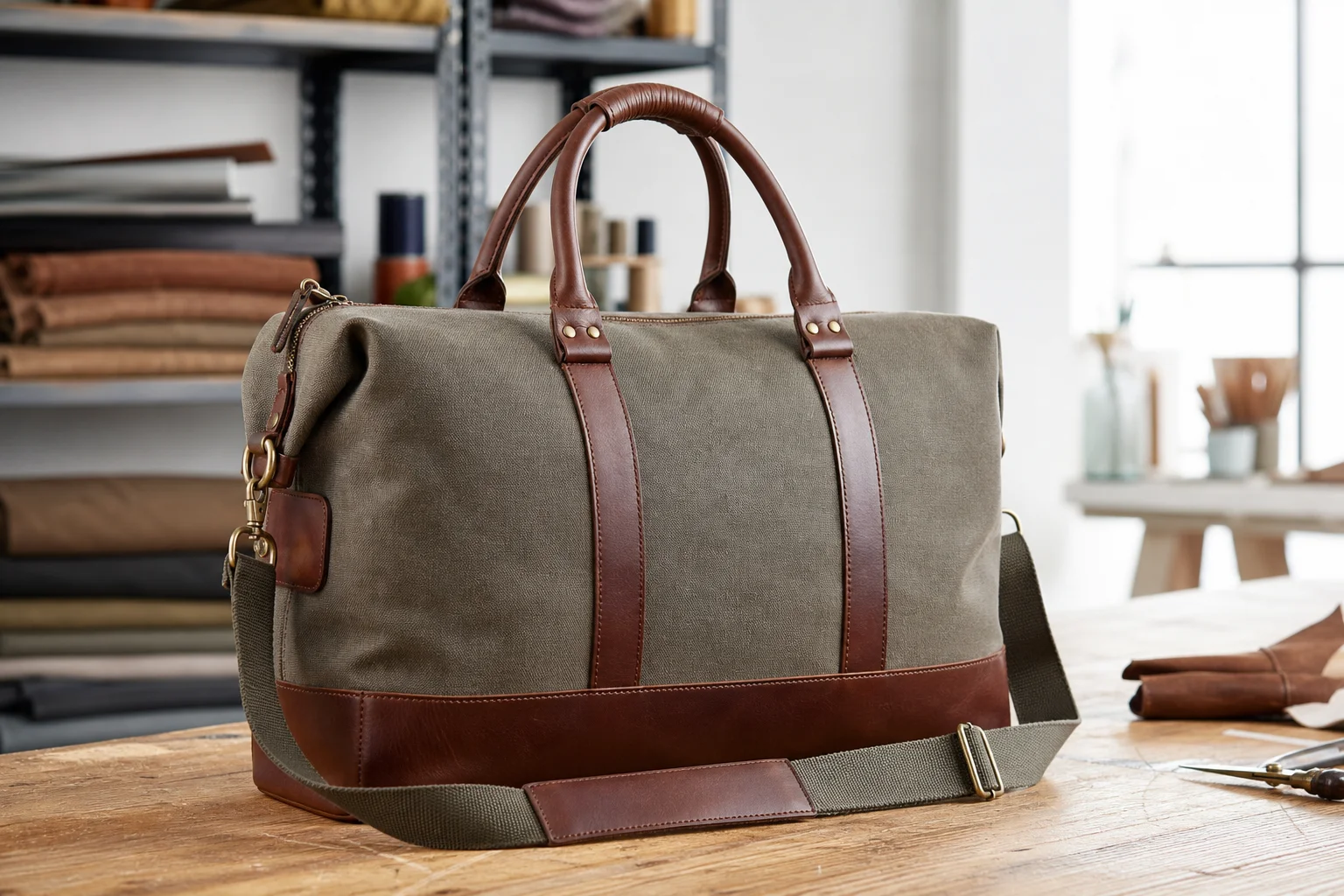
The format determines the load path. A duffel concentrates all weight on one shoulder strap, whereas a weekender with a wrap handle distributes load to the hand and the body of the bag.
Interior shape and usable volume
A bag with squared ends and a flat base uses its stated volume more effectively than a rounded one. Interior pockets and structure also consume space, so a heavily organised bag may hold less than its nominal capacity suggests.
Measuring usable volume — how much actually fits after the structure and pockets are accounted for — is a useful exercise at the sample stage.
Overpacking allowance
Customers pack more than the contents list assumes, especially on a return journey. The construction must tolerate a bag that is pressed closed under load.
This is why zip strength and zip end reinforcement matter in the travel category far more than in daily bags, where overpacking is less common.
Structure: Base, Walls and Shape
Structure is what allows a loaded travel bag to keep its shape, protect its contents and be carried comfortably. It is also the main difference between a bag that looks expensive and one that collapses.
The base
The base carries the full weight of the contents, and it is the surface that contacts floors, racks and car boots. It needs both load distribution and abrasion resistance.
A rigid base board distributes weight so the bag sits flat rather than sagging into a point. Reinforcement on the outside of the base adds wear resistance, and studs lift the base clear of wet and rough surfaces.
The walls and ends
A lightly built travel bag bows outward when packed and collapses inward when empty. Interlining in the side panels and reinforced ends keep the bag’s shape in both states and protect the contents at the corners.
Structured ends are particularly valuable because they prevent the classic sagging silhouette that appears once a soft bag is fully loaded.
Structure options compared
| Element | Option | Effect |
|---|---|---|
| Base | Board insert | Flat, load distributing |
| Base | Board plus external reinforcement | Adds abrasion resistance |
| Base | Studs or feet | Lifts the bag off surfaces |
| Walls | Foam interlining | Holds shape, cushions contents |
| Walls | Foam plus stiffener | Firm, structured look |
| Ends | Reinforced panels | Prevents corner collapse |
| Ends | Structured end pocket | Shape plus storage |
| Top edge | Piping or binding | Crisp opening, protects seam |
A travel bag needs more structure than a daily bag of the same size. The additional interlining and board are a small share of the total cost and a large share of the perceived quality.
Shape retention under load
The practical test is to fill the sample to capacity, close it and set it down. A bag that stands, keeps its silhouette and does not deform at the ends has the right structure; one that bulges, sags or twists does not.
Repeating the test after a day of carrying reveals whether the interlining recovers, which is where cheaper materials show their limits.
Protecting the contents
Travel contents include items that can be damaged by compression: a laptop, camera equipment, or a gift. Internal padding at the ends and base is more effective than padding everywhere, because those are the impact points.
Where a specific device is expected, the padding should be specified around its dimensions rather than applied generally.
Handles, Straps and Carry Modes
Travel bags are carried in several ways during a single journey, and the handle system must support all of them comfortably.
Top handles and wraps
Wrap handles join the two top handles into a single grip, which distributes load across the hand instead of cutting into it. On a fully loaded bag this is the difference between carrying it and dragging it.
The wrap must be attached across both handles with reinforcement at each end. A wrap that is only decorative fails at the point where it is asked to carry the load.
Shoulder straps
A detachable shoulder strap allows a loaded bag to be carried hands-free, which matters at airports and on public transport. The strap and its attachment hardware must be rated for the loaded weight, since they become the single load path.
Padding on the strap improves comfort noticeably at travel weights, and a sliding pad also protects clothing from abrasion.
Carry systems compared
| Carry mode | Best for | Construction requirement |
|---|---|---|
| Fixed top handles | Short carries, light load | Reinforced anchors |
| Wrap handle | Loaded hand carry | Wrap across both handles |
| Detachable shoulder strap | Hands-free carrying | Rated clips and rings |
| Padded shoulder strap | Longer carries at weight | Wide padded strap |
| Trolley sleeve | Airport transit | Back panel sleeve sized to handle |
| Backpack straps | Long distances | Harness, padding, structure |
| Rolling wheels | Heavy loads | Frame, wheel housing, base |
Most travel bags combine two or three modes. Each addition is a separate load path, and each one must be individually strong enough for the full weight of the bag.
The trolley sleeve
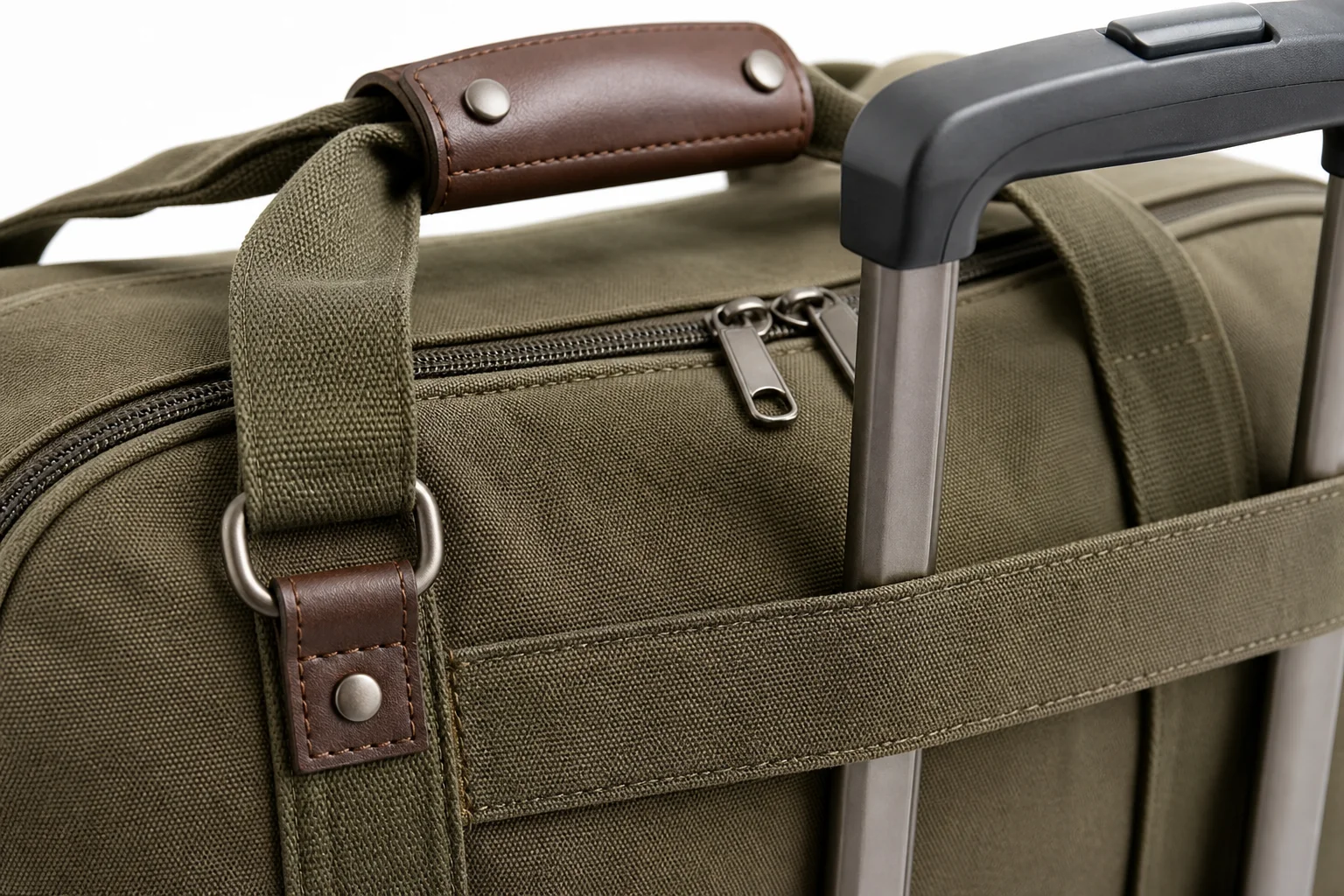
A sleeve on the back panel that slides over a rolling suitcase handle is one of the most appreciated travel features, because it removes the need to carry a heavy bag through a terminal.
Its construction is simple, but its sizing matters: it must accommodate common suitcase handle widths. Testing it on a real suitcase before production is a quick and worthwhile check.
Comfort at travel weights
Comfort becomes a genuine constraint once a bag exceeds a few kilograms. Contact width, padding and the position of the load relative to the body all affect how far it can be carried.
Because travel bags are often carried for long distances, comfort features that would be optional on a smaller bag become part of the specification.
Handle failure prevention
Handles fail where they are attached, not in the middle. Reinforcing the anchor over a wide area, using box-and-cross stitching and avoiding sharp corners where the stress concentrates addresses nearly every case.
On a loaded bag, a pull test on each handle anchor gives a direct measurement of whether the construction is adequate.
Closures and Opening Design
The opening of a travel bag determines how easily it packs and how secure it is in transit. Both qualities are judged repeatedly over the life of the product.
Zip geometry
A straight zip across the top of a travel bag opens only a narrow slot, which makes packing awkward. A U-shaped opening extends down the ends and gives full access to the interior.
Because a U-shaped zip is far more useful, it is standard on quality travel bags — and it requires more accurate construction, since the zip must follow a curve at each end.
Two-way zips
A two-way zip allows the bag to be opened at either end, which is convenient when the bag is full and something needs to be retrieved from one side. It also allows a padlock to be fitted through the two sliders.
The additional slider adds cost but is one of the most valued features in the travel category, particularly for bags used on flights.
Closure options compared
| Closure | Access | Security | Notes |
|---|---|---|---|
| Straight top zip | Limited | Moderate | Simple construction |
| U-shaped zip | Full | Moderate | Standard for quality travel bags |
| Two-way zip | Full, either end | Higher | Accepts a lock through sliders |
| Flap over zip | Full, protected | Moderate | Weather protection |
| Zip plus storm flap | Full, protected | Higher | Best weather resistance |
| Buckle and strap | Full | Lower | Vintage and casual styles |
| Drawstring top | Full | Lowest | Soft duffels only |
A zip with a protective flap beneath it is the most practical arrangement for travel: it reduces water ingress, protects the zip from abrasion in transit and allows a lock to be fitted.
Zip end reinforcement
The ends of the zip, where the sliders rest when closed, are the most highly stressed points on a packed travel bag. Reinforcement here prevents the classic failure in which the zip bursts open at one end.
On a loaded sample, the zip should be tested by closing it over a full bag and then lifting the bag by the zip area. If the ends show strain, the reinforcement is inadequate.
Zip quality in the travel category
Travel bags warrant a heavier zip than daily bags of the same construction. A larger tooth size, a stronger tape and a robust slider are all justified by the load and by the frequency of opening and closing.
Because the zip runs along a curved path on a U-shaped opening, tape flexibility also matters: a stiff tape resists the curve and produces puckering at the ends.
Interior Organisation for Travel
Travel interiors are designed around a different problem from daily bags: separating clean from dirty, wet from dry, and shoes from clothing.
The compartments that earn their place
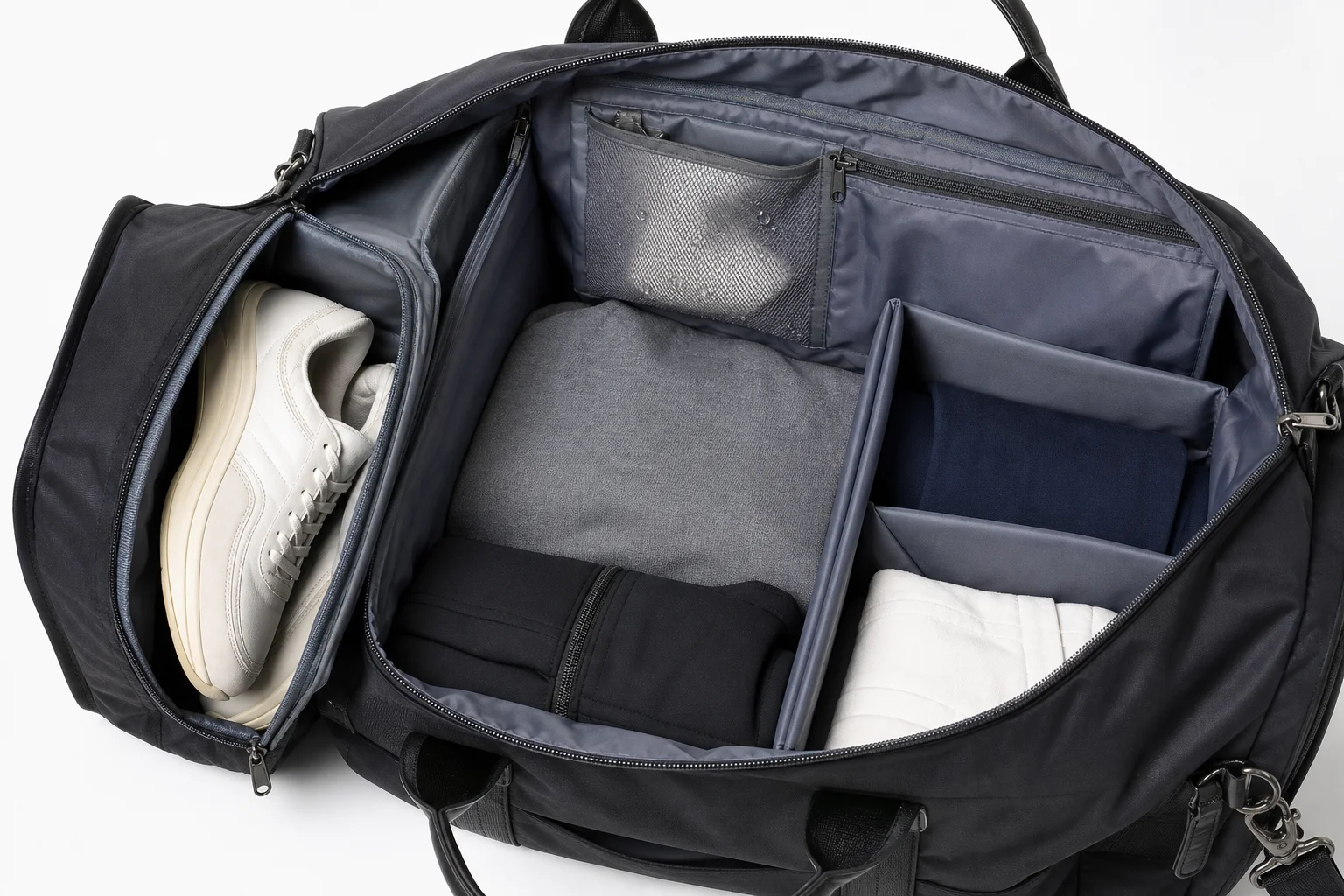
A shoe compartment, a wet or laundry pocket and a separate device sleeve cover most travel needs. Each addresses a real conflict in packing rather than adding generic storage.
Where a bag must remain light, the most valuable single feature is usually a shoe compartment, because it solves a problem no packing cube can solve inside the same bag.
Travel interior features
| Feature | Purpose | Construction impact |
|---|---|---|
| Shoe compartment | Separates footwear | Partition panel and zip |
| Wet pocket | Separates damp items | Water-resistant lining pocket |
| Device sleeve | Protects electronics | Padded panel |
| Zip mesh pocket | Visibility for small items | Mesh and zip |
| Key leash | Keys without searching | Small strap plus clip |
| Card slot or document pocket | Travel documents | Small panels |
| Compression straps | Reduces packed volume | Internal straps and buckles |
| Removable base board | Converts to soft duffel | Base pocket and board |
Compression straps are worth considering where the bag is used for both full and partial loads, because they keep contents from shifting.
How much organisation is too much
Every compartment consumes volume and adds weight. On a bag that is already structured, a full organiser can reduce usable capacity by a noticeable margin.
The useful test is to pack the sample with a realistic travel list. If items no longer fit, the interior has been over-specified for the intended use.
Lining and interior durability
Travel interiors are packed and unpacked frequently, and the lining is the surface that takes the abrasion. A heavier woven lining with bound seams lasts considerably longer than a light taffeta.
Where a wet pocket is specified, the lining choice for that pocket is separate from the rest: a water-resistant material is needed there rather than a standard woven lining.
Interior access while travelling
Access matters as much as capacity. Small items should be reachable without opening the main compartment, which is usually achieved with an exterior pocket or a pocket built into the lid.
Placing the most-used pocket where the bag naturally rests when set down saves the customer from unbuckling or reopening the bag repeatedly.
Materials and Abrasion Resistance
Travel exposes a bag to surfaces and conditions that a daily bag rarely meets: luggage carousels, rough concrete, vehicle floors and overhead racks.
What travel demands from a material
Abrasion resistance comes first, followed by tear strength and the ability to hold shape. Appearance and surface refinement matter, but they are secondary to surviving the journey.
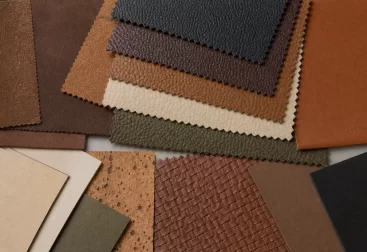
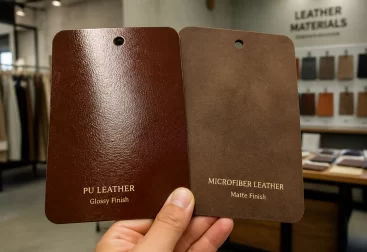
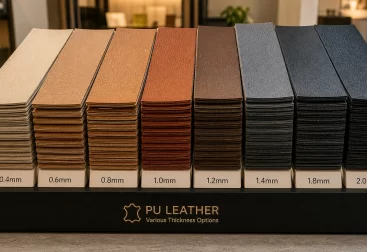
PU leather in a heavier grade with a durable top finish performs well and holds a structured silhouette. Coated fabrics offer excellent abrasion resistance and lower weight, at some cost in structure.
Reinforcing the contact zones
Rather than upgrading the entire bag, reinforcing the areas that actually contact the ground and the vehicle is more efficient. The base, the base corners and the lower part of the ends are the critical zones.
This targeted approach keeps weight and cost low while addressing the failure points directly.
Material strategy by zone
| Zone | Requirement | Typical approach |
|---|---|---|
| Base | High abrasion resistance | Reinforced panel, heavier material |
| Base corners | Abrasion plus impact | Corner patches or studs |
| Lower ends | Abrasion resistance | Reinforcement or panel overlay |
| Body panels | Shape, appearance | Main material with interlining |
| Top and opening | Flex and abrasion | Piping, binding, durable tape |
| Handles | Strength and grip | Doubled material, wrap |
| Lining | Abrasion and tear | Heavier woven, bound seams |
Zoned specification keeps material cost proportional to function, which is more effective than upgrading everything uniformly.
Weather and transport exposure
Travel bags sit on wet airport floors and are moved between vehicles in rain. Water resistance at the base and around the opening is more valuable than full waterproofing.
A coated material with a protective flap over the zip and a reinforced, non-absorbent base handles most real travel conditions without the cost of a fully waterproof construction.
Hardware, Locks and Security
Travel hardware is judged on strength and reliability rather than decoration, because it is loaded more heavily and operated more often than on any other bag type.
Load-rated hardware
Shoulder strap clips, D-rings and buckles must be rated for the loaded weight of the bag, and the rating should be confirmed with the supplier rather than assumed from appearance.
Where a clip is the single load path between the bag and the wearer, its failure rating determines the safety of the product.
Hardware selection
| Component | Consideration |
|---|---|
| Shoulder strap clips | Rated load, secure gate, no accidental release |
| D-rings and rings | Thickness, welded or formed, load rating |
| Adjusters | Holding under load, corrosion resistance |
| Zip sliders | Two-way compatibility, lockable design |
| Zip pulls | Easy to grip, no sharp edges |
| Studs and feet | Abrasion resistance, attachment security |
| Luggage tag attachment | Convenient, reinforced loop |
Corrosion resistance is worth considering for markets where the bag will be exposed to salt or humidity, since plated hardware with a thin finish will deteriorate visibly.
Security features
Lockable sliders, a covered closure and a concealed pocket all contribute to security. None of them is a substitute for care, but each is valued by travellers.
Where a lock is offered, the two sliders must be designed to accept it; otherwise the feature cannot be used as intended.
Hardware wear and replacement
Metal hardware that rubs against the bag body during transit leaves marks, particularly on coated materials. Separating hardware from panels or choosing a shape that does not present a sharp contact point reduces this.
Where a component is likely to wear first — a strap clip, for example — designing it to be replaceable extends the product’s life considerably.
Weight Engineering
Travel bags have a difficult weight problem: they must be strong, but they are carried by a person who also has to carry everything inside them.
Where the weight goes
Structure, hardware and lining account for a large share of an empty travel bag’s weight. Body material contributes less than might be expected, because it is spread over a large area.
This means weight reduction usually comes from choosing lighter hardware and linings, rather than from a thinner body material that would compromise durability.
Weight reduction options
| Option | Weight effect | Trade-off |
|---|---|---|
| Lighter lining material | Noticeable | Lower abrasion resistance |
| Smaller hardware | Noticeable | Lower load rating |
| Lightweight base board | Noticeable | Less rigidity |
| Aluminium rather than steel | Moderate | Higher hardware cost |
| Fewer interior pockets | Small | Less organisation |
| Thinner interlining | Small | Less shape retention |
| Removable structure | Flexible | Slightly more complex |
A removable base board is an elegant compromise: the bag carries its structure when needed and sheds it when not, which suits multi-purpose use.
Setting a weight target
Specifying a target weight during development, then weighing the sample, keeps attention on this dimension. Without a target, weight tends to accumulate through small additions that individually seem minor.
Weighing hardware before selection is a simple practice that often reveals large differences between visually similar components.
Testing: Load, Drop, Abrasion and Cycle
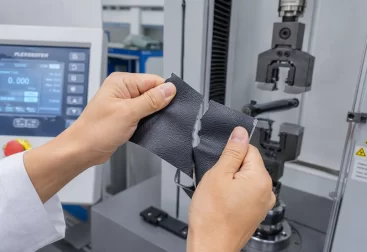
Travel bags are the easiest category in which to justify physical testing, because their failure modes are predictable and their loads are high.
Load testing
Filling the bag to its intended capacity and then testing each carry point — every handle anchor, every strap attachment and every clip — measures the load path directly.
A loaded bag should be lifted, held and swung by each carry point in turn. Any point that shows strain, stretching or stitch distortion indicates a weakness before it reaches a customer.
The tests worth running
| Test | What it reveals |
|---|---|
| Static load on each handle | Anchor strength and stitch integrity |
| Static load on shoulder strap | Clip and ring rating |
| Drop test on the base | Base reinforcement and corner strength |
| Zip cycle test | Slider and tape durability |
| Closure test when overpacked | Zip end stress under load |
| Abrasion test on the base | Material resistance at contact surfaces |
| Wet base test | Water absorption and transfer to contents |
| Handle comfort check when loaded | Whether the grip width is adequate |
Testing the loaded sample is more informative than any inspection of an empty bag, and it takes less than an hour.
In-service wear patterns
Over the product’s life, wear concentrates at the base, the base corners, the handle anchors and the zip ends. Checking these four areas on returned or aged samples tells a brand exactly where to specify better next time.
This feedback loop is inexpensive and produces design improvements that no amount of studio evaluation reveals.
A travel bag is judged at the end of a journey, not at the point of sale. Every specification decision should be tested against what the bag will look like after a year of use.
Cost Drivers and Quality Control
Travel bags are the most material-hungry and most structured products in a bag range, and their cost profile reflects that.
Where the cost sits
Material consumption is high because the bag is large and structured. Hardware is more substantial than on smaller products. Labour is higher because the bag has more components, more reinforcements and a more demanding closure.
Because all three are significant, travel bag pricing responds to design decisions rather than to a single dominant factor.
Cost decisions and their effect
| Decision | Cost effect | Impact if reduced |
|---|---|---|
| U-shaped opening | More zip, more labour | Packing becomes difficult |
| Two-way zip | Extra slider | Loss of a valued feature |
| Structured ends | Extra panels and interlining | Sagging silhouette |
| Reinforced base | Material and labour | Early wear |
| Base studs | Hardware and setting | Base soaks and wears |
| Trolley sleeve | Extra panel | Loss of a key travel feature |
| Wrap handle | Material and labour | Uncomfortable hand carry |
| Shoe compartment | Partition and zip | Loss of separation |
The features that are cheapest to remove are also the ones that make the product usable for travel. Savings are better found in material efficiency and in hardware selection than in the structural features.
Quality control priorities
Inspection on travel bags should concentrate on the load path and the closure: handle anchors, strap attachments, hardware function and zip behaviour under load.
Dimensions, colour consistency and appearance still matter, but a travel bag’s reputation is determined by whether it holds together when packed.
Documenting the standard
Sealing the approved sample, recording the loaded test results and photographing the reinforcement details gives the factory an unambiguous reference. It also gives the brand evidence if a batch deviates.
For a category where strength is the promise, documenting what was tested is as valuable as the test itself.
Packing, Storage and Retail Presentation
A travel bag is often stored flat between trips, which puts it under the kind of pressure that produces permanent creases. How it is packed and presented therefore affects both durability and how it sells.
Holding shape through transit and storage
Filling the bag with paper or air pillows keeps the panels flat and prevents the top edge from collapsing during shipping. Structure helps here as well: an interlined travel bag resists carton pressure far better than a soft duffel.
Handles should be laid flat against the body and wrapped, since a crushed handle is difficult to restore and is the first defect a customer notices when opening the box.
Retail and e-commerce presentation
| Element | Purpose |
|---|---|
| Shape filling | Preserves silhouette for photography |
| Handle wrapping | Prevents crushing and marks |
| Hardware separation | Avoids pressure marks on panels |
| Care and use card | Explains capacity, cleaning and warranty |
| Dust bag | Protection during storage between trips |
| Carton marking | Correct warehouse handling |
Because travel bags photograph as large, shapeable objects, presentation decisions have a direct effect on how the product reads online. A collapsed bag photographs as a soft sack regardless of its construction quality.
Storage between trips
Customers store travel bags in cupboards, often folded or compressed. Designing the base board to be removable supports that behaviour and extends the bag’s life, because the structure is not left under permanent load.
Including this in the care card turns a construction feature into a use instruction, which is an inexpensive way to protect the product’s reputation.
FAQ
What size weekender fits airline cabin limits?
Cabin limits vary by carrier and cabin class, so the design should be built to the limits of the target market with a small margin. Confirm the current limits before finalising dimensions.
Why do travel bag handles fail before the bag itself?
Because the handle anchor concentrates the full loaded weight on a small area of material. Spreading the load with a wide reinforcement and box-and-cross stitching addresses most failures.
Is a U-shaped opening worth the extra cost?
Yes, for anything larger than a small duffel. It allows the bag to be packed and unpacked easily, which is the most frequent criticism of travel bags with straight top zips.
Should a travel bag have internal structure or be soft?
Structure protects contents and holds shape under load, which suits travel. A softer bag packs down when empty, which suits storage but deforms once filled.
How do I make a travel bag comfortable to carry when full?
Use a wrap handle for hand carry, a wide padded strap for shoulder carry, and distribute load across two carry points where possible. Comfort is specified, not incidental.
What is the most useful interior feature on a weekender?
Usually a shoe compartment, because it solves a problem no packing cube can solve inside the same bag. A wet pocket is the next most valued addition.
Do travel bags need a water-resistant base?
A reinforced, non-absorbent base is worth having, because travel bags are placed on wet and dirty surfaces. Full waterproofing is rarely necessary.
How should a travel bag be tested before production?
Load it to capacity and test every carry point, drop it on its base, cycle the zip and check the closure when overpacked. These tests take under an hour and reveal the main risks.
Is a trolley sleeve worth the extra construction?
For bags used on flights or trains, yes. It removes the need to carry a heavy bag through a terminal, and it is one of the most appreciated travel features.
What hardware rating should a shoulder strap clip have?
It must be rated above the maximum loaded weight of the bag, confirmed with the supplier. The clip is the single load path, so its rating defines the product’s safety margin.
How can a travel bag be made lighter without weakening it?
Reduce hardware and lining weight rather than body material. Both contribute significant weight and can be lightened without affecting the structure that carries the load.
Which material suits a travel bag best?
A heavier-grade PU leather or a coated, abrasion-resistant fabric, reinforced at the base and base corners. Travelling wears the contact zones, so specify those zones specifically.
Next Steps: Engineer the Load Path First
Travel bags are defined by their load path. Specify the base, the handle anchors, the closure and the carry modes first, then refine appearance and interior layout around them.
Send us your travel bag design and expected load, and we will propose the structure, reinforcements, closure and carry system that suit the brief.
Developing a travel bag or weekender and want the load path engineered properly? Contact our team at info@gionar.com and we will prepare the structural specification for your styles.
Related reading: our custom bag manufacturing portfolio shows the travel and weekender constructions we produce.