Is Cross-Border E-Commerce Creating New Demand for Bag Factories?
Cross-border e-commerce did not create a new product category, but it changed the shape of the orders that reach a bag factory. The goods are the same bags; the quantities, the frequency, the customisation and the number of buyers behind each order are different, and that difference is what factories are being asked to absorb.
For a PU leather manufacturer the change is visible in the order book rather than in the catalogue. Ten years ago a mid-sized factory could build a season on a handful of container orders from importers and wholesalers. Today the same factory may hold those accounts and, alongside them, dozens of smaller programmes run by online sellers who order in hundreds rather than thousands and expect to reorder within weeks.
This creates genuine new demand, but it is demand of an inconvenient kind. It arrives in small quantities, with short lead times, with customisation that used to be reserved for large accounts, and with buyers who have no history and sometimes no clear channel strategy. Factories that reorganise for it gain volume that their competitors cannot serve; factories that treat it as a nuisance lose it to those that do.
This article looks at what has actually changed from the manufacturing side, where the new demand comes from, which parts of a conventional factory system break under it, what the order profile now looks like, and what a factory has to build in order to serve it profitably rather than reluctantly.
- What Has Actually Changed
- Where the New Demand Comes From
- Why Factory Systems Struggle With It
- The New Order Profile
- What Factories Need to Serve It
- Costing Small Runs Without Losing Margin
- What Buyers Should Ask a Factory
- Risks Specific to Cross-Border Channels
- What It Means Over the Next Few Years
- FAQ
| Dimension | Importer model | Cross-border e-commerce model | Factory consequence |
|---|---|---|---|
| Order size | Container scale | Hundreds per style | Set-up must be amortised differently |
| Frequency | Two seasons a year | Continuous reorders | Materials and capacity held ready |
| Customisation | Limited, negotiated annually | Per seller, per listing | Many small specifications |
| Buyer profile | Established importer | New sellers, rapid entry | Credit and qualification risk |
| Lead time | Long and planned | Short and reactive | Flexible scheduling needed |
| Design ownership | Buyer’s design | Often factory-supported | Development capability matters |
What Has Actually Changed
The most useful way to describe the change is that the unit of production has shrunk while the number of production units has grown. The total volume may be similar, but it arrives in a very different pattern.
Smaller orders, more often
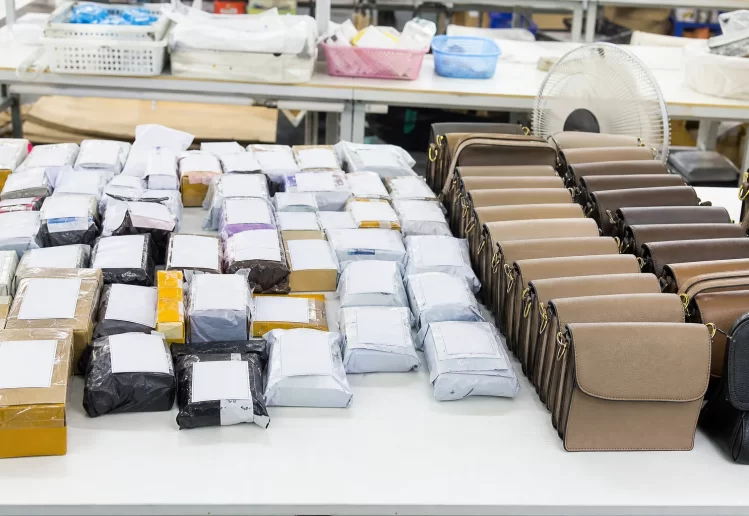
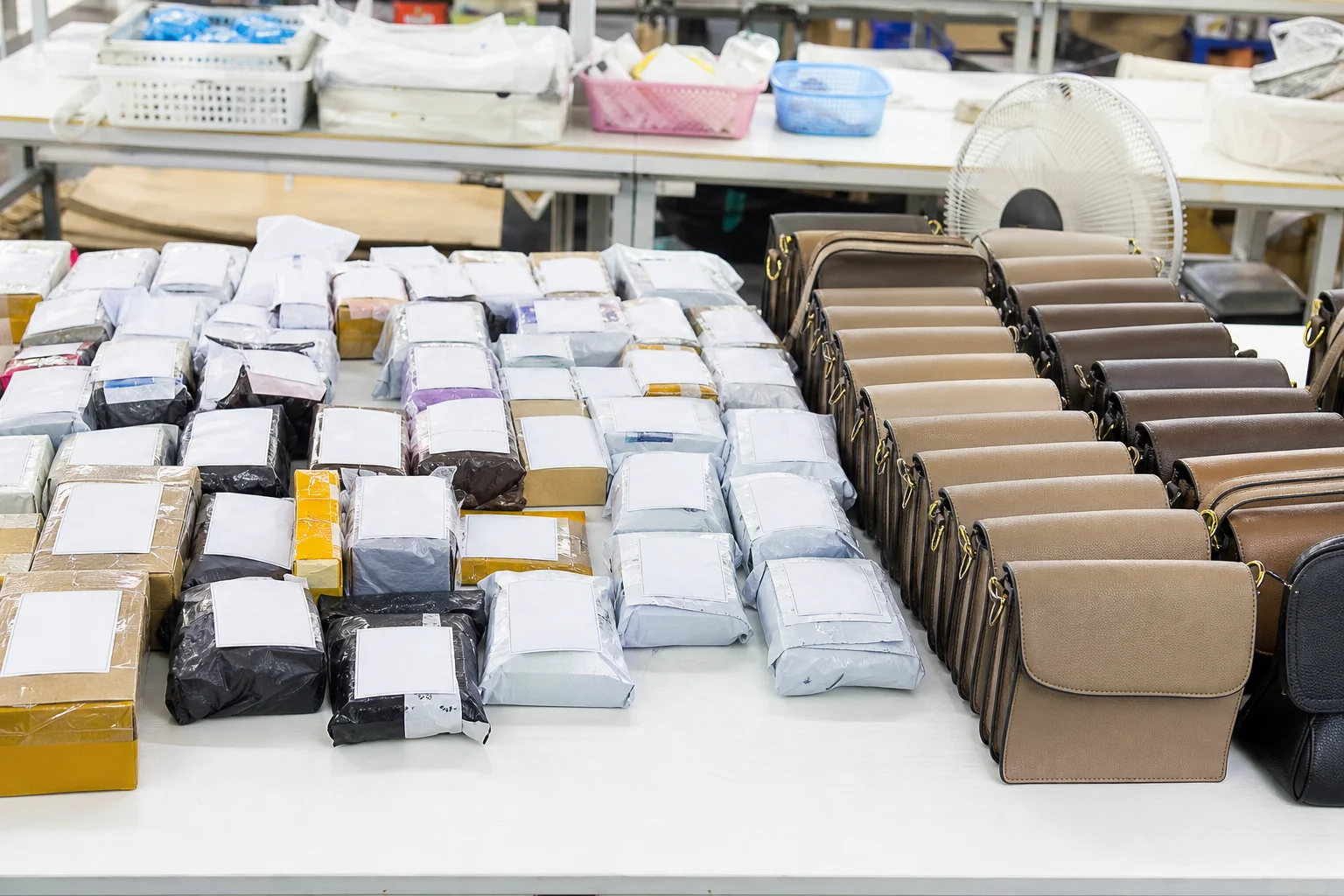
A single online seller may order two hundred pieces of one style, sell through in a few weeks, and reorder. Across fifty such sellers a factory sees considerable volume, but it sees it as fifty programmes rather than one.
This changes the cost structure more than the revenue. Each programme carries its own sampling, material booking, cutting set-up, line changeover and inspection, and those fixed elements do not shrink proportionally with the order.
Customisation moving down the order book
Private label used to be a privilege of large accounts, because tooling and development costs only made sense at volume. Online channels lowered the cost of reaching customers, so smaller sellers now expect their own label, their own colour and often their own shape.
The factory response has been to standardise the hidden parts and customise the visible ones. Shared patterns, shared hardware and shared linings with variable outer material and branding let a small order carry a private label without a full development cycle.
Speed as a product feature
Online selling rewards sellers who restock quickly, because a listing that goes out of stock loses ranking. That translates into pressure on the factory for shorter production lead times and for the ability to run a repeat order without a fresh sampling round.
The shift in who does the designing
Traditionally the importer brought a finished design and the factory executed it. Online sellers more often bring a market position and a price point, and expect the factory to propose the construction that delivers it.
That moves design work into the factory without moving the risk with it. Factories that charge for development, or build it into a standard platform, protect themselves; those that give it away are funding the buyer’s product launch.
Where the New Demand Comes From
The demand is not evenly distributed. It clusters in a few channels, and understanding which ones a factory is actually serving helps in deciding what capability to build.
Marketplace sellers and their restock rhythm
Marketplace sellers form the largest group. They test a design in small quantity, and if it sells they reorder repeatedly within the same season. For the factory the first order is a trial and the reorders are the business.
This makes the first order’s margin less important than its repeat potential. A factory that prices the trial order to win the reorder usually earns more across the year than one that maximises the first invoice.
Independent brands selling direct
Direct-to-consumer brands typically order in smaller quantities but with more customisation and a stronger interest in material quality. They tend to value consistency and communication over the lowest unit price.
These buyers often need development support, because they know the customer they are selling to but not the construction that will deliver it at a cost that works. A factory able to translate a market position into a specification wins these accounts.
Regional distributors buying online
A third group is the traditional distributor who now sources through online channels rather than trade fairs. Their order sizes remain moderate, but their expectations of speed and documentation have risen to online standards.
| Buyer type | Typical first order | Reorder pattern | What they value most |
|---|---|---|---|
| Marketplace seller | 200-500 pieces | Frequent, same design | Speed and repeatability |
| DTC brand | 300-800 pieces | Seasonal, evolving design | Material quality and development |
| Regional distributor | 500-2,000 pieces | Planned, multi-style | Documentation and reliability |
| Social commerce seller | 100-300 pieces | Trend-driven, short cycles | Flexibility and low commitment |
| Corporate and promotional | 500-3,000 pieces | Project-based | Deadline certainty |
Why the channels overlap
The groups are not distinct. A distributor may sell through a marketplace, and a small brand may supply a corporate account. A single buyer can therefore present as three different order profiles across a year, which complicates capacity planning more than the order sizes themselves.
What is not new demand
Some of the volume attributed to cross-border e-commerce is displaced rather than additional. A distributor who now buys online was previously buying through an importer, and the factory that loses the importer account may gain the smaller orders that replace it.
Distinguishing displacement from genuine growth matters for capacity planning. Capacity added for displaced volume is capacity that will sit idle once the shift finishes.
The new demand is real, but it is fragmented demand. A factory that cannot serve fragments profitably will experience it as extra work rather than as growth.
Why Factory Systems Struggle With It
A conventional factory is organised around the assumption that orders are large, planned and few. Most of its systems, from quoting to line scheduling, encode that assumption without stating it.
Quoting designed for large orders
Traditional quoting spreads fixed costs across a large quantity, which makes the calculation simple and the margin comfortable. Run the same calculation on two hundred pieces and the fixed costs dominate the price.
Factories then either quote a price the buyer rejects or absorb the fixed costs and lose money. Neither outcome is sustainable, which is why small-order pricing needs a different structure rather than a different number.
Scheduling that assumes long runs
Production planning that optimises for long continuous runs will place small orders at the end of the queue, where they wait for a gap. The buyer experiences this as unpredictable lead times, and the factory experiences it as constant expediting.
Serving small orders requires reserving capacity for them rather than fitting them into leftovers. That is a planning decision, not a production one, and it is usually the hardest change for an established factory to make.
Material purchasing in full rolls or dye lots
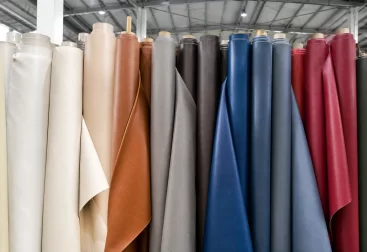
Material is bought in roll quantities and matched by dye lot. A small order that needs a specific colour may consume a fraction of a roll, and the remainder becomes stock that may never be used.
The response is a curated material platform: a defined range of colours and finishes held as standing stock, from which small orders can be cut without a fresh purchase. Custom colours remain available, but at a quantity that justifies the commitment.
| System | Assumption it encodes | What breaks on small orders | Practical response |
|---|---|---|---|
| Quoting | Fixed costs spread widely | Price becomes uncompetitive | Separate development charge |
| Scheduling | Long uninterrupted runs | Orders wait for gaps | Reserved small-order capacity |
| Material buying | Full rolls per colour | Dead stock from part rolls | Standing colour platform |
| Sampling | One sample per season | Sampling load exceeds capacity | Standard constructions, fewer variables |
| Inspection | Bulk AQL per shipment | Disproportionate inspection cost | Tiered inspection by order value |
| Documentation | One consignment, one set | Many small shipments, many sets | Templated export documents |
Why quoting speed matters as much as price
An online seller comparing three factories will usually place the order with the one that answers first and clearly, even at a slightly higher price. Slow quoting is read as slow production, and in this channel that assumption is usually correct.
The New Order Profile
Describing the profile precisely is what allows a factory to decide which orders to accept and how to price them, rather than treating every small enquiry as the same problem.
Quantity bands and what each implies
Orders cluster into bands, and each band carries a different economics. Below a few hundred pieces a programme is essentially custom work; between several hundred and a low thousand it can be semi-standard; above that conventional production logic applies.
Naming the bands internally helps sales staff quote consistently and helps production plan capacity. It also prevents the common situation where a three-hundred-piece order is quoted as though it were a container order and then delivered at a loss.
Customisation depth
Customisation ranges from a label sewn into a stock bag to a fully new shape with new tooling. The cost and the risk rise steeply along that range, and the factory should be explicit about which levels it offers at which quantity.
| Customisation level | What changes | Minimum sensible quantity | Development effort |
|---|---|---|---|
| Label only | Woven label, hangtag | 200 pieces | Minimal |
| Colour and lining | Standard shape, chosen materials | 300 pieces | Low |
| Hardware and trim | New fittings on standard shape | 500 pieces | Moderate |
| Modified shape | Pattern changes, new panels | 800 pieces | High |
| New design | New pattern and tooling | 1,000 pieces | Full development |
Lead time expectations
Online sellers generally expect a repeat order to ship faster than a first order, and they are right to, because nothing needs developing. A factory that can hold a pattern and a material allocation for a repeat client can cut weeks out of the second order.
How packaging expectations changed
Online orders are handled individually before they reach the customer, so packaging has to survive parcel networks rather than pallet transport. Individual poly bags, smaller cartons and clearer labelling become standard requirements.
This adds cost per unit at exactly the quantities where cost per unit is already under pressure, and it should be quoted as a line rather than absorbed into the price.
Payment and credit reality
New online sellers frequently have limited trading history, which makes conventional credit terms difficult. Deposits, staged payments and platform-based guarantees become normal rather than exceptional, and the factory’s finance process has to accommodate them.
What Factories Need to Serve It
Serving fragmented demand is a capability problem before it is a pricing problem. The factories that do it well have built four things: a standard platform, a small-order line, a fast sampling route and a quotation model that reflects real costs.
A standard platform behind the customisation
The platform is a set of approved shapes, materials, linings and hardware that can be combined in many ways. Customisation then happens at the combination level, which keeps tooling and development to a minimum.
This is what allows a two-hundred-piece order to carry a private label at a sensible price. The buyer sees a distinct product; the factory sees a configuration of standard elements.
A line or cell reserved for small runs
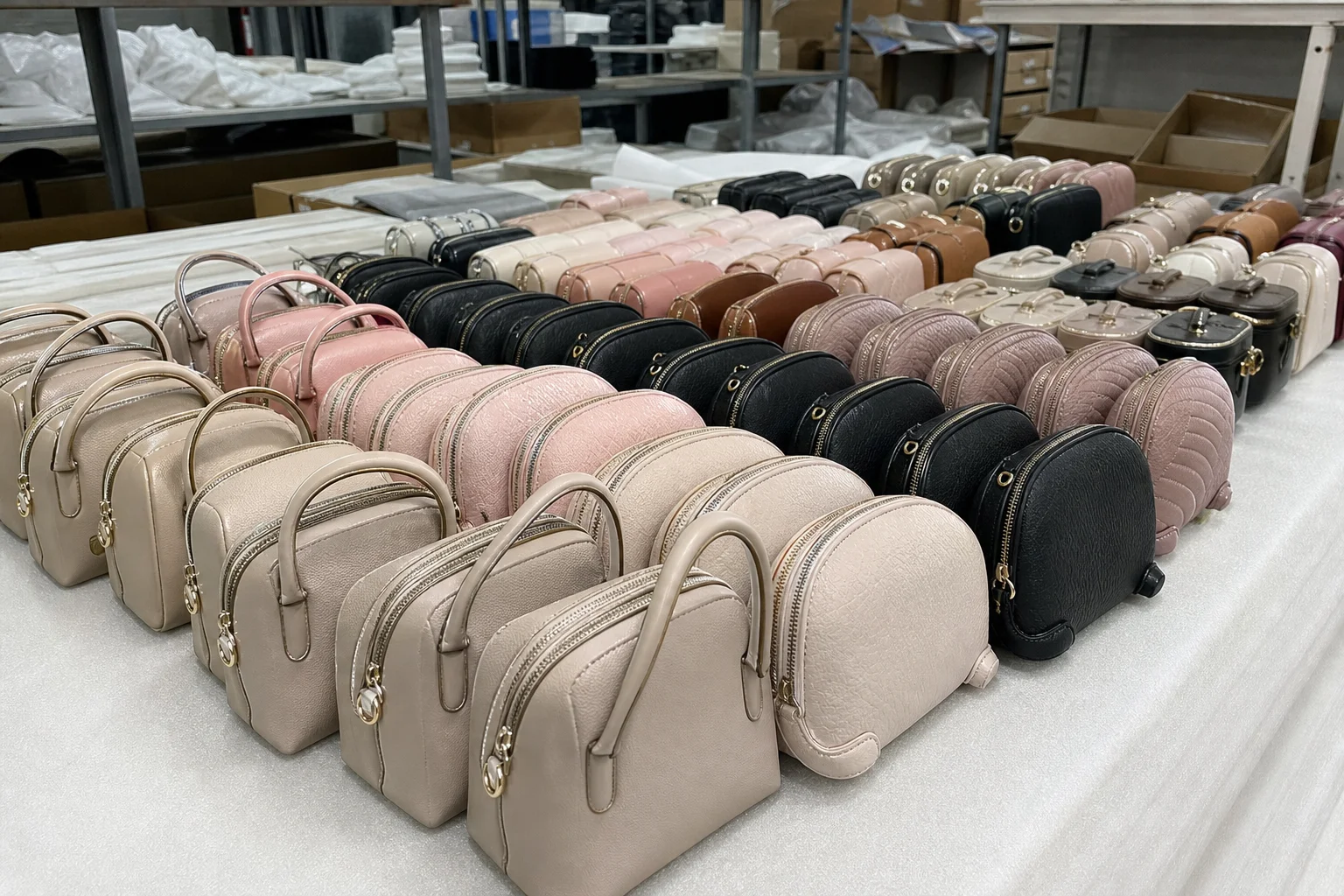
Small orders move efficiently through a dedicated cell with flexible operators and quick-change equipment. Mixed into a high-volume line they disrupt everything; run in their own space they become a stable, if more labour-intensive, operation.
Sampling capacity that does not bottleneck
When order count rises, sampling volume rises with it. A factory with one sample room serving large accounts will be overwhelmed by dozens of small buyers each needing a sample before ordering.
Digital sampling for shape and colour reduces the physical rounds required, and a standard construction library reduces the number of genuinely new samples. Both lower the load without lowering the standard.
Training operators for mixed production
Operators used to one style for weeks need different habits for mixed production: reading a work ticket, checking the style before stitching, and returning part-finished work to the correct bundle. The training is short, but it is not optional.
Factories that skip it find the small-run cell producing at high-volume speed with high-volume assumptions, which is where mix-ups and skipped operations begin.
Quotation that separates development from production
Charging development, sampling and tooling separately, and pricing production on its own variable costs, makes small orders viable. The buyer sees why the price is what it is, and the factory stops subsidising development out of production margin.
| Capability | What it looks like | Effect on small orders |
|---|---|---|
| Standard platform | Approved shapes, materials, trims | Customisation without tooling |
| Small-run cell | Flexible line, quick changeover | Predictable lead times |
| Sampling library | Standard constructions, digital previews | Faster approvals |
| Separate development charge | Quoted and invoiced apart | Margin protected |
| Templated documents | Export sets prepared in advance | Lower admin cost per shipment |
| Tiered inspection | Sampling level matched to value | Inspection cost proportionate |

The platform does the work that volume used to do. Once shapes, materials and trims are standardised, a small order stops being a development project.
Costing Small Runs Without Losing Margin
The pricing problem is not that small orders are unprofitable by nature. It is that the conventional pricing method hides the fixed costs inside a unit price that no longer has the volume to absorb them.
Build the quote from cost blocks
A workable structure separates four blocks: development and sampling, materials, production labour and overhead, and logistics and documentation. Each is quoted on its own basis, and the buyer can see which blocks scale with quantity.
This transparency usually helps the sale rather than hurting it. A buyer who understands that the sampling charge is one-off will often accept a higher first-order price and a lower reorder price, which is the economics the factory wants anyway.
Set a genuine minimum
Every factory has a quantity below which an order cannot be produced profitably at any price the market will accept. Stating that minimum protects both sides, and it is more honest than quoting a price that will be recovered later through shortcuts.
| Cost block | Basis | Scales with quantity | How to quote |
|---|---|---|---|
| Development and sampling | Per programme | No | Fixed charge |
| Material | Per unit plus waste | Yes, with thresholds | Unit rate by band |
| Cutting set-up | Per run | No | Fixed charge |
| Sewing labour | Per unit, efficiency-dependent | Partly | Unit rate, banded |
| Inspection | Per shipment | Weakly | Fixed charge or tiered |
| Export documentation | Per shipment | No | Fixed charge |
Price the reorder differently from the first order
A reorder carries no development and no sampling, and it reuses an approved material and pattern. It can therefore be priced lower without loss, and pricing it lower is what secures the repeat business.
Watch the hidden cost of many small shipments
Documentation, packing and freight booking are per shipment, not per unit. A programme that ships monthly rather than quarterly multiplies those costs, and they need to be recovered somewhere in the price.
What Buyers Should Ask a Factory
Buyers sourcing for an online channel can avoid most of the friction by asking a small number of direct questions before placing a first order. The answers reveal whether the factory is genuinely set up for small programmes or merely willing to accept them.
What is standard and what is custom
The first question is which shapes, materials and trims are already in regular production. A factory with a defined platform answers precisely and quotes quickly; one that answers vaguely will treat every order as a development project.
The follow-up is which of those elements can be changed without new tooling. That single answer determines whether the buyer’s differentiation is affordable at their quantity or whether it pushes them into a development budget they did not plan for.
What the minimum really is, and why
Asking for the minimum quantity and the reason behind it separates a policy from a guess. A factory that explains the threshold in terms of roll quantities, line set-up or coating runs is describing constraints that will not quietly move later.
Where the answer is a number with no explanation, it is worth assuming the number is negotiable in one direction only, and that it will rise once the order is confirmed.
How a reorder is handled
The reorder path matters more than the first order. Knowing whether the pattern and a material allocation are retained, and what lead time a repeat carries, tells the buyer whether restocking is realistic or whether every order starts from the beginning.
A factory that can name a shorter reorder lead time, and explain what makes it shorter, is describing a system. One that quotes the same lead time for both is describing a queue.
| Question | Good answer | Warning sign |
|---|---|---|
| What is on your standard platform? | Named shapes, materials and trims | Anything you need |
| What can change without tooling? | Specific list of options | Everything is possible |
| What is the minimum, and why? | Quantity tied to a real constraint | A number with no reason |
| How long is a reorder? | Shorter than the first order, stated | Same as the first order |
| Who owns the pattern? | Written terms, agreed in advance | A vague assurance |
| What is the defect standard? | Documented, with photographs | Our quality is good |
What the answers reveal
Together the answers show whether the factory has built capability or is improvising. Improvisation can produce a good first order and still fail at the third, which is exactly the point at which an online seller most needs reliability.
A buyer who asks these questions before ordering learns more about the relationship than a factory visit usually reveals, because the answers describe process rather than presentation.
Ask about the reorder before placing the first order. The answer describes the relationship you will actually have.
Keeping the material commitment bounded
Small programmes can quietly commit large amounts of material if each order triggers a fresh purchase. Capping the commitment per programme, and drawing from standing stock wherever possible, keeps the working capital tied to orders rather than to optimism.
The discipline is to treat leftover material as a cost of that order until it is consumed by another, rather than as an asset the factory happens to hold.
Risks Specific to Cross-Border Channels
Cross-border e-commerce introduces risks that a factory dealing with established importers does not usually face, and most of them are commercial rather than technical.
Buyer failure and payment exposure
New sellers enter and exit quickly. A factory that extends credit to an unproven buyer is exposed to a failure it cannot recover, and the sums involved are often too small to pursue legally.
Deposits, balance before shipment and platform guarantees reduce this exposure without refusing the business. The policy should be written down and applied consistently, so it is not negotiated case by case under pressure.
Intellectual property and copycat risk
Designs that sell online are copied quickly. A factory holding a buyer’s pattern may be asked by another buyer for something very similar, and the answer needs to be governed by an agreement rather than by judgement.
Exclusivity terms, agreed at the point of development, protect both parties. Without them the factory risks losing a good client over a pattern it did not realise was meant to be exclusive.
Compliance and destination requirements
Different destinations impose different labelling, material and documentation requirements, and online sellers are not always aware of them. A factory that flags the requirement early prevents a shipment being held at the border.
| Risk | How it appears | Mitigation |
|---|---|---|
| Buyer default | Balance unpaid after shipment | Deposit and balance before dispatch |
| Copying | Same design under another brand | Written exclusivity terms |
| Compliance failure | Shipment held at destination | Pre-shipment requirement check |
| Returns and quality claims | Disputes over minor defects | Agreed defect standard with photos |
| Forecast collapse | Order cancelled before production | Material commitment limit |
| Channel policy change | Platform rule alters demand | Avoid single-channel dependency |
What It Means Over the Next Few Years
The direction is unlikely to reverse. Online channels continue to lower the cost of reaching customers, and each new seller creates another small programme for a factory somewhere.
Fragmentation continues, consolidation happens above it
Order fragmentation is likely to increase, while the factories able to serve it consolidate their position, because the capability is not quick to build. Factories without a standard platform and a small-run cell will find the segment increasingly difficult.
The premium moves to reliability
As more factories offer small orders, price competition will intensify at the bottom. The durable advantage is reliability: predictable lead times, consistent quality across repeat orders, and documentation that does not hold shipments up.
What would reverse the trend
A sustained rise in parcel costs, tighter import rules for low-value shipments, or platform consolidation would each slow the flow of small sellers. None would restore the previous order pattern, because the reach that created it is already built.
What to build first
For a factory entering this segment, the sequence that works is a standard platform first, then a small-run cell, then a separate development charge, then templated documentation. Each step makes the next cheaper to operate.
Cross-border e-commerce rewards factories that can be small-order capable without being small-order chaotic. The capability, not the channel, is the asset.
FAQ
Is cross-border e-commerce really creating new demand for bag factories?
Partly. Some volume is displaced from traditional import channels rather than added, but the number of distinct buying programmes has genuinely increased, and that is new demand for factories able to serve smaller orders.
What order sizes are typical from online sellers?
Most first orders fall between two hundred and eight hundred pieces per style, with reorders in similar or slightly larger quantities. Marketplace sellers tend to sit at the lower end and distributors at the higher end.
Can a factory make money on two-hundred-piece orders?
Yes, if development, sampling and set-up are charged separately rather than absorbed into the unit price. The production itself can be profitable; it is the hidden fixed costs that make small orders appear unviable.
How does private label work at small quantities?
Through a standard platform. Approved shapes, materials and trims are combined with the buyer’s label, lining and hardware, so the order is a configuration rather than a new development.
Why do small orders disrupt production so much?
Because conventional scheduling optimises for long runs. Small orders placed into gaps create unpredictable lead times and constant expediting, while a reserved cell handles them predictably.
What is the biggest risk in serving online sellers?
Payment exposure to buyers with limited trading history. A written policy of deposit plus balance before dispatch removes most of it without refusing the business.
Do online sellers need different quality standards?
They need the same standard agreed more explicitly. Because they often lack inspection capability of their own, the defect definitions and acceptance criteria have to be documented and photographed in advance.
How fast can a reorder be shipped?
Substantially faster than a first order, since no development or sampling is required. A factory holding the pattern and a material allocation can often cut several weeks from the second order.
Should a factory refuse very small orders?
It should set a genuine minimum and state it. Below that quantity no price the market accepts will cover the fixed costs, and accepting the order simply transfers the loss to the factory.
What does a standard platform actually contain?
A set of approved shapes, a defined material range with standing colours, approved linings, a hardware library and standard construction methods. Customisation happens by combining these elements.
How does this affect material purchasing?
It shifts from buying per order to holding a curated stock range. Custom colours remain possible but require a quantity that justifies the mill run and the leftover stock.
Will this segment still be attractive in three years?
Probably, but with thinner margins at the low end. The advantage will sit with factories whose reliability and documentation allow buyers to plan, rather than with the lowest quoted unit price.
Looking for a PU leather bag factory that can handle small, frequent and customised orders?
Send your requirements to info@gionar.com and we will advise on quantities, customisation levels and the lead times that fit an online restock cycle.