Do Functional Features Really Drive Demand for Wholesale Bags?
Functional features are the easiest thing to add to a bag and the hardest thing to sell. A padded laptop sleeve, a water-resistant zip, a trolley strap or a hidden pocket can be specified in a sentence and added at modest cost, yet whether any of them produces demand depends on something the specification cannot capture: whether the buyer’s customer was already looking for it.
This matters because functional features have become a default selling argument in wholesale catalogues. Lists of features fill product pages, and buyers are invited to assume that more features mean a stronger product. In practice the relationship is uneven. Some features reliably convert because they solve a problem the customer has already recognised; others are added, mentioned once and never influence a purchase.
From the manufacturing side the pattern is visible across seasons. A factory will produce a style with six functional additions and see it sell no better than the same style with two. The difference is rarely the quality of the additions. It is whether the feature was connected to a use the customer could picture.
This article examines which features carry real weight, where features stop selling, what each one costs to add at factory level, how to evidence a feature so it can actually be sold, and how a buyer should decide what to include in a wholesale range. The aim is a working view rather than a list: a way of deciding which features earn their place and which simply add cost and complexity to the specification.
What Buyers Actually Ask For
Wholesale enquiries reveal a consistent short list. The same handful of functional requests appears across markets and price points, which suggests the demand is structural rather than fashionable.
The recurring short list
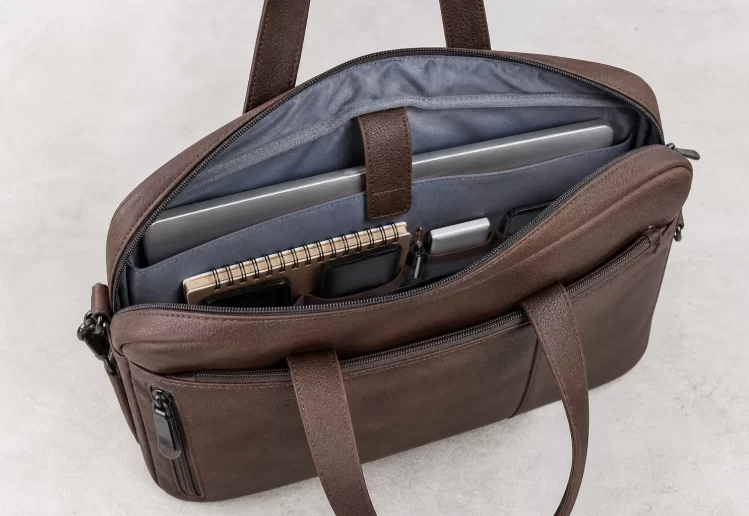
Laptop protection, water resistance, secure closure, organised interior and carry comfort account for most functional requests. Each addresses a use the customer already has, which is why they recur.
Requests outside that list tend to be buyer-specific: a convertible strap for a particular retail chain, a document sleeve for a corporate account. They are legitimate but they do not generalise, and treating them as trends misreads the market.
Why the list is short
Features compete with weight, cost and appearance. Every addition makes the bag heavier, more expensive or less clean visually, so the customer’s tolerance is limited and only the features that solve a felt problem survive that trade-off.
This is also why features cluster by category. A work bag accumulates organisation because its user carries equipment; a small crossbody does not, because its user carries three things.
| Functional request | Problem it solves | Typical category | How often it converts |
|---|---|---|---|
| Padded device compartment | Protecting equipment in transit | Work and commuter bags | High where devices are carried |
| Water-resistant closure | Weather exposure | Commuter, travel | Moderate to high |
| Secure closure | Theft and spillage | Travel, city | High in transit contexts |
| Interior organisation | Finding items quickly | Work, travel | Moderate |
| Trolley strap | Carrying with luggage | Travel, business | High in travel ranges |
| Convertible carry | Changing context during the day | Multi-use | Situational |
| External pocket | Quick access | Most categories | Low on its own |
What buyers say versus what they buy
Buyers routinely request features they do not ultimately order, because the request is made before costing and the order is placed after. A feature that adds a meaningful percentage to the unit price frequently disappears at that point.
The useful signal is not the request but the order. Where a buyer accepts the cost increase and keeps the feature in the final specification, the feature has demonstrated value. Where it is dropped, it was an intention rather than a requirement.
Which requests come from the buyer’s customer
There is a difference between a feature the buyer wants and a feature the buyer’s customer has asked for. The second converts reliably, because it arrives with a demand already attached rather than with an expectation.
Buyers who can name the customer request behind a feature are usually right to include it. Buyers who describe the feature as an improvement are usually guessing, and the guess is often wrong at the price point.
Which Features Carry Real Weight
The features that convert share a common structure: they attach to a specific moment of use and they remove a risk the customer already worries about.
Risk-removing features
Protection and security features convert because they remove a cost the customer can imagine. A damaged laptop or a bag opened in a crowd are concrete losses, and a feature that prevents them is easy to justify.
These features also survive price pressure better than convenience features, because the alternative is a visible loss rather than a marginal inconvenience.
Effort-reducing features
Organisation and carry-comfort features convert where the effort they remove is repeated daily. A trolley strap matters to someone who travels weekly; it is irrelevant to someone who does not.
This makes them strong in some ranges and inert in others, which is why carrying them across an entire collection rarely works. The feature is only as good as the frequency of the use it addresses.
Why comfort features grow with weight
As a bag gets heavier, comfort moves from a nice addition to a functional requirement. A strap that is adequate on a light bag becomes painful on a loaded one, which is why reinforced anchors and padded straps appear together with device protection.
This creates a natural pairing rule: once a style carries equipment, the comfort features stop being optional. Skipping them produces a bag that protects the device and punishes the shoulder.
The two-feature rule
Where a style is selling into an unfamiliar market, limiting it to two functional features keeps the proposition testable. If it sells, the additions can be layered in the following season with something to compare against.
Features that mostly serve the listing
Some features exist to fill a specification table. A branded lining, an extra slit pocket or a decorative puller may appear in the list without changing a purchase decision.
They are not worthless, but they should be costed as marketing rather than as function. Including them is a legitimate choice when the price allows it and the buyer understands what they are paying for.
A feature converts when the customer can picture the moment it prevents. Features that cannot be pictured are specification, not demand.
Where Features Stop Selling
Features fail in predictable ways, and recognising the failure modes prevents a range from accumulating additions that raise cost without raising appeal.
When the feature is invisible
An internal reinforcement or a better zip tape improves the product without being visible. It may reduce returns, but it will not generate demand, and it cannot be the reason a buyer chooses the style.
These features belong in a quality argument rather than a selling argument. They justify a price, but they do not create interest.
When the feature fights the design
Functional additions change proportion and line. A padded sleeve thickens the profile, an external pocket interrupts the silhouette, and a security closure adds hardware to a clean face. On a design-led bag these costs are visible even when the feature is not.
This is where a feature can make a product worse in the customer’s judgement while making it better on paper. The trade should be decided deliberately rather than by default.
The cost of a feature nobody can name
Some additions improve the product in ways that cannot be described in a listing. They consume cost and production time while contributing nothing the customer can recognise, and they are usually invisible in sales data.
The test is simple: if the feature cannot be named in one sentence that means something to a shopper, it belongs in the quality argument or nowhere at all.
When the price crosses a threshold
Every feature has a price below which it is accepted and above which the style is rejected. The threshold varies by channel and market, but it exists, and it is usually reached sooner than the specification suggests.
| Failure mode | How it appears | What to do |
|---|---|---|
| Invisible feature | Cost rises, appeal unchanged | Move it to the quality argument |
| Design conflict | Silhouette or proportion suffers | Decide the trade explicitly |
| Price threshold | Style rejected at quotation | Offer the feature as an option |
| Wrong category | Feature unused by the buyer’s customer | Restrict it to relevant ranges |
| Too many at once | Weight and cost both rise | Limit to two or three per style |
| Unprovable claim | Buyer cannot repeat it to customers | Evidence it or drop it |
When there are too many
A style with eight functional features is difficult to describe and difficult to justify. The customer cannot identify what the product is for, and the buyer cannot write a coherent listing.
Two or three well-chosen features usually sell better than six, because they define the product’s purpose instead of obscuring it.
What Each Feature Costs to Add
Cost is where most feature discussions should begin, because a feature that cannot be produced at an acceptable price is not a design option. The figures below describe relative cost rather than absolute prices, since labour and material rates vary by factory and market.
Material and component cost
Component cost covers the visible additions: the zip, the padding foam, the lining panel, the strap hardware. These are the easiest costs to quote and the least likely to surprise.
Water-resistant zips carry a premium over standard zips and the premium varies by length, so a feature that looks trivial can become material where it is used on three openings.
Labour cost
Labour is usually the larger element. A padded device compartment requires cutting, laminating, stitching and fitting, and each step adds handling time per unit that does not fall much with volume.
Features that sit on an existing seam cost less than features that create a new operation. This is why an interior slip pocket is cheap and an independent padded sleeve is not.
Pattern and tooling cost
Any feature that changes the pattern carries a one-off cost: new pattern work, a new sample round, and sometimes a new cutting die. These costs are per programme, so they weigh heavily on small orders.
| Feature | Component cost | Labour impact | One-off cost | Volume needed to justify |
|---|---|---|---|---|
| Interior slip pocket | Low | Low | Minimal | Any quantity |
| Padded device sleeve | Moderate | High | Moderate | 500 pieces and above |
| Water-resistant zip | Moderate to high | Low | Minimal | Any quantity |
| Trolley strap | Low | Moderate | Low | 300 pieces and above |
| External pocket | Low | Moderate | Moderate | 500 pieces and above |
| Reinforced strap anchors | Low | Moderate | Low | Any quantity |
| Convertible strap system | High | High | High | 1,000 pieces and above |
Why small orders pay more per feature
The one-off costs of pattern work and sampling are spread across the order quantity. On a small order those costs sit on few units, so the same feature can appear far more expensive than it would at volume.
This is a reason to defer features on trial orders rather than a reason to avoid them. Once the reorder arrives, the one-off cost has already been absorbed.
Weight and packing consequences
Every functional addition adds weight, and weight affects freight in a category already sold largely on volume. Padding and hardware are the main contributors, and a heavy feature set can move a carton into a different freight band.
Packing is also affected. Bulkier bags require larger cartons, which hold fewer units and change the container calculation. Those costs sit outside the unit price but they are real, and they belong in a landed-cost comparison rather than a quotation.
How Features Interact With PU Leather
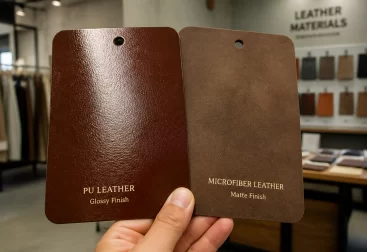
Coated fabric behaves differently from leather or textile when functional elements are added, and several features that work well on other materials behave poorly on PU. Understanding the interaction prevents specifying something the material cannot support.
Seams are the weak point
Water resistance on a coated bag is limited by its seams. The coating resists water across the panel, but every stitch line creates a path through it. Taping or sealing seams is possible, but it adds a process and leaves a visible ridge.
This is why the honest claim is water-resistant rather than waterproof, and why the feature should be positioned around splashes and light rain instead of sustained exposure.
Padding changes the shape
Coated fabric holds a fold and shows a crease. Padding stiffens the panel and can make the bag stand away from the body, which changes how it hangs and how it looks when carried.
The effect is stronger on soft constructions. On a structured tote the padding disappears into the shape; on a soft shoulder bag it becomes the dominant visual element and can make the bag look bulky.
Hardware loads the material
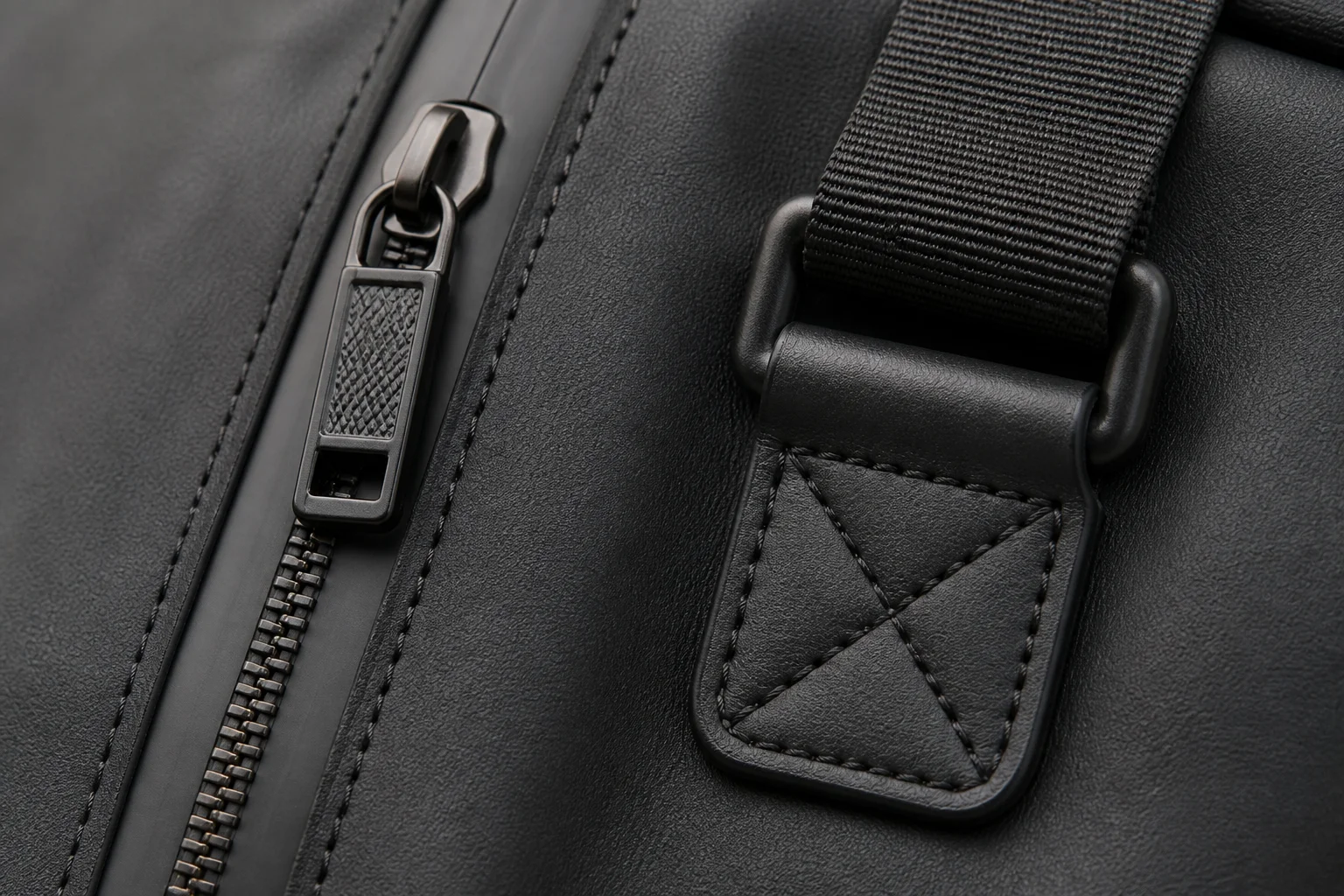
Functional hardware concentrates load on small areas. On coated fabric the risk is not tearing but stretching and shining at the anchor point, which shows as a permanent mark that cannot be corrected.
Reinforcement behind the anchor, and a backing patch in the same material, distribute the load and keep the surface intact. The reinforcement is invisible, which is precisely why it is often omitted under cost pressure.
| Feature | Interaction with PU leather | Practical response |
|---|---|---|
| Water-resistant zip | Seams remain the weak point | Claim splash resistance, not waterproof |
| Padded sleeve | Stiffens soft panels and changes drape | Restrict to structured shapes |
| Trolley strap | Anchor points shine under load | Backing patch and bar-tack |
| External pocket | Adds a seam line to a clean face | Accept the line or move it inside |
| Convertible hardware | Multiple anchors on a coated surface | Reinforce every anchor point |
| Magnetic closure | Coating can crack at the fold | Test fold cycles before approval |
Why this matters at specification stage
Each of these interactions is cheap to accommodate at design stage and expensive to fix after tooling. A short conversation with the factory about material behaviour, before the specification is fixed, prevents most of them.
The pattern is consistent: on coated fabric the feature is rarely the problem. The interaction between the feature and the material is.
On coated fabric the feature is rarely the problem. The interaction between the feature and the material is.
How to Evidence a Feature
A feature that cannot be evidenced cannot be sold by anyone other than the person who specified it. Evidence converts a claim into something a buyer can repeat to their own customer.
Test what can be tested
Zips, straps and closures can be tested: cycles, load, pull force. A test result gives the buyer a number to quote and gives the factory a defensible claim.
Water resistance is testable in a limited way. A coating or a coated zip resists splashes and light rain; describing it as waterproof invites returns. The accurate claim is the one that can survive a customer complaint.
Photograph the inside
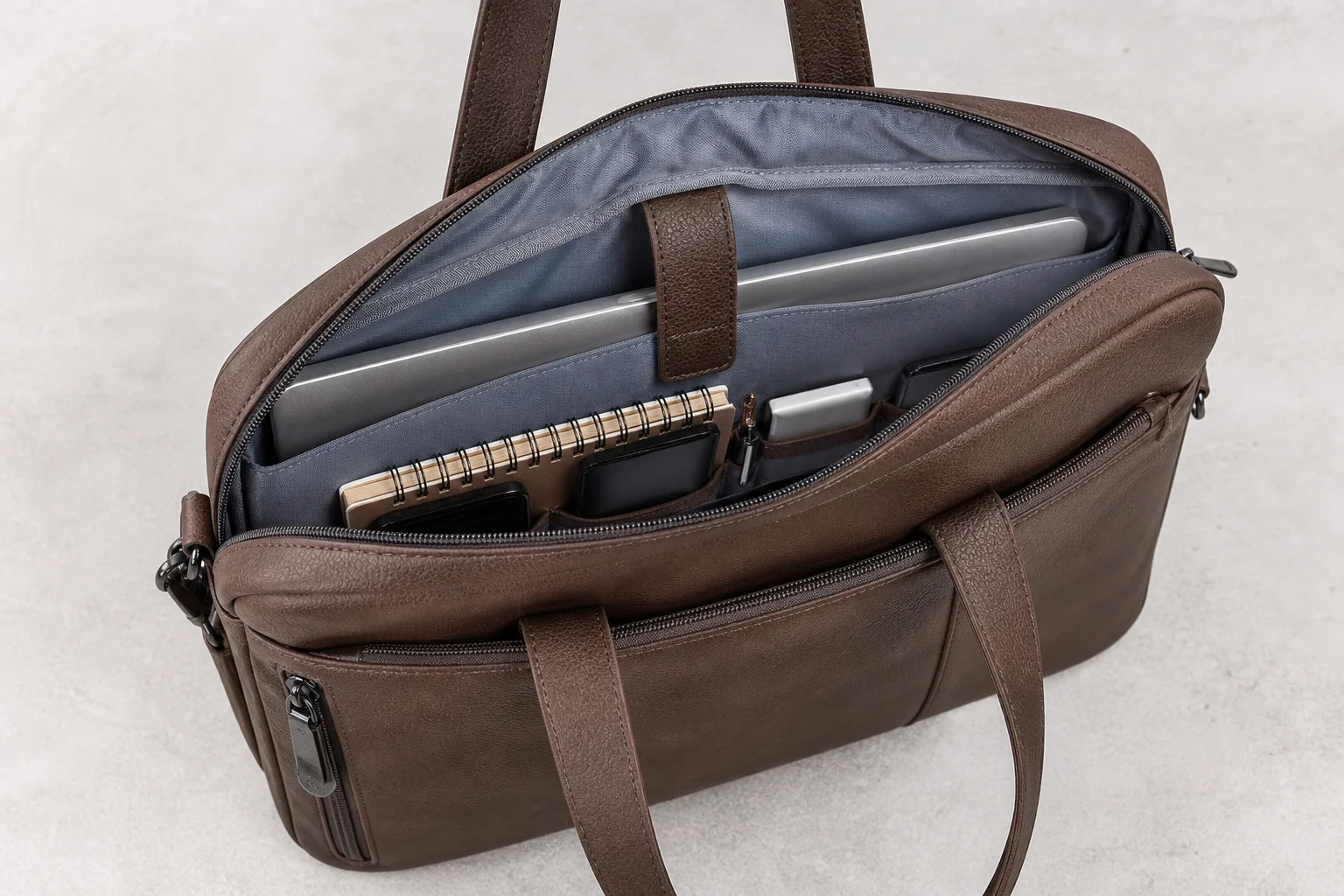
Most functional features live inside the bag, where a product photograph does not reach. An interior photograph showing the sleeve, the pocket and the organisation is often the single most useful asset for selling a functional style.
Scale matters in these photographs. A sleeve photographed beside a device, or a pocket photographed with a hand in it, communicates size in a way a description cannot.
Write the claim in the buyer’s language
A factory’s technical description rarely transfers to a listing. The claim needs to be written as the customer’s benefit, with the technical basis available underneath for anyone who asks.
| Feature | Evidence that works | Claim to avoid |
|---|---|---|
| Water-resistant zip | Splash test description, coated tape detail | Waterproof |
| Padded sleeve | Interior photograph with device, foam thickness | Shockproof |
| Strap anchors | Load test result, bar-tack detail | Unbreakable |
| Trolley strap | Photograph fitted to a case handle | Universal fit |
| Secure closure | Closure cycle count, hardware specification | Anti-theft |
| Organisation | Interior photograph with items in place | Fits everything |
Keep the evidence with the specification
Evidence that lives in a chat thread is lost by the next order. Test results, photographs and approved claims should be attached to the specification so that a reorder reproduces both the product and the argument for it.
A feature is only as strong as the sentence a buyer can repeat about it. If the sentence does not exist, the feature is a cost.
Building a Range Around Features
A range needs a logic that connects features to the customers each style serves. Without that logic, features accumulate unevenly and the range becomes difficult to explain.
One lead feature per style
Giving each style a single lead feature makes the range legible. The commuter style leads on device protection, the travel style on security and trolley compatibility, the everyday style on organisation and light weight.
Supporting features can follow, but the lead feature is what the buyer uses to position the style and what the customer uses to choose between them.
Share the platform underneath
Different lead features do not require different constructions. A shared body pattern with varied interiors keeps tooling low while allowing the range to address several uses.
This is the same principle that makes small orders viable: standardise what the customer does not see, vary what they do.
Price the features into tiers
Features give a natural structure for price tiers. The entry tier carries the essential feature, the middle tier adds protection or organisation, and the top tier adds the convertible or high-cost system.
| Tier | Feature set | Customer logic | Cost position |
|---|---|---|---|
| Entry | Core closure, one interior pocket | Basic everyday use | Lowest |
| Mid | Padded sleeve, water-resistant zip | Carrying a device daily | Moderate |
| Upper mid | Mid set plus trolley strap and organisation | Frequent travel | Higher |
| Top | Convertible system, reinforced anchors | Multiple contexts in one day | Highest |
Avoid feature creep within a season
Adding a feature to an existing style mid-season resets part of the process and complicates reorders. Feature changes belong at the start of a programme, not in the middle of one.
How the Channel Changes the Answer
The same feature can be decisive in one channel and irrelevant in another, because the customer’s information and their reason for buying differ.
Online listings need describable features
An online customer cannot touch the bag, so features that can be described and photographed carry disproportionate weight. A padded sleeve shown in an interior photograph does more work than a superior stitch density that cannot be seen.
This pushes functional styles toward features that photograph well, which is a different criterion from features that perform well. Both matter, but they are not the same list.
Physical retail sells on handling
In a shop the customer picks the bag up. Weight, balance and the feel of the closure decide more than the feature list, and a bag that feels good in the hand can outsell a better-specified one.
This is why feature-heavy styles sometimes underperform in physical retail: the specification is strong but the handling experience is heavy or awkward.
How returns data changes the answer
Return reasons reveal which features were actually used. A style sold on device protection that returns mainly for being too heavy is telling the buyer that the comfort features were under-specified, not that the protection was unwanted.
Reading returns this way turns a feature decision into an evidence-based one, and it usually points toward fewer features executed better rather than more features added.
Corporate and promotional buyers want certainty
For corporate orders the feature is often a logo placement and a delivery date rather than a function. Functional requests exist but they are secondary to deadline certainty and consistent quality across the run.
| Channel | What decides the sale | Features that help | Features that hurt |
|---|---|---|---|
| Online marketplace | Listing clarity and photographs | Visible, describable functions | Invisible improvements |
| Brand direct-to-consumer | Positioning and material quality | Coherent, few, well-evidenced | Feature clutter |
| Physical retail | Handling and appearance | Balance, comfort, clean lines | Weight and bulk |
| Corporate orders | Deadline and consistency | Simple, repeatable, robust | Complex options |
| Travel retail | Specific travel use | Trolley strap, security | Unrelated additions |
A Decision Framework for Buyers
The framework below is deliberately short. It is intended to be used before a specification is sent to a factory, when changes are still cheap.
Ask four questions of every feature
The first is which moment of use the feature addresses. The second is whether the customer already knows that moment is a problem. The third is what the feature adds to the unit price. The fourth is what evidence will support the claim.
A feature that fails any of the four is a candidate for removal. In practice most features that survive all four end up in the range, and most that fail one are dropped at costing anyway.
Test on a small order first
Where a feature’s value is genuinely uncertain, a small order answers the question at limited cost. Selling through on a test quantity is more informative than any amount of internal discussion.
Sequencing features across seasons
Introducing one feature per season keeps the range moving without resetting it. Each addition can be tested in the market, and the styles that carry it can be adjusted before the next change.
Adding several features at once makes the result unattributable: if the style sells better, the buyer cannot tell which addition did the work, and the same debate returns next season.
Record what happened
Recording which features sold and which were dropped at quotation builds a record that improves the next range. Without it, the same features are debated again each season with no evidence either way.
| Decision stage | Question | If the answer is weak |
|---|---|---|
| Use case | Which moment does it serve? | Drop it |
| Customer awareness | Do they already see this as a problem? | Educate or drop |
| Cost | What does it add per unit? | Make it an option |
| Evidence | What proves the claim? | Test it or soften the claim |
| Channel fit | Does it suit where it will be sold? | Restrict to other channels |
| Range fit | Is it this style’s lead feature? | Move it to a different style |
What good feature planning looks like
A well-planned functional range has few features, each attached to a use, each costed, each evidenced and each assigned to a price tier. It is easier to produce, easier to describe and easier to sell than a range with twice the additions.

Function drives demand only when it is attached to a use the customer already recognises. Everything else is cost waiting to be justified.
FAQ
Do functional features actually increase demand for wholesale bags?
Some do, reliably. Features that remove a risk the customer already recognises, such as device protection or a secure closure, convert well. Features that only improve the specification without addressing a felt problem rarely change a purchase decision.
Which functional features sell best?
Padded device compartments, water-resistant closures, secure closures, trolley straps and interior organisation. They recur across markets because they attach to uses the customer already has rather than to trends.
How many features should one style carry?
Two or three well-chosen features usually outperform six. A small number defines the product’s purpose, while a long list obscures it and raises weight and cost at the same time.
What does a padded laptop sleeve add to cost?
It is one of the more expensive additions because it requires cutting, laminating, stitching and fitting. It also carries a pattern cost, which is why it generally needs an order of several hundred pieces to justify.
Can a PU leather bag be called waterproof?
Not accurately. A coated material and a water-resistant zip resist splashes and light rain, but the seams and closures are not sealed. Describing it as water-resistant keeps the claim defensible and avoids returns.
How do you prove a functional feature to a buyer?
Through test results where the feature is testable, and through interior photography where it is not. A claim the buyer can repeat to their own customer is worth more than a technical description.
Do features sell better online or in physical retail?
Different features do. Online rewards features that photograph and describe well, while physical retail rewards handling, balance and comfort. A feature set optimised for one channel may underperform in the other.
Is a trolley strap worth adding to every style?
No. It converts strongly in travel and business ranges and adds cost without benefit elsewhere. It should be restricted to styles whose customer actually travels with a case.
How do features affect freight cost?
Through weight and packing volume. Padding and hardware add weight, and bulkier bags need larger cartons holding fewer units. The effect appears in landed cost rather than in the unit quotation.
Should features be standard or optional?
Optional where the cost impact is meaningful and the benefit is situational. Making a high-cost feature standard raises the entry price for every buyer, including those who do not need it.
When should a feature be added to an existing style?
At the start of a programme, not mid-season. A change mid-season resets part of the process, complicates reorders and makes the earlier stock inconsistent with the later.
What is the biggest mistake buyers make with functional features?
Specifying them before costing them. Once the cost per unit is known, most marginal features disappear, and the range that remains is stronger and easier to produce.
Planning a functional bag range and unsure which features will earn their cost?
Send your specification to info@gionar.com and we will advise on feature costing, minimum quantities and the evidence needed to support each claim.