How Do Matte, Gloss and Grain Finishes Change PU Leather Bags?
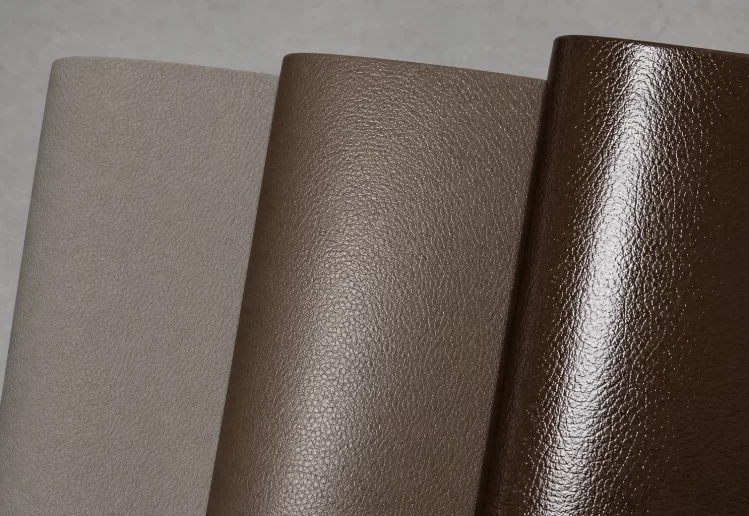
Two bags can be made from the same base material and feel like different products. The finish is what separates them: a matte surface reads as restrained and modern, a gloss surface reads as formal and premium, and a grain pattern decides whether the material looks like leather at all. None of these differences live in the polymer. They live in how the surface is built.
For buyers, finish is the most visible decision in a range and the one most often made from a photograph. That is a problem, because finish behaves differently under different light, wears differently, soils differently and costs differently. A swatch photographed in a studio can look entirely unlike the same material in a shop window or on a warehouse shelf.
In manufacturing terms the finish is a set of layers and processes. A base coating provides colour and coverage; a surface treatment sets the gloss level; an embossing step, or a textured release paper, creates the grain. Each of those steps can be varied, and each variation has consequences for durability, price and how the bag ages.
This article explains what matte, gloss and grain actually are, how they change wear and handling, how they affect perceived value and colour rendering, how they interact with cleaning claims, what to specify at sampling, and where finish choices fail after delivery. The aim is to make finish a decision a buyer can specify precisely rather than a look they approve from a screen.
- What a Finish Actually Changes
- Matte, Gloss and Semi-Gloss Compared
- Grain Options: Embossed, Printed or Smooth
- How Finish Affects Wear and Durability
- Scuffing, Fingerprints and Handling
- How Finish Changes Perceived Value
- Colour, Finish and Light
- Matching Finish to Hardware and Lining
- Cleaning Claims and Aftercare
- Specifying a Finish at Sampling
- Where Finish Choices Fail in the Field
- FAQ
What a Finish Actually Changes
Finish is often treated as a colour decision. It is a separate variable that changes four things at once: how the surface reflects light, how it resists abrasion, how it holds soil, and how much it costs to make.
The surface layer, not the colour
Colour comes from pigment in the coating. Finish comes from the top treatment applied over it. A matte additive scatters light; a smooth topcoat reflects it. Changing the finish changes the appearance without changing the pigment.
This distinction matters when a buyer approves a colour on one finish and orders another. The pigment is identical, but the colour will appear different because the surface reflects differently.
Gloss is measured, not described
Gloss levels are expressed as a number measured at a fixed angle, typically 60 degrees. Low readings indicate matte, mid readings semi-gloss, high readings gloss. Buyers rarely see these numbers, which is why finish disputes are common.
Asking for a gloss range rather than a word removes most of the ambiguity. “Matte” can mean anything from dead flat to a soft sheen depending on the supplier.
Grain is a separate decision
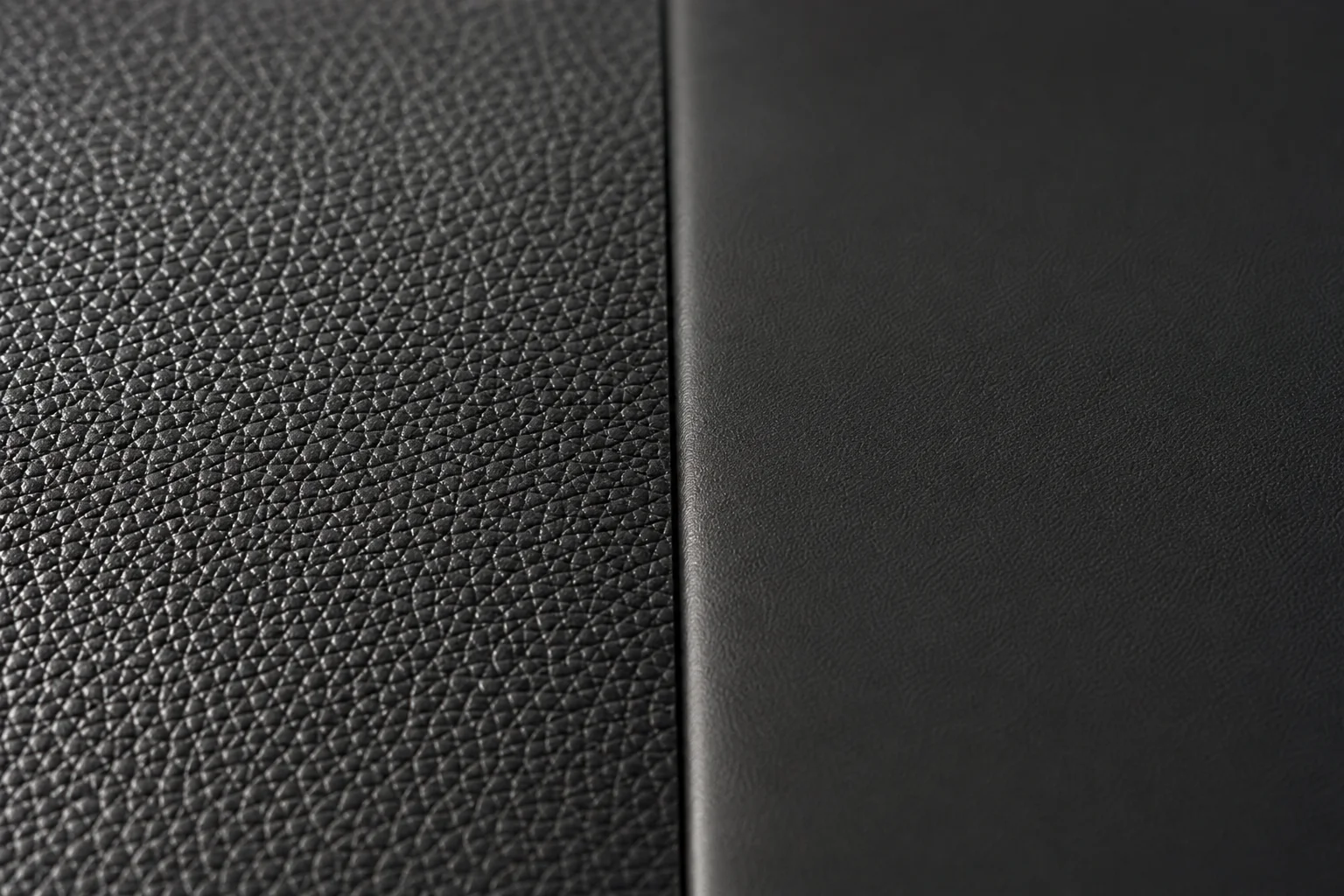
Grain and gloss are independent. A grained surface can be matte or glossy, and a smooth surface can be either. Treating them as one choice limits the range of results and often produces a material that is close to the intent but not the intent itself.
Specifying them separately gives four combinations instead of two, and the combinations behave quite differently in wear.
| Variable | What it controls | How it is set | Typical buyer error |
|---|---|---|---|
| Pigment | Hue and depth of colour | Formulation in the coating | Judging colour on a different finish |
| Gloss level | Light reflection | Top treatment and additives | Approving “matte” without a number |
| Grain | Texture and leather-look | Embossing or release paper | Assuming grain implies durability |
| Top coat | Abrasion and soil resistance | Additional treatment layer | Omitting it to save cost |
| Hand feel | Touch and drape | Coating softness and additives | Confusing softness with quality |
Finish is decided before colour is matched
Because finish changes how colour reads, the sequence matters. Matching a colour on a matte surface and then switching to gloss produces a mismatch that has to be resolved by adjusting pigment.
Buyers who fix the finish first and match colour to it avoid a second approval round, which is usually a week saved per style.
Why finish drives cost more than expected
A matte topcoat usually costs more than a plain gloss finish, because the matting agent and the additional process step both add expense. Deep embossing costs more than a light pattern, and a fine pattern costs more than a coarse one.
These differences are small per metre and meaningful per order. A buyer who specifies finish by appearance alone often discovers the cost at quotation, after the design is already fixed.
Matte, Gloss and Semi-Gloss Compared
The three broad finish levels behave differently in every respect that matters to a bag: how they wear, how they show handling, and what they signal to a customer.
Matte
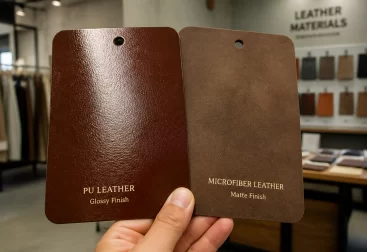
Matte surfaces scatter light in all directions, which hides fine scratches and softens colour. They read as contemporary and understated, and they photograph well without glare.
The trade is soil visibility. Matte surfaces hold dust and transfer more visibly than gloss, and cleaning can leave a sheen if the wrong product is used.
Semi-gloss
A semi-gloss finish is the practical middle. It reflects enough light to look cared-for without showing every mark, and it tolerates handling better than either extreme.
For volume ranges this is often the safest choice, because it fails gracefully rather than conspicuously.
Choosing between levels
The decision usually comes down to where the bag will be handled. High-touch retail and daily use favour matte or semi-gloss; display-driven and formal ranges can carry gloss without the same penalty.
Where a range must serve both, semi-gloss is the compromise that fails least conspicuously across contexts.
Gloss
High gloss reflects sharply and reads as formal or premium. It resists soil well because the surface is smooth and non-absorbent.
The trade is visibility of damage. Fine scratches, scuffs and handling marks show clearly, and the surface can look worn earlier than a matte equivalent at the same level of actual wear.
| Property | Matte | Semi-gloss | High gloss |
|---|---|---|---|
| Light reflection | Low, diffuse | Moderate | High, directional |
| Scratch visibility | Low | Moderate | High |
| Soil and dust | Shows easily | Moderate | Wipes clean |
| Fingerprint risk | Low to moderate | Moderate | High |
| Perceived formality | Casual, modern | Versatile | Formal, dressy |
| Relative cost | Higher | Moderate | Lower |
| Photographs well | Yes, no glare | Yes | Needs controlled light |
Matte and gloss do not differ in quality. They differ in which imperfections they hide and which they advertise.
Grain Options: Embossed, Printed or Smooth
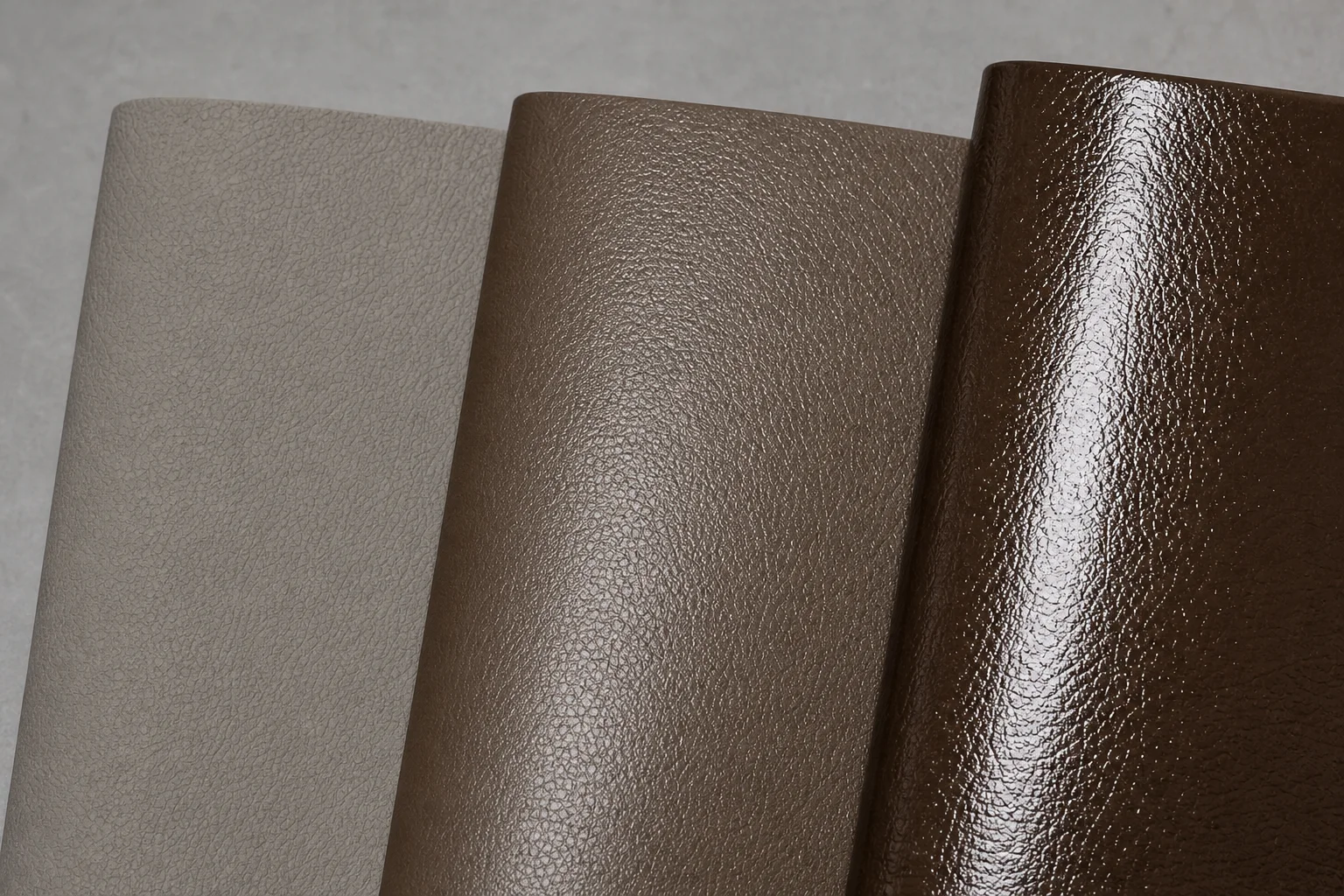
Grain is what makes a coated material read as leather, and the method used to create it determines both appearance and durability.
Embossed grain
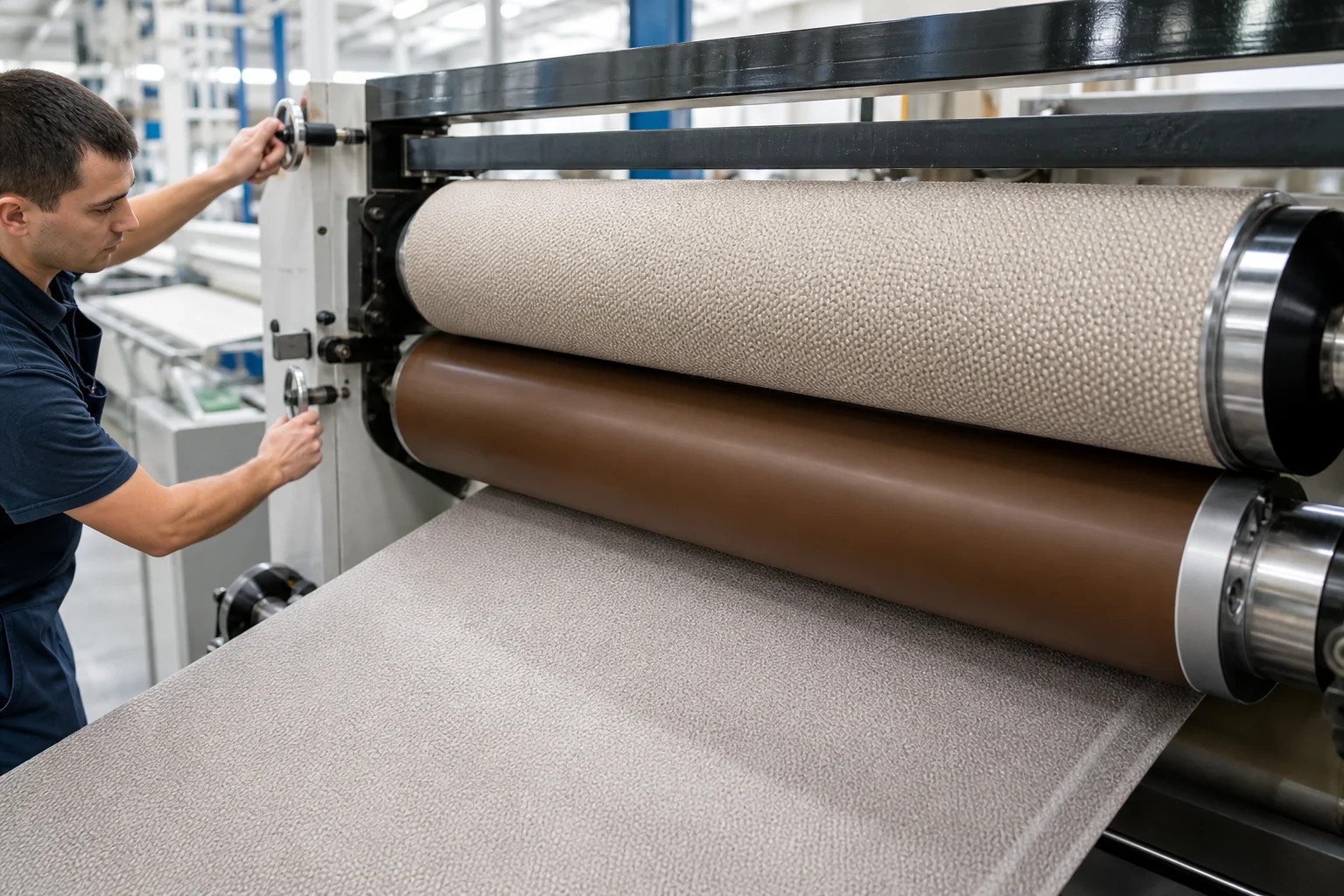
Embossing presses a pattern into the coating with a heated roller or a textured release paper. The pattern is permanent and survives handling, and deep embossing adds a sense of substance.
Fine patterns require more precise process control and cost more. Coarse patterns are more forgiving and more common in volume ranges.
Printed grain
Printed grain applies a pattern with ink rather than pressure. It is cheaper and allows more intricate designs, but it sits on the surface and can wear away at high-friction points.
Printed patterns suit low-wear panels and entry price points. On handles and corners they tend to be the first thing to disappear.
Smooth finish
A smooth surface has no grain at all, which gives a clean modern look and makes cleaning simple. It also makes every mark visible, because there is no texture to break up the light.
Smooth finishes work best on structured styles in mid to dark colours, where small marks are less conspicuous.
Matching grain to the style
A fine grain suits small leather goods and formal bags; a pronounced pebble suits casual totes and travel. The grain should follow the product’s use rather than a general preference.
Grain depth also interacts with construction. Deep embossing stiffens the material slightly, which helps structure and hurts drape on soft styles.
| Grain method | Durability | Detail level | Cost | Best use |
|---|---|---|---|---|
| Deep embossed | High | Bold patterns | Higher | Casual, travel, large panels |
| Fine embossed | High | Subtle leather look | Highest | Formal bags, small goods |
| Printed | Low at wear points | Intricate designs | Lower | Low-wear panels |
| Smooth | Dependent on topcoat | None | Moderate | Structured modern styles |
How Finish Affects Wear and Durability
Finish changes wear in ways that are not obvious from a swatch. The same base material with a different top treatment can survive twice as long in the same use, or fail noticeably earlier.
The topcoat is the wearing surface
Abrasion acts on the outermost layer. Where a topcoat is present, it absorbs the friction and protects the pigment beneath. Where it is absent or thin, the colour layer wears first and the loss shows as a patch.
This is why two materials of the same colour can look equally good when new and entirely different after a year of use.
Grain depth and friction
Deep grain creates high points that contact surfaces first. Those points receive concentrated abrasion, which is why pronounced patterns can wear at the peaks while the valleys remain intact.
The result is a mottled appearance rather than a hole, which is visually less alarming but still a sign of wear. Fine grain distributes contact more evenly.
Gloss and surface damage
Gloss finishes do not necessarily wear faster, but they reveal wear sooner. A scratch on gloss breaks the reflection and becomes visible from a distance; the same scratch on matte scatters with the surrounding surface.
Buyers sometimes interpret this as lower quality. It is a difference in visibility rather than in resistance, and it is worth explaining in internal training before it becomes a returns issue.
| Wear type | Matte | Semi-gloss | Gloss | Grained |
|---|---|---|---|---|
| Abrasion resistance | Depends on topcoat | Depends on topcoat | Good where coated | Wears at peaks |
| Scratch visibility | Low | Moderate | High | Masked by texture |
| Colour loss appearance | Gradual | Gradual | Sharp, visible | Mottled |
| Edge wear | Moderate | Moderate | Visible early | Moderate |
| Perceived ageing | Slow | Slow | Fast | Moderate |
What to test before approving
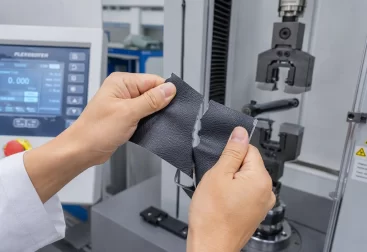
Rub testing and abrasion testing answer the durability question directly. A finish approved on appearance alone has no evidence behind it, and the first season of field use becomes the test.
Testing both the base material and the finished surface matters, because a topcoat applied later can change the result.
Scuffing, Fingerprints and Handling
Handling marks are the most common complaint about finish, and they differ sharply between gloss levels.
Fingerprints and gloss
Gloss surfaces show fingerprints clearly because skin oils alter the reflection. On a dark gloss bag the effect appears within minutes of handling, and it is one reason gloss is difficult in retail environments where customers touch products.
Matte surfaces absorb and scatter the same oils with far less visible effect, which makes them more forgiving in high-touch settings.
Scuffing at contact points
Corners, base edges and the area where a bag rests against the body take the most scuffing. On gloss these marks read as damage; on grain they blend into the texture.
Reinforcement at these points is a pattern decision, but the finish decides how visible the result will be.
Transfer to clothing
Dark finishes with excess surface pigment can transfer onto light clothing, particularly in warm conditions. This is a formulation issue rather than a gloss issue, but it appears more often on deep matte finishes where pigment loading is high.
Rub-fastness testing catches it before production. Without that test, transfer complaints arrive after the goods are in stores.
| Handling risk | Worst finish | Best finish | Practical control |
|---|---|---|---|
| Fingerprints | Dark high gloss | Matte, grained | Choose matte for high-touch retail |
| Corner scuffing | Gloss, smooth | Grained | Reinforce corners, use grain |
| Colour transfer | Deep matte | Mid-tone semi-gloss | Rub-fastness test before approval |
| Dust accumulation | Matte | Gloss, semi-gloss | Specify a cleanable topcoat |
| Cleaning sheen | Matte | Gloss | Issue care instructions |
How Finish Changes Perceived Value
Finish is one of the cheapest levers on perceived value, and one of the most frequently misused.
Gloss reads as formal, matte as modern
The association is cultural rather than technical. Gloss suggests patent leather and evening wear; matte suggests utility, minimalism and technical fabrics. Neither is inherently more premium.
What matters is consistency with the rest of the product. A matte finish on a highly formal shape can read as unfinished, and gloss on a casual tote can read as cheap.
Grain and the leather signal
Fine grain signals leather more effectively than heavy pattern, because real leather at quality levels is usually subtle. Very pronounced patterns read as synthetic to experienced buyers.
This is a case where restraint carries a price premium. The finer the embossing, the closer the material reads to the reference it imitates.
The cost of upgrading finish
Upgrading from gloss to a durable matte, or from printed to embossed grain, adds a modest amount per metre. Across a full order it is a real cost, but it is usually small against the retail price the finish supports.
This is one of the few places where a material upgrade is easy to justify, because the benefit is visible to the customer rather than buried in construction.
Where finish cannot compensate
Finish improves the first impression but not the second. A bag with a premium finish and weak hardware or poor seams is still a weak bag once handled.
Buyers who invest in finish while economising on construction usually find the improvement does not hold at the price point they are targeting.
Finish buys the first impression. Construction decides whether the second impression holds up.
Colour, Finish and Light
The same pigment appears different on different finishes, and the difference is large enough to cause approval disputes.
Why matte looks deeper
Matte scatters light, so less of it returns directly to the eye. The result is a colour that appears deeper and more saturated, and dark shades can look almost black in low light.
Gloss returns more light, which lifts the apparent value and can make a dark colour look lighter and more reflective.
The approval problem
Swatches are usually approved under studio lighting or on a screen. Both conditions differ from a shop floor, and the difference is amplified by finish.
Approving on the final finish, viewed in daylight and in the intended retail lighting, prevents most of these disputes. A photograph is not a substitute.
Consistency across a range
When a range mixes finishes, colours that are nominally identical will not match visually. Either the finish should be consistent across a family, or the pigments should be adjusted per finish.
Adjusting pigments is the more precise route and the more expensive one, because it requires separate approval for each finish.
Matching Finish to Hardware and Lining
Finish does not exist in isolation. It sits next to metal hardware, lining fabric and edge treatment, and a finish chosen without reference to those elements often looks unresolved once assembled.
Hardware tone against gloss level
Bright polished hardware belongs with gloss or semi-gloss, where the reflection is consistent. On a dead-matte surface, highly polished hardware can look abrupt and draw attention to the contrast.
Brushed, matte or antiqued hardware sits more comfortably with matte finishes. The pairing is a visual rule rather than a technical one, but it is the difference between a coherent product and a collection of parts.
Lining contrast
A lining is seen every time the bag is opened, and its finish should relate to the exterior. A glossy satin lining inside a matte exterior reads as a deliberate contrast; the same lining inside a gloss exterior can look repetitive.
Lighter linings also help customers find items, which is a practical argument that has nothing to do with appearance.
Edge treatment
Edge paint is usually glossier than a matte body, which creates a visible outline. On fine grain this reads as a deliberate edge; on heavy grain it can look applied.
Where the body is deeply grained, a matte edge treatment or a folded seam produces a more resolved result than a glossy painted edge.
Thread and stitching
Thread sheen is subtle but visible on matte surfaces, where a glossy thread stands out against the body. On grained or gloss surfaces the effect is less pronounced.
For a clean matte product, a bonded matte thread is worth specifying. It is a small cost line that removes a distracting detail.
| Body finish | Hardware that suits | Lining that suits | Edge treatment |
|---|---|---|---|
| Matte smooth | Brushed or matte metal | Matte or contrast satin | Matte edge paint or folded seam |
| Matte grained | Antiqued or matte metal | Matte twill or cotton | Folded seam preferred |
| Semi-gloss | Brushed or polished | Satin or twill | Either, depending on style |
| High gloss | Polished metal | Satin | Gloss edge paint |
Why this is decided at sampling, not at production
These pairings are visible in a sample and difficult to change later, because hardware and lining are ordered against the approved sample. A mismatch discovered at production stage becomes a change order.
Reviewing the sample as an assembled object, rather than as a set of separate approvals, catches most of these conflicts before they cost anything.
Cleaning Claims and Aftercare
Finish determines what can honestly be claimed about cleaning, and the gap between an ambitious claim and a supported one creates returns.
Matte needs careful cleaning
Matte surfaces respond poorly to aggressive cleaning. Rubbing a matte finish with a damp cloth can polish it locally, leaving a shiny patch that cannot be restored.
The honest instruction is to use a soft dry cloth and mild soap sparingly, and to avoid solvents. That is a lower claim than most brands want, but it prevents the most common aftercare complaint.
Gloss cleans easily but scratches
Gloss wipes clean readily, which is a genuine advantage for travel and commuter products. The same smooth surface, however, marks easily during cleaning if grit is present.
The instruction should be to remove loose dirt before wiping, so the cloth does not drag particles across the surface.
Grain hides but traps
Deep grain hides marks but holds dust in the valleys. Cleaning requires a soft brush rather than a cloth, because a cloth passes over the pattern without reaching into it.
This is worth stating in care guidance, since customers who use a cloth will report that the bag does not come clean.
| Finish | Cleaning method | What to avoid | Claim to make |
|---|---|---|---|
| Matte | Soft dry cloth, mild soap sparingly | Solvents, repeated rubbing | Wipe clean with a soft cloth |
| Semi-gloss | Damp cloth after removing grit | Abrasive pads | Wipe clean |
| Gloss | Damp cloth, mild soap | Dry wiping over grit | Easy to wipe clean |
| Deep grain | Soft brush, then damp cloth | Cloth-only cleaning | Brush clean |
| Smooth light colours | Damp cloth, prompt drying | Dye transfer from clothing | Wipe clean, avoid dark denim |
Specifying a Finish at Sampling
Finish is easy to specify precisely and usually specified vaguely. A short, concrete specification removes most of the risk.
Name the level, not the mood
Specify a gloss range with a measurement angle rather than a description. A number can be verified; a word cannot, and the same word means different things to different suppliers.
Pairing the number with a retained physical swatch gives both a measurable target and a visual reference.
Specify grain and method
State whether the grain is embossed or printed, and whether the aim is a fine or pronounced pattern. The method matters more than the pattern name, because it determines durability.
Where a supplier proposes a substitute, the substitution should be tested rather than approved on appearance.
Record the topcoat
The presence and type of topcoat should be part of the specification, not an assumption. It is the layer that determines abrasion and soil behaviour, and it is also a cost line a supplier may quietly remove.
| Specification item | What to state | Why it matters |
|---|---|---|
| Gloss level | Measured value and angle | Removes ambiguity between suppliers |
| Grain method | Embossed or printed | Determines wear behaviour |
| Grain depth | Fine, medium or bold | Affects hand, structure, wear |
| Topcoat | Type and presence | Abrasion and soil resistance |
| Hand feel | Soft, standard or firm | Affects drape and perceived quality |
| Retained swatch | Physical approved sample | Reference for every later batch |
Approve in the right conditions
Approval should happen in daylight and in the lighting the product will be sold under. Two finishes that look identical in a studio can diverge sharply in a shop.
Where the product will be sold online, approval should also include a photograph taken under the lighting used for listings, since that image is what the customer will judge.
Where Finish Choices Fail in the Field
Finish failures cluster into a small number of patterns, and each one is preventable at specification stage.
The polished patch
A matte bag cleaned repeatedly in one area develops a shiny patch. The matting agent has been smoothed by friction, and the patch cannot be restored.
Prevention is through care instructions and, where relevant, a more durable matte topcoat rather than a cosmetic matting additive.
Disappearing pattern
A printed grain wears away at corners, handles and base edges, leaving a smooth patch beneath. The result looks like a defect rather than wear.
Embossed grain does not fail this way, which is why printed patterns belong on low-wear panels rather than on handles and corners.
Colour that shifts between batches
Successive batches arrive with a visible colour difference. The cause is usually a finish change rather than a pigment change, made without notifying the buyer.
Retained swatches and a written finish specification make this visible immediately, before the goods are cut.
Mismatch between sample and bulk
The approved sample looked matte and the bulk arrived with a sheen. The cause is usually inconsistent matting agent dispersion, which shows up as variation within a batch rather than between batches.
Acceptance criteria written as a measured gloss range, checked on incoming goods, catch it before cutting rather than after delivery.
Gloss that reads as worn
A gloss bag shows handling marks early and is judged as worn before it is. The material may be intact while the impression is not.
For high-touch retail, a semi-gloss or matte finish usually produces a better customer impression over the life of the product, even though gloss looks stronger on the shelf.
| Field symptom | Likely cause | Fix at specification stage |
|---|---|---|
| Shiny patch on matte | Matting additive smoothed | Durable matte topcoat, care guidance |
| Pattern gone at corners | Printed grain on wear points | Embossed grain for handles and corners |
| Batch colour shift | Undisclosed finish change | Written finish spec and retained swatch |
| Scratches everywhere | Gloss in high-touch use | Move to semi-gloss or matte |
| Dust in the grain | Deep pattern, cloth cleaning | Issue brush-based care guidance |
| Colour transfer to clothes | Excess surface pigment | Rub-fastness test before approval |
The short version
Matte, gloss and grain change how a bag looks, wears, soils and sells, and they do so independently of the base material. Finish is therefore a specification, not a preference.
Buyers who name a gloss range, choose the grain method deliberately, keep a retained swatch and approve in the right light get a material that behaves the same on the tenth batch as on the first. That predictability is what makes a finish decision cheap instead of expensive.
FAQ
Is matte or gloss PU leather better for bags?
Neither is better in isolation. Matte hides scratches and suits casual and modern styles; gloss cleans easily and reads as formal. Semi-gloss is the most forgiving for volume ranges and high-touch retail.
Which finish shows wear the least?
Grained matte finishes hide wear best, because texture breaks up light and masks small marks. High gloss reveals scratches and handling most clearly even when the material itself is intact.
Does grain make PU leather more durable?
Not by itself. Durability comes from the substrate and the topcoat. Embossed grain does help by distributing contact across high points, while printed grain can wear away at friction points.
What gloss level counts as matte?
It depends on the measurement standard and angle, so the value should be specified numerically rather than described. Asking for a measured range instead of the word “matte” removes most supplier ambiguity.
Why does the same colour look different on two finishes?
Matte scatters light and makes colour appear deeper, while gloss reflects more light and lifts the apparent value. Pigment can be identical and the visual result will still differ.
Can matte PU leather be cleaned without leaving a shine?
It requires care. Repeated rubbing smooths the matting agent and leaves a polished patch. A soft dry cloth with mild soap used sparingly, and no solvents, is the safe instruction.
Is embossed grain more expensive than printed grain?
Yes, particularly fine embossing, because it needs tighter process control and often a textured release paper. The cost buys durability at wear points, which is why it matters on handles and corners.
Do I need a topcoat on PU leather?
For any bag that will be carried regularly, yes. The topcoat is the layer that resists abrasion and soil, and it is also one of the first cost lines a supplier may remove without saying so.
How should a finish be approved?
In daylight and in the lighting the product will be sold under, on the intended finish rather than a stand-in, and with a physical swatch retained as the reference for later batches.
Does gloss PU leather crack more easily?
Gloss does not inherently crack faster. It reveals surface damage sooner because scratches interrupt the reflection, which makes the same level of wear look more severe.
Can a range mix matte and gloss finishes?
It can, but nominally identical colours will not match visually across finishes. Either keep the finish consistent across a family or approve adjusted pigments for each finish.
What causes colour transfer from a dark matte bag?
Excess surface pigment, often on deep matte finishes with high pigment loading, especially in warm conditions. Rub-fastness testing before approval is the control.
Choosing a finish for your next bag range and want it specified precisely?
Send your target look and market to info@gionar.com and we will advise on gloss level, grain method and topcoat for your construction and price position.