How Should Wholesale Buyers Build a Bag Range for a New Store?
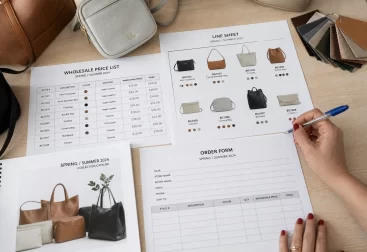
A new store needs a bag range that sells, fits its shelves and can be replenished. Most first ranges fail not because the bags are poor but because the range is badly shaped: too many styles, no size logic, colours that cannot be repeated, and a minimum order quantity that consumes the entire buying budget on one silhouette.
The wholesale buyer’s problem is different from the brand’s. A brand builds a range to express a position. A wholesale buyer builds a range to cover a customer base, keep stock turning, and leave room to reorder the pieces that work. The range has to be wide enough to offer choice and narrow enough to stay funded.
The arithmetic is unforgiving
A new store has limited open-to-buy, limited shelf space and no sales history. Every style added consumes cash, display space and attention. A range of twenty silhouettes in three colours is sixty decisions made blind; a range of eight styles in two colourways is sixteen decisions the buyer can actually manage.
Replenishment changes the shape of the range
A style that cannot be reordered is a one-off, not a range piece. Wholesale ranges need core styles with stable material and repeatable construction so that a sold-out bestseller can be restocked in weeks rather than replaced with something similar.
This article sets out how to structure a first bag range: how many styles, which silhouettes, how to handle colour and size, what to order in the first buy, how to plan reorders, what to negotiate on MOQ, and how to read the first weeks of sales so the second buy is better than the first.
- What a Bag Range Actually Is
- Deciding Range Width
- Choosing Silhouettes
- Colour Strategy and Repeatability
- Size Grading and Dimensions
- Price Architecture
- The First Buy Quantity
- Working With MOQ
- Core, Seasonal and Test Pieces
- Material Consolidation
- Planning Reorders
- Building a Coordinated Range
- Designing for the Shelf
- Choosing the Right Supplier
- Terms That Protect the Range
- Reading the First Weeks
- Building the Second Buy
- Common Range Mistakes
- FAQ
What a Bag Range Actually Is
A range is a set of decisions about coverage, not a collection of products.
Coverage over variety
The range exists to cover the purchase occasions a store serves: daily carry, work, travel, evening, gifting. Coverage means every occasion has at least one credible option, not that every occasion has five.
Depth versus breadth
Breadth is how many styles; depth is how many units per style. A new store with no history should favour breadth early to discover demand, then shift to depth on the winners.
The range as a system
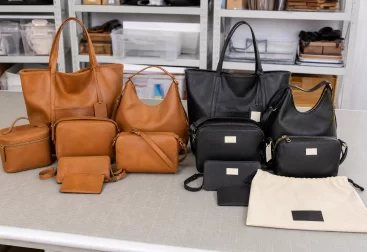
Styles should relate: shared materials, consistent hardware, compatible colour. A range where every piece is unrelated reads as a random assortment and sells worse than its individual quality suggests.
What the range must survive
A season of selling, a reorder cycle and a shelf reset. A range that cannot be reordered or consolidated into a smaller display is fragile.
| Range attribute | What it controls | New store priority |
|---|---|---|
| Breadth | Number of styles | Moderate, discover demand |
| Depth | Units per style | Low initially |
| Cohesion | How pieces relate | High, builds identity |
| Repeatability | Can it be reordered | High, protects bestsellers |
| Price spread | Entry to premium | Moderate, three tiers |
| Display fit | Works on the shelf | High, limited space |
The first range is research
Treat the first buy as a structured test. Its purpose is to identify which two or three styles deserve depth in the second buy, not to maximise first-season revenue.
Why this framing helps
A buyer who accepts the first range is research spends differently: more breadth, less depth, tighter price points, faster reorder on wins.
Deciding Range Width
Range width is the single decision that most affects whether the buy stays funded.
The shelf constraint first
Count the display positions available before choosing styles. A wall that holds twelve facings cannot support a twenty-style range without crowding, and crowded displays sell less per unit of space.
The cash constraint second
Divide open-to-buy by the average landed cost per style. That gives the maximum number of styles the budget can cover at a workable depth.
A workable starting point
Six to ten styles for a small store, twelve to sixteen for a larger one. Below six the store looks thin; above sixteen the buyer cannot manage the data.
The temptation to over-range
Suppliers encourage breadth because it increases order value. The buyer carries the risk of unsold breadth, so the decision should be made against shelf and cash, not the catalogue.
| Store size | Suggested styles | Colourways | Total SKUs |
|---|---|---|---|
| Small, under 50 sqm | 6 to 8 | 2 | 12 to 16 |
| Medium, 50 to 120 sqm | 10 to 12 | 2 to 3 | 20 to 36 |
| Large, over 120 sqm | 14 to 18 | 3 | 42 to 54 |
| Online only | 8 to 12 | 3 | 24 to 36 |
| Wholesale to retailers | 12 to 20 | 3 to 4 | 36 to 80 |
| Pop-up or seasonal | 4 to 6 | 2 | 8 to 12 |
The SKU arithmetic
Every style multiplied by every colour multiplied by every size is a SKU. Each SKU needs a unit, a shelf position and a data record. Buyers who count styles rather than SKUs consistently over-order.
Cutting width to fund depth
If the budget cannot cover the planned width at a sellable depth, reduce width. A range of eight styles with four units each sells better than sixteen styles with two units each.
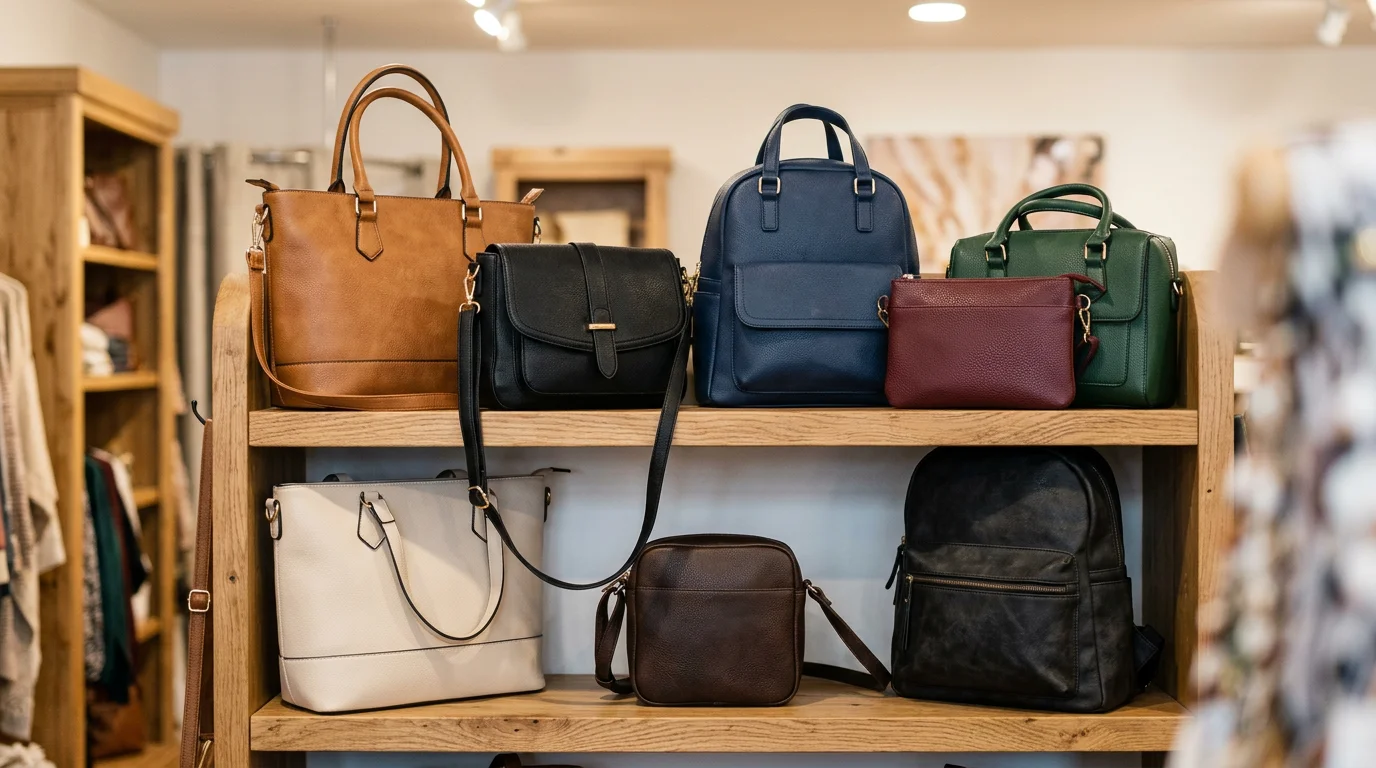
Choosing Silhouettes
Silhouette selection determines whether the range covers real use occasions.
Start from occasions, not from products
List how customers will use bags: commuting, shopping, travel, evening, work documents, gifting. Then assign a silhouette to each occasion before looking at a catalogue.
The four anchors
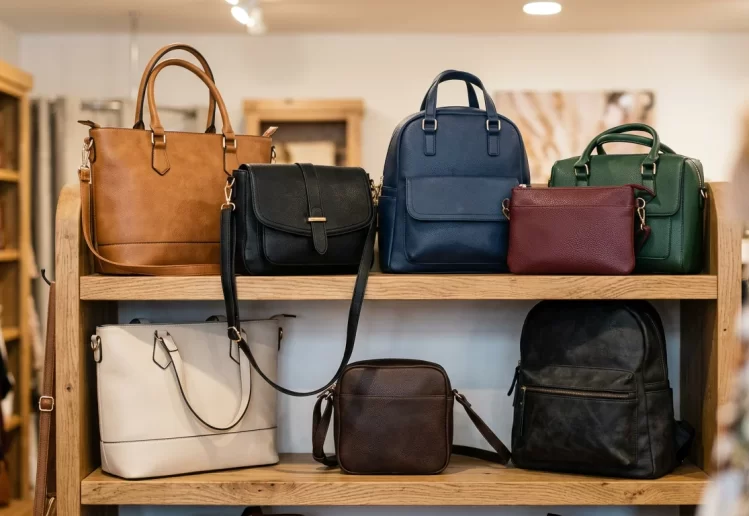
Most bag ranges need a tote, a crossbody, a shoulder or hobo, and a backpack or larger carry. These four cover the majority of occasions and give the shelf structure.
Size variation within a silhouette
Offering one tote in two sizes is cheaper than offering two separate tote designs. It uses the same pattern, material and construction knowledge.
What to avoid in a first range
Highly seasonal shapes, complex constructions and novelty hardware all raise cost and risk before the store has any sales data.
| Occasion | Silhouette | Range role |
|---|---|---|
| Daily commute | Tote or shoulder | Core volume |
| Errands and weekends | Crossbody | Entry price, impulse |
| Work with laptop | Structured tote or backpack | Higher price tier |
| Travel | Duffel or large carry | Occasional, high value |
| Evening | Small clutch or mini | Gifting, add-on |
| Gifting | Small crossbody or pouch | Seasonal driver |
Construction complexity as a cost driver
Every additional panel, zip, lining division and hardware piece adds labour and failure points. A first range should favour simple construction executed well over complex construction executed inconsistently.
The silhouette that sells in your market
Local carrying habits vary: public transport, cycling, car use and climate all change what sells. A range built from a foreign catalogue without adjusting for local use tends to leave the wrong styles in stock.
Colour Strategy and Repeatability
Colour is where wholesale ranges most often fail, because colour decisions made for one season cannot be repeated for the next.
Core colours first
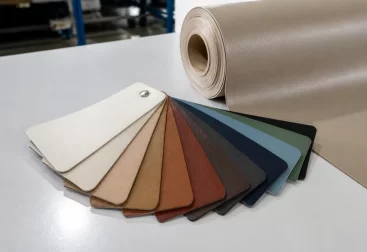
Two or three colours that can be repeated across seasons give the range stability. Black, a neutral tan and a dark brown cover most markets.
Accent colours in small quantity
One or two seasonal accents add interest without carrying replenishment risk. They are bought shallow and not reordered.
The repeatability test
Before committing, ask whether the material in that colour will be available in six months. If the answer is uncertain, the colour is an accent, not a core.
Shade consistency across a range
If several styles share a colour, they should share a material batch where volume allows. Independently produced batches in the same nominal colour will differ visibly on a shelf.
| Colour role | Share of range | Reorder intent |
|---|---|---|
| Core neutral | 50 to 60 percent | Repeat every season |
| Secondary neutral | 20 to 25 percent | Repeat, adjust shade if needed |
| Seasonal accent | 15 to 20 percent | One season only |
| Statement colour | Under 10 percent | Test, no reorder |
| Print or texture | Under 10 percent | Test, no reorder |
| Lining contrast | N/A | Can change freely |
A colour that cannot be repeated is not a range colour. It is a one-off purchase wearing a range colour’s clothes.
Approving colour before the order
Approve from a physical standard in the light where customers will see it, and retain a sealed sample. A reorder approved against a new batch rather than the original sample will drift.
Size Grading and Dimensions
Size logic affects cost, shelf presentation and customer satisfaction.
Grading within a silhouette
Offering a style in two sizes uses one pattern and one construction method. The second size adds pattern work but little else, which makes it an efficient way to widen a range.
Useful dimensions versus arbitrary ones
Size should be defined by function: does it hold a laptop, an A4 folder, a water bottle. Dimensions chosen for visual balance alone tend to fail in use.
Stated dimensions and tolerance
Publish dimensions with a tolerance. A bag specified at 40 cm that arrives at 38 cm is within most production tolerances but outside a customer’s expectation if the listing implies precision.
Weight as a specification
Weight matters for crossbody and shoulder styles and is often omitted. A bag that is functionally correct but uncomfortable will be returned.
| Size decision | Functional basis | Common failure |
|---|---|---|
| Tote height | Holds A4 or laptop | Too shallow for folders |
| Base width | Stability when standing | Tips over when loaded |
| Strap drop | Fits over a coat | Too short in winter |
| Crossbody strap length | Adjustable range | Fixed, fits one body type |
| Interior divisions | Device and bottle fit | Dividers too narrow |
| Weight empty | Comfort threshold | Heavy hardware, thin straps |
The two-size rule
For the highest-volume silhouette, offer two sizes. It captures customers who would otherwise buy elsewhere for size reasons while keeping the range narrow.
Price Architecture
Price architecture determines whether the range can serve different customers without confusing them.
Three tiers, clearly separated
An entry tier, a core tier and a premium tier. Each should be visibly different in size, material or construction so the price difference is justified on the shelf.
Gaps that lose sales
Large gaps between tiers leave customers with nothing to step up to. Small gaps make the tiers pointless and cannibalise the middle.
Landed cost and margin
Work from landed cost: goods, freight, duty, and any inspection or compliance cost. A wholesale price that looks healthy against goods cost alone can be thin after freight.
Markdown room
Build the range so that at least the core tier can be marked down without selling below cost. A range priced too tightly has no room to respond to slow sell-through.
| Tier | Role | Typical share of units |
|---|---|---|
| Entry | Footfall and first purchase | 25 to 30 percent |
| Core | Volume and repeat purchase | 50 to 60 percent |
| Premium | Margin and aspiration | 15 to 20 percent |
| Add-on | Attachment rate, gifting | 5 to 10 percent |
| Statement | Identity, press, display | Under 5 percent |
| Markdown buffer | Room to discount | Built into core tier |
Why the entry tier must be genuine
An entry price point supported by a bag that looks cheap damages the whole range. The entry tier should be simpler, not worse.

The First Buy Quantity
The first buy sets the tone for the range and the season. Getting the quantity logic right matters more than getting every style right.
Units per style in the first buy
Enough to fill the display and provide a sell-through read, typically three to six units per SKU. Fewer than three and a style sells out before it can be judged; more than six and cash is tied in unproven stock.
Depth on the anchors
The four anchor silhouettes can carry slightly more depth than the accents. They are the styles the range is built around, and they are the most likely candidates for reorder.
Reserve for reorder
Hold back part of the budget for reorder rather than committing everything to the first buy. A range that cannot be topped up in the first two months loses its best sellers.
Total budget split
A practical split is roughly seventy percent to the first buy and thirty percent to reorder and response. New buyers routinely spend ninety percent and then watch bestsellers sell out.
| Range element | Units per SKU | Purpose |
|---|---|---|
| Anchor silhouettes | 4 to 6 | Display plus sales read |
| Secondary styles | 3 to 4 | Choice and test |
| Accent colours | 2 to 3 | Interest, no reorder |
| Premium tier | 2 to 3 | Margin, display anchor |
| Entry tier | 4 to 6 | Footfall conversion |
| Add-ons | 6 to 10 | Attachment rate |
The display minimum
Each SKU needs enough units to survive the first display period without looking depleted. A shelf with two units of each style reads as a clearance rather than a range.
Seasonality timing
Order so that stock arrives before the season, not during it. Late arrival compresses the selling window and forces markdowns on goods that never had a chance.
Working With MOQ
Minimum order quantities shape what a range can be, especially at small scale.
Where MOQ applies
Usually per style, per colour, per material combination. A low MOQ per style with a higher MOQ per colour creates a hidden constraint that appears when colours are chosen.
Consolidating colours to meet MOQ
If a colour MOQ is high, choose fewer colours rather than spreading volume thin. Two colours at full depth beat four colours at half the minimum.
Negotiating MOQ with structure
Suppliers reduce MOQ when the order is easy to produce: shared material, shared hardware, simple construction, standard packaging. Offering those simplifications is more persuasive than asking for a discount.
The real cost of small orders
Low MOQ usually carries a higher unit price and a longer lead time. The saving in commitment is real, but it is paid for per unit.
| MOQ lever | Effect | Trade-off |
|---|---|---|
| Shared material across styles | Lowers material MOQ impact | Less variety |
| Shared hardware | Lowers component minimums | Fewer design options |
| Standard packaging | Reduces setup labour | Less branded presentation |
| Single colour per style | Concentrates volume | Narrower colour offer |
| Repeat pattern from prior order | Removes pattern cost | Less newness |
| Longer lead time | Allows production batching | Less responsive to demand |
Ask for the constraint, not the discount
Ask which specific minimum is driving the price: material, hardware or setup. The answer usually reveals a lever that costs nothing to pull.
Total order value versus per-style MOQ
Some suppliers will flex per-style minimums if total order value is adequate. That flexibility is worth more to a new store than a small unit discount.
Core, Seasonal and Test Pieces
Separating the range into roles makes buying decisions and reorder decisions much simpler.
Core pieces
Styles intended to run for multiple seasons in stable colours. They carry the volume and are expected to be reorderable.
Seasonal pieces
Styles or colours that run for one season. They provide newness and are planned to sell through rather than repeat.
Test pieces
Deliberately small buys to explore a silhouette, colour or price point. They are expected to either fail cheaply or earn promotion to core.
Why the split matters operationally
Each role has different depth, different markdown tolerance and different reorder expectations. Mixing them produces the common error of reordering a test piece or under-buying a core style.
| Role | Depth | Reorder | Markdown tolerance |
|---|---|---|---|
| Core | Deep | Expected | Low, protect price |
| Seasonal | Medium | None | Medium, plan exit |
| Test | Shallow | Only if promoted | High, accept loss |
| Statement | Very shallow | None | Low, sells on identity |
| Add-on | Deep | Expected | Low, high turnover |
| Carry-over | Medium | Yes, next season | Medium |
A range without roles is a list of products. Roles are what turn a list into a plan.
Promotion and demotion
A test piece that sells strongly becomes core in the next buy. A core style that declines becomes carry-over and then exits. Reviewing roles each cycle keeps the range honest.
Material Consolidation
Material choices drive cost, consistency and reorder feasibility more than most buyers expect.
Fewer materials, better terms
Using two or three materials across the whole range concentrates purchasing volume and simplifies quality control. Each additional material adds a minimum, a lead time and a shade reference.
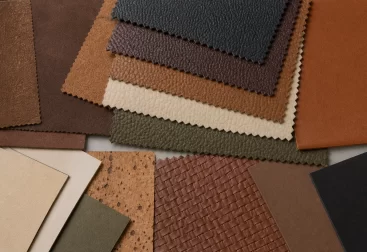
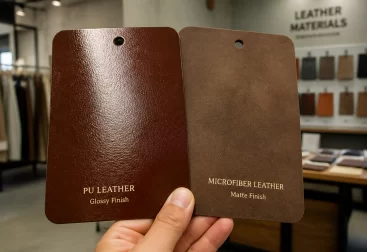
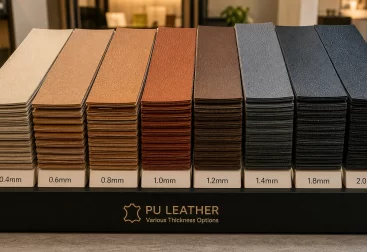
PU leather as a range material
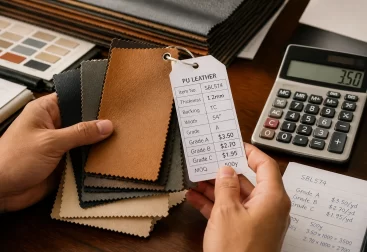
Coated material offers consistent colour and easy cleaning, which suits wholesale ranges where repeatability matters. It also allows a range to share a single material across many styles without visible variation.
Mixing materials deliberately
Where a range includes both coated and textile materials, the mixing should be intentional: a canvas body with coated trim reads as design, not as inconsistency.
The reorder question
Before committing to a material, confirm it will be available for reorder. A material that disappears mid-season strands the range and forces a colour change that customers notice.
| Material decision | Benefit | Risk |
|---|---|---|
| Single material, multiple colours | Volume leverage, consistent quality | Less textural variety |
| Two materials, split by tier | Clear price separation | Two supply chains |
| Exclusive material | Differentiation | Reorder dependency |
| Stock material | Fast reorder | Competitors use it too |
| Seasonal material | Newness | Cannot repeat |
| Coated plus textile | Visual variety | Two care stories |
Lining as a range tool
Lining can vary without affecting the exterior material or the reorder risk. It is the cheapest way to give a range seasonal newness while keeping core shells unchanged.
Planning Reorders
A wholesale range is only as good as its ability to restock what sells.
Lead time plus safety
Work out the total replenishment time: production lead time, transit and receiving. Stock cover should exceed that total, or the style will gap before the reorder lands.
Reorder triggers
Set a stock level that triggers a reorder rather than waiting for a sellout. The trigger should account for lead time, not for when the shelf looks empty.
What to reorder
Reorder the styles with proven sell-through and stable size demand. Reordering an unproven style because the colour is popular is a common and expensive mistake.
The colour continuity problem
A reorder in the same nominal colour from a new batch may differ. Agree in advance that reorders match a retained sample, and check the first units on arrival.
| Reorder element | Practical approach | Failure mode |
|---|---|---|
| Lead time | Measured, not assumed | Gap before stock lands |
| Trigger level | Based on lead time and rate | Waiting for sellout |
| Style selection | Sell-through evidence | Reordering on opinion |
| Colour match | Retained sample reference | Visible batch drift |
| Size mix | Per-size sell-through | Reordering the wrong sizes |
| Quantity | Cover to next cycle | Over or under cover |
The size mix correction
If one size sells out first, the reorder should shift the mix rather than repeat the original ratio. Size demand is one of the fastest things to learn from a first buy.
Minimum reorder quantities
Confirm reorder minimums before the first order. A style that can be reordered only at the original MOQ may be impossible to restock economically.
Building a Coordinated Range
Coordination is what makes a range look designed rather than assembled.
Shared hardware
Using one hardware family across styles creates visual consistency and simplifies quality control. Mixed hardware finishes read as unrelated products.
Consistent proportions
Styles in a range should share a visual language: similar strap widths, comparable edge treatment, coherent scale relationships. Proportion mismatch is the most common reason a range looks cheap.
Colour linkage
Colours should repeat across styles so that a customer who likes one bag recognises the family. A colour used once in a range has no reinforcing effect.
The signature element
One repeated detail, whether a stitch line, a hardware shape or a lining pattern, gives the range identity at almost no cost.
| Coordination device | Cost impact | Effect |
|---|---|---|
| Shared hardware family | Neutral to positive | Strong consistency |
| Repeated stitch detail | Low | Recognisable signature |
| Common lining | Low | Cohesion inside the bag |
| Consistent edge treatment | Neutral | Premium perception |
| Colour repetition | Neutral | Family recognition |
| Mixed hardware finishes | Neutral | Range looks assembled |
Coordination across suppliers
Where a range is split across suppliers, coordination requires a written specification for hardware, thread and edge treatment. Two suppliers interpreting a verbal brief will produce two languages.
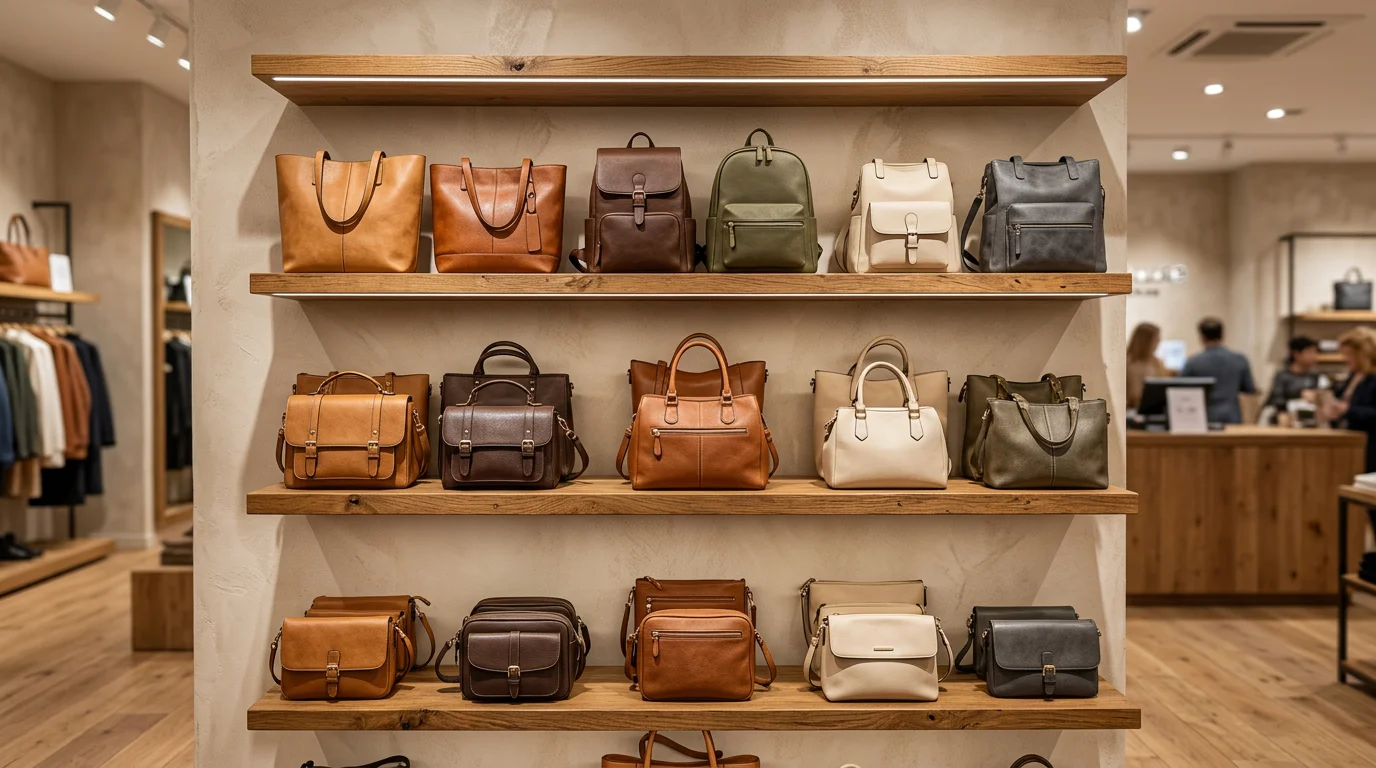
Designing for the Shelf
A range that does not display well sells below its quality.
Counting facings
Work out how many facings the fixture offers and plan the range to that number. Overflow styles end up stacked, where they sell poorly and look like surplus.
Colour blocking
Grouping by colour rather than by style often reads better on a wall. It also makes a range look larger than its style count.
Size sequencing
Arrange by size within style so customers can compare. Random sequencing forces the customer to handle every bag, which reduces conversion.
Height and sightline
Place the highest-margin and highest-conversion styles at eye level. The best-selling silhouette should not be on the bottom row.
| Display decision | Effect on selling |
|---|---|
| Facings matched to range | No crowding, full range visible |
| Colour blocking | Range reads larger and coherent |
| Size sequencing | Easier comparison |
| Eye-level placement | Higher conversion on key styles |
| Adequate lighting | Colour and finish read correctly |
| Removable props | Flexibility for reorders |
Plan for depletion
A display that collapses when one style sells out forces a reset. Build the range so remaining styles can be re-blocked into a smaller footprint without looking empty.
Choosing the Right Supplier
The supplier determines whether the range can be repeated, expanded or corrected mid-season.
Range capability, not just product capability
A supplier who can make one style well may not be able to make a coordinated range. Ask how many styles they can run concurrently and how they manage shared materials across styles.
Reorder flexibility
Ask directly what the minimum reorder is and how long it takes. A supplier who treats a reorder as a new order with full MOQ limits the range’s ability to respond.
Consistency across styles
For a coordinated range, the same hardware and thread must be available across all styles. Confirm this before the first order rather than discovering a substitution later.
Communication during production
A supplier who reports progress and flags problems without being asked is worth more than a cheaper one who goes quiet. Range launches are timing-critical.
| Supplier question | What a good answer shows |
|---|---|
| How many styles can you run at once? | Capacity matched to range width |
| What is the reorder minimum? | Realistic replenishment |
| Can hardware be shared across styles? | Coordination is feasible |
| What is your lead time range? | Measured, with assumptions |
| How do you handle material changes? | Change control exists |
| Can you hold a retained sample? | Colour continuity possible |
The single-supplier advantage
For a first range, one supplier usually beats several. Shared material, shared hardware and a single quality standard produce a more coherent result and simpler administration.
When to split
Split only when a supplier cannot cover a category, or when volume justifies a second source. Splitting early multiplies coordination work before the range has any sales evidence.
Terms That Protect the Range
Commercial terms decide what happens when something goes wrong, which in a first range is often.
Payment structure
A deposit with balance on inspection or shipment is standard. Paying in full before production removes the buyer’s leverage at exactly the point it is needed.
Inspection rights
State the right to inspect before shipment and to reject outside the agreed standard. Without it, the first range becomes a test of the supplier’s goodwill.
Lead time with consequences
A lead time without a consequence is a hope. Agree what happens if shipment slips past the window that matters for the season.
Colour and material approval
Require written approval of colour and material before bulk production, and retain samples. This is the cheapest clause in the contract and prevents the most common dispute.
| Term | Purpose | If absent |
|---|---|---|
| Deposit and balance split | Retains leverage | No remedy after payment |
| Inspection before shipment | Catches defects at source | Defects arrive with goods |
| Lead time with remedy | Protects the season | Late stock misses selling window |
| Colour approval in writing | Defines the standard | Dispute over what was agreed |
| Retained samples | Enables reorder matching | Batch drift on reorder |
| Reorder commitment | Secures replenishment | Bestseller cannot be restocked |
The reorder clause
Ask for a written commitment on reorder lead time and minimum at the time of the first order. It costs nothing to request and is very hard to obtain later.
Packaging and labelling
Agree packaging and labelling standards up front. A range that arrives without consistent labelling costs days of rework at the worst moment.
Reading the First Weeks
The first weeks of selling produce the information the second buy depends on.
What to measure
Sell-through by style, by colour and by size. These three cuts answer different questions and should be read separately.
Sell-through by style
Identifies which silhouettes deserve depth. Styles that sell out fastest are candidates for promotion to core and for deeper reorder.
Sell-through by colour
Reveals whether the core colours are doing their job or whether an accent is outperforming expectation. A strong accent is a signal about the market, not necessarily a prompt to reorder.
Sell-through by size
Shows the correct size ratio for the reorder. Most ranges start with an assumed ratio and correct it after the first cycle.
| Measure | Reads | Action |
|---|---|---|
| Style sell-through | Silhouette demand | Promote winners to core |
| Colour sell-through | Colour appetite | Adjust core colour depth |
| Size sell-through | Size ratio | Correct reorder mix |
| Rate of sale | Speed not just total | Set reorder timing |
| Return reasons | Functional failures | Fix specification |
| Attachment rate | Add-on performance | Adjust add-on depth |
Rate of sale versus total
A style that sold ten units in two weeks is performing differently from one that sold ten in eight weeks. Rate of sale drives reorder timing; total sales volume alone does not.
Returns as specification feedback
Return reasons reveal specification errors: straps too short, base too narrow, lining too tight. These are fixable in the second buy at no cost if the data is read.
Building the Second Buy
The second buy is where a range becomes a business.
Deepen the winners
Increase depth on the styles with the strongest rate of sale. Most of the second buy should go to proven styles, not to new experiments.
Retire the failures cleanly
Styles with weak sell-through should exit rather than be carried forward out of habit. Carrying them consumes budget and shelf space that the winners need.
Add selectively
Add one or two new styles to test, funded from the retired styles’ budget. This keeps the range evolving without destabilising it.
Fix specification errors
Correct the functional issues surfaced by returns. A strap length change or a base width adjustment costs little and removes a recurring complaint.
| Second buy decision | Typical share of budget | Basis |
|---|---|---|
| Deepen proven styles | 50 to 60 percent | Rate of sale |
| Maintain core colours | 15 to 20 percent | Colour sell-through |
| New test styles | 10 to 15 percent | Gap in coverage |
| Specification fixes | 5 to 10 percent | Return reasons |
| Seasonal accent | 10 percent | Calendar |
| Reserve for reorder | Held back | In-season response |
A range improves when the second buy is driven by the first buy’s data rather than by the first buy’s intentions.
The range review meeting
Review the range on a fixed cycle with style, colour, size and return data in front of you. Decisions made without the data tend to repeat the previous assumptions.
Keeping supplier continuity
Repeat styles should stay with the same supplier where possible. Switching supplier on a proven style reintroduces variation and risks the bestseller.
Common Range Mistakes
Most first ranges repeat a small number of structural errors.
Too much breadth, too little depth
The most common error. A wide range with two units per style looks thin, sells slowly and leaves nothing to reorder.
Colours that cannot be repeated
Seasonal colours bought as if they were core create a range that cannot be replenished and a customer expectation that cannot be met next season.
No reorder plan
A range planned only to the first delivery is a one-off purchase. Bestsellers sell out and the store loses the demand it just created.
Price tiers that overlap
Tiers too close together confuse customers and cannibalise the middle. Tiers too far apart leave gaps that send customers elsewhere.
| Mistake | Consequence | Correction |
|---|---|---|
| Excessive breadth | Thin display, no reorder | Cut styles, add depth |
| Unrepeatable colours | Cannot replenish | Core neutrals plus accents |
| No reorder plan | Bestsellers gap | Trigger levels and lead time |
| Overlapping tiers | Confused positioning | Visible differentiation |
| Buying from catalogue only | Styles unsuited to market | Start from occasions |
| Ignoring display capacity | Crowded shelves | Plan to facings |
Buying the catalogue instead of the range
Selecting styles one by one from a supplier catalogue produces a collection, not a range. The range has to be designed against occasions, shelf space and price tiers before products are chosen.
Skipping the retained sample
Without a retained sample, a reorder cannot be checked against the original. The first sign of drift is a customer complaint about a colour that changed.
FAQ
How many bag styles should a new store open with?
Six to ten styles for a small store, twelve to sixteen for a larger one. The constraint is usually shelf facings and open-to-buy rather than customer demand, so count positions and divide the budget before choosing styles.
Should I buy more styles or more units per style?
In the first buy, favour breadth enough to learn what sells, at three to six units per SKU. Once the data shows which styles work, shift budget toward depth on those styles in the second buy.
How many colours should a first range have?
Two or three core neutrals that can be repeated, plus one or two accents bought shallow. Core colours should carry fifty to sixty percent of the range; accents should not be treated as reorderable.
What is a reasonable first order quantity per style?
Three to six units per SKU for most styles, with slightly more depth on anchor silhouettes. Fewer than three makes the display look depleted; more than six ties cash in unproven stock.
How do I handle high MOQs on a limited budget?
Concentrate volume rather than spreading it: fewer colours, shared materials, shared hardware and standard packaging. Ask the supplier which specific minimum drives the price, since that answer usually reveals a lever that costs nothing.
Should I use one supplier or several for a first range?
One supplier is usually better at the start. Shared material, shared hardware and a single quality standard produce a more coherent range and far less administration. Split only when a category is not covered or volume justifies it.
How much of my budget should I hold back for reorder?
Around thirty percent. Spending ninety percent on the first buy is the most common cause of bestsellers selling out before they can be restocked.
How long should I wait before judging a style?
Long enough to read rate of sale rather than total sales, typically four to six weeks of trading. A style that sells ten units in two weeks is performing differently from one that takes two months.
What should I do with styles that do not sell?
Retire them in the second buy and redirect the budget to proven styles. Carrying weak styles forward out of habit consumes the shelf space and cash the winners need.
Why does the same colour look different between two styles?
They were probably produced from different material batches. Where styles share a colour, they should share a batch where volume allows, and reorders should be matched against a retained physical sample.
How important is packaging for a wholesale range?
More than most buyers expect. Inconsistent labelling and packaging costs days of rework at launch. Agree the standard with the supplier before production rather than after arrival.
When should I add a second size to a style?
For the highest-volume silhouette, in the second buy, once demand is proven. Offering two sizes of one proven style is cheaper and more effective than adding a new style.
Building a wholesale bag range for a new store?
Send your store profile, target price points and quantity plan to info@gionar.com and we will share the range structures, MOQ options and reorder terms we work with, together with material and colour availability for the coming season.