Which In-Process Checks Stop Defects Before Final Inspection?
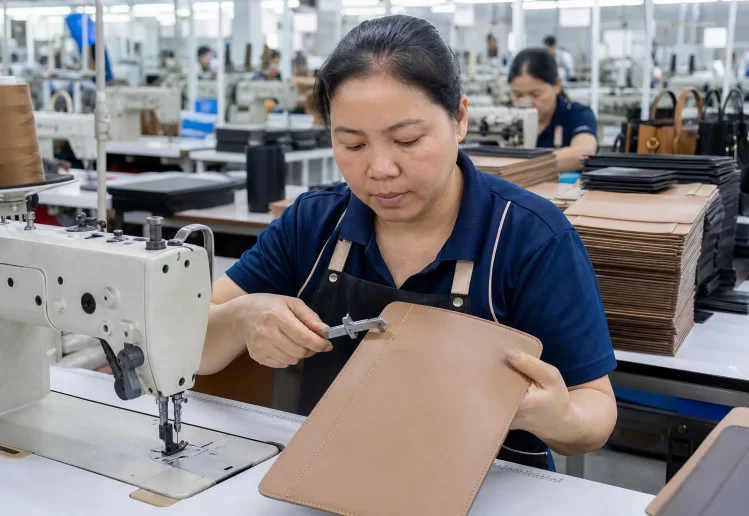
Final inspection is the most expensive place in a bag factory to find a defect. By the time a bag reaches that table, the material has been cut, the seams are sewn, the hardware is set and the labour is spent. Rejecting it means writing off all of that, and accepting it means shipping a known fault.
The alternative is not more final inspectors. It is a sequence of checks placed where a defect is still cheap to correct. A cut panel that is wrong can be re-cut from remnant material in minutes. The same error discovered after assembly costs a whole bag.
Most factories do run in-process checks. The problem is that many of them are decorative. A stitch count is recorded on a card nobody reads. A first-off sample is approved after the batch has already run. A patrol inspector walks past without stopping. The check exists in the procedure, satisfies an audit, and catches nothing.
The difference between a working check and a decorative one comes down to four properties: it happens early enough to matter, it produces a decision rather than a signature, it has a defined reaction when it fails, and its results are visible to the people whose work it measures. A check missing any of those four becomes paperwork.
PU leather adds specific pressure. Coated surfaces show stitch marks and needle damage permanently, so a seam cannot simply be unpicked and redone without a visible trace. Hardware setting compresses the coating. Cutting errors reveal themselves as mismatched panels rather than as measurable size faults. The checks have to be positioned accordingly.
This article sets out the checks that actually stop defects: what to check at each stage, how often, who performs it, what decision the check must produce, and how to tell whether a check is working or merely present.
- Why Final Inspection Is Too Late
- The Gate Model of Process Control
- Incoming Material Checks
- First-Off Approval at Cutting
- Cut Panel Verification
- Component and Sub-Assembly Checks
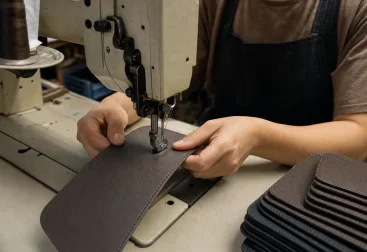
- Stitch and Seam Checks on the Line
- Hardware and Attachment Checks
- Dimensional Checks Mid-Process
- Shade and Appearance on the Line
- Edge, Cleaning and Finishing Checks
- The Travelling Record
- Roving Inspection and Patrol QC
- Self-Check Versus Dedicated Inspector
- Frequency, Sampling and Trigger Points
- Stop Authority and Escalation
- Checks Specific to PU Leather
- Measuring Whether the Checks Work
- FAQ
Why Final Inspection Is Too Late
The economics of defect discovery explain why the position of a check matters more than its thoroughness.
Cost rises with position
A defect caught at material intake costs a roll replacement. Caught at cutting, it costs material and cutting time. Caught after assembly, it costs the entire bag plus the labour invested in it.
Final inspection cannot inspect everything
At final inspection a bag is complete and complex. Checking every seam, every hardware set and every dimension takes minutes per unit. At the station where each operation happens, the same check takes seconds.
Some defects are hidden by assembly
Stitch density inside a gusset seam, thread tension on a hidden lining join and reinforcement placement are all invisible once the bag is closed. They can only be checked before.
The sorting trap
A factory that relies on final inspection ends up sorting rather than producing. Sorting is a cost that repeats every order and leaves the process unchanged.
| Discovery point | Typical cost | Recovery |
|---|---|---|
| Material intake | Roll replacement | Full, supplier claim possible |
| Cutting | Material plus cutting time | Re-cut from remnant |
| Pre-assembly | Components plus handling | Replace component |
| Sewing | Panels plus labour | Unpick, often visible |
| Final inspection | Whole bag plus all labour | Rework or scrap |
| After shipment | Return, freight, reputation | Rarely recoverable |
The ratio that matters
In most bag operations, a defect caught at final inspection costs several times what the same defect would have cost at the station where it originated. That ratio, not the inspection headcount, determines quality cost.
Why factories still lean on final inspection
Final inspection is visible, easy to staff and easy to show a buyer. In-process checks require supervisors to own quality at their own stations, which is harder to organise than a table at the end of the line.
The Gate Model of Process Control
Useful process control is a series of gates, each of which must pass before work continues.
What makes something a gate
A gate has an entry condition, a check, a decision and a consequence. If work can continue without the decision, it is not a gate but a note.
The five gates in bag production
Material release, cutting approval, component release, station checks and pre-packing verification. Each has a different owner and a different failure mode.
Gate ownership
Each gate needs a named owner who can hold the work. A gate owned by the production supervisor is usually weaker than one owned by a separate quality role, though both can work.
Why gates beat patrols
A patrol samples whatever is happening. A gate blocks the flow until a condition is met, which makes it structurally harder to skip.
| Gate | Owner | Holds what |
|---|---|---|
| Material release | Stores plus QC | Rolls entering production |
| Cutting approval | Cutting supervisor | Batches after first-off |
| Component release | Prep supervisor | Bundles to the line |
| Station checks | Operator and supervisor | Units leaving a station |
| Pre-packing verification | QC | Cartons before sealing |
The weakest link rule
A chain of gates is only as good as its most permissive one. A factory with four strong gates and one that operates on trust has one gate.
Incoming Material Checks
The first gate determines how much of the rest of the work is even possible.
What to check on receipt
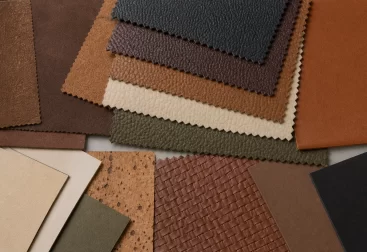
Colour against the approved standard, thickness, surface finish, backing integrity and roll length. Each is quick and each catches a class of problem that is expensive later.
Sampling per roll, not per shipment
Variation occurs between rolls in the same delivery. Checking one roll from a pallet of twenty does not establish the pallet.
Record the roll identity
Every roll released to production should carry an identifier traceable to its delivery and inspection result. Without it, nothing downstream can be traced.
The release decision
Material must be explicitly released, held or rejected. Silent acceptance because nobody decided is the most common failure at this gate.
| Check | Method | Failure consequence if missed |
|---|---|---|
| Colour | Compare to retained standard in defined light | Shade complaints at retail |
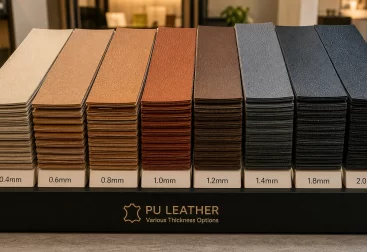
| Thickness | Gauge at several points per roll | Inconsistent feel and stitch behaviour |
| Surface finish | Visual and touch against sample | Gloss or grain mismatch |
| Backing integrity | Flex and peel at the edge | Delamination in use |
| Roll length | Measure or weigh | Yield shortfall, cost overrun |
| Roll condition | Check for marks and compression | Usable area reduced |
Why per-roll sampling pays
A single rejected roll caught at intake costs an argument with the supplier. The same roll discovered after cutting costs a batch of mismatched panels and a delayed order.
First-Off Approval at Cutting
First-off approval is the highest-leverage check in the whole process and the one most often performed too late.
What first-off means
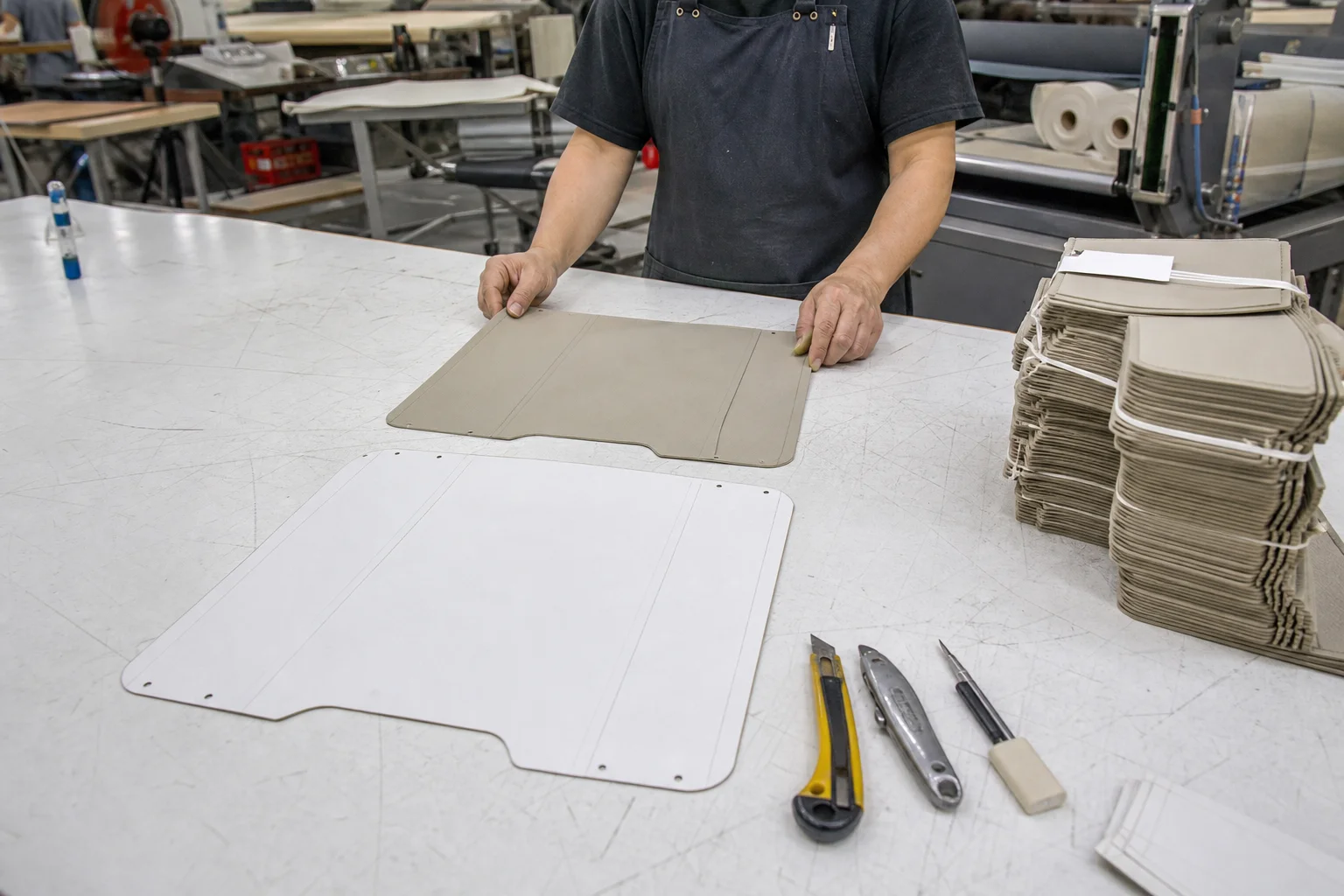
The first complete set of components from a new order, a new marker, a new material lot or a machine change is checked in full before the batch continues.
When it must happen
Before the batch runs, not after. An approval taken from the first completed bag is a post-mortem of material already consumed.
What to verify
Dimensions against the specification, grain direction, shade consistency across the set, notch and hole positions, and edge quality.
Who signs
A named person with authority to stop the batch. A signature from someone who cannot stop production is a formality.
| First-off element | Verified against | If skipped |
|---|---|---|
| Dimensions | Approved specification | Whole batch wrong size |
| Grain direction | Marked direction on marker | Texture mismatch on bag |
| Shade across set | Same-roll rule | Two-tone bags |
| Notch and hole position | Pattern reference points | Assembly misalignment |
| Edge quality | Cut sample standard | Fraying and rough edges |
| Count per set | Bill of components | Short sets at the line |
Triggers for a new first-off
A new order, a new material lot, a re-sharpened blade, a marker change or a change of operator on a critical station. Each introduces a variable that the previous approval did not cover.
Retaining the approved set
The approved first-off set should be kept at the cutting table as a physical reference. It converts an approval into something a cutter can compare against hours later.
Cut Panel Verification
After first-off, ongoing verification keeps the batch aligned with the approved standard.
Frequency that matches risk
Check the first set of each bundle, then at a defined interval through the batch. Interval checks catch drift from blade wear and operator fatigue.
What drift looks like
Dimensions move gradually as a blade dulls. The panels remain within a loose tolerance individually while the set no longer assembles cleanly.
Counting and bundling
Verify that each bundle holds a complete set with the correct count. Short bundles create line stoppages and mismatched panels.
Marking and identification
Bundles need style, size, colour and order identification. Unmarked bundles cannot be traced and are the usual cause of mixed shipments.
| Verification | Frequency | Catches |
|---|---|---|
| First set of each bundle | Every bundle | Set completeness and size |
| Dimensional spot check | Defined interval | Blade wear drift |
| Notch and hole position | Every bundle | Assembly misalignment |
| Shade across set | Every bundle | Mismatched panels |
| Bundle count | Every bundle | Short sets |
| Bundle labelling | Every bundle | Mixed orders |
The record at this gate
A short entry per bundle, with time and initials. Its purpose is not to satisfy an auditor but to show when drift began if a problem appears later.
Component and Sub-Assembly Checks
Bags are assembled from components, and component defects are cheapest to fix before they are joined to anything.
Pre-assembly operations
Edge folding, skiving, reinforcement attachment and lining preparation all happen before the main assembly. Each can be checked in isolation.
Skiving and thickness
Skived edges must be even, or the finished seam will be lumpy. Uneven skiving is invisible on the component and obvious on the bag.
Reinforcement placement
Reinforcement that is misplaced or missing cannot be detected after closing. Check position and presence at the point of attachment.
Sub-assembly integrity
Pockets, dividers and internal organisers are sub-assemblies. Check their dimensions and attachment before they disappear inside the bag.
| Component check | Method | Hidden if missed by |
|---|---|---|
| Skive evenness | Visual and thickness gauge | Closed seam |
| Reinforcement present | Count and position | Lining attachment |
| Pocket dimensions | Template check | Assembly into body |
| Lining cut quality | Visual at edges | Bag closure |
| Edge fold width | Gauge against sample | Top stitching |
| Component count | Against bill of components | Line start |
A component check costs seconds. The same defect found after closing the bag costs the bag.
Why this gate is often absent
Component preparation is treated as low-skill work and supervised loosely. It is also where a large share of hidden defects are created.
Stitch and Seam Checks on the Line
Sewing is where the bag takes its final form, and where defects become difficult to reverse.
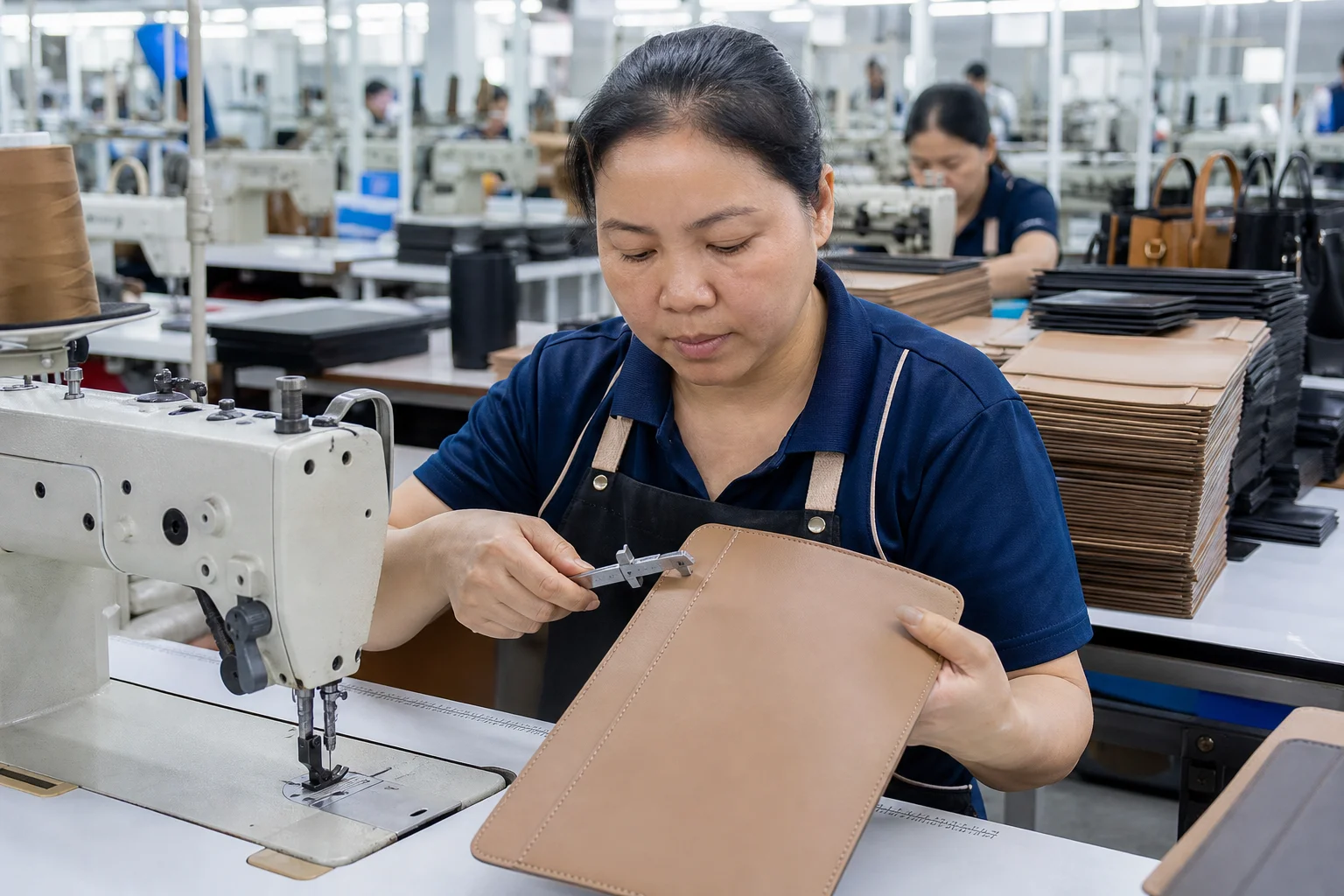
Stitch density
Check stitches per inch against the specification at each machine, at the start of a run and at intervals. Density drift from tension changes is gradual and invisible to the eye.
Tension and appearance
Looping on the underside, puckering on the top and skipped stitches all indicate tension problems. A first-run check on scrap material catches them before the first panel.
Seam allowance
Verify that the allowance matches the specification. A narrow allowance reduces strength and shows at the edge after folding.
Needle damage on coated material
PU leather marks permanently where a needle has been. Wrong needle type or a bent needle produces visible holes that cannot be repaired without trace.
| Seam check | Standard | Failure mode |
|---|---|---|
| Stitches per inch | Per specification | Weak or bulky seams |
| Tension balance | No looping, no puckering | Visible defects, weakness |
| Seam allowance | Per pattern | Edge failure after folding |
| Backstitch at ends | Defined length | Seam opening in use |
| Needle condition | Correct type, undamaged | Permanent holes in coating |
| Thread match | Approved shade and ticket | Visible contrast error |
The scrap check
Before running the first panel of a new order, each machine should sew a test piece of the actual material. Tension and density behave differently on coated material than on the scrap used for setup.
Who checks
The operator checks their own first piece; the supervisor verifies at intervals. A check performed only by a roving inspector misses the first faulty unit.
Hardware and Attachment Checks
Hardware failures are highly visible to end users and largely preventable at the setting station.
Setting and compression
Rivets, snaps, magnets and eyelets must be set to the correct depth. Over-setting compresses and cracks the coating; under-setting leaves the fitting loose.
Pull testing
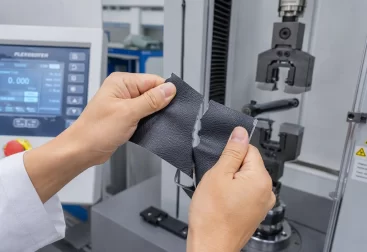
A defined pull test on a sample of settings per shift catches weak settings before they reach the customer. The test is quick and does not require equipment beyond a simple gauge.
Backing and reinforcement
Hardware should be backed where the design specifies. Missing backing plates are invisible from outside and cause tearing in use.
Position and alignment
Hardware placed from a template keeps positions consistent across a run. Freehand placement produces visible asymmetry between the two sides of a bag.
| Hardware check | Method | If missed |
|---|---|---|
| Setting depth | Visual and feel against sample | Cracked coating or loose fitting |
| Pull strength | Sample pull test each shift | Fitting separates in use |
| Backing present | Check before lining | Tearing at the attachment |
| Position alignment | Template comparison | Visible asymmetry |
| Finish condition | Visual for plating faults | Corrosion or discolouration |
| Matching sets | Colour and finish consistency | Mismatched hardware on one bag |
Timing of the check
Hardware checks must happen before the lining covers the attachment. After lining, a missing backing plate cannot be seen and cannot be corrected without opening the bag.
Dimensional Checks Mid-Process
Dimensions drift through assembly, and catching the drift early limits how much work is affected.
Measuring at defined points
Specify which dimensions are critical and where they are measured. A bag has many dimensions; checking all of them wastes time and checking none loses control.
Checking after key joins
Measure after the gusset join and after the top edge is finished. These are the points where accumulated error becomes visible.
Tolerance in practice
Tolerances should reflect what affects fit, function and appearance. A pocket position that must hold a device needs a tighter tolerance than overall height.
Recording the drift
Record measurements, not just pass or fail. A trend toward the tolerance limit warns before a failure occurs.
| Stage | What to measure | Why here |
|---|---|---|
| After cutting | Panel dimensions | Earliest correction point |
| After gusset join | Width, depth, base | Accumulated error visible |
| After top edge | Height, opening | Final shape fixed |
| Strap attachment | Drop length, spacing | Carry comfort |
| Pocket placement | Position from reference | Function and appearance |
| Pre-packing | Overall against spec sheet | Shipment gate |
The first-piece measurement
Measure the first assembled unit fully. If it is within tolerance, subsequent spot checks can be targeted at the dimensions most likely to drift.
Shade and Appearance on the Line
Appearance defects are the most common cause of buyer rejection and the hardest to correct after assembly.
Shade consistency within a bag
Check that panels joined by a seam come from the same roll. This is a procedural check performed at the station, not an inspection performed at the end.
Surface condition
Look for handling marks, press marks and scuffs introduced during assembly. Coated material records every contact.
Cleanliness at the station
Glue residue, oil from machines and dust from cutting all transfer to the surface. A station check for cleanliness prevents a cleaning problem later.
Directional consistency
Grain and nap must run the same way on adjacent panels. A panel rotated during assembly reads as a different shade under raking light.
| Appearance check | Where performed | Defect prevented |
|---|---|---|
| Shade across joined panels | Sewing station | Two-tone bag |
| Grain direction | Sewing station | Texture mismatch |
| Handling marks | Every station | Surface scuffs |
| Glue residue | Gluing and folding | Staining and stiffness |
| Machine oil transfer | Sewing station | Dark marks on light material |
| Dust and lint | Pre-packing | Visible contamination |
Light at the station
Appearance checks need adequate light where the work happens. A station lit only by general overhead lighting cannot support a shade judgement.
Why this cannot wait
A shade difference on separate panels can be sorted later. A shade difference across a sewn seam cannot; it requires unpicking, which leaves needle marks on coated material.
Edge, Cleaning and Finishing Checks
Finishing operations are the last chance to catch defects before packing, and they introduce their own failure modes.
Edge treatment
Painted or folded edges must be even, fully covered and free of drips. Edge painting defects are highly visible and cannot be hidden.
Adhesive and bonding
Check bond strength on folded edges and laminated areas. Weak bonding appears as lifting after a few days, usually after packing.
Cleaning
Verify that cleaning removes residue without damaging the surface. Aggressive solvents dull the finish and leave a patch that reads as a shade difference.
Final hardware and trim
Confirm that all trims, labels and tags are present and correctly positioned. Missing labels are a common and entirely avoidable rejection.
| Finishing check | Standard | Typical defect |
|---|---|---|
| Edge coverage | Even, full coverage | Thin patches, drips |
| Edge smoothness | No ridges or steps | Visible lines |
| Bond strength | Resists defined peel | Lifting after packing |
| Surface cleanliness | No residue or dulling | Patchy appearance |
| Label placement | Per specification | Missing or misplaced |
| Trim completeness | All components present | Short shipment |
The curing window
Adhesives and edge paints need time before handling and packing. Packing inside the curing window produces marks that appear only after the carton is closed.
The Travelling Record
A travelling record follows the order through the process and accumulates the result of each gate.
What it should contain
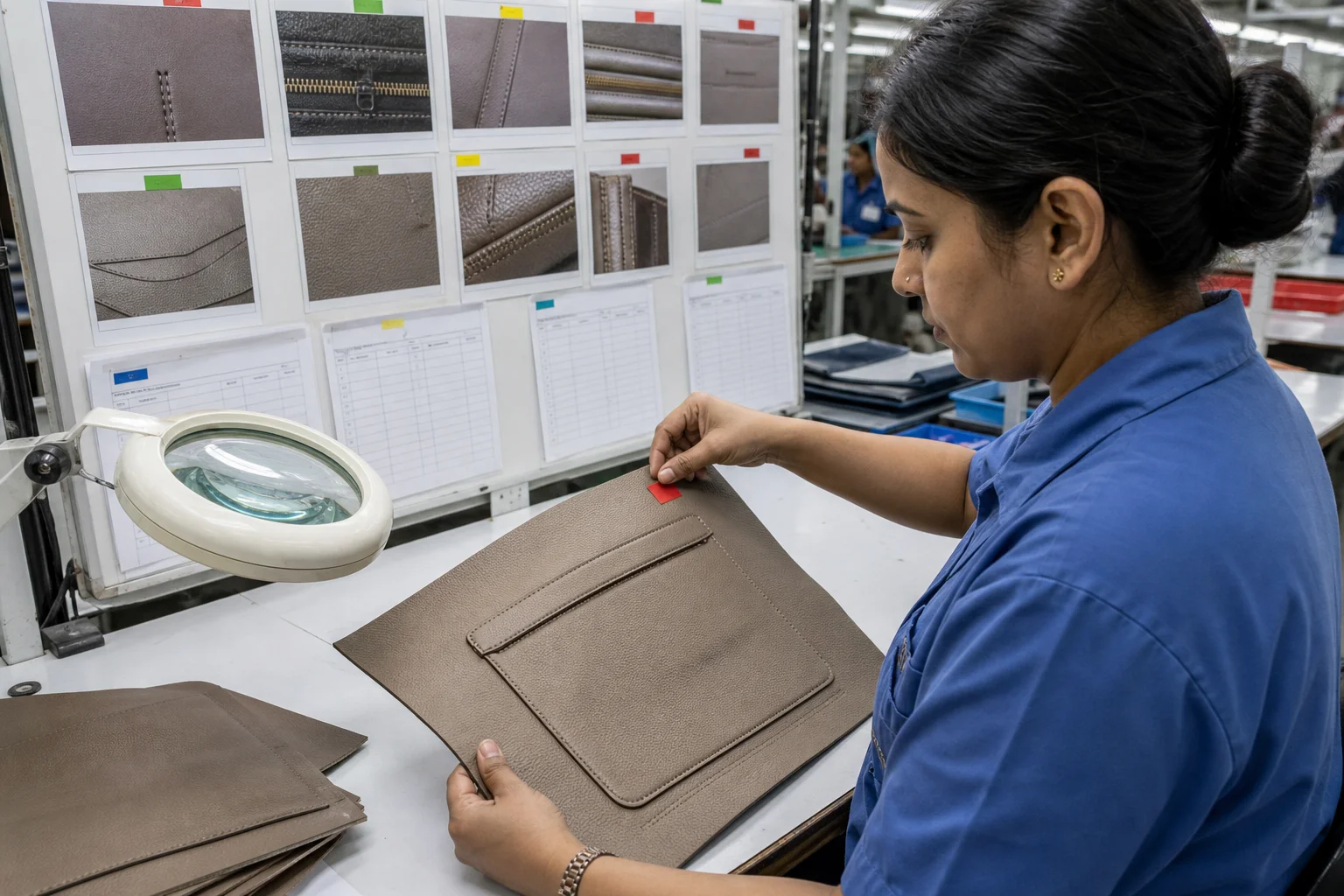
Order identification, quantity, the checks required at each stage, the result, the time, the initials and any deviation. It should be readable at a glance by a supervisor.
Why paper still works
Paper at the station is visible, immediate and does not require a terminal. Digital systems are better for analysis; paper is better for presence.
What breaks it
Records completed at the end of the shift, records signed in advance, and records that travel separately from the goods so nobody can compare them.
The deviation field
A field for recording exceptions is what turns a checklist into a control. Without it, a failed check either stops production or is silently ignored.
| Field | Purpose | Failure if absent |
|---|---|---|
| Order and quantity | Links record to goods | Untraceable results |
| Check list per stage | Defines what must be done | Inconsistent practice |
| Result | Pass or fail per item | No decision recorded |
| Time | Proves contemporaneity | Retrospective filling |
| Initials | Names responsibility | Diffuse accountability |
| Deviation note | Records exceptions | Silent acceptance |
| Sign-off | Authorises continuation | Work proceeds unapproved |
Reading the record as evidence
A traveller showing identical times across several stages, or one set of initials for every check, indicates reconstruction rather than control.
Roving Inspection and Patrol QC
Patrol inspection adds coverage between gates but is frequently ineffective.
What patrol does well
It catches drift between formal checks, verifies that station checks are actually being performed, and provides a second pair of eyes on appearance.
Why patrol fails
A patrol that walks the same route at the same time each day is predictable. Stations are tidied before the inspector arrives and revert afterwards.
Varying the route
Randomise the order and the timing. Appearing at a station at an unexpected moment reveals the true state of practice.
Patrol as verification of checks
The most valuable patrol activity is not inspecting product but confirming that the station’s own check was done. That closes the gap between a documented system and an operating one.
| Patrol activity | Value | Risk |
|---|---|---|
| Product spot check | Catches drift | Duplicates station checks |
| Verifying station records | Confirms checks happen | Needs access to records |
| Appearance review | Second opinion on shade | Subjective without standard |
| Random route timing | Sees true practice | Requires discipline |
| Immediate feedback | Corrects in the moment | Can undermine supervisor |
| Trend notes | Feeds improvement | Useless if not reviewed |
The relationship problem
A patrol inspector who reports to the production supervisor cannot independently hold that supervisor’s stations. Independence is what makes the role useful.
Self-Check Versus Dedicated Inspector
Where a check sits determines how quickly a defect is caught and how honestly it is reported.
The case for self-check
The operator who performed the work sees the result immediately. A self-check catches the fault before the unit moves, which is the cheapest possible point.
The conflict of interest
Self-checks fail when output pressure exceeds quality pressure. An operator paid by piece rate has little incentive to stop their own work.
The verification layer
Self-check works when it is verified. A supervisor or patrol confirming that the check occurred converts a personal habit into a system.
Dedicated inspection at critical stations
At the stations where defects become irreversible, a dedicated check is justified. Hardware setting, closing seams and final assembly are typical candidates.
| Model | Strength | Weakness |
|---|---|---|
| Operator self-check | Immediate, cheap, at source | Pressured, unverified |
| Supervisor check | Authority to stop | Competing production duties |
| Dedicated inspector | Independent, consistent | Adds headcount, can be bypassed |
| Next-station check | Customer mindset internally | Rejects travel backwards slowly |
| Combined model | Self-check plus verification | Requires clear roles |
| Final only | Simple to organise | Expensive, cannot see hidden defects |
The next-station principle
Treating the next station as the customer catches defects at the point of handover. It works best where the handover is physically obvious, as with bundled components.
Frequency, Sampling and Trigger Points
A check performed at the wrong frequency either wastes time or misses the defect entirely.
Time-based versus count-based
Count-based checks suit stable operations; time-based checks suit processes that drift with temperature, tool wear or fatigue. Most bag operations need both.
Trigger points that force a check
New order, new lot, shift change, machine change, operator change, blade change and restart after a stoppage. Each is a moment when the previous check no longer applies.
Sampling within a batch
Sample across the batch rather than clustering at the start. Defects that appear late are exactly the ones a start-only check misses.
The cost of over-checking
Excessive checks are skipped checks. A schedule the line cannot sustain in practice produces falsified records rather than better quality.
| Check type | Suggested frequency | Basis |
|---|---|---|
| Stitch density | Start, mid-shift, end | Time and drift |
| Seam appearance | Every 50 units or hourly | Count and time |
| Dimensional spot check | First of each bundle, then interval | Count |
| Hardware pull test | Once per shift per machine | Time |
| Shade match | Every bundle change | Trigger |
| Full unit check | First assembled unit of each order | Trigger |
Reviewing frequency annually
Defect data should drive frequency. A station with no defects for a year may be over-checked; one with recurring escapes is under-checked.
Stop Authority and Escalation
A check without the power to stop work is an observation, not a control.
Who can stop the line
Name the people and the conditions. Ambiguity means nobody stops anything until the problem is too large to ignore.
What happens after a stop
Containment, quarantine of affected units, a decision on rework, and a root cause step. A stop without a defined sequence becomes a delay rather than a correction.
Protecting the person who stops
If stopping production carries a personal cost, checks will not be enforced. Formal protection for the stop decision is what makes the authority real.
Escalation timing
Define how quickly a defect class escalates to management. Repeated minor defects are a process signal that individual corrections will not fix.
| Condition | Action | Escalates to |
|---|---|---|
| Single unit out of tolerance | Isolate and rework | Station supervisor |
| Pattern across a bundle | Stop bundle, check source | Production supervisor |
| Same defect twice in a shift | Stop station, investigate | Quality lead |
| Material-related defect | Quarantine remaining rolls | Quality and stores |
| Defect reaching packing | Hold cartons, trace back | Plant management |
| Repeat across orders | Process change required | Management review |
The reluctance problem
In many factories operators know a defect exists but will not stop because the consequence falls on them. The check is present and the control is absent.
Checks Specific to PU Leather
Coated material behaves differently from textile and needs checks that reflect that.
Permanent needle marks
Every stitch leaves a hole in the coating. Unpicking leaves a visible line, so seam defects must be prevented rather than corrected.
Heat sensitivity
Heat from pressing, fusing and drying can change the surface. Check temperature settings and the result on a test piece before running production.
Adhesion between coating and backing
Delamination is a field failure that starts as a small edge lift. Check bond integrity at cut edges and after any heat operation.
Surface susceptibility
Plasticiser migration, solvent attack and abrasion all show on the surface first. Handling cleanliness is a quality control measure on this material, not housekeeping.
| PU-specific risk | Check | When |
|---|---|---|
| Needle damage | Needle type and condition | Start of run and after changes |
| Heat marking | Test piece through heat process | Before each heat operation |
| Edge delamination | Peel at cut edge | At cutting and after fusing |
| Plasticiser migration | Contact with incompatible materials | Storage and assembly |
| Solvent dulling | Cleaning agent test on scrap | Before first use |
| Abrasion marks | Handling and stacking check | Every transfer |
On coated material, prevention is not the cheaper option. It is the only option for seam defects, because correction leaves a record on the surface.
Why the test piece matters
Settings that work on textile scrap may fail on coated material. A test piece of the actual material, through the actual process, is the only reliable check.
Measuring Whether the Checks Work
The final question is whether the check programme reduces defects or merely records them.
Escape rate
Count defects found after the gate that should have caught them. A high escape rate means the gate is decorative regardless of how thorough it looks.
Detection point shift
Track where defects are found over time. A working programme moves discovery upstream, toward cutting and components.
Repeat rate
Measure how often the same defect class recurs. Recurrence means the corrective action addressed the symptom, not the cause.
Record completeness
Sample travellers and check whether the entries could have been written at the times shown. Completeness is easy to fake; consistency of timing is harder.
| Measure | What it reveals | Target direction |
|---|---|---|
| Escape rate | Gate effectiveness | Down |
| Detection point | Whether control moved upstream | Earlier |
| Repeat defect rate | Whether causes were fixed | Down |
| Record timing consistency | Whether checks are real | Consistent |
| Rework hours | Cost of failure | Down |
| Final inspection rejection | Residual escapes | Down |
The quarterly review
Review the four measures quarterly and change one thing at a time. A programme that adds checks without removing ineffective ones eventually collapses under its own paperwork.
What good looks like after a year
Fewer final inspection rejections, more defects found at cutting, a stable record system and a shrinking rework area. Those four together indicate that the checks are working rather than present.
FAQ
How many in-process checks does a bag order actually need?
Enough to cover five points: material release, cutting first-off, component release, critical station checks and pre-packing verification. Adding more checks without removing ineffective ones usually reduces compliance rather than improving quality.
What is the single most valuable in-process check?
First-off approval at cutting, performed before the batch runs. It prevents whole batches from being made to a wrong dimension, wrong grain direction or wrong shade set, and it is the cheapest point at which those errors can be caught.
Why is final inspection not sufficient on its own?
It cannot see defects hidden by assembly, such as stitch density inside a gusset or missing reinforcement under a lining. It also discovers defects at the point of maximum cost, after all labour has been invested.
Should operators check their own work?
Yes, provided the self-check is verified. Operator checks catch defects fastest, but under output pressure they are the first thing skipped. A supervisor or patrol confirming that the check happened is what makes it reliable.
How often should stitch density be checked?
At the start of a run, mid-shift and at the end, plus after any tension adjustment, needle change or machine change. Density drifts gradually with tension, so interval checks catch what a single start check misses.
What checks are unique to PU leather bags?
Needle condition and type, because every stitch leaves a permanent hole in the coating; heat exposure through pressing and fusing; edge adhesion to catch delamination; and cleanliness, because solvents and plasticiser contact show immediately on the surface.
How do I tell whether a check is real or decorative?
Look for three things: whether work can continue without the check’s decision, whether the record shows realistic timing and varied initials, and whether anything changed the last time the check failed. If all three are absent, the check is paperwork.
Where should a dedicated inspector sit?
At the stations where defects become irreversible: hardware setting, closing seams and final assembly before lining. Earlier stages are better served by operator self-checks with supervisor verification.
What is an escape rate and why does it matter?
It is the share of defects found after the gate that should have caught them. A high escape rate shows the gate is not functioning, regardless of how complete its checklist looks on paper.
How should checks change when a new material lot arrives?
A new lot should trigger a new first-off, a stitch test on the actual material, and a shade comparison to the retained standard. Settings that worked on the previous lot are not automatically valid on the next.
Is a digital check system better than paper?
Digital is better for analysis and trending; paper is better for visibility at the station. Many factories run paper travellers and digitise the results weekly, which captures both benefits without forcing operators onto terminals.
How do I reduce checks without losing control?
Use defect data. A station with no defects for a year and no escapes can have its frequency reduced; a station with recurring defects needs more attention. Prune by evidence rather than by convenience.
Reviewing in-process controls for a PU leather bag order?
Send your style list and inspection requirements to info@gionar.com and we will share the gate structure, check frequencies and traveller format we apply in production, along with the defect data behind them.