Every bag order reaches the same moment: the goods are finished, packed and ready to ship — and the buyer must decide whether to release them. That decision is the most expensive quality decision in the entire sourcing cycle, because it is the last point where a defect costs nothing but a rework; after the containers leave the dock, the same defect costs freight, duties, returns, refunds and a damaged relationship with every customer downstream. The instrument that makes this decision reliable is the pre-shipment inspection — and at its center sits AQL, the statistical sampling standard that turns “does this batch look okay?” into “does this batch meet the agreed defect tolerance?”
This guide covers bag inspection before shipping from the inspector’s method outward: what AQL is and how the tables really work, how to set the right AQL levels for your category and market, what the physical inspection checks on every bag (with the defect classifications that decide accept or reject), what happens after the inspection — rework, sorting and re-inspection — and how to go beyond AQL into the checks that protect your brand when the goods reach your customers. Whether you hire a third-party inspection company, send your own inspector, or inspect the shipment yourself on arrival, the method inside is the professional standard.
- Why Pre-Shipment Inspection Is Non-Negotiable
- AQL Explained: How the Tables Really Work
- Setting the Right AQL Levels for Bags
- What the Inspector Checks on Every Bag
- Defect Classifications and the Accept/Reject Decision
- After the Inspection: Rework, Sorting and Re-Inspection
- Beyond AQL: Brand-Protection Checks
- Choosing an Inspection Partner
- FAQ
Why Pre-Shipment Inspection Is Non-Negotiable
The pre-shipment inspection exists because the factory’s own quality control and the buyer’s quality requirement are two different systems — and the inspection is the point where they meet. The factory’s QC works to its own standard, shaped by its costs, its line speed and its own defect tolerance; the buyer’s requirement is shaped by a brand, a market and a customer who will return a defective bag and never buy again. Neither system is wrong; they are simply different, and without an independent check the difference ships — invisibly, inside cartons, at scale.
The economics make the inspection’s value easy to calculate. A pre-shipment inspection costs a small fraction of the order value (typically a fixed fee or a low percentage, often around $300–$600 for a standard batch), and it converts the factory’s self-reported quality into an independent verdict with legal standing. Compare that to the alternative: a defect rate of a few percent on a 2,000-piece order is 60–100 defective bags arriving at your warehouse or your customers — each one a return, a refund, a review and a discount. The inspection is not a cost to be minimized; it is the cheapest insurance in the sourcing chain, and its premium is a rounding error next to the loss it prevents.
The inspection also changes the factory’s behavior, which is its quieter value. A factory that knows its shipments are independently inspected to a written AQL standard produces differently — the QC works harder, the rework happens before packing, and the “we thought it was fine” conversations disappear. The inspection is not only a gate on the goods; it is a discipline on the factory, and the discipline compounds across every order in the relationship. Buyers who skip the inspection save the fee and pay the difference — in defects, in disputes, and in the slow erosion of the factory’s standards that only an independent check prevents.
“An inspection does not make good bags out of bad ones. It makes the bad ones visible while the fix still costs nothing — and visibility, at the last gate before shipping, is the entire game.”
AQL Explained: How the Tables Really Work
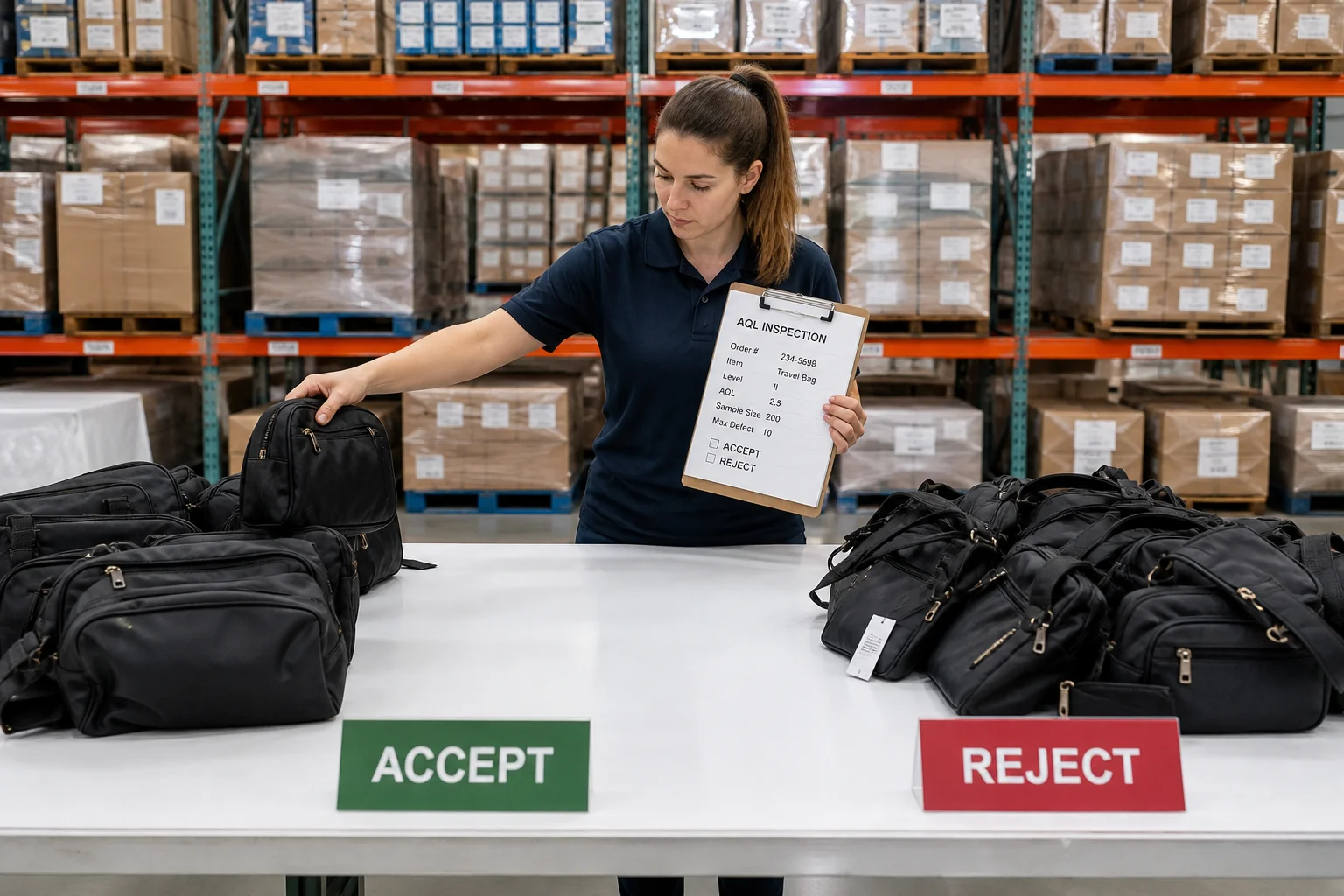
AQL — Acceptable Quality Limit — is the statistical sampling standard (ISO 2859-1 / ANSI/ASQ Z1.4) that defines how many defective pieces a batch may contain and still be accepted, and how many pieces must be sampled to decide. It is not “zero defects” — it is the agreed level of defect tolerance, and the entire inspection method follows from that agreement.
The method runs on three tables. The first table sets the sample size from the batch (lot) size: a 2,000-piece batch draws a sample of 125 pieces at the general inspection level II, the standard level for most goods. The second table sets the acceptance number for each defect class at each AQL level: at AQL 2.5 with a sample of 125, the batch is accepted if it has 7 or fewer major defects and rejected if it has 8 or more; at AQL 4.0 the tolerance rises to 10, and at AQL 1.0 it falls to 3. The third table — the critical-defect rule — usually sits at zero: any critical defect in the sample fails the batch regardless of count, because critical defects are safety or function failures that no tolerance can justify.
The statistical logic deserves one sentence of understanding: sampling does not prove the batch is perfect — it proves, with a defined confidence, that the batch’s defect rate is below the agreed limit. A batch can pass at AQL 2.5 and still contain defects — up to the tolerance level — and the buyer who expects “inspection = zero defects” is expecting the impossible. The professional expectation is precise: the inspection verifies the batch meets the agreed tolerance, and the agreed tolerance is a commercial decision the buyer makes deliberately, not a mystery the factory reveals. Setting that tolerance correctly is the subject of the next section.
Setting the Right AQL Levels for Bags
The AQL level is a commercial decision, and the right level for your order balances the quality your brand needs against the price the factory must charge to deliver it. The industry norm for bags provides the starting point; your market and product refine it.
| Defect class | Typical AQL for bags | What it covers | When to tighten |
|---|---|---|---|
| Critical | 0 (zero tolerance) | Safety, function, legal compliance | Never loosen — always zero |
| Major | 2.5 | Visible/functional defects affecting saleability | Premium brands: 1.0–1.5 |
| Minor | 4.0 | Small cosmetic deviations | Wholesale/high volume: 4.0–6.5 |
Two rules guide the choice. First, the critical level is never negotiated: safety and function defects (a strap that detaches, a broken closure, sharp hardware, prohibited materials) carry zero tolerance in every serious program, because one critical defect in the market costs more than any batch. Second, the major level follows your brand position: a premium brand selling at full retail tightens to AQL 1.0–1.5 because its customers’ tolerance for visible defects is near zero; a wholesale or promotional program can run at 2.5–4.0 because its channel accepts a higher rate in exchange for the price. The level is written into the contract and the inspection order — before production, not at the inspection table.
Three practical notes complete the setting. The inspection level (I, II or III) also matters: level II is the default for most goods, level I for simple categories with a long history of low defects, level III for complex or high-risk products where a larger sample is worth the cost. The sample size grows with the level — level III on a 2,000-piece batch draws 200 pieces instead of 125 — and the confidence in the verdict grows with it. And the AQL applies per inspection, per defect class: the verdict is computed on each class independently, so a batch can pass on majors and fail on minors, or pass both and fail on a single critical. The buyer who understands the three tables can read any inspection report and know exactly what the verdict means — and what it does not mean.
What the Inspector Checks on Every Bag
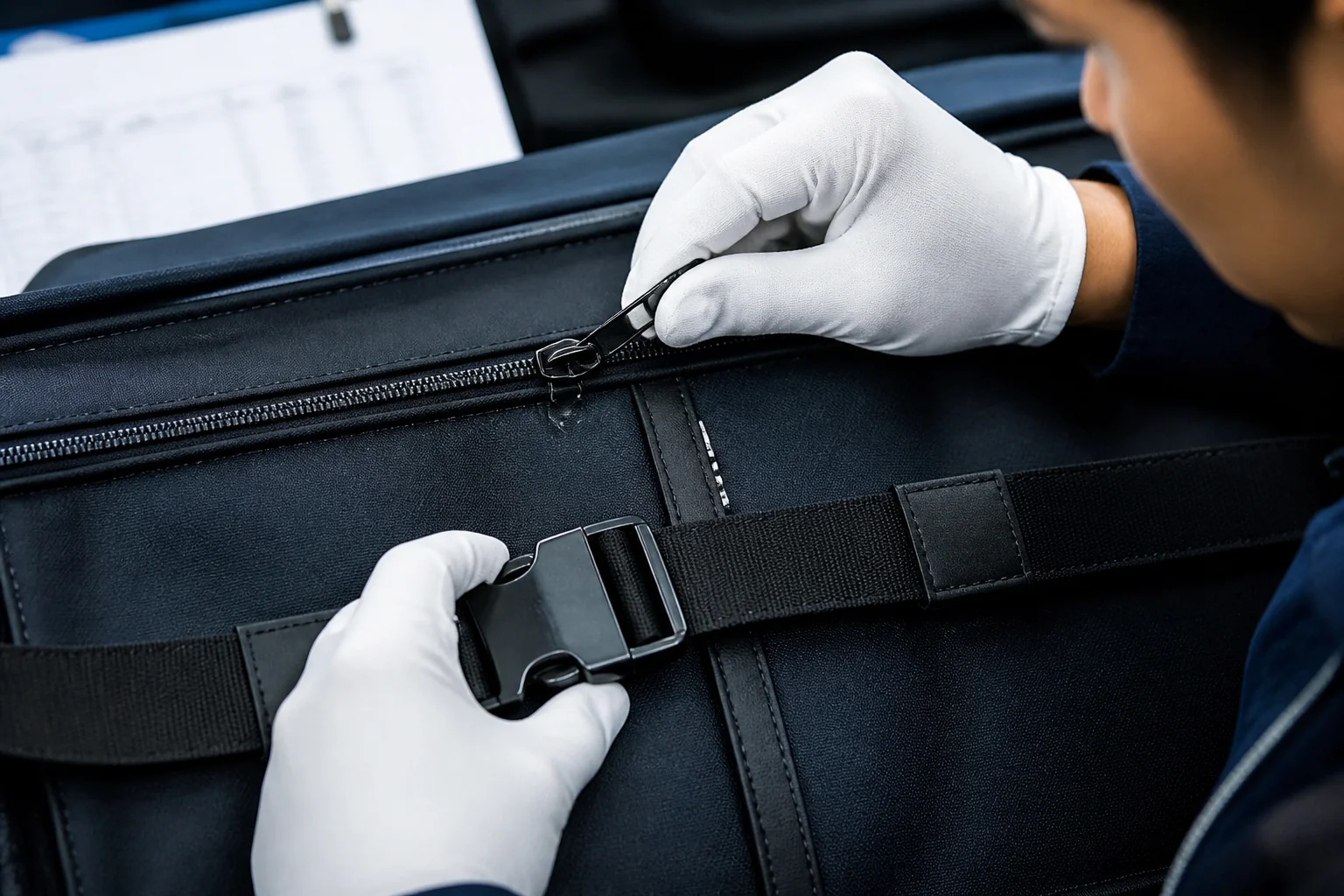
The physical inspection works through a structured checklist on every sampled piece, against the specification and the approved sample as the reference. The checklist for bags divides into five areas, and each area has its critical observations.
| Check area | What is verified | Typical defects found |
|---|---|---|
| Dimensions and shape | Length, width, depth, strap/handle drop against spec | Shrinkage, pattern drift, misshapen silhouette |
| Construction and stitching | Stitch density and alignment, seam strength, edge treatment | Puckering, skipped stitches, open seams, uneven edges |
| Hardware and closures | Zippers, buckles, snaps, magnets, rivets, D-rings | Misalignment, weak closures, wrong finish, function failure |
| Materials and color | Color, texture, thickness against approved references | Color drift, shading, substituted material |
| Function and finish | Loading, opening/closing, strap under weight, surface finish | Strap strain, zipper snag, loose lining, finish flaws |
The discipline of the check is as important as the list. The inspector measures, never eyeballs — dimensions are taken with a tape against the spec, stitch density counted over a defined length, hardware operated repeatedly rather than glanced at. The function test is physical: the bag is loaded with what it is meant to carry, every closure opened and closed repeatedly, the strap tested under weight — because the defects that survive a visual check are exactly the ones that fail in use. And every observation is recorded per piece on the inspection sheet, because the per-piece record is what makes the defect count — and therefore the accept/reject verdict — auditable and defensible. The checklist is the same one the factory’s own QC should run; the difference is that this run is independent, and its records decide whether the batch ships.
Defect Classifications and the Accept/Reject Decision
Every observation the inspector records is classified into one of three defect classes, and the classification — not the raw observation — drives the accept/reject arithmetic. Getting the classification right is the inspector’s core skill, and the buyer who reads the report should understand what each class means.
Critical defects are the non-negotiables: a safety hazard (sharp hardware, a strap attachment that fails under load), a functional failure (a closure that will not close, a zipper that separates), or a compliance failure (a prohibited material, wrong labeling for the destination market). Critical defects are counted at zero tolerance — one in the sample fails the batch, because the cost of a critical defect reaching the market exceeds the cost of any batch rework.
Major defects are the saleability issues: visible or functional deviations that a customer would notice and reject — a crooked seam, a color mismatch, a misaligned logo, hardware that sits wrong. Majors are counted against the AQL tolerance (typically 2.5), and the count decides the verdict at the table: 7 or fewer in a sample of 125 at AQL 2.5 passes; 8 or more fails.
Minor defects are the cosmetic deviations that do not affect saleability: loose threads, slight shading, a tiny scuff. Minors are counted against their own tolerance (typically 4.0), and the note is the key: a batch can fail on minors even when majors pass, and the report’s verdict is computed per class, never blended. The buyer who reads an inspection report should read all three counts — the verdict headline hides the distribution, and the distribution is where the factory’s real quality trend lives. A batch that passes with zero majors but 200 minors is a different signal from one that passes with 7 majors and 10 minors — and the buyer who sees the distribution knows which factory to push.
After the Inspection: Rework, Sorting and Re-Inspection
A failed inspection is not the end of the order — it is the beginning of a defined process with three possible outcomes: rework, sorting, or negotiation. The professional buyer knows the options and their costs before the failure happens.
Rework is the preferred outcome for fixable defects: the factory repairs the failed pieces — re-sewing a seam, replacing hardware, re-attaching a strap — and the batch is re-inspected. The rework is done at the factory’s cost, on a deadline tied to the shipping schedule, and the re-inspection confirms the fix. The discipline is contractual: the rework deadline is written when the failure is declared, and the re-inspection is a new inspection with its own verdict, not a courtesy re-check.
Sorting (100% inspection) is the outcome for borderline or widespread defects: every piece is checked individually, the defective pieces are removed or repaired, and the acceptable pieces ship. Sorting costs money — typically a per-piece fee that can rival the profit on the batch — and it reveals the factory’s real quality level with brutal clarity. The buyer’s decision at sorting is commercial: is the batch worth the sorting cost, or does the defect pattern tell you this factory cannot deliver this product at this price? Sorting once is a process; sorting on every order is a strategy that is not working.
Negotiation is the outcome when the defects are within tolerance but the batch still does not meet your expectations: a discount, a credit against the next order, or a documented deviation agreement. The negotiation is legitimate when the goods are sellable at a reduced price — and it is a trap when it becomes the routine way a factory converts its failures into your discount. The professional pattern: accept the occasional negotiated deviation, treat the repeated one as the signal it is, and let the inspection records — which accumulate order after order — drive the decision on the relationship. The records are the memory, and the memory is the management tool.
Beyond AQL: Brand-Protection Checks
AQL covers the goods on the table; the checks beyond it protect the brand after the goods leave it. The professional inspection program adds four layers that sampling alone cannot provide.
Pre-production checks happen before the line starts, not after: verifying materials against the approved swatches, confirming the production sample matches the approved sample, and checking the line setup. The pre-production check converts problems from rework (expensive) into adjustments (cheap), and it is the highest-leverage inspection dollar in the program — a material substitution caught at pre-production costs nothing; the same substitution caught at final inspection costs a failed batch and a schedule.
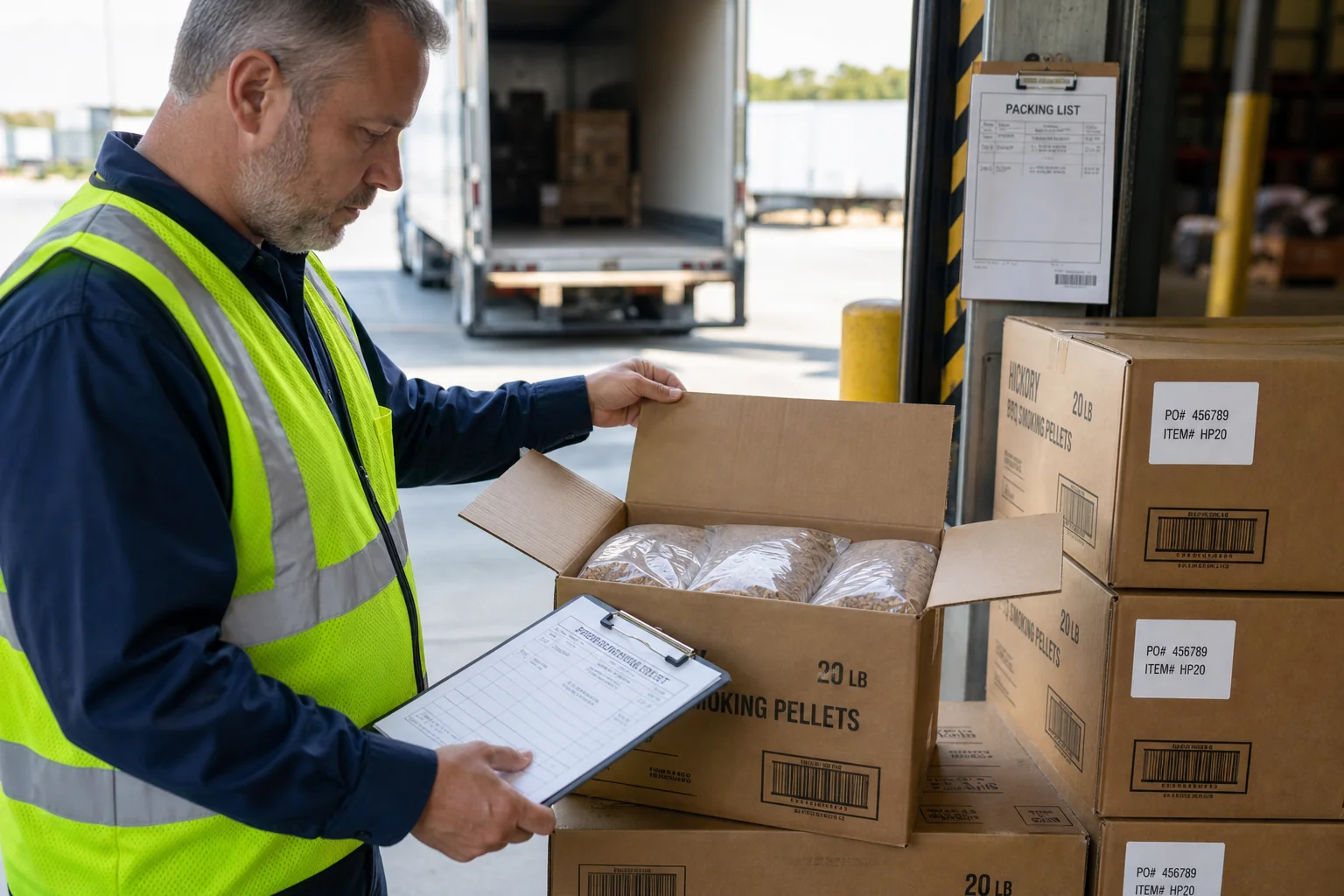
Carton and packing verification checks what sampling on the table cannot: the correct carton count, the correct styles and colors per carton, the packing quality (polybags, padding, carton strength), and the labels and markings against the destination requirements. A batch can pass the product inspection and still ship wrong — wrong styles in the wrong cartons, or labels that fail customs — and the carton check is the gate that catches it before the container loads.
Compliance and documentation checks verify the paperwork that travels with the goods: material certificates (REACH, CPSIA), the commercial invoice, packing list, and any destination-specific documentation. Compliance failures can stop a shipment at customs for days or weeks — and the cost of the delay dwarfs the cost of the check.
Load supervision (container loading supervision) verifies what is actually loaded: the right cartons, the right counts, the right loading quality. Load supervision closes the loop — the inspection verified the goods, the carton check verified the packing, and the load check verifies that the verified goods are the goods that board the ship. The four layers together turn the inspection from a sample verdict into a shipment verdict, and that is the difference between protecting a batch and protecting a brand.
Choosing an Inspection Partner
The inspection is only as good as the inspector, and choosing the partner is a sourcing decision in its own right. Three options exist, and each fits a different stage of the relationship.
Third-party inspection companies (SGS, Bureau Veritas, Intertek, TÜV, and specialized apparel-and-accessories agencies) are the professional standard: independent, trained to the AQL tables, operating worldwide, and issuing reports with legal standing. Their cost is a fixed fee per inspection (commonly a few hundred dollars for a standard batch), and their value is independence — the verdict no one at the factory can influence. Third-party inspection is the default for first orders, large orders and any relationship where trust is still being built.
The buyer’s own inspector — an employee or a trusted local agent — works when the relationship is mature, the product is complex, or the buyer wants eyes beyond the standard checklist (brand-specific aesthetics, a particular construction). The trade: deeper, brand-specific coverage at the cost of independence and availability. Many buyers combine the two: the third party runs the standard AQL verdict while their own agent watches the pre-production and the factory’s process.
The factory’s own inspection is not a partner choice — it is the baseline that every buyer starts from and should never end with. The factory’s QC is part of its system, and a good system is worth having; but the buyer’s gate must be independent, because the factory’s incentive and the buyer’s requirement are structurally different. The professional program is a ladder: the factory’s QC as the first check, the buyer’s own eyes as the second, the third-party verdict as the gate — with the rung chosen by the order’s size, the relationship’s age and the product’s risk.
Reading the Inspection Report Like a Professional
The inspection report arrives with a verdict — PASS or FAIL — and the professional reading starts there but does not end there, because the verdict is a headline and the report’s value lives in the details beneath it.
Start with the report’s basic facts: the inspection date, the location, the lot size, the sample size and the inspection level. The facts establish what the verdict covers — a report on 125 sampled pieces from a 2,000-piece lot is a statistical verdict, and the reader who knows the sample size knows the confidence behind it. Next, read the defect counts per class: the verdict says “pass,” but the distribution — zero majors and 300 minors, or 7 majors and 40 minors — tells you where the factory’s quality really stands and where the next order’s problems will come from. A batch that passes with a high minor count is a factory whose finish discipline is slipping, and the slip is visible in the numbers a season before it becomes major defects.
Then read the details of the defects themselves, not just the counts: the report lists each defect with its location and description, and the pattern in the descriptions is the diagnosis. Zipper failures concentrated in one run, seam puckering on one construction, color drift on one material — each pattern names the process that is failing, and each named process is a conversation with the factory and a check on the next order. Finally, compare the report across orders: the inspection records accumulate into a trend, and the trend — improving, stable, or degrading — is the factory’s real quality history. The single report decides the batch; the trend decides the relationship.
FAQ
What does a bag pre-shipment inspection cost?
Typically a few hundred dollars for a standard batch (commonly around $300–$600 depending on the agency, the location and the sample size), plus travel if the inspection site is remote. The cost is a small fraction of the order value and a rounding error next to the cost of a failed shipment.
What AQL level should I use for my bag order?
The common standard is AQL 2.5 for major defects and 4.0 for minor defects, with critical defects at zero tolerance. Premium brands tighten majors to 1.0–1.5; high-volume wholesale can run 4.0. The level should be written into the contract before production, and the approved sample is the inspection reference.
Does passing the inspection guarantee zero defects?
No — sampling verifies that the batch meets the agreed defect tolerance, not that it is perfect. At AQL 2.5, a batch can pass and still contain defects up to the tolerance. That is why the AQL level is a commercial decision: it sets the quality the brand accepts, and it must be set deliberately, not discovered at the inspection table.
What happens if the batch fails inspection?
Three options: rework (the factory fixes the defects and the batch is re-inspected), sorting (100% inspection at a per-piece fee), or negotiation (a discount or credit when the goods are sellable at reduced value). The rework deadline and re-inspection should be contractual, and repeated failures are a signal about the relationship.
Should I inspect every order?
Yes, in practice — the inspection is the gate that keeps the factory’s standards honest, and skipping it saves a fee while paying the difference in defects and disputes. For mature relationships with a long clean record, the buyer can adjust the program (fewer inspections, larger intervals), but the independent gate should never disappear entirely.
Can I use the factory’s own QC report instead of an independent inspection?
As a baseline, yes — a good factory QC system is valuable. As the buyer’s gate, no: the factory’s incentive and the buyer’s requirement are structurally different, and the verdict must be independent to be reliable. Use the factory’s QC as the first check and an independent inspection as the gate.
What is container loading supervision?
It is the verification that the right cartons — correct styles, colors, counts — are actually loaded into the container with correct loading quality. It closes the loop after the product and carton checks: the inspection verifies the goods, and the load check verifies that the verified goods are what board the ship.
When should the inspection happen in the production schedule?
The final inspection happens when at least 80% of the order is packed and ready — the standard timing that lets the sample represent the actual shipment. Pre-production checks happen before the line starts, and the inspection should be scheduled in the calendar with the factory, not requested after the goods are already at the dock.
Can I rely on photos and videos instead of a physical inspection?
Photos and videos are useful supplements — for verifying the factory’s claims between inspections, for spot-checking details, or for covering simple checks remotely. They cannot replace the physical inspection for the verdict: measuring, function-testing and defect counting require the inspector’s hands on the goods, and the AQL verdict needs the physical sample.
Next Steps: Inspect with Method, Not Hope
The pre-shipment inspection is the last gate before the goods leave your control — and the method inside this guide is how the gate is made reliable: set the AQL deliberately and in writing, run the structured checklist against the approved sample, read the per-class verdicts instead of the headline, and add the brand-protection layers — pre-production, carton, compliance and load — that sampling alone cannot provide. The factories that ship clean goods do not fear the inspection; they schedule for it. The buyers who sleep well do not hope for clean goods — they verify them.
Building a bag order and want to see how inspection-ready production works? Contact info@gionar.com and ask about our QC system, our inspection records and our AQL performance — we welcome the independent gate. Explore our custom bag manufacturing services and custom backpack manufacturing to see how a factory built for inspection ships.