Every bag defect has a cause, and the cause is almost never the one the defect appears to suggest. A crooked flap is rarely a careless operator. A zipper that splits is rarely a faulty zipper. Behind each visible fault sits a process decision made earlier, and until that decision changes the defect will return in the next batch.
This matters commercially because buyers and factories usually negotiate at the wrong level. The buyer reports a defect, the factory promises to be more careful, and the next shipment contains the same fault in the same proportion. Care is not a process variable. Nothing in the conversation has changed the tooling, the material, the sequence or the training.
For exporters and importers, distinguishing a symptom from a cause determines whether a corrective action plan works or merely postpones the problem. It also determines who should pay. A defect caused by a material the buyer specified is not the factory’s fault, and a defect caused by a pattern error is not the buyer’s. Establishing the cause is therefore both a technical exercise and a commercial one.
This guide catalogues the defects that appear most often in PU leather bag production, traces each back to its root cause, and sets out the correction that actually resolves it. It is organised by defect family rather than by severity, because defects of the same severity frequently share an origin.
Why Root Cause Analysis Beats Blame
Defects recur because they are treated as performance problems rather than process problems. A root-cause approach asks what in the system produced the fault, which is a question with an answer that can be acted on.
Symptom, cause and contributing condition
Three levels need separating. The symptom is what the inspector sees. The cause is the mechanism that produced it. Contributing conditions are the circumstances that allowed the cause to persist undetected.
A puckered seam is a symptom. The cause may be a feed rate too high for the material. The contributing condition is that nobody measured stitch density during production, so the deviation was invisible until the goods arrived.
The five recurring sources
In PU leather bag manufacturing, root causes cluster into five sources: pattern and specification, material, machine set-up, operator method, and handling or storage. Almost every defect traces to one of these.
Identifying which source is responsible narrows the corrective action immediately. A material source requires a supplier conversation; a machine source requires a set-up change; a pattern source requires a revision before the next order.
| Source | Typical defects | Corrective owner |
|---|---|---|
| Pattern and specification | Asymmetry, wrong dimensions, panel mismatch | Buyer and factory jointly |
| Material | Colour variation, coating faults, stretch | Material supplier |
| Machine set-up | Stitch irregularity, skipped stitches, puckering | Factory production |
| Operator method | Inconsistent alignment, trimmed edges, handling marks | Factory training |
| Handling and storage | Creasing, pressure marks, moisture damage | Factory logistics |
Why the apparent cause is usually wrong
The most common analytical error is to accept the first plausible explanation. A zipper that splits is assumed to be a bad zipper, when the actual cause is a loaded bag putting the zip under tension it was never designed to carry.
A useful discipline is to ask what would have to be true for the explanation to hold, then check that condition. If a bad zipper were the cause, the defect would appear randomly across the batch. If it appears only on one style or one panel, the zipper is not the cause.
Recording defects in a form that supports analysis
Root cause analysis depends on the defect record. A record that says “stitching poor” supports nothing. A record that states the location, the panel, the stitch count observed and the batch identifier allows patterns to emerge.
A defect described precisely is halfway to being fixed. A defect described as poor workmanship cannot be fixed at all.
Assigning cost according to the cause
Root cause analysis also settles who pays. A defect traced to material the buyer specified is not the factory’s cost, and a defect traced to a pattern error the buyer supplied is not either. Establishing the cause objectively removes the argument that otherwise consumes the claim.
Recording the cause in the inspection report, rather than only the defect, makes this possible. It also builds a history that shows which supplier or which specification repeatedly produces problems, which is more useful than a single claim.
Stitching Defects
Stitching faults are the most frequently reported defect family in bag production and the most frequently misdiagnosed. They are almost always machine set-up or material interaction issues rather than operator carelessness.
Uneven stitch density
Stitch density that varies along a single seam usually indicates inconsistent feed. The causes include a feed dog set too high, material that varies in thickness along the seam, or a machine running near its capability limit for the material.
The correction depends on which of these applies, which is why measuring stitch count at several points along the seam is the first diagnostic step. If density varies with position on the panel, material or geometry is the cause. If it varies with time, machine or operator is.
Skipped and loose stitches
Skipped stitches point to needle and thread incompatibility, incorrect needle size for the material, or a timing fault in the machine. Loose stitches point to tension settings, bobbin winding or thread quality.
Both faults are more common on coated and laminated materials because the needle meets resistance and heat builds up. A needle that becomes hot enough can melt the coating, which then clogs the eye and produces an erratic stitch.
Puckering and seam distortion
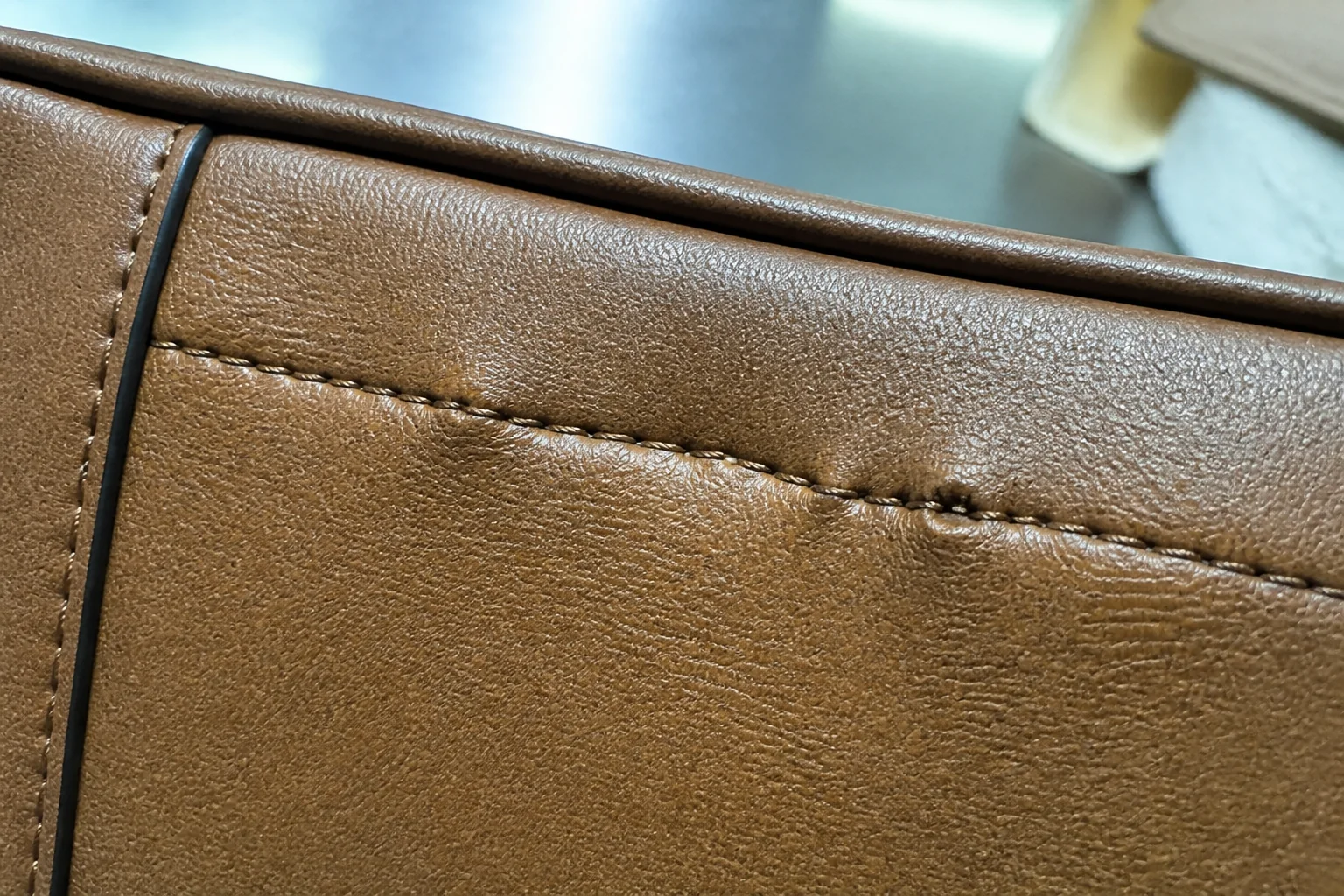
Puckering is a wave or ripple along a seam caused by the material being stretched or compressed as it passes under the needle. It is more visible on PU leather than on fabric because the surface is smooth and reflects light in a way that emphasises any distortion.
The common causes are excessive feed pressure, a feed rate too high for the material, or a needle that is too large for the seam. The corrective action is usually a specific machine adjustment rather than a change to the design.
| Defect | Likely root cause | Corrective direction |
|---|---|---|
| Uneven stitch density | Feed dog height, material thickness variation | Adjust feed, check material consistency |
| Skipped stitches | Needle and thread mismatch, timing | Change needle size, service machine |
| Loose stitches | Tension, bobbin, thread quality | Reset tension, verify thread spec |
| Puckering | Feed pressure or rate too high | Reduce feed, slow the run |
| Coating melt at stitch | Needle heat on coated material | Cooling, slower speed, needle type |
| Rework holes visible | Seam unpicked and restitched | Address the original fault upstream |
The rework indicator
On PU leather, unpicked stitches leave permanent needle holes. Visible rework is therefore a diagnostic rather than a defect in itself: it shows that a fault occurred earlier in the line and was corrected by hand.
The presence of rework at a consistent location indicates a systematic problem that will recur. The presence of rework at random locations indicates an operator-level issue. Inspectors should record where rework appears, not merely that it exists.
Needle and thread selection as a defect source
Needle size and thread weight interact with the material in ways that produce predictable faults. A needle that is too large leaves visible holes along the seam; one that is too small deflects under load and produces skipped stitches.
Thread weight follows the same logic. A heavy thread in a light material tears the material rather than holding, while a light thread in heavy material breaks first. Specifying the combination rather than leaving it to the line removes an entire class of stitching defect before production begins.
Seam and Construction Defects
Construction defects affect the way the bag holds together and holds its shape. They are more serious than stitching faults because they are harder to correct after assembly.
Seam slippage and opening
Seam slippage occurs when the material pulls away from the stitch line, leaving the seam intact but the join open. It happens when the seam allowance is too narrow for the load, or when the material is too loosely structured to hold the stitch.
This defect is characteristic of under-specified material rather than poor sewing. Increasing the seam allowance or changing to a material with a firmer backing resolves it, but neither can be done after the goods are sewn.
Misaligned panels and asymmetry
A bag that leans, that has one side longer than the other, or whose flap sits off-centre is almost always a pattern problem. Cutting errors produce inconsistency within a batch, while pattern errors produce the same fault in every unit.
The distinction is diagnostic. If every bag in the batch leans the same way, the pattern or the cutting template is wrong. If only some lean, the cause is handling during cutting or assembly.
| Defect | Likely root cause | Corrective direction |
|---|---|---|
| Seam slippage | Narrow seam allowance, loose material | Widen allowance, change backing |
| Every unit leans | Pattern or template error | Revise pattern, re-cut template |
| Some units lean | Cutting or assembly handling | Improve cutting control |
| Collapsed base | Insufficient base reinforcement | Add or thicken base board |
| Base corners splitting | Corner construction under load | Reinforce or bind corner |
| Lining visible at edge | Lining cut too large | Adjust lining pattern allowance |
Shape collapse and loss of structure
A bag that loses its shape when loaded has a structural defect rather than a sewing defect. The cause is usually insufficient interlining, a base board that is too thin for the intended load, or a gusset construction that cannot hold its form.
Because the fault appears only under load, it is frequently missed at inspection. Testing a sample while loaded, rather than empty, is the only reliable way to catch it before production.
Lining and interior faults
Lining defects are common and frequently underestimated. A lining cut slightly too large puckers at the seam; a lining cut too small restricts the bag’s opening and stresses the seam. Both look like sewing faults but originate in the lining pattern.
Interior faults also include pockets positioned so that they cannot be reached with the bag loaded, which is a usability defect rather than a structural one but is equally likely to generate a complaint.
Reinforcement placement errors
Reinforcement that is present but incorrectly positioned produces a distinctive defect pattern. The bag holds its shape except at one point, where it distorts under load and creases. The material is adequate and the reinforcement is adequate; only the placement is wrong.
Because the fault appears only under load, it survives empty-bag inspection. Checking the reinforcement position on a physical sample against the specification, before production, is the reliable control.
Surface and Material Defects
Surface defects are the most visible and the most damaging at retail, because they appear on the part of the bag the customer examines first. Their causes sit upstream of the sewing floor.
Coating faults and adhesion failure
PU leather consists of a coating layer bonded to a backing fabric. When the bond is weak, the coating can lift, blister or separate, usually at a fold or a high-flex area.
This is a material defect, and it originates with the supplier rather than the bag factory. It becomes visible during assembly because folding and stitching place the coating under stress, but the bag factory cannot correct it.
Colour variation and batch matching
Colour variation appears in two forms: within a single roll, and between rolls or batches. Within-roll variation is a material quality issue. Between-batch variation is a supply planning issue.
The practical defence is to require a master colour standard, to check each delivery against it, and to reserve material from a single production run for any order that must match. Bags from different material batches rarely match closely enough to sit together on a shelf.
Pressure marks, creasing and handling damage
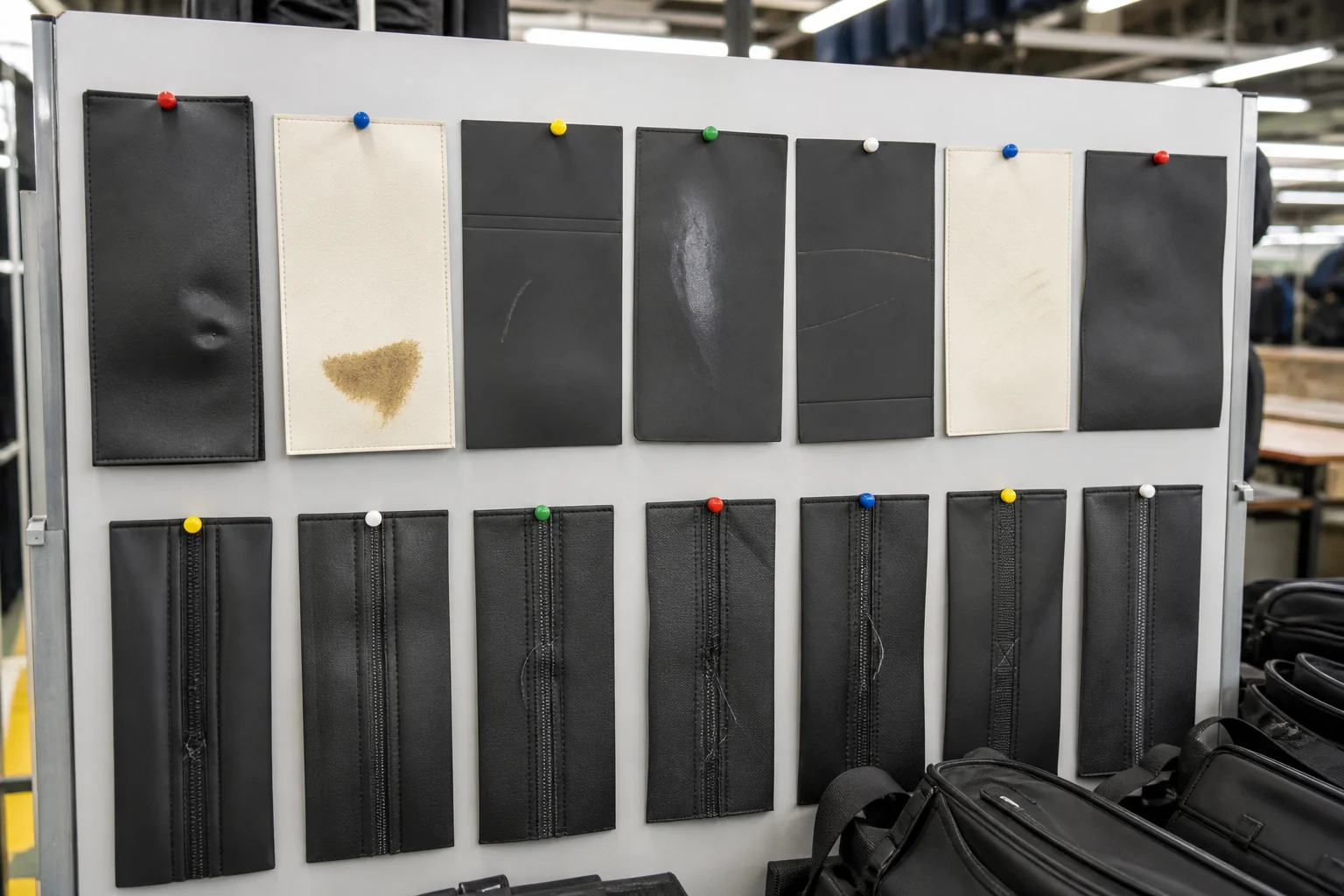
PU leather retains pressure marks. Stacking panels too high, leaving goods under a heavy object, or folding a bag for packing can produce creases that do not recover.
Handling damage is often treated as inevitable when it is actually a controllable process issue. Specifying stacking limits, using interleaving paper between panels, and packing bags so they are not folded under load all reduce it.
| Defect | Likely root cause | Corrective direction |
|---|---|---|
| Coating lifts or blisters | Weak bond in supplied material | Reject material, change supplier |
| Colour varies within roll | Material quality | Claim against supplier |
| Colour varies between batches | Production run differences | Reserve single-run material |
| Creases that do not recover | Stacking or folding under load | Limit stacking, interleave panels |
| Surface scuffs and shine | Handling and abrasion in transit | Protective wrapping, careful handling |
| Adhesive or glue marks | Assembly adhesive application | Control adhesive quantity and masking |
Adhesive and assembly contamination
Adhesives used to hold interlining, stiffeners and reinforcements frequently migrate to the surface during assembly, leaving visible marks that cannot be removed without damaging the coating.
The root cause is usually the application method rather than the adhesive itself: too much material applied, insufficient masking, or handling of glued panels before the adhesive has set. Controlling the quantity and the drying time resolves most cases.
Storage conditions as a defect source
Material and finished goods stored in humid or poorly ventilated conditions develop faults that appear during assembly or on arrival. Moisture in coated fabric can produce surface bloom, and damp storage accelerates corrosion on plated hardware.
Because the fault appears later, it is often attributed to the wrong stage. Where a shipment arrives with surface or corrosion problems, confirming storage and transit conditions is as important as examining the goods themselves.
Hardware and Zipper Defects
Hardware and zipper faults generate a disproportionate share of customer complaints because they affect function rather than appearance, and because they tend to appear after the product has been used.
Zipper faults and their real origins
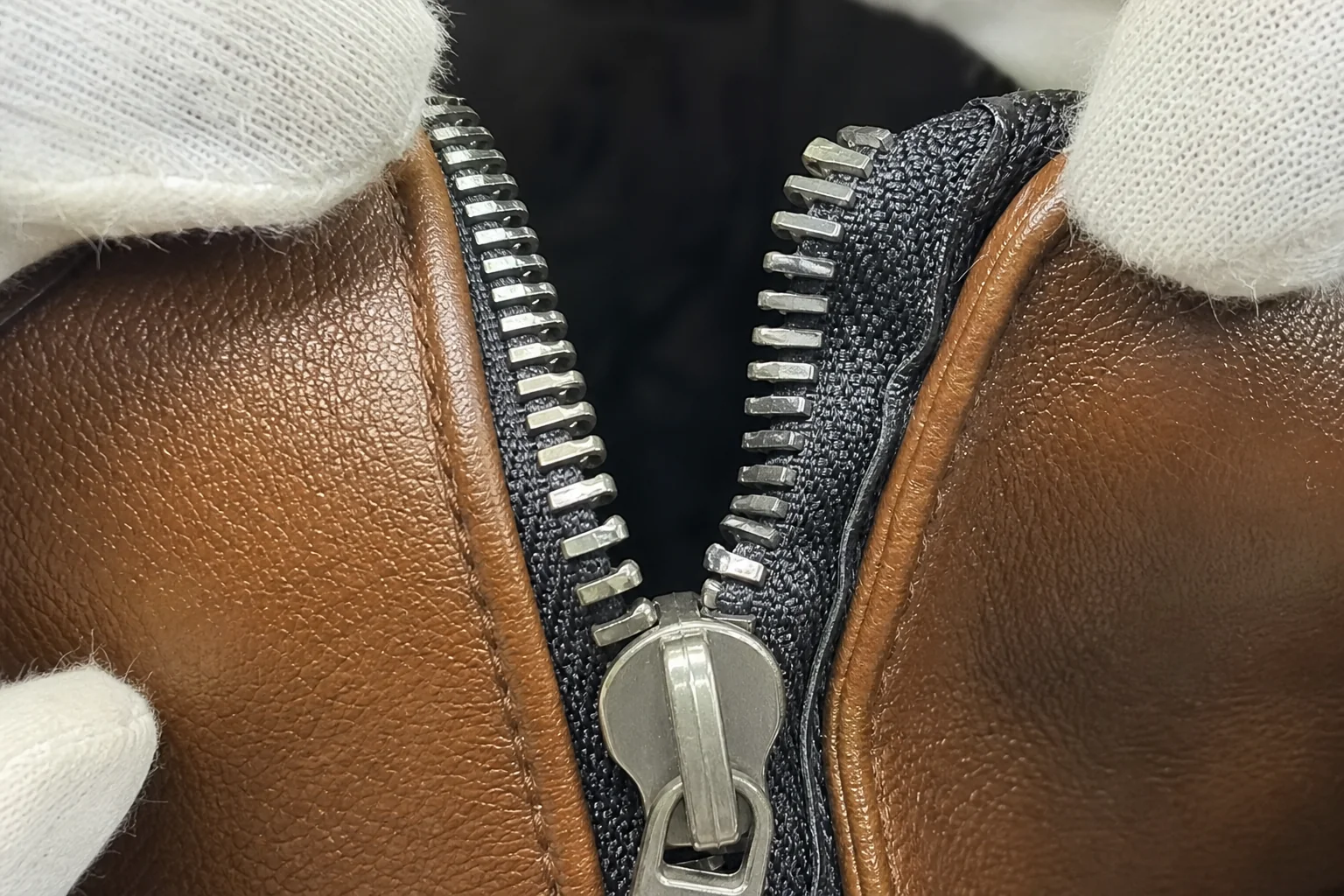
A zipper that skips teeth, splits under load or jams at a curve is usually not faulty. The more common causes are a slider mismatched to the tape gauge, a zip that is too light for the load the bag carries, or a curve radius too tight for the tape to follow.
The diagnostic question is whether the fault appears across all styles or only on specific ones. If only one style is affected, the zip specification or the seam geometry is the cause, not the zipper supplier.
Plating and finish failures
Hardware plating that flakes, discolours or corrodes indicates an under-specified finish for the intended market and use. Salt spray exposure in coastal or winter markets accelerates the problem.
Finish specification is therefore a market decision, not a cost decision. Selecting a lower-grade plating to reduce cost is a false economy when the target market exposes hardware to salt or humidity.
| Defect | Likely root cause | Corrective direction |
|---|---|---|
| Zip splits under load | Zip grade too light for the load | Upgrade zip specification |
| Zip skips teeth | Slider and tape mismatch | Change component combination |
| Zip jams at curve | Curve radius too tight | Adjust seam geometry |
| Plating flakes or discolours | Finish under-specified for market | Upgrade plating specification |
| Hardware deforms in use | Component underrated for load | Increase component capacity |
| Rivets loosen or rotate | Setting pressure or length wrong | Correct tooling and setting force |
Attachment and component failure
Rivets that rotate, eyelets that pull through and snap hooks that open under load are all attachment failures. They originate in tooling and setting force as much as in the component itself.
Because setting quality is invisible on a finished bag, the reliable control is a simple pull test on a sample of finished units. It is one of the few tests that catches a whole class of defect that visual inspection cannot.
Testing hardware on finished units
Setting quality for rivets and eyelets is invisible on a finished bag, which is why a functional defect can pass visual inspection entirely. The control that works is a simple pull test on a small sample of completed units.
It is one of the few checks that catches a whole class of defect before shipment. Because it destroys the unit tested, sample size is small, but even a handful of tested units identifies a systematic setting problem reliably.
Dimensional and Symmetry Defects
Dimensional faults are the easiest to measure and the easiest to attribute, because the measurement itself distinguishes pattern errors from production errors.
Measurement method as a source of false defects
Before treating a dimensional difference as a defect, confirm that both parties measure the same way. In soft materials, a bag measured flat and a bag measured filled can differ substantially, as can a bag measured by hand and one measured on a form.
A significant share of dimensional disputes are measurement disagreements rather than production faults. Agreeing the method in writing, with the point of measurement specified for each dimension, removes them.
Within-batch and between-batch variation
Variation within a batch points to cutting or assembly control. Variation between batches points to pattern revision, template wear or a change in material behaviour between deliveries.
Templates and cutting dies wear over time, and a template used for several years can drift enough to change the finished size measurably. Periodic verification of the template against the current specification catches this before it affects an order.
Odour, Colour and Finish Defects
These defects do not affect function but have an outsized influence on the customer’s first impression, and some carry regulatory implications.
Solvent and adhesive odour
A noticeable solvent smell when a carton is opened indicates insufficient drying time for adhesives or coatings, or material that was packed before volatile compounds had dispersed.
The cause is a production schedule problem rather than a material defect. Extending drying time, improving workshop ventilation, or packing later all resolve it. Where the odour is severe, restricted substance testing may be warranted, because some solvents are subject to regulatory limits.
Finish consistency across a range
Where a range of bags shares a material and finish, variation between styles is more noticeable than variation within a style. A tote and a crossbody cut from different rolls can read as different products even when both are within tolerance.
The corrective is planning rather than production: reserve material for a full range from one production run, and treat matching as a requirement stated at the material ordering stage rather than a check performed at the end.
| Defect | Likely root cause | Corrective direction |
|---|---|---|
| Solvent smell on opening | Insufficient drying before packing | Extend drying, improve ventilation |
| Range does not match | Material from different runs | Reserve single-run material |
| Gloss level inconsistent | Surface finish variation | Specify and verify finish |
| Hardware tone mismatched | Plating batch variation | Order hardware in one batch |
| Smell persists after airing | Material or adhesive formulation | Change formulation, test substances |
When odour becomes a compliance question
Odour that persists after airing, or that is accompanied by any irritation, should be treated as a potential compliance issue rather than a cosmetic one. Some solvents and plasticisers are restricted in major markets, and a smell can be the first indication.
In that situation the correct response is material and adhesive documentation followed by testing, not further airing. Treating a compliance issue as a cosmetic one creates a much larger exposure later.
Building a Corrective Action Plan
A corrective action plan converts a defect analysis into a change in the process. Without a documented plan, the analysis is a report rather than an improvement.
The four elements of a workable plan
A plan needs the defect defined precisely, the root cause identified with evidence, the specific change to be made, and a date by which the change will be in place and verified. Elements that are missing are usually the last two.
Verification deserves particular attention. A change is not complete when it has been agreed; it is complete when a subsequent batch has been inspected and the defect is absent or materially reduced.
| Element | What it contains | Common failure |
|---|---|---|
| Defect definition | Location, characteristic, rate observed | Vague descriptions |
| Root cause | Source and mechanism, with evidence | Guessing the obvious cause |
| Corrective action | Specific process change, with owner | Promising more care |
| Verification date | When and how the fix is confirmed | No verification at all |
Distinguishing correction from containment
Sorting defective units out of a shipment is containment, not correction. It protects the current order but leaves the process unchanged, so the defect reappears in the next batch at a similar rate.
Both are needed, and confusing them is a common source of repeated problems. Containment addresses the goods in hand; correction addresses the process that produced them.
Feeding conclusions back into specifications
The most durable outcome of a defect analysis is a change to the specification. If a defect was caused by a narrow seam allowance, the revised allowance becomes a written requirement for every future order rather than a lesson that has to be relearned.
Containment protects one shipment. Correction protects every shipment that follows.
FAQ
What is the most common defect in bag manufacturing?
Stitching irregularity, particularly uneven stitch density and puckering. It is the most frequently reported fault because it is highly visible on smooth PU leather surfaces. It is also the most frequently misdiagnosed, since it usually originates in machine set-up or material behaviour rather than operator carelessness.
Why does the same defect keep coming back after the factory promises to fix it?
Because the promise addresses performance rather than process. Nothing in the tooling, material, machine settings or training has changed, so the same conditions produce the same result. A workable fix names a specific process change, an owner and a verification date, then confirms the defect is absent in a later batch.
How do I tell whether a defect is the factory’s fault or the material’s?
Look at where the defect appears. A material defect appears across all styles using that material, regardless of construction. A process defect appears on specific styles, panels or machines. If the fault follows the material rather than the model, the material supplier is the corrective owner.
Why is a zipper usually not the cause of a zipper failure?
Because zips rarely fail in isolation. Most zipper problems trace to a slider mismatched to the tape gauge, a zip grade too light for the load the bag carries, or a curve radius too tight for the tape to follow. If the fault appears on only one style, the specification or seam geometry is the cause, not the zipper.
What causes puckering along a seam?
Material being stretched or compressed as it passes under the needle, usually because feed pressure is too high or the feed rate is too fast for the material. On PU leather it is especially visible because the smooth surface reflects light in a way that emphasises any distortion. It is corrected by machine adjustment, not by design change.
Why do some bags from the same order not match in colour?
Because they were cut from different material rolls or different production runs. Colour can vary within a roll as well as between batches. The defence is to require a master colour standard, check each delivery against it, and reserve material from a single run for orders that must match closely.
Is a solvent smell on opening a real defect?
Yes. It usually indicates that goods were packed before adhesives or coatings had fully dried, which is a scheduling problem the factory can correct. If the smell persists after airing, or is accompanied by irritation, treat it as a potential restricted substance issue and request material and adhesive documentation rather than simply airing the goods further.
Why does a bag lose its shape when it is loaded?
Insufficient structural reinforcement: interlining that is too light, a base board too thin for the intended load, or a gusset that cannot hold its form. Because the fault only appears under load, it is frequently missed when samples are inspected empty. Testing a loaded sample before production is the only reliable way to catch it.
What do visible needle holes tell me?
That a seam was unpicked and restitched. On PU leather these holes are permanent, so visible rework is a diagnostic rather than a defect in itself. Consistent rework at one location indicates a systematic upstream problem; scattered rework indicates an operator-level issue. Inspectors should record where rework appears, not just that it exists.
Why do dimensional differences cause so many disputes?
Because in soft materials the measurement method changes the result substantially. A bag measured flat and one measured filled, or measured by hand and on a form, can differ noticeably. Many dimensional disputes are measurement disagreements rather than production faults, and agreeing the method in writing removes most of them.
How should a corrective action plan be structured?
Four elements: a precise defect definition, a root cause supported by evidence, a specific process change with an owner, and a verification date. The last two are most often omitted. A change is only complete when a subsequent batch has been inspected and the defect is absent or materially reduced.
What is the difference between containment and correction?
Containment sorts defective units out of a shipment and protects the current order. Correction changes the process so the defect does not recur. Both are needed, but confusing them is why problems repeat: sorting is visible and satisfying, while the process change that actually prevents recurrence is easy to defer indefinitely.
Working with a PU leather bag manufacturer?
We manufacture PU leather bags in Guangzhou on OEM and ODM programmes, with defect reference libraries, root cause analysis and documented corrective action plans built into every production order. Send your requirements to info@gionar.com, or review our custom bag manufacturing capabilities.