AQL sampling appears in almost every bag purchase order and is understood in detail by almost nobody who signs one. Buyers accept the numbers because they look technical and because the supplier proposed them, then discover during a dispute that the statistic they agreed to permits exactly the number of defective bags they are now complaining about.
The confusion is understandable. AQL is a statistical system, not a quality guarantee. It does not describe the quality you want; it describes the risk you are accepting when you decide how many units to check and how many defects to tolerate before rejecting a batch.
For bag buyers and importers, the stakes are concrete. A shipment of several thousand PU leather bags is inspected on a sample, and the result determines whether the goods ship, are reworked or are rejected. Getting the sampling plan wrong means either accepting a batch with an unacceptable defect rate or rejecting a batch that is broadly fine, both of which carry cost.
This guide explains what AQL means in practice, how inspection levels change what you are testing, how to classify bag defects so that the numbers mean something, and how to write requirements into a purchase order so that an inspection result is not open to interpretation.
- What AQL Actually Means
- Sampling Plans and Inspection Levels
- Defining Defects: Critical, Major and Minor
- Building the Inspection Checklist for Bags
- Pre-Shipment, During-Production and Final Random
- Reading and Acting on an Inspection Report
- Common Misuses of AQL
- Writing AQL Requirements into a Purchase Order
- FAQ
What AQL Actually Means
AQL stands for acceptance quality limit. It is the worst average quality level that will still be accepted as satisfactory most of the time under a given sampling plan.
The two numbers that define a plan
An AQL plan is defined by two decisions: how many units to inspect, and how many defects of each class are permitted. The sample size comes from the lot size and the inspection level. The acceptance number comes from the AQL value and the sample size.
Change either input and the meaning of the plan changes. A buyer who quotes an AQL percentage without specifying the inspection level and the defect classes has specified almost nothing, because the same AQL value produces very different practical outcomes under different levels.
What AQL does not promise
AQL does not guarantee that a batch contains no more than the stated percentage of defects. It is a sampling system, and sampling carries statistical risk in both directions: a good batch can fail, and a poor batch can pass.
It also does not describe the defect rate in the whole shipment. The inspection result describes the sample. If the sample is drawn properly the result is a reasonable estimate of the batch, but it remains an estimate, and the tolerance for that uncertainty is baked into the numbers you agreed.
AQL is not a quality target. It is a statement of how much defect risk you are willing to accept before rejecting a shipment.
Why it is used anyway
Full inspection of every unit is incompatible with the economics of bag manufacturing at volume. Checking every bag would add labour and time that no buyer wants to fund, and destructive or wear tests cannot be applied to saleable units at all.
Sampling gives a defined, repeatable and comparable result. Because the same system is used across the industry, an inspection result expressed in AQL terms can be compared between suppliers, batches and inspection agencies.
| Term | What it means | Why it matters to a buyer |
|---|---|---|
| AQL | Acceptance quality limit | Sets the tolerance for defects |
| Lot | The batch being inspected | Defines the sample size |
| Sample size | Units actually inspected | Controls confidence |
| Acceptance number | Defects allowed before rejection | Determines pass or fail |
| Inspection level | How strict the sample is | Changes the sample size |
Where the numbers came from
The system originates in military procurement standards developed to make acceptance decisions repeatable across suppliers and inspectors. Its tables were designed to balance the cost of inspection against the cost of accepting defective goods, which is still the correct way to read them today.
Understanding that origin clarifies an otherwise confusing feature: the tables are deliberately conservative in the middle of the range and less so at the extremes, because they were built around the volumes and risks of large-scale purchasing rather than the priorities of any individual brand.
The practical takeaway
Buyers should treat an AQL figure as a business decision rather than a technical default. The question is not which number is standard, but how many defective bags the business can absorb in a shipment without damaging the customer relationship.
Sampling Plans and Inspection Levels
Inspection levels control how much of a lot is examined. They are the most misunderstood part of the AQL system, because the level is often left unstated while the AQL value is quoted precisely.
The three general levels
Standard sampling systems define three general inspection levels, conventionally labelled I, II and III. Level II is the default used in most commercial inspections. Level I examines fewer units and Level III more, at the same AQL value.
The practical effect is that a stricter level makes it easier to reject a batch, because a larger sample is more likely to reveal defects. A looser level makes acceptance easier. Neither changes the underlying quality of the goods; both change the risk the buyer carries.
Special levels for tight control
Beyond the general levels, most systems define special inspection levels intended for destructive or expensive tests, or for characteristics where confidence matters more than cost. These reduce sample sizes substantially for a given lot.
For bags, special levels are useful for tests that consume or damage the unit, such as strap pull tests, abrasion checks or seam strength tests. Applying a special level to these keeps the test programme affordable while still generating evidence.
| Level | Sample size direction | When to use for bags |
|---|---|---|
| General I | Smallest general sample | Low-value, low-risk repeat orders |
| General II | Standard default | Most pre-shipment inspections |
| General III | Largest general sample | New suppliers, complex or high-value bags |
| Special levels | Much smaller | Destructive and wear tests |
How lot size feeds the sample
Sample size is derived from lot size and inspection level together, not from lot size alone. The relationship is deliberately non-linear: the sample grows much more slowly than the lot, which is what makes large-batch inspection affordable.
This has a practical consequence that surprises buyers. A shipment of five hundred bags and a shipment of twenty thousand bags may be inspected on similar sample sizes at the same level, meaning the inspection is proportionally far stricter on the smaller lot.
Choosing a level deliberately
Level II is a reasonable default for established suppliers producing a proven product. Move to Level III when the supplier is new, the construction is complex, the product is high value, or a previous batch failed badly.
Move to Level I only for genuinely low-risk repeat production where the cost of a tighter inspection is not justified by the value of the goods. Reducing the level to save inspection cost on a first order is a false economy.
Changing level during a programme
Inspection level is not a permanent setting. A buyer can start at Level III for the first order and step down to Level II once the supplier has demonstrated consistency across two or three shipments, then move back up if results deteriorate.
Making this progression explicit in the purchase order gives the factory a clear incentive: consistent quality reduces the inspection burden, while repeated defects restore it. That is a more effective lever than a single fixed requirement that never changes.
Defining Defects: Critical, Major and Minor
AQL limits have no meaning until defects are classified, because each class carries its own acceptance number. Most disputes about inspection results are really disputes about classification.
The three classes
Critical defects are those that make the product unsafe, illegal or unsuitable for sale. For bags these include sharp metal edges, severe chemical or restricted substance issues, or a failure that injures a user. The acceptance number for critical defects is normally zero.
Major defects affect function, appearance or saleability in a way a customer would notice and reject. Examples include a broken zipper, a strap that separates under normal load, a crooked flap, or a colourway outside tolerance.
Minor defects are noticeable on close inspection but would not stop a purchase at the price point. Loose threads, slight stitch irregularity, faint surface marks or a marginally misaligned label usually fall here.
| Class | Definition for bags | Typical acceptance number |
|---|---|---|
| Critical | Unsafe, illegal or unsaleable | Zero |
| Major | Function or appearance failure | Low, set by AQL |
| Minor | Cosmetic, acceptable at price point | Higher, set by AQL |
Why classification defines the outcome
Two inspectors can examine the same bag and reach opposite conclusions if the classes are not defined. A single loose thread is minor to one and evidence of poor workmanship to another. A misaligned logo may be a major defect for a premium brand and a minor one for a value line.
The classification must therefore be written, illustrated and agreed. Written descriptions alone are weaker than descriptions plus photographs showing a passing and a failing example of each characteristic.
Building a defect library
A practical approach is to build a defect library for each product: a photographed reference for each characteristic, labelled as pass, minor or major. This library becomes the sampling plan’s companion document and removes most ambiguity from the inspection.
The library also improves consistency over time. When a new inspector or a new agency takes over, the reference remains the same, so results stay comparable across batches.
An AQL number protects you only as far as your defect definitions are unambiguous.
Agreeing the classes before production
The classification should be settled at the sampling stage, when a physical sample is available and can be photographed. Discussing defect classes for the first time after a failed inspection almost always produces disagreement, because the factory has an interest in reclassifying whatever went wrong.
Recording the agreement in the purchase order or an annex, with the reference photographs attached, converts a conversation into an enforceable standard. It also removes the most common cause of inspection disputes.
Building the Inspection Checklist for Bags
The checklist determines what the sample actually tests. A generic checklist applied to a specific bag will miss the characteristics that matter most and spend effort on those that do not.
Workmanship characteristics
Workmanship covers stitching, alignment, symmetry and finishing. For a PU leather bag, the observable items include stitch density and consistency, seam alignment at panel joins, edge finishing quality, and the evenness of topstitching around a flap.
Because PU leather does not self-heal like some textiles, stitch holes from removed and restitched seams remain visible. Inspectors should check for evidence of rework, which is a reliable indicator of inconsistent production.
Functional characteristics
Functional items are the ones that generate customer complaints, and they should be tested rather than observed. Zippers should be cycled along their full length. Magnetic closures should be checked for alignment and holding force. Straps should be pulled at their attachment points.
Internal organisation should be checked with the bag loaded. A laptop sleeve that measures correctly when empty can become unusable when the bag is full, and only a loaded test reveals that.
| Area | What to check | How to check |
|---|---|---|
| Stitching | Density, alignment, rework marks | Visual, close range |
| Zippers | Smooth operation, end stops, pulls | Cycle full length |
| Hardware | Plating, attachment, function | Visual plus manual force |
| Straps and handles | Attachment strength, length | Pull test at anchors |
| Lining and pockets | Fit, seaming, access when loaded | Load and reach test |
| Surface | Colour, coating, marks, adhesion | Visual under controlled light |
| Odour | Solvent or adhesive smell | Smell test immediately on opening |
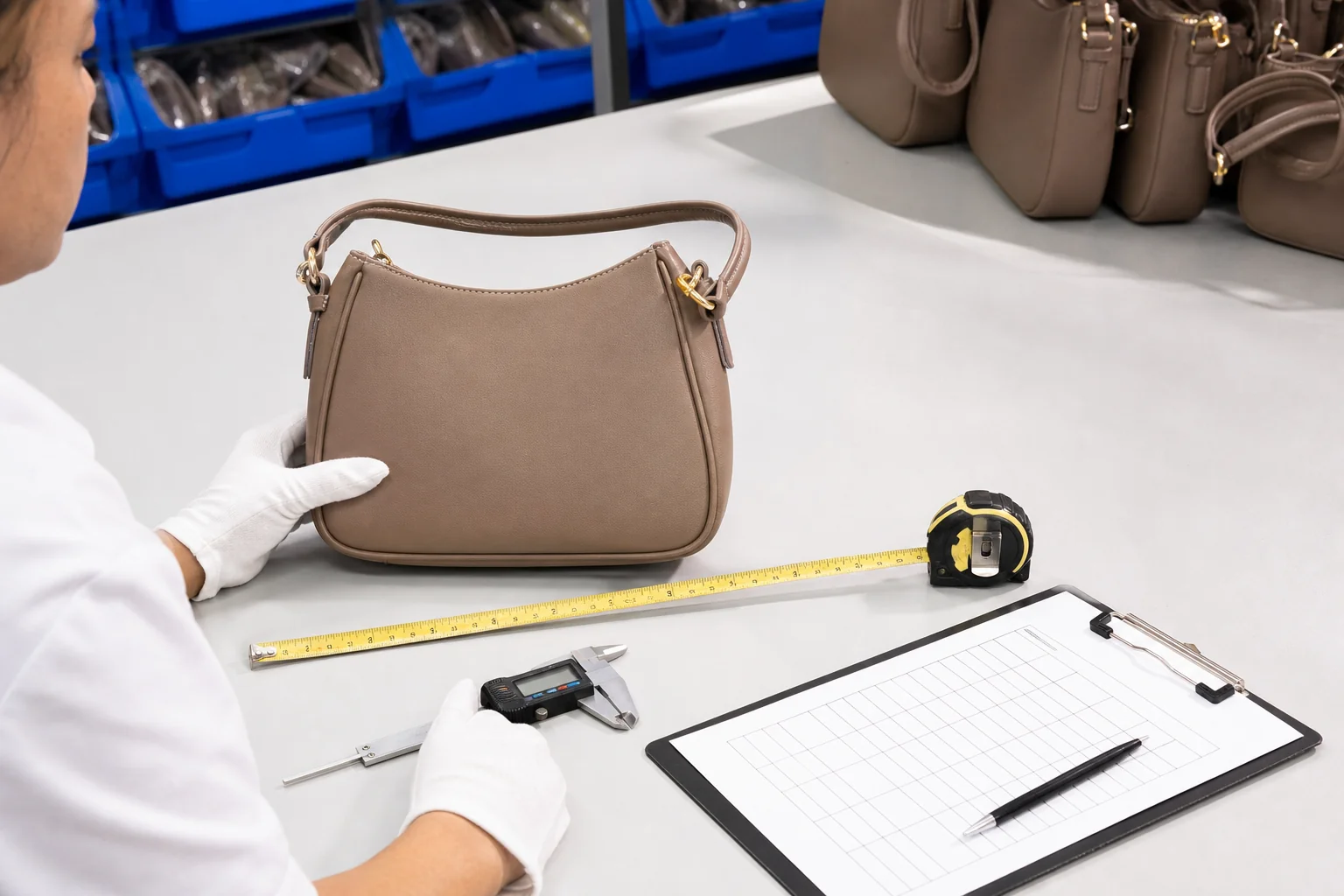
| Measurements | Dimensions within tolerance | Measure against spec |
Measurements and tolerances
Dimensional tolerances should be stated on the specification rather than left to the inspector’s judgement. Bag dimensions in soft material vary with how the unit is laid out, so measurement method matters as much as the tolerance itself.
Specify whether dimensions are taken flat, filled or hanging, and allow a realistic tolerance for flexible materials. A tolerance that ignores material behaviour produces failures that are not really defects.
Odour and off-gassing
Odour deserves specific attention in PU leather goods because adhesives and coatings can release solvent vapour that lingers in a sealed carton. The check should be done immediately after opening a carton, before the goods air out.
A noticeable solvent smell is a genuine defect: it affects retail presentation and, in some markets, may indicate a restricted substance issue. It is also one of the easiest issues for a factory to address if it is caught early, and one of the most damaging if it reaches a customer.
Packing, labelling and carton checks
Packing is part of the product for most buyers, and it fails in predictable ways: incorrect polybag size, missing desiccant, wrong carton markings, or a carton that does not meet a retailer’s requirement. These are easy to check and expensive to correct after loading.
The inspection should confirm carton dimensions against the specification, verify shipping marks and barcodes, check that each bag is individually protected, and record the number of units per carton. A discrepancy here usually indicates a packing instruction that was never clearly communicated.
Pre-Shipment, During-Production and Final Random
Where an inspection sits in the production timeline changes what it can achieve. The three common types serve different purposes and are not interchangeable.
During-production inspection
A during-production inspection takes place while the order is still being made, typically when a modest share of the lot has been completed. Its value is timing: defects found at this stage can still be corrected within the same production run.
This is the most cost-effective inspection type for a new product or a new supplier, because corrective action is still possible. A failure discovered at this point costs rework; the same failure discovered at pre-shipment costs a delayed shipment.

Final random inspection
Final random inspection happens when the goods are complete and packed, and the sample is drawn from the finished lot. This is the inspection most buyers mean when they refer to AQL testing.
Its purpose is to decide whether the shipment is acceptable, and it typically also checks packing, labelling and carton markings. Because production is finished, the only remedies available are rework, sorting or rejection, all of which cost time.
Container loading supervision
A loading check verifies that the goods that passed inspection are the goods actually shipped, and that the container is loaded and sealed correctly. It closes the gap between a batch that passed at the factory and the batch that arrives at the destination.
| Inspection type | Timing | Main value |
|---|---|---|
| During production | Partly completed | Correction still feasible |
| Final random | Complete and packed | Ship or reject decision |
| Loading supervision | At container loading | Verifies quantity and identity |
| Pre-production check | Before the line starts | Confirms materials and sample match |
Timing the inspections
For a first order, a pre-production check plus a during-production inspection plus a final random inspection gives the strongest coverage. For repeat orders from a proven supplier, a final random inspection alone is usually sufficient.
Buyers should confirm that the inspection occurs after production is complete and packed but before loading, because it is the last point at which a rejection is practically meaningful.
Reading and Acting on an Inspection Report
An inspection report is only useful if the buyer reads the defect detail rather than the summary verdict. The verdict states pass or fail; the detail states whether the batch is genuinely acceptable.
What to read first
Start with the defect breakdown by class, not the total. A report with a pass verdict and a concentration of major defects close to the acceptance number describes a batch that will generate returns, even though it technically passed.
Then read the description of each defect rather than the count. Ten minor defects of the same type usually indicate one systematic process issue, which is easier to fix and more predictable than ten unrelated faults.
The three possible outcomes
A batch can be accepted, rejected, or accepted conditionally. The conditional case covers the common real-world situation in which a batch exceeds the acceptance number but is still usable if specific units are removed.
In that situation the practical tool is a sorting agreement: the factory or a third party inspects a hundred percent of the units, removes the identified defective pieces, and the buyer accepts the remainder. This is often the fastest route to a shipment, provided the buyer checks the sorting was actually done.
| Outcome | What it means | Practical response |
|---|---|---|
| Accept | Within acceptance numbers | Proceed, note defect pattern for next order |
| Conditional | Exceeds limit in one class | Agree sorting, verify units removed |
| Reject | Fails on major or critical | Rework, re-inspect, or refuse |
| Void | Sample or method incorrect | Re-inspect with corrected plan |
Following through after the inspection
The value of an inspection is realised in what changes for the next order. A defect pattern that is not fed back to the factory will recur, because the process that produced it has not changed.
The most effective feedback names the characteristic, the observed rate and the specific process change expected. General requests to improve quality produce no change; a reference to a specific seam or a specific hardware attachment produces a targeted correction.
Sample selection errors
A statistically valid sample has to be drawn randomly from the whole lot. In practice samples are often taken from the top cartons or from units the factory has set aside, which biases the result toward the best goods in the batch.
The corrective is straightforward: require the inspector to select cartons from different positions in the stack and from different production dates where they are marked. This single instruction removes most of the gap between an inspection result and what the buyer experiences on receipt.
Common Misuses of AQL
Several recurring errors make AQL plans weaker than buyers believe. Each is easy to avoid once identified.
Quoting a percentage without the rest
The most common error is specifying an AQL percentage without the inspection level, the defect classes or the sample size. A number alone does not define a plan and cannot be applied consistently.
Treating a pass as a quality guarantee
A pass means the sample was within the acceptance numbers. It does not mean the batch contains that defect rate, nor that the buyer will not find defects in the units customers receive. A batch can pass and still produce returns.
Applying one plan to every product
A plan appropriate for a simple tote is not appropriate for a structured bag with multiple zips, a laptop compartment and a removable strap. Higher complexity means more opportunities for defects and justifies a stricter level.
| Misuse | Consequence | Correction |
|---|---|---|
| Percentage only | Plan cannot be applied | Specify level and classes |
| Pass treated as guarantee | Returns after delivery | Read defect detail, not the verdict |
| One plan for all products | Complex bags under-inspected | Vary level by complexity |
| Undefined defect classes | Inconsistent results | Build a photographed defect library |
| Inspector not independent | Results favour the factory | Use a third-party agency |
| No feedback loop | Same defects recur | Feed patterns into the next order |
Using the factory’s own inspector
A factory’s internal quality team is not a substitute for an independent inspection, because the commercial incentive runs the other way. Internal checks are valuable for process control, but the buyer’s acceptance decision should rest on an inspection with no interest in the outcome.
Writing AQL Requirements into a Purchase Order
An AQL requirement is only enforceable if it is part of the contract. Verbal agreements and email references are difficult to rely on when a shipment must be rejected.
The clauses to include
Four elements should appear in the purchase order: the inspection level and AQL values by defect class, the definition of each class for this product, the sample size basis and the point in production at which inspection occurs.
Adding the remedy for a failed inspection closes the loop. Without a stated remedy, a failed inspection leaves the buyer negotiating from a weak position while goods sit in a warehouse accruing storage cost.
Specifying remedies in advance
The remedy should distinguish degrees of failure. A minor excess might be resolved by sorting. A major failure should trigger rework and re-inspection at the factory’s cost. A critical defect should permit outright rejection with a defined liability for freight and delay.
| PO element | What to state |
|---|---|
| Inspection level | General II by default, III for new or complex orders |
| AQL values | Separate value for critical, major and minor |
| Defect definitions | Class definitions plus reference photographs |
| Inspection point | Complete, packed, before loading |
| Inspection party | Named third-party agency or buyer’s representative |
| Remedies | Sorting, rework or rejection by defect class |
| Cost liability | Who pays for rework, re-inspection and delay |
Keeping the requirement simple enough to apply
A specification that is too elaborate will be applied inconsistently. The most workable approach states the plan clearly, attaches a photographed defect reference, and reserves detail for the characteristics that genuinely determine whether the customer accepts the bag.
Write the inspection plan into the order, attach the defect photographs, and state what happens if it fails. Everything else is documentation.
FAQ
What is a standard AQL for bag inspections?
A common commercial default is zero for critical defects, 2.5 for major and 4.0 for minor, applied at general inspection level II. These are conventions rather than rules, and a premium brand or a complex product justifies a stricter plan. The right values depend on how many defective bags the business can absorb.
What does AQL 2.5 actually mean?
It means that under the agreed sample size, a defined number of major defects will still be accepted as satisfactory most of the time. It is not a defect rate guarantee for the shipment. Applied at the standard level, a lot can pass while containing more defects than the percentage suggests.
Should I use inspection level I, II or III?
Level II is the sensible default for established suppliers and proven products. Move to Level III for a new supplier, a complex construction, a high-value order or after a previous failure. Level I is appropriate only for low-risk repeat production where a tighter inspection is not justified.
How many bags will actually be inspected?
It depends on lot size and inspection level together, and the sample grows far more slowly than the lot. A shipment of several thousand bags is typically checked on a sample in the low hundreds. That is why the defect definitions matter so much: they determine what the sample is really testing.
What counts as a major defect on a bag?
A defect a customer would notice and reject: a zipper that sticks or fails, a strap that separates under normal load, a crooked flap, visible rework marks, a colour outside tolerance, or a significant solvent odour on opening. Each should be photographed with a passing and failing example before the order starts.
Can I reject a shipment if the inspection fails?
Only if the purchase order says so. The remedy should be stated in advance and graduated by defect class: sorting for a minor excess, rework and re-inspection for a major failure, outright rejection with defined cost liability for critical defects. Without a stated remedy, rejection becomes a negotiation.
Should I inspect during production or before shipment?
Both have value at different stages. During-production inspection finds defects while correction is still possible within the run, which makes it the most cost-effective option for a first order. Final random inspection decides whether the completed shipment is acceptable, but remedies at that point are limited to rework, sorting or rejection.
Do I need a third-party inspection agency?
For a first order with a new supplier, yes. An independent agency has no commercial interest in the result, which makes its verdict a reliable basis for the acceptance decision. Factory internal quality teams remain useful for process control but are not a substitute for an independent check.
How long does a bag inspection take?
A final random inspection of a typical order is usually completed within one working day, including opening cartons, measuring, functional testing and repacking. Complex products with many functional features take longer. The report is normally issued within a day or two of the inspection.
What if my supplier disputes the inspection result?
Disputes are usually about defect classification rather than the count, which is why a photographed defect library agreed before production is so valuable. If the classification was agreed in advance, the discussion narrows to whether specific units fall inside or outside the agreed reference.
Is AQL the same for every market?
The statistical system is widely used internationally, but the values applied vary by market, retailer and product category. Some markets also impose mandatory safety and chemical requirements that sit outside the AQL framework and must be satisfied regardless of the sampling result.
How do I set the right AQL for my product?
Start from the cost of a defective bag reaching a customer, not from an industry default. The more damaging a defect is to the relationship, the stricter the plan should be. Then apply a tighter level for new suppliers and complex constructions, and loosen only where the value of the goods genuinely does not justify tighter control.
Working with a PU leather bag manufacturer?
We manufacture PU leather bags in Guangzhou on OEM and ODM programmes, with defined inspection plans, defect reference libraries and third-party inspection coordination built into every order. Send your requirements to info@gionar.com, or review our custom bag manufacturing capabilities.