How Can You Audit a Bag Factory’s Quality System in One Day?
One day is enough to reach a sound judgement about a bag factory’s quality system, provided the day is spent looking at evidence rather than listening to presentation. Factories prepare for audits. Documents are printed, samples are arranged, and the defects are moved. A single day is short enough that the prepared version can hold up for the whole visit — unless the auditor controls the route.
The productive assumption is that a quality system is not described by its certificates but by a small number of observable behaviours. What happens when a defect is found. What records exist for a roll of material. Whether the inspection station is being used. Whether the same problem appeared last month and was fixed. These leave physical traces, and traces can be checked in a few hours.
Most buyer audits fail in one of two ways. Either they become document reviews, where the auditor ticks boxes against a quality manual that describes an ideal factory, or they become product inspections, where the auditor checks fifty finished bags and forms an impression from the sample. Neither tests the system. The first tests writing ability, the second tests one lot.
A factory’s quality system is the set of routines that reproduce an acceptable bag on a bad day. It is visible in the material store, at the cutting table, along the line and in the reject bin. All four places can be walked in a morning.
This article sets out a one-day structure: what to prepare before arriving, how to divide the day, which evidence to demand, which questions expose a system that exists only on paper, how to score what you see, and how to write a conclusion that is useful rather than diplomatic.
- What One Day Can and Cannot Prove
- Preparing Before You Arrive
- Structuring the Day
- Incoming Material Control
- Cutting and Panel Control
- The Production Line Walk
- In-Process and Final Inspection
- Records That Reveal a System
- Defect Handling and Rework
- Equipment and Calibration
- Training and Accountability
- Subcontracting and Outsourced Stages
- Traceability End to End
- Supplier Quality Management
- Housekeeping as Evidence
- Scoring and Weighting
- Writing the Audit Report
- Follow-Up and Verification
- FAQ
What One Day Can and Cannot Prove
An honest audit starts by defining its own limits. A one-day visit produces a reliable read on routines and a weak read on long-term consistency.
What a single day establishes well
Physical state, record availability, whether procedures are followed at the moment of observation, and whether problems from previous months were closed. These are all present in the building and cannot be faked for a whole day without effort.
What it establishes poorly
Consistency across seasons, behaviour under pressure during peak load, and whether the system survives a change of production manager. These need either time or a records trail.
Why the records trail compensates
Twelve months of inspection data, defect logs and corrective actions reveal behaviour over time. Reading them is faster than observing and usually more honest.
The correct claim in the report
State what was verified directly, what was inferred from records, and what remains untested. A report that overclaims is worse than a narrow one, because it transfers risk to the buyer who relied on it.
| Question | Verifiable in one day | Needs more |
|---|---|---|
| Are procedures followed today? | Yes, by direct observation | — |
| Is the inspection station used? | Yes, by wear and records | — |
| Were past defects closed? | Yes, from the log | — |
| Is capacity credible? | Partly, from line count | Peak season proof |
| Will quality hold for a year? | No | Repeat visits, trend data |
| Will it hold after a manager change? | No | Long relationship, history |
The one-day advantage
Because the visit is short, it is hard to stage. A factory can prepare a room and a folder; it cannot make every worker on the line behave differently for eight hours. That is why unannounced routes through the building are the most informative part of the day.
Preparing Before You Arrive
Preparation determines whether the day produces evidence or impressions.
Define the scope in writing
State which product family, which processes and which questions are in scope. A vague scope lets the factory steer the day toward its strengths.
Request documents in advance
Ask for the quality manual, the inspection standard, recent inspection records, the defect log and the corrective action list before the visit. Reading them beforehand turns the day into verification rather than discovery.
Prepare a question list
Write the twenty questions that matter and rank them. Auditors who improvise ask easy questions and leave with easy answers.
Bring the right instruments
A tape measure, a light source, a thermometer and a camera cover most physical checks. A colour reference and a seam gauge help in bag factories specifically.
| Preparation item | Purpose |
|---|---|
| Written scope | Prevents the visit drifting to strengths |
| Quality manual | Baseline to test against reality |
| Recent inspection records | Shows whether the system runs |
| Defect log | Reveals real failure modes |
| Corrective action list | Shows whether problems close |
| Ranked question list | Keeps the day focused |
| Basic instruments | Verifies claims on the spot |
| Previous audit report | Tests whether findings were fixed |
Ask for the previous audit
If the factory has been audited before, request the last report and its follow-up. What happened to those findings predicts how this visit’s findings will be treated.
Agree the route in advance, then vary it
Agree a schedule so the right people are present, but walk a different path between stops than the one proposed. The route not prepared for is the informative one.
Structuring the Day
A workable structure follows the material: from arrival of goods, through transformation, to shipment.
Morning: opening and material
Use the first thirty minutes for introductions and scope, then move immediately to the material store before the factory has warmed into presentation mode.
Mid-morning: cutting and components
Cutting is where material becomes product and where many quality problems are created. It is also where procedures are most visible.
Afternoon: line, inspection and records
Walk the line during production, then spend the last part of the day with records. Records reviewed after observation are far more revealing, because discrepancies become obvious.
Close: findings and clarification
Present preliminary findings while still on site. Factory response at that moment is itself informative, and it prevents later disagreement about what was seen.
| Time block | Focus | Output |
|---|---|---|
| 09:00–09:30 | Opening, scope, org chart | Named contacts, process map |
| 09:30–10:30 | Material store and incoming check | Lot control evidence |
| 10:30–11:30 | Cutting and component prep | Matching and records check |
| 11:30–12:00 | Warehouse and sub-stores | Storage and ageing check |
| 13:00–14:30 | Production line walk | Workstation observations |
| 14:30–15:30 | Inspection stations | Standard and gauge check |
| 15:30–16:30 | Records, logs, corrective actions | Trend and closure evidence |
| 16:30–17:00 | Close-out discussion | Preliminary findings |
Why the order matters
Observing before reading records prevents the records from framing what you see. An auditor who reads first tends to confirm the written version.

Incoming Material Control
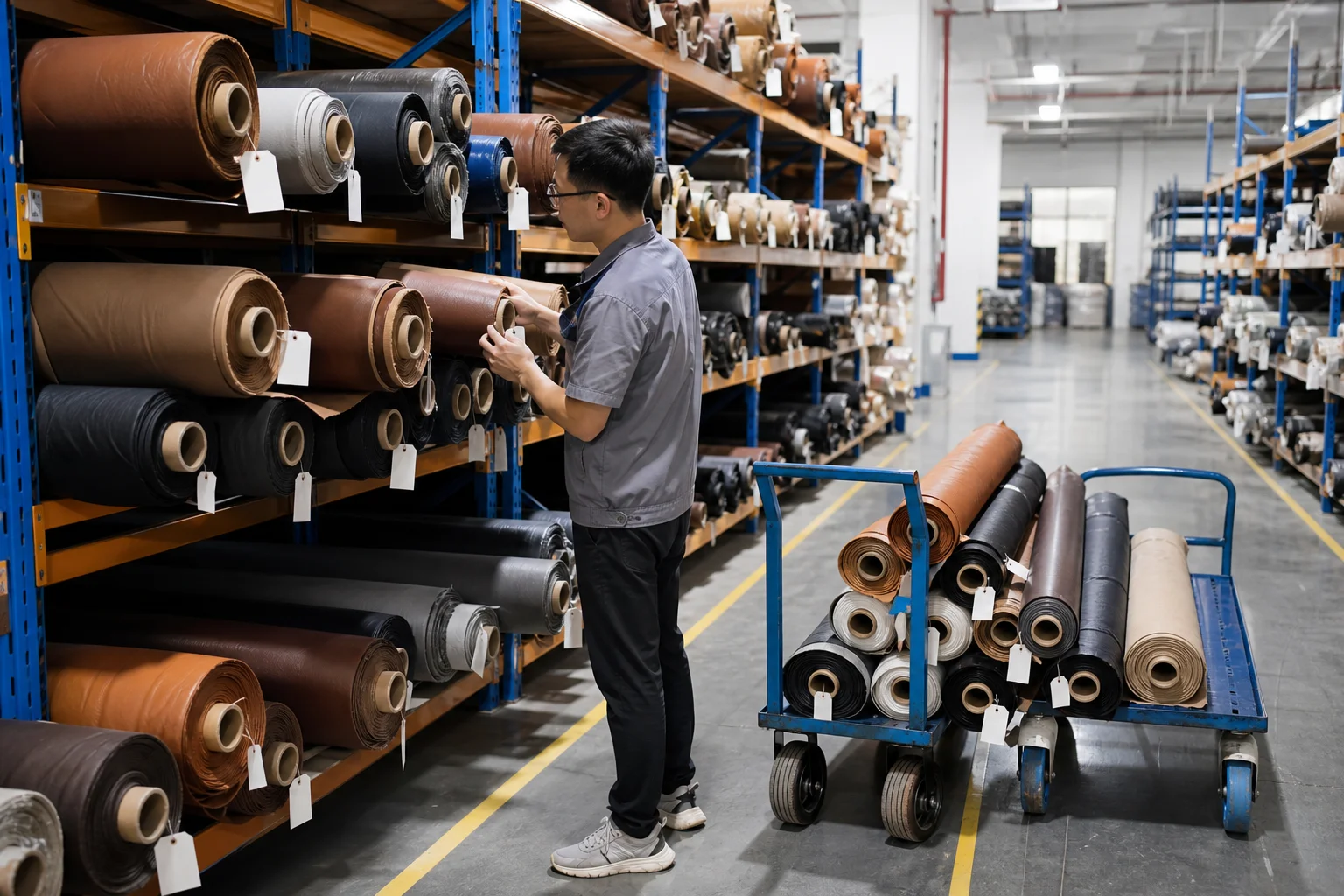
The material store is the highest-leverage place in a bag factory. Most quality failures begin with material that should have been rejected or segregated.
Is there a receiving inspection?
Ask to see the record for a specific roll received last week. A system that cannot produce a record for a named roll does not have a receiving inspection.
Lot identification
Every roll should carry a lot or batch identifier traceable to a supplier delivery. Without it, a defect found in production cannot be traced or contained.
Segregation of holds
Material awaiting decision must be physically separated and labelled. Material in the general rack that is quietly known to be suspect is a systemic risk.
Storage conditions
PU leather is sensitive to light, heat and stacking pressure. Check for skylights above the racks, proximity to heat sources and stack heights that mark surfaces.
| Check | Evidence to demand | Red flag |
|---|---|---|
| Receiving inspection | Record for a named recent roll | “We check everything” with no record |
| Lot identification | Label matching a delivery note | Unlabelled rolls in racks |
| Hold area | Physical separation and labels | Suspect material in general stock |
| Storage light | Rolls wrapped or shaded | Direct skylight over racks |
| Stack height | Within a stated limit | Compressed lower rolls |
| Age control | First-in first-out visible | Old rolls at the front |
The named-roll test
Pick a roll at random and ask for its full history: delivery date, supplier lot, inspection result and the orders it went into. A factory with a working system answers in minutes. A factory without one makes phone calls.
Why this section carries weight
Material control determines whether defects are prevented or discovered. It is also the cheapest area to fix, which makes weakness here a signal about management priorities rather than capability.
Cutting and Panel Control
Cutting converts material into components and fixes many quality outcomes before sewing begins.
Marker and yield discipline
Check whether cutting follows a marker and whether the marker is approved. Freehand cutting produces dimensional variation that shows up later as assembly problems.
Shade and grain matching
Panels for one bag should come from the same roll and adjacent positions. Ask what rule applies and watch whether the cutter follows it when nobody is explaining.
Directional material
Grain, nap and pattern direction must be consistent across panels. A panel cut in the wrong direction reads as a different colour or texture.
Component counting and bundling
Components should be bundled by bag or by set with a count. Loose components that must be re-counted at the line create both delay and mismatch risk.
| Cutting check | What good looks like | What it prevents |
|---|---|---|
| Approved marker | Marker on the table, dated | Dimensional drift |
| Shade matching rule | Stated and followed | Two-tone bags |
| Grain direction | Marked on panels | Texture mismatch |
| Bundle identification | Tag with style, size, count | Mixed components |
| Cut panel inspection | Spot check recorded | Errors reaching the line |
| Remnant control | Remnants reserved or binned | Odd panels appearing late |
The observation that matters
Watch a cutter for five minutes without asking questions. Whether the rule is followed when unobserved tells you more than the written procedure.
The Production Line Walk
The line shows whether the system operates under normal conditions, which is where most variation originates.
Workstation standard
Each station should have a visible standard: a sample, a photo or a specification. Stations without a standard produce to individual judgement.
In-line checks
Ask a worker what they check and what they do when they find a fault. The answer reveals whether inspection is a role or a ritual.
Work in progress
Excessive work in progress hides problems and makes tracing difficult. Bounded buffers indicate controlled flow.
Tool and machine condition
Worn needles, blunt cutters and misadjusted machines produce consistent defects that look like material problems. Check condition directly.
| Line observation | Indicator of a working system |
|---|---|
| Station standards | Visible sample or spec at each station |
| Worker knowledge | Can state what they check and why |
| Work in progress | Bounded, identified, moving |
| Needle and blade condition | Replacement schedule visible |
| Defect tagging | Faults marked at the station |
| Rework separation | Rework physically separated |
| Supervisor presence | Supervisor on the floor, not in an office |
Asking the awkward question
Ask a worker, not a manager, what happens when a panel does not match. If the answer is “I set it aside and tell the supervisor”, the system reaches the floor. If it is “I use it anyway”, the system does not.
In-Process and Final Inspection
Inspection stations are the most frequently audited and most frequently misunderstood part of a factory.
Is the station actually used
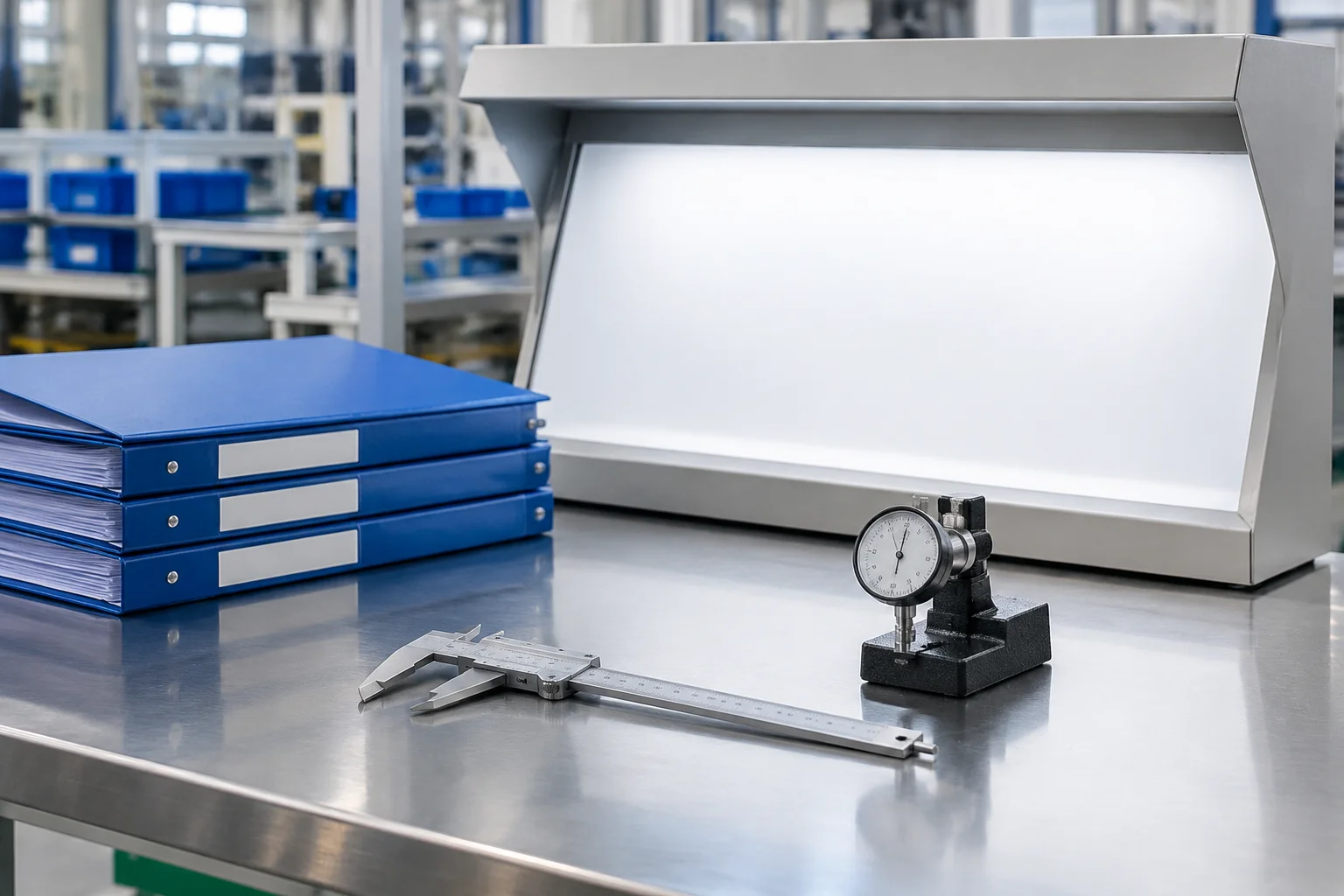
Look for wear: scuffed light box surfaces, worn templates, pencils and tags in use. A pristine inspection station in a busy factory is a display.
Written inspection standard
The standard should define defect classes and acceptable limits. Verbal standards cannot be applied consistently across shifts.
Sampling logic
Ask how many units are checked and why that number. A sampling plan that cannot be explained is not a plan.
Recording and escalation
Every inspection should produce a record and a decision. Records without a decision path are paperwork.
| Inspection element | Evidence | Weak signal |
|---|---|---|
| Station in use | Wear, tools, current work | Spotless, unused light box |
| Written standard | Documented defect classes | “We know what to look for” |
| Sampling plan | Defined levels and rationale | Arbitrary fixed count |
| Records | Dated sheets per lot | Undated or retrospective |
| Escalation | Named decision maker | Nobody owns the result |
| Gauge availability | Measuring tools at hand | Tools locked in an office |
The sealing question
Ask whether inspected cartons are sealed and marked as inspected. If inspected and uninspected goods are visually identical, the inspection result cannot be trusted downstream.
Records That Reveal a System
Records are the only part of a quality system that survives the visit, so they deserve serious attention in the final hours.
Are they contemporaneous
Look for records written during the shift, with times and initials. Records completed at the end of the week from memory are reconstructions.
Do the numbers agree
Compare the inspection record against the production order and the packing list. Quantities should reconcile. Unreconciled quantities mean unrecorded losses or unrecorded rework.
Is there a trend
Twelve months of defect data should show something: a stable rate, an improvement or a specific recurring failure. A perfectly flat record with no variation suggests the data is decorative.
Are corrective actions closed
Pick three entries from the corrective action list and ask for evidence of closure. A list of open actions from a year ago is a clear finding.
| Record | Test to apply | What failure means |
|---|---|---|
| Inspection sheets | Contemporaneous times and initials | Reconstructed after the fact |
| Production orders | Reconcile with inspection and packing | Unrecorded loss or rework |
| Defect log | Look for trend and repeats | Data decoration |
| Corrective actions | Trace three to closure | No learning loop |
| Calibration records | Check dates against instruments | Measurements unverified |
| Training records | Match names to current staff | Paper compliance only |
A factory with dull records and a clean floor is usually better than one with glossy records and a floor nobody walks.
The reconciliation test
Choose one finished carton, find its production order, then find the inspection record for that order. Three documents that agree prove a traceability chain. Three documents that cannot be found prove the opposite.
Defect Handling and Rework
How a factory handles a defect reveals more about its system than how it handles a good unit.
Where defects go
Ask to see the reject area. It should exist, be labelled and contain identifiable items. A factory with no rejects is either perfect or hiding them.
Classification and disposition
Each defect should be classified and dispositioned: rework, downgrade, scrap or accept with concession. Undispositioned defects accumulate and eventually ship.
Rework control
Rework is a second production process and needs its own check. Reworked units that bypass inspection are a common source of field failures.
Root cause versus containment
Sorting a lot contains a problem; changing a process prevents it. Ask what changed after the last significant defect, not just what was sorted.
| Defect stage | Good practice | Finding if absent |
|---|---|---|
| Detection | Tagged at the station | Faults travel downstream |
| Segregation | Physically separated | Defects re-enter the flow |
| Classification | Documented class | Arbitrary judgement |
| Disposition | Rework, downgrade, scrap, concede | Accumulation and late shipment |
| Rework inspection | Re-checked before packing | Field failures |
| Root cause | Process change recorded | Same defect recurs |
The repeat-defect question
Ask which defect appeared most often last quarter and what was changed. A factory that can answer has a learning loop. One that cannot has an inspection function only.
Equipment and Calibration
Measurement credibility depends on the instruments, and instruments are easy to verify.
Which instruments matter
In bag factories the critical ones are scales for material weighing, thickness gauges, tape measures and any colour or seam strength equipment used for acceptance decisions.
Calibration status
Each instrument should carry a calibration label with a date. Check that the label matches the calibration record and that the interval is sensible for the use.
Instruments in use
An instrument with a lapsed calibration that is still being used for acceptance is worse than no instrument, because it produces confident numbers that cannot be defended.
Everyday tools
Worn tape measures and damaged squares cause dimensional drift across a whole order. They are cheap to replace and often neglected.
| Equipment | Why it matters | Check |
|---|---|---|
| Weighing scale | Material and component accuracy | Label and record match |
| Thickness gauge | Material consistency | Zero check, calibration date |
| Tape measure | Dimensional control | Wear at the tip |
| Seam strength tester | Join integrity claims | Calibration and use log |
| Light box | Colour judgement | Lamp type and age |
| Sewing machine tension | Stitch consistency | Checked per shift |
Light boxes age
Fluorescent tubes shift spectrum with age. A light box that has not had lamps replaced still looks functional and no longer matches the standard it was set to.
Training and Accountability
Systems are executed by people, and the audit should establish whether the people know the system exists.
Who owns quality
Ask who is accountable for a quality decision when the production manager disagrees. If the answer is “the boss”, quality has no independent authority.
Training records against reality
Match training records to the people currently on the line. Records for departed staff and missing records for new staff are both common findings.
Skill distribution
Critical operations performed by one person create a single point of failure. Ask how many people can perform the most skilled operation.
Communication of standards
Standards must reach the floor in a form workers can use: photographs, samples, simple diagrams. A standard that exists only in an English-language manual has not reached the floor.
| People check | Question to ask | Strong answer |
|---|---|---|
| Quality authority | Who can stop a shipment? | A named quality role, independent |
| Training | When was this operator trained? | Record matching the person |
| Skill depth | How many can do this operation? | More than one, documented |
| Standard access | Show me the standard for this station | Visual, in the local language |
| Turnover | How long has this team been here? | Stable core team |
| Shift consistency | Does the night shift apply the same standard? | Same documents, same checks |
Asking about the night shift
Most audits occur during the day. Asking how the night shift applies the same standard, and requesting its records, tests whether the system is a document or a practice.
Subcontracting and Outsourced Stages
Many bag factories outsource embroidery, printing, metal finishing or part of the sewing. Outsourced stages are where quality systems commonly break down.
Which stages leave the building
Ask directly and cross-check with the production flow. A factory that describes a fully in-house process while trucks leave daily is describing an aspiration.
Control at the subcontractor
Is there an agreed standard, an incoming check on return, and a record? Outsourced work that returns without inspection transfers the subcontractor’s quality directly to the customer.
Liability and rework
Establish who pays when subcontracted work is defective. Factories that have never resolved this question pass the cost on.
Capacity and lead time risk
Subcontractors serve several customers and prioritise by relationship. Their capacity becomes your lead time risk during peak season.
| Outsourced stage | Control needed | Common gap |
|---|---|---|
| Embroidery | Approved design, first-off check | No first-off approval |
| Printing | Colour standard, cure check | Colour drift across runs |
| Metal finishing | Plating thickness or salt spray | No test evidence |
| Partial sewing | Dimensional check on return | Accepted without inspection |
| Packing | Count and label verification | Mixed cartons |
| Transport | Condition check on receipt | Damage undisputed |
The return check
The single most useful question about outsourcing is what happens when goods come back. A recorded return inspection indicates control; an informal look indicates hope.
Traceability End to End
Traceability is the ability to move from a finished bag back to its material and forward from a material to the bags it entered.
Forward traceability
Given a roll, which orders and cartons contain it? This is what allows a recall to be targeted rather than total.
Backward traceability
Given a bag, which roll, which batch and which inspection record? This is what allows a complaint to be investigated rather than argued.
How far it usually reaches
Many factories can trace to an order but not to a roll. The gap is usually at cutting, where roll identity is lost when material is issued.
Testing it live
Ask for the trace of a specific carton number. A working system produces the answer within the visit; a broken one produces a promise to email.
| Direction | Question | Where systems fail |
|---|---|---|
| Forward | Which cartons contain roll X? | Roll identity lost at cutting |
| Backward | Which roll is in carton Y? | No carton to order link |
| Inspection | Who inspected this lot? | Unnamed or shared sign-off |
| Material | Which supplier lot? | Delivery notes not filed |
| Subcontract | Which external batch? | No return record |
| Time | When was it made? | Undated records |
Why this matters commercially
Without traceability, a defect complaint becomes a negotiation about percentage rather than a targeted correction. Buyers pay for that ambiguity in the end.
Supplier Quality Management
A factory’s own quality depends heavily on how it manages the factories behind it.
Approved supplier list
Ask whether material suppliers are approved and on what basis. A list maintained by habit rather than assessment offers no assurance.
Incoming performance data
Does the factory track defect rates by supplier? Suppliers that repeatedly deliver marginal material should be visible in that data.
Change notification
Are suppliers contractually required to notify changes in material or process? Unannounced substitution is one of the most common causes of late-discovered quality failures.
Response to a failing supplier
Ask what happened the last time a supplier failed. A documented response, whether corrective or a change of supplier, indicates an active system.
| Supplier control | Evidence | Gap indicator |
|---|---|---|
| Approved list | Criteria and assessment dates | List with no basis |
| Performance tracking | Defect rate by supplier | No data by supplier |
| Change notification | Written requirement | Verbal understanding only |
| Corrective response | Recorded action on failure | No recorded response |
| Incoming inspection | Sampling per supplier risk | Uniform check regardless |
| Audit of suppliers | Periodic visits | Never visited |
The substitution question
Ask what happens if a pigment or base material becomes unavailable. A factory with a change control process answers with a procedure. One without answers with reassurance.
Housekeeping as Evidence
Housekeeping is the cheapest observable indicator of management discipline, which is why it deserves a section rather than a glance.
What a clean floor indicates
A factory that maintains its floor, tools and stores is applying routine discipline. That discipline usually extends to records and checks that cannot be seen in a single visit.
What disorder predicts
Mixed components, unlabelled material and cluttered workstations predict mixed shipments and untraceable defects. Disorder at the physical level tends to mirror disorder at the procedural level.
Distinguishing tidy from organised
A tidy factory prepared for a visit differs from an organised one. Look for marked locations, labelled bins and materials returned to defined places, not just a swept floor.
Safety as a proxy
Obstructed exits, missing guards and unmarked hazards indicate the same management gap that produces quality escapes. They are also faster to assess.
| Observation | Working system | Risk signal |
|---|---|---|
| Floor condition | Clean, dry, unobstructed | Offcuts and spills |
| Bin labelling | Contents and part number | Unlabelled containers |
| Tool storage | Defined locations | Tools on machines and floors |
| Offcut handling | Collected and binned | Offcuts mixed into stock |
| Aisle access | Clear and marked | Blocked by work in progress |
| Lighting | Adequate at workstations | Dim inspection areas |
Why this belongs in the report
Housekeeping findings are easy for the factory to accept and quick to fix. Including them gives the report early credibility before the harder findings arrive.
Scoring and Weighting
A score makes the audit comparable across factories and across years, provided the weighting reflects commercial consequence.
Weight by consequence, not by ease
Incoming material control and cutting matching carry more weight than document formatting, because they prevent defects rather than record them.
Separate prevention from detection
Score the two families separately. A factory that detects well and prevents poorly will pass inspections and still generate complaints.
Use a simple scale
A four-point scale for each item, with a written definition of each level, is enough. Elaborate scoring systems produce precision without accuracy.
Flag critical items separately
Some findings should override the score: no receiving inspection, no calibration, no traceability. A factory can score well overall and still be unsuitable.
| Area | Weight | Why |
|---|---|---|
| Incoming material control | 20 percent | Prevents most downstream defects |
| Cutting and matching | 15 percent | Fixes many visible failures |
| In-process inspection | 15 percent | Contains defects early |
| Final inspection | 15 percent | Protects the shipment |
| Records and traceability | 15 percent | Enables correction and recall |
| Equipment and calibration | 10 percent | Makes measurement credible |
| People and training | 5 percent | Determines execution |
| Housekeeping | 5 percent | Indicates discipline |
Read the score as a profile
Two factories can score the same total with opposite profiles. One prevents and does not document; the other documents and does not prevent. The profile, not the total, tells you what to expect.
Writing the Audit Report
The report is the deliverable. A careful day produces nothing usable if the report is vague.
Separate finding from opinion
State what was observed, where, and what it implies. “No receiving inspection record could be produced for three randomly selected rolls” is a finding. “Weak material control” is an opinion.
Grade the findings
Critical findings affect fitness for supply. Major findings affect consistency. Minor findings affect efficiency. The grade drives the response.
Attach the evidence
Photographs with timestamps, document references and the names of the areas observed. Evidence prevents later dispute about what was seen.
Recommend in order of consequence
Sequence recommendations by risk reduced rather than ease of implementation, then note which are quick wins.
| Report element | Content | Common failure |
|---|---|---|
| Scope | Products, processes, date, duration | Vague or missing |
| Method | Observation, records, interviews | Unstated |
| Findings | Observed fact plus implication | Opinion presented as fact |
| Grading | Critical, major, minor | All findings equal |
| Evidence | Photographs, references | Assertions without evidence |
| Recommendations | Ordered by risk reduced | Generic checklist |
| Limitations | What was not tested | Overclaiming |
The limitations section
Stating what the audit did not cover protects both parties. It is also the mark of an audit written by someone who understands what a day can prove.
Follow-Up and Verification
An audit that ends with a report has produced a document. An audit that ends with verified closure has produced a better supplier.
Set dated actions
Each finding needs an owner and a date. Actions without dates are intentions.
Require evidence of closure
Photographs of the new hold area, a copy of the receiving record, a calibration certificate. Evidence is checkable; statements are not.
Verify by re-audit or by sample
A short follow-up visit focused only on the open findings is efficient. Where travel is impractical, request evidence and test it through the next order’s inspection data.
Watch the first shipment after the audit
The order placed immediately after an audit is the real test. Inspection data from that shipment shows whether anything changed.
| Follow-up stage | Timing | Evidence |
|---|---|---|
| Action plan received | Within two weeks | Dated plan with owners |
| Interim evidence | Within one month | Photographs, new documents |
| First shipment data | Next order | Inspection results and defect rate |
| Focused re-audit | Three to six months | Direct observation of fixes |
| Full re-audit | Annually | Comparable score |
| Escalation | If no progress | Commercial consequence |
What to do when nothing changes
A supplier that ignores findings is telling you its priorities. The correct response is commercial, not a further round of requests.
FAQ
Can a one-day audit really assess a factory’s quality system?
It can reliably assess routines, physical state and record keeping, and it can verify whether past problems were closed. It cannot prove consistency across seasons or behaviour under peak load. State those limits in the report rather than overclaiming.
What is the single most informative place to start?
The material store. Most quality failures begin with material that should have been rejected or segregated, and the store shows whether receiving inspection, lot identification and hold procedures actually operate.
Should I audit the factory or just inspect the finished goods?
They answer different questions. Product inspection tells you about one lot. A system audit tells you what to expect from the next lot. For a new supplier, the audit is more valuable; for a repeat shipment, inspection is sufficient.
How do I tell whether records are real?
Look for contemporaneous times and initials, then reconcile quantities across the production order, inspection record and packing list. Fabricated records usually fail reconciliation because they were written without reference to the others.
What findings should disqualify a factory immediately?
No receiving inspection, no calibration on instruments used for acceptance, and no traceability from carton back to material. Any of these means defects cannot be contained or investigated, which makes every future shipment a gamble.
How much weight should certificates carry?
Certificates indicate that a system was documented at a point in time. They do not indicate that it operates today. Treat them as a starting point and verify behaviour directly.
What should I ask workers rather than managers?
Ask what they check, what they do when they find a fault, and where they put it. The answer reveals whether the system reaches the floor. Managers describe the system; workers demonstrate it.
How do I audit outsourced stages I cannot see?
Ask which stages leave the building, then examine the return inspection record for those stages. A recorded check on return indicates control; an informal look indicates that the subcontractor’s quality is passing straight through.
Is housekeeping a legitimate audit finding?
Yes. It is the cheapest observable indicator of management discipline, and disorder at the physical level usually mirrors disorder in procedures. It is also quick for the factory to fix, which makes it useful for testing responsiveness.
How many people should be on the audit team?
One experienced auditor can cover a single product family in a day. Two are useful when the factory is large or when one person must observe the line while the other reviews records, since both activities compete for the same hours.
What if the factory refuses to show certain areas?
Record the refusal as a finding in itself and note the area. A refusal is informative: it indicates the factory knows the area would not withstand inspection, which is more useful than a polite tour of a prepared line.
How soon after an audit should the first order be placed?
Soon enough that the inspection data from that order can be compared with the audit findings. A long gap lets the factory return to its prior routine and makes the comparison meaningless.
Planning a supplier audit for PU leather bags?
Send your product scope and target order to info@gionar.com and we will share the audit checklist and record templates we use in production, together with the inspection data we hold for each batch.