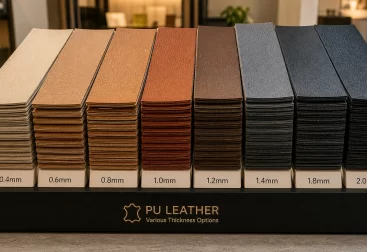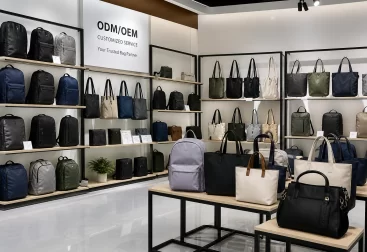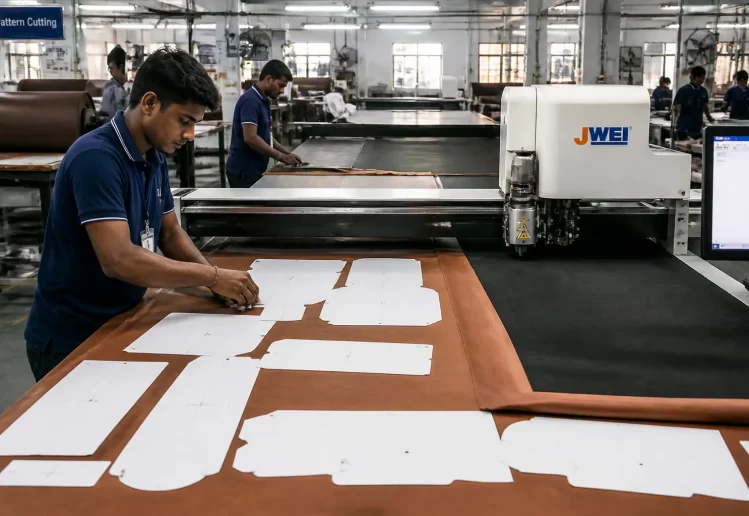
Starting a bag brand is one of the most accessible businesses in fashion — and one of the most competitive. You do not need a factory, a warehouse or a design team to begin; every one of those can be rented from an OEM manufacturer. What you do need is a clear product idea, a realistic market position, and the discipline to move through a well-defined production process without skipping steps. The brands that fail in their first season rarely fail because the market rejected them; they fail because they ordered the wrong product from the wrong factory, with no specification and no testing.
This guide walks through the OEM route from zero to launch, in the order a serious manufacturer would recommend: defining the product, understanding what OEM actually includes, designing a technical specification, qualifying a factory, sampling, pricing, production control and launch. It is written from the factory side of the table, so it tells you what manufacturers expect from good clients — and what good clients demand in return. Follow the steps in order, and your first order has a fighting chance of being your best one.
- The Starting Point: Define the Product and Market
- Understanding the OEM Model: What a Factory Does for You
- Step 1 — Research and Positioning
- Step 2 — Design and Technical Specification
- Step 3 — Choosing and Qualifying Your Factory
- Step 4 — Sampling and Prototyping
- Step 5 — Pricing, MOQ and Payment Terms
- Step 6 — Production, Quality Control and Delivery
- Step 7 — Launching and Growing the Line
- FAQ
The Starting Point: Define the Product and Market
Every successful bag brand starts with a decision that has nothing to do with factories: what exactly are you selling, and to whom? The more precise this definition, the easier every later step becomes — because the factory, the materials, the sampling and the pricing all follow from it.
Start with the customer and the use case. Are you selling a daily-use tote for working professionals, a laptop backpack for students, a fashion crossbody for a trend-driven market, or a premium vegan handbag for sustainability-minded buyers? Each of these points to a different material family, price band, construction complexity and sales channel. A brand that tries to serve all of them at once produces a line with no identity and a factory relationship with no focus.
Then define the price point. Your retail price determines everything downstream: the material grade you can afford, the construction detail you can specify, the margin available for freight, returns and marketing. A useful discipline is to work backwards: set the retail price, deduct the retailer or platform margin, deduct freight and duties, deduct the safety margin for returns — what remains is your target landed cost from the factory. Most first-time founders are surprised by how little room this leaves, which is exactly why the exercise belongs at the start, not after the first sample.
Finally, define the first collection’s scope: how many styles, how many colors, what quantities. A focused launch of two or three styles with shared hardware and lining is dramatically cheaper and faster to produce than a ten-style line, because every distinct material, color and component adds setup cost and minimums. The brands that launch lean and expand from real sales data have a structural advantage over brands that launch everything they dreamed of at once.
Understanding the OEM Model: What a Factory Does for You
OEM — Original Equipment Manufacturing — means the factory produces a product to your specification, using your designs or designs developed with you, without the factory’s own brand attached. In the bag industry, OEM covers far more than sewing: a full-service manufacturer provides pattern engineering, material sourcing, sampling, production, quality control and export logistics. Understanding what is included — and what is not — is the foundation of a clean working relationship.
| Service | What it includes | Who usually provides it |
|---|---|---|
| Pattern engineering | Turning design sketches into production patterns | Factory (from your tech pack or sketches) |
| Material sourcing | Finding and qualifying fabrics, hardware, linings | Factory, with your approval |
| Sampling | Development samples, sales samples, production samples | Factory |
| Production | Cutting, sewing, assembly, finishing | Factory |
| Quality control | Incoming material checks, inline inspection, final AQL inspection | Factory + third-party inspectors if required |
| Export logistics | Packing, export documentation, freight booking | Factory + freight forwarder |
| Design | Original silhouettes and styling | You, or factory’s ODM service (see below) |
Two models are worth distinguishing. In pure OEM, you bring the design and the factory executes it. In ODM (Original Design Manufacturing), the factory offers its own designs and production-ready styles that you can brand as yours — a fast, low-investment way to launch, at the cost of less exclusivity. Many first-time brands launch with ODM styles, validate the market, then develop their own OEM designs once they know what sells. Both models are legitimate; the mistake is confusing them and assuming exclusivity where none was agreed.
Step 1 — Research and Positioning
Before any factory conversation, research answers three questions: who else sells to your customer, at what price, and with what product gap you can exploit.
Competitor research should be specific. Pick five brands that sell to your target customer and list their product range, price bands, materials and best-selling styles. Look for the gap — the style, material or price point they are not serving well. A brand that launches with a clear answer to “what do we do that the incumbents don’t” has a positioning; one that launches with “we make nice bags” has a wish.
Research also validates demand before you spend on sampling. Search trends for your product category and keywords, read retailer reviews in the category to learn what customers complain about (quality, sizing, straps, materials — every complaint is a design requirement), and talk to potential buyers or retail partners early. The feedback you collect before production is free; the same feedback collected after a container arrives is expensive.
Finally, position within your price band deliberately. If your target retail is the mid-tier, design for the mid-tier’s expectations: quality hardware, clean stitching, consistent material grade. Trying to deliver a luxury impression at an economy price almost always fails on quality; delivering economy quality at a mid-tier price fails on trust. Match the product to the price, and the price to the customer.
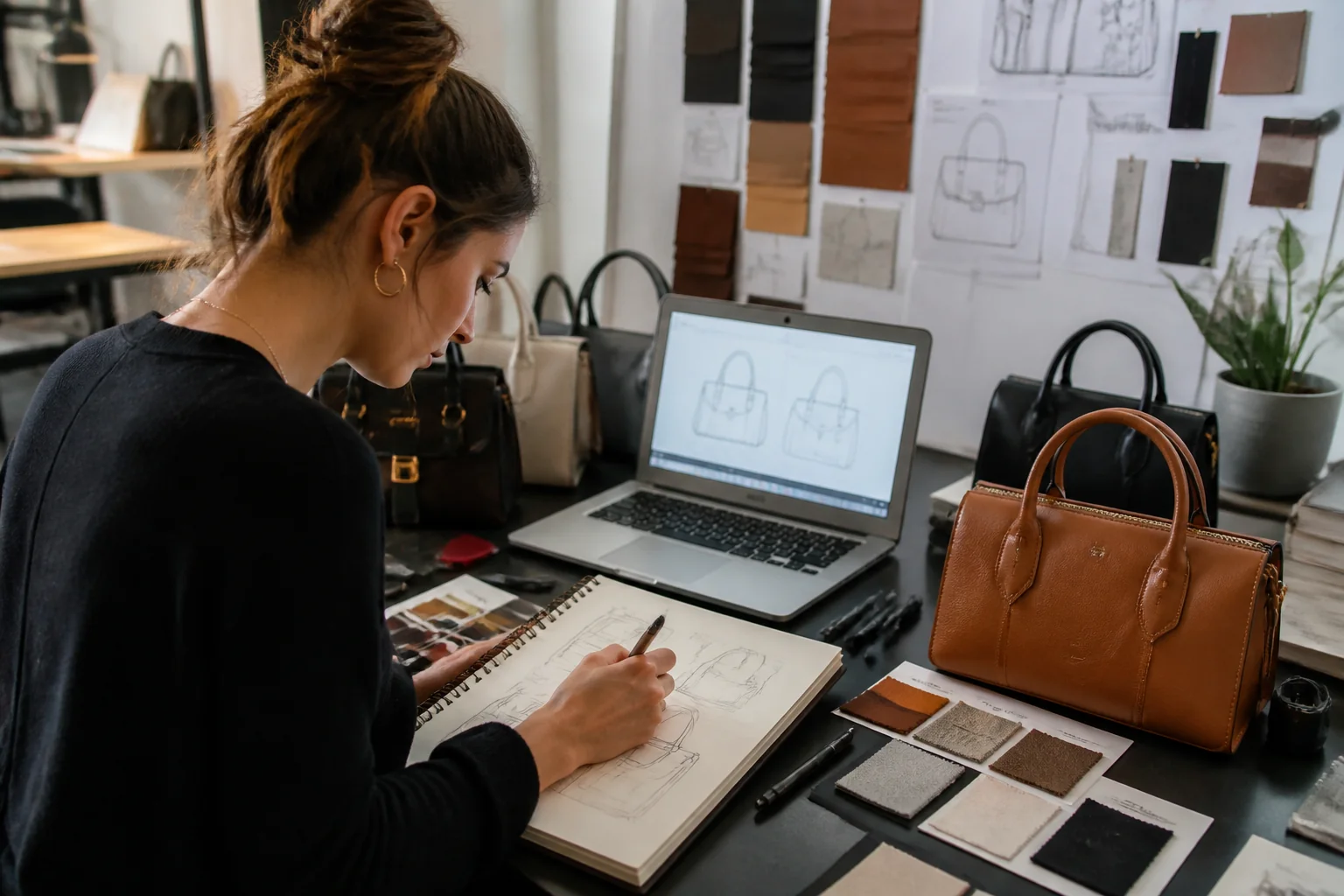
Step 2 — Design and Technical Specification
Design is where a bag brand’s identity is created — and the technical specification is where it becomes manufacturable. You need both, and the second is what factories actually build from.
Your design should resolve the functional questions before sampling: the silhouette, the dimensions, the closure (zipper, magnetic, flap), the strap type and length, the pocket layout, the lining, the hardware style and finish. Even a simple handbag involves dozens of decisions; leaving them open at sampling stage produces samples that drift from your vision and cost you iteration cycles.
The technical specification — the tech pack — is the document that turns the design into numbers. It includes: front, back and side views with measurements; material specifications (main material, lining, hardware with finishes); construction notes (stitching type and density, seam allowances, edge treatment); component lists; and quality standards. A complete tech pack lets a factory quote accurately, sample correctly and produce consistently. An incomplete one produces surprises.
The good news for first-time founders: most bag factories will help build a complete tech pack from your sketches and references — this is standard OEM service. What they cannot do is read your mind. Bring reference images, dimensions, material preferences and an honest budget, and the factory team will translate them into a manufacturable specification with you.
Step 3 — Choosing and Qualifying Your Factory
Your factory is your most important business partner, and choosing it deserves the same rigor as choosing a co-founder. A qualification checklist keeps the decision objective.
- Specialization: Does the factory make your category? A backpack specialist, a handbag specialist and a travel-bag specialist run different production lines, source different materials and hold different skills. Match the specialization to your product.
- Capacity and scale: Can the factory handle your order size, and can it scale with you? A factory whose minimum order is ten times your launch order is the wrong partner for year one — and a micro-workshop cannot deliver the volume your growth will need.
- Quality systems: Ask about inspection processes, defect targets, and whether they use independent third-party inspection. The factory’s answer tells you whether quality is a process or a hope.
- Export experience: Your product must clear customs, meet destination-market labeling rules and survive international freight. Export experience — packing standards, documentation, shipping lanes — is a real capability, not paperwork.
- Communication: For a first order, responsive, clear communication matters more than any brochure. The factory that answers technical questions precisely and promptly will be easier to work with across the whole order cycle.
Shortlist two or three factories, send them the same brief and tech pack, and compare their responses: the questions they ask, the samples they propose, the timelines they promise and the quotes they return. The factory that asks sharp questions about your market and materials is usually the factory that will build your product well — questions are the signature of a factory that thinks.
Step 4 — Sampling and Prototyping
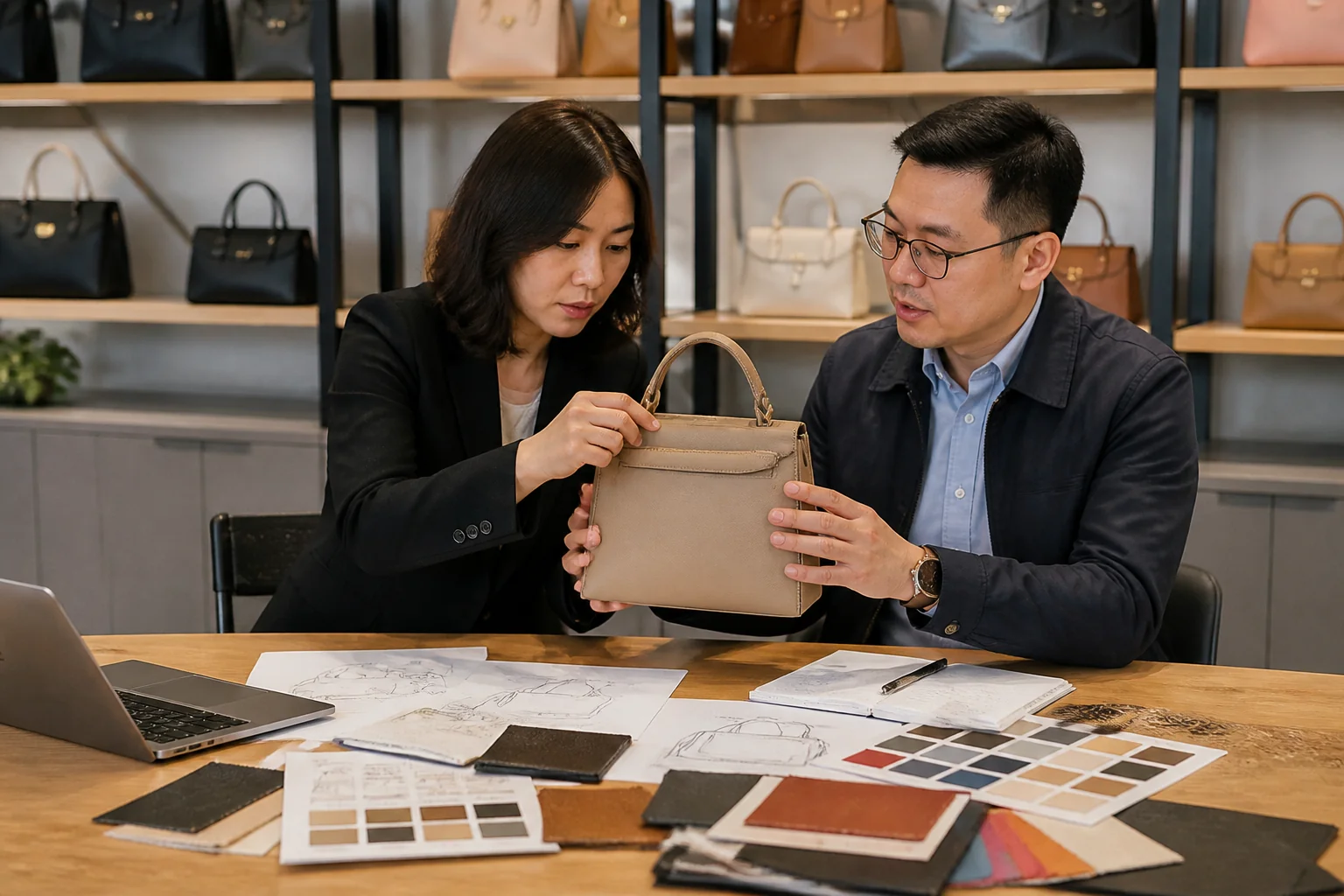
Sampling is where the product becomes real — and where most first-time founders underestimate both the number of rounds and the value of each one. Plan for three types of samples.
Development sample: the first physical realization of your design, built to check proportions, materials and construction. Expect changes — the sample reveals what the sketch could not: how the material drapes, how the strap sits, where the hardware lands.
Sales / approval sample: the corrected sample that represents the final product. This is the sample you photograph, show to buyers and use as the quality reference for production. It must be built from the exact production materials and hardware, and it becomes your sealed reference — the standard every production piece is compared against.
Production sample (pre-production / PP sample): the first piece off the actual production line, confirming that the line setup, materials and operators reproduce the approved sample at scale. Checking the PP sample before full production is the cheapest quality insurance in the entire process.
Budget for two to four sampling rounds in your timeline and cost plan. Each round takes days to weeks depending on the factory’s load, so a realistic first-order timeline runs roughly eight to twelve weeks from brief to shipment. Factories that promise samples in a week and production in three are either exceptionally efficient or dangerously overconfident — verify with references before believing it.
Step 5 — Pricing, MOQ and Payment Terms
Three numbers define the commercial agreement: the unit price, the minimum order quantity and the payment terms. Each deserves scrutiny.
Unit price
Your landed unit cost includes the factory price, freight, duties, and any inspection or agent fees. When comparing factory quotes, compare like with like: same materials, same hardware, same construction, same quality standard. The lowest quote is often the most expensive in the end — through cheaper materials, thinner hardware or skipped processes that surface as quality problems later.
MOQ
Minimum order quantities in the bag industry commonly range from 300 to 1,000 pieces per style, depending on complexity and the factory’s scale. MOQs are driven by component minimums — hardware, lining, custom labels — as much as by sewing capacity. If the factory’s MOQ exceeds your launch plan, discuss sharing components across styles (same hardware in different bags) or paying a small premium for a reduced quantity; both are common arrangements.
| Commercial term | Typical range for first orders | What to watch |
|---|---|---|
| Sample fee | Free to full cost, often credited against bulk | Clarify crediting terms in writing |
| Deposit | 30%–50% at order confirmation | Balance due after inspection, before shipment |
| Payment methods | TT (wire transfer) standard; PayPal for samples | Never pay the full balance before inspection |
| MOQ | 300–1,000 pcs per style | Confirm component sharing options |
| Incoterms | FOB common; EXW if you handle freight | Know where your risk and cost begin |
Payment terms
Standard practice is a deposit at order confirmation (commonly 30–50 percent) and the balance after production and inspection, before shipment. This structure protects both sides: the deposit funds materials, the balance funds delivery. Never pay the full amount before the goods are inspected — and never accept a factory that demands full prepayment as a condition of doing business.
Step 6 — Production, Quality Control and Delivery
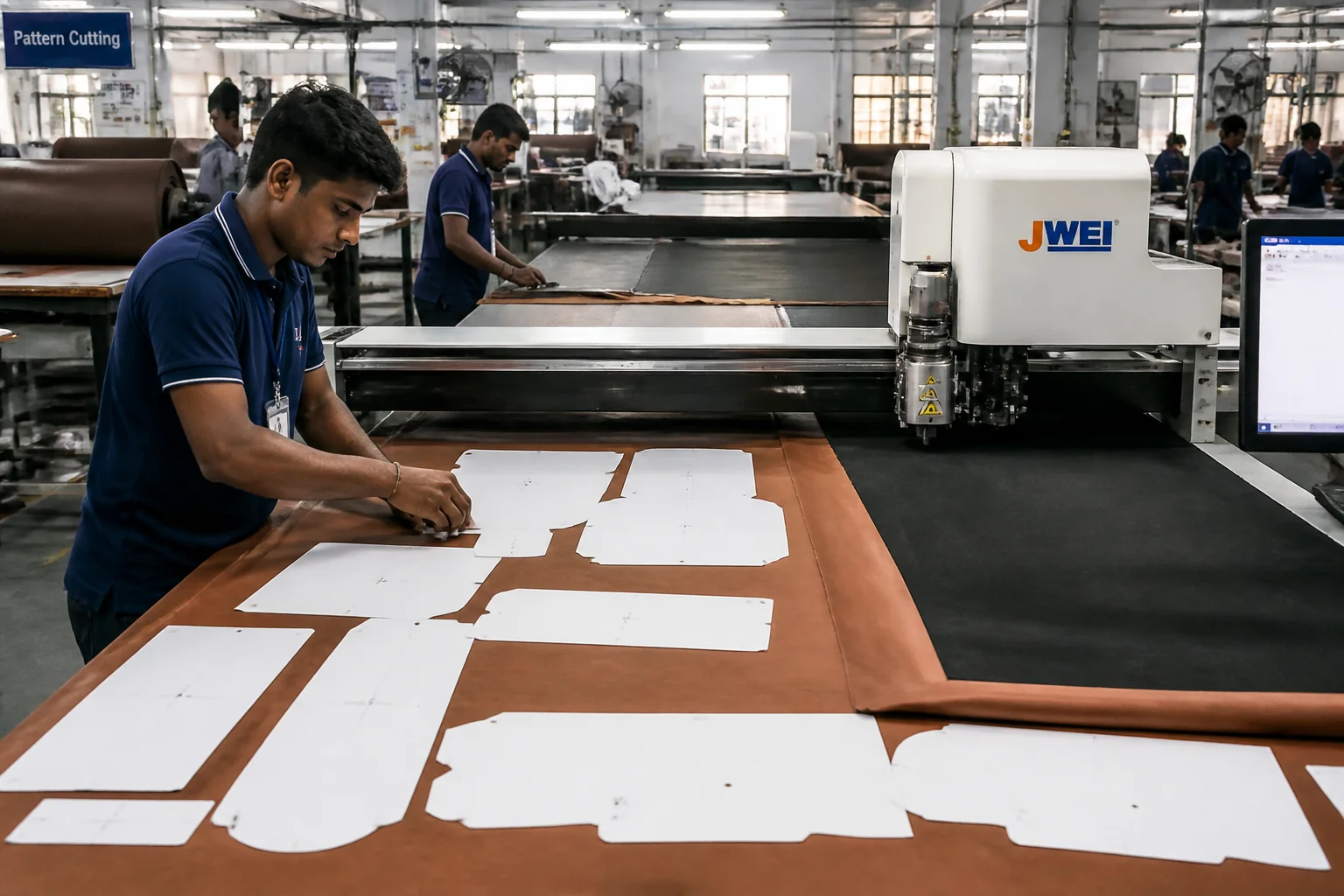
Once production starts, your job shifts from design to verification. Three checkpoints protect the order.
Incoming material inspection: the bulk materials arrive before cutting begins. Verify main material, lining, hardware and components against the approved specification and the sealed reference — thickness, color, hardware finish. Material rejected here costs a roll; material rejected after sewing costs a production run.
Inline inspection: check the first finished pieces as the line produces them, then sample at intervals through production. Look for the defects that show up in volume: stitching tension and spacing, alignment, hardware seating, edge treatment, zipper function. Catching a defect pattern early lets the line correct it while the fix is cheap.
Final inspection: before packing and shipment, run the agreed AQL sampling (commonly AQL 2.5 major / 4.0 minor) — either by the factory’s QC, a third-party inspector you appoint, or both. The inspection report and photos become the evidence that the goods match the standard, and the basis for accepting or rejecting the shipment.
Delivery terms are settled with Incoterms: FOB (you take over risk at the port) and EXW (you collect at the factory) are the most common for first orders. Clarify packing standards, carton markings and the shipping schedule in the order confirmation, and keep the documentation — commercial invoice, packing list, certificates — organized before the goods leave, because customs and your freight forwarder will demand them exactly when you least expect it.
Step 7 — Launching and Growing the Line
Launch is the beginning of the learning loop, not the end of the project. Three habits separate brands that grow from brands that stall after the first container.
First, capture data from the launch: which styles sell, which colors repeat, which sizes return, and what customers say in reviews. Every data point feeds the next collection — sales data tells you what to reorder, review data tells you what to fix, return data tells you what to stop making.
Second, reorder from real demand rather than hope. The brands that survive year one reorder best-sellers promptly (which means reserving component stock with the factory) and develop new styles against a budget funded by actual revenue. The brands that fail order their second collection on optimism and sit on the inventory.
Third, deepen the factory relationship: consolidate orders, pay on time, communicate specifications clearly, and grow volume with the same partner rather than shopping each order to the lowest bidder. A factory that knows your brand, your quality standard and your customers becomes a strategic asset — one that prototypes faster, sources better and protects your interests. Long-term partners are the strongest competitive advantage a small brand has, and they are built order by order.
FAQ
How much money do I need to start a bag brand with an OEM factory?
For a focused first order — two or three styles, 300–1,000 pieces per style — budget for sampling, the 30–50 percent deposit, freight and launch marketing. Total investment varies widely, but planning for a realistic working capital buffer on top of production costs is essential; under-capitalized launches fail on cash flow, not quality.
Do I need a design tech pack before contacting factories?
A complete tech pack helps, but most bag factories will help you build one from sketches, reference images and measurements. Bring your vision, dimensions, material preferences and budget, and the factory translates it into a manufacturable specification with you.
What is the difference between OEM and ODM for bags?
OEM means the factory produces your design to your specification. ODM means the factory provides its own designs that you brand as yours — faster and cheaper to launch, but less exclusive. Many brands launch with ODM styles, then develop OEM designs once they know what sells.
What is a typical MOQ for custom bags?
Commonly 300–1,000 pieces per style, depending on complexity and factory scale. MOQs are driven by hardware and component minimums as much as sewing capacity. Ask about sharing components across styles to reduce effective minimums.
How long does it take from brief to delivery?
Realistically eight to twelve weeks for a first order: sampling rounds, material sourcing, production and shipping. Plan the timeline backwards from your launch date and add a buffer — compressed timelines produce the most quality mistakes.
Should I use third-party inspection?
For a first order, yes — it is inexpensive insurance. An independent inspector checks the goods against the AQL standard you agreed and issues a report you can act on, removing the conflict of interest of a factory inspecting its own work.
Can I start with a small order to test the market?
Yes — discuss a reduced MOQ with the factory (often possible for a small premium), or launch via ODM styles which carry lower minimums. Testing the market with a small, well-made order is far cheaper than guessing wrong with a large one.
Next Steps: From Idea to First Order
Starting a bag brand is a sequence of decisions, and every decision in the sequence is learnable — product definition, specification, factory selection, sampling, pricing, quality control. The brands that succeed are not the ones with the most talent or the most capital; they are the ones that run the process in order, with written specifications and verified quality at every gate.
Ready to take your bag idea to production? Contact info@gionar.com with your sketches or reference images for a free OEM consultation and quotation. Explore our custom bag manufacturing services and custom backpack manufacturing to see how we take brands from brief to shipment.