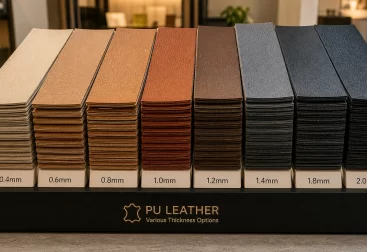
Minimum order quantity — MOQ — is the number that stops more bag projects than any other: 500 pieces per style, 1,000 pieces, sometimes 3,000. For a first-time brand with a modest budget, an MOQ can feel like an arbitrary wall built by factories to force bigger orders. In reality, the MOQ is an economic calculation — a number that balances the factory’s fixed costs against your order’s share of them. Understanding how that calculation works is the difference between accepting an MOQ as a barrier and treating it as a negotiable, optimizable variable.
This guide explains MOQ from the factory’s perspective: what drives the number, why it differs between products and factories, how to evaluate whether an MOQ is fair, and — most usefully — the legitimate strategies brands use to reduce, share or work around minimums. You will find the math behind the number, the negotiation levers that actually move it, and the traps that turn MOQ pressure into inventory mistakes. Written from the factory floor, it turns the MOQ from a wall into a tool.
What MOQ Means and Why It Exists
MOQ is the smallest quantity a factory will produce per order — but the number itself is a proxy for something more fundamental: the fixed costs that must be spread across the order. Every production run carries costs that do not change with quantity: material purchasing and setup, pattern preparation, cutting markers, machine setup and line changeover, sample confirmation, quality documentation. Whether the factory produces 200 bags or 2,000, many of these costs occur once. The MOQ is the quantity at which the order still covers those fixed costs and leaves the factory a viable margin.
Think of it as a ticket price with two parts. The fixed part — the setup, the engineering, the materials minimums — is the entry fee, and it does not scale down. The variable part — labor per bag, material per bag — scales directly with quantity. A factory’s MOQ is the point where the entry fee stops dominating the economics. Below that point, the factory would lose money per unit even at a “fair” price, so it either refuses the order, raises the unit price, or finds a way to share the fixed costs across multiple buyers — which is exactly how ODM catalog styles with low MOQs work.
Understanding this structure changes how you approach the number. An MOQ is not an arbitrary rule; it is an equation with identifiable components. When a factory says “MOQ 500,” it is really saying: “the fixed costs of this order require at least 500 units to stay viable.” Once you know which fixed costs dominate — materials, setup, or custom components — you know which lever can move the number. That is the subject of the next sections.
What Actually Drives the MOQ
Five cost components drive the MOQ, and each behaves differently. Knowing which ones dominate your product tells you where the negotiation room is.
| Driver | What it is | How it sets the MOQ |
|---|---|---|
| Material minimums | Minimum purchase quantities from mills and suppliers | Mills sell by the roll or lot; leftover material cost must be absorbed |
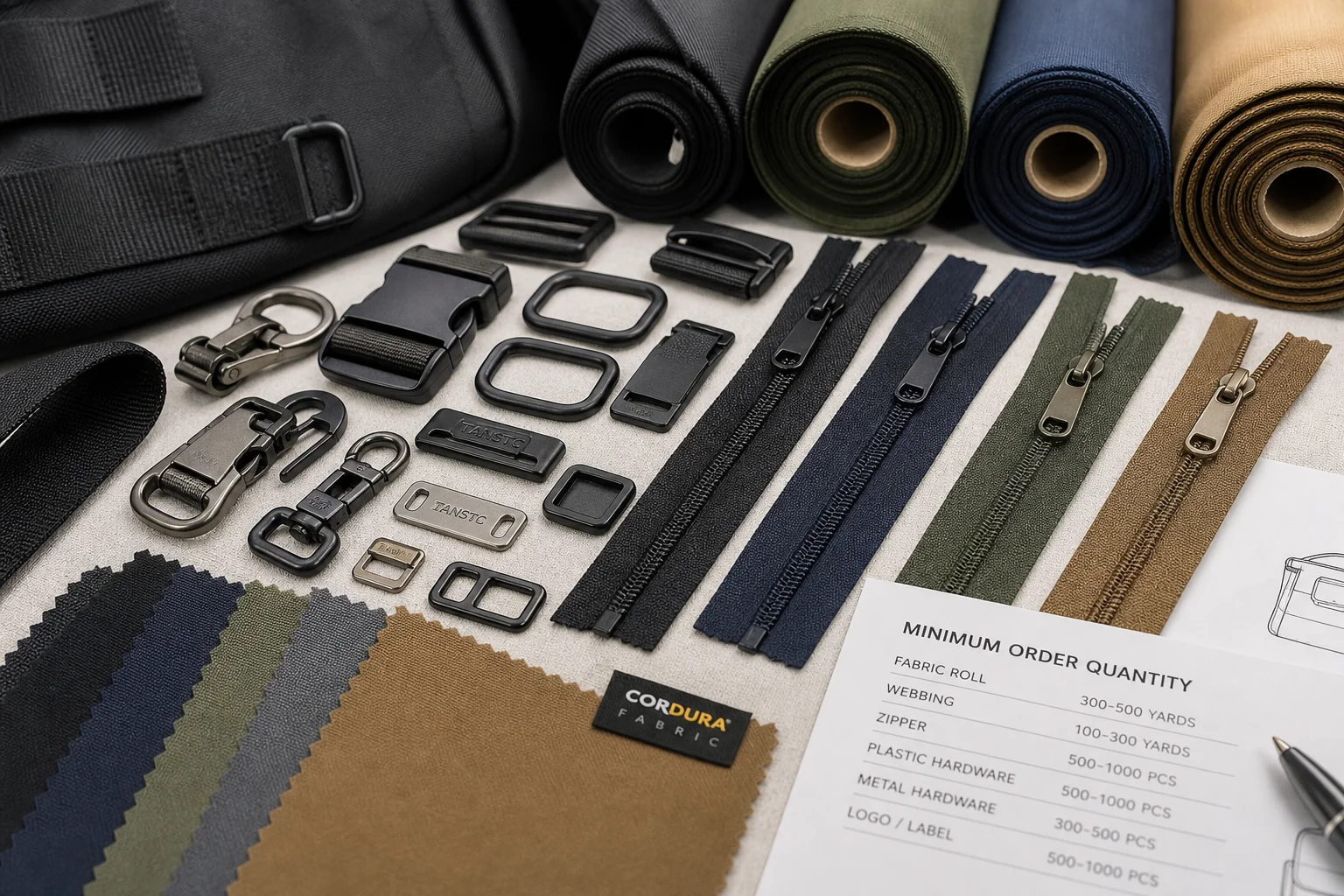
| Custom components | Custom hardware, zippers, labels, packaging | Custom tooling and minimums per component, often 300–1,000 units |
| Setup and engineering | Patterns, markers, machine setup, sampling | Fixed cost amortized over the run; small runs make it per-unit dominant |
| Line efficiency | Production runs below a size are inefficient | Sewing lines need a minimum run to be worth scheduling |
| Administration | Order processing, QC, documentation | Smaller orders have proportionally higher admin cost |
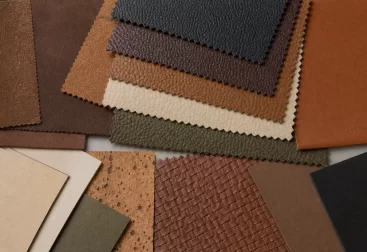
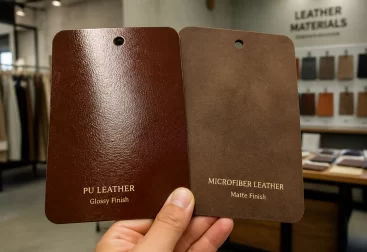
In the bag industry, the dominant driver is almost always materials and custom components. A custom color material is produced in mill minimums that can dwarf a small bag order; custom hardware with your logo requires tooling and component minimums of its own. This is why the most powerful MOQ-reduction strategy — discussed below — is component standardization: sharing materials, hardware and components across styles, so the factory’s minimums are spread over your whole line rather than per style.
Note also what is NOT a driver: the buyer’s brand size. MOQ is set by production economics, not by a factory’s estimate of your seriousness — although in practice, a factory is more willing to flex its MOQ for a buyer it trusts to reorder. Trust, payment history and relationship quality are real negotiation assets, and they compound over time.
How MOQs Vary by Product and Factory
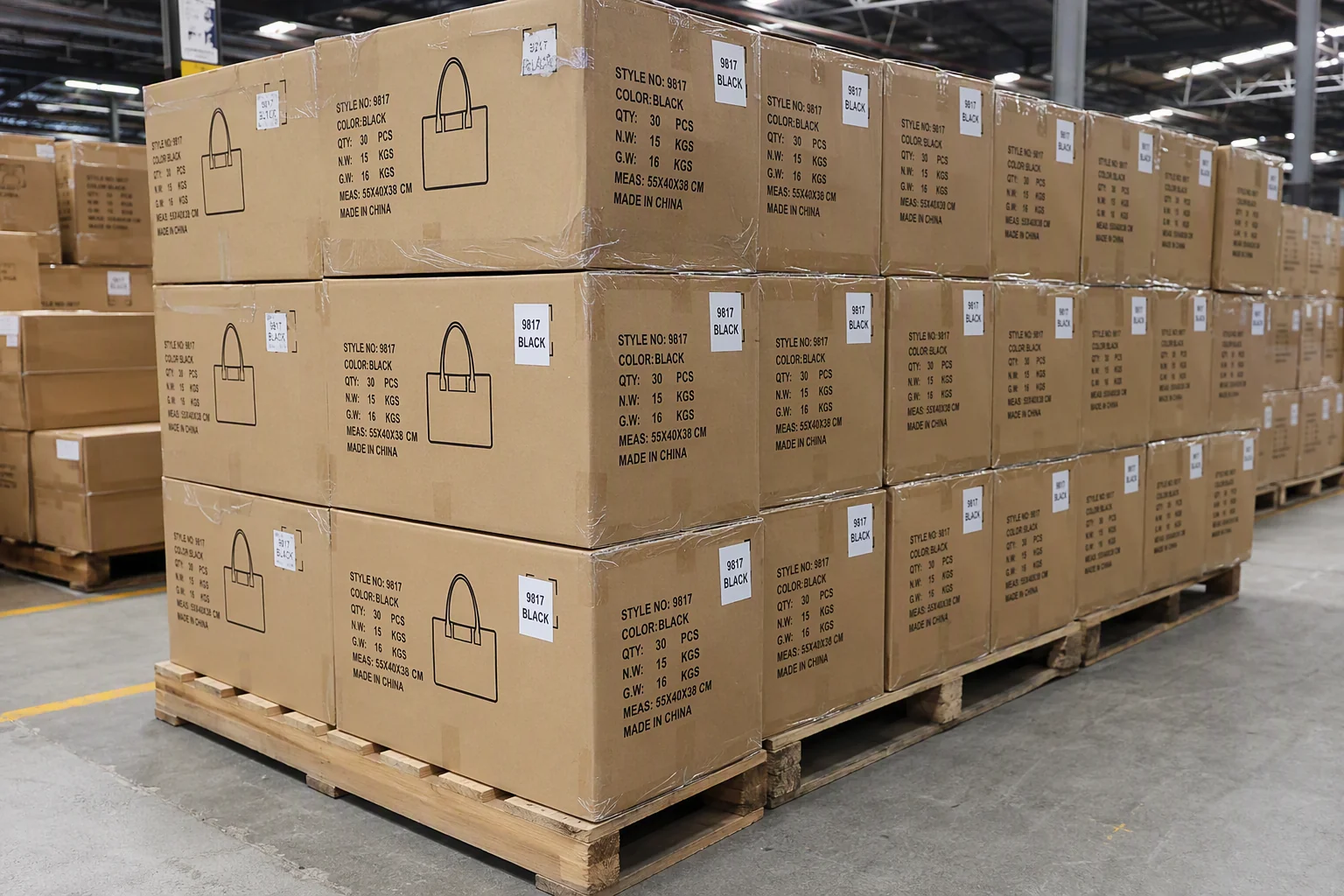
MOQs are not uniform across the industry — they vary with product type, customization level and factory scale, and the variation is information. Comparing MOQs across suppliers tells you how each factory is built.
| Order type | Typical MOQ | Why |
|---|---|---|
| ODM catalog style (standard materials) | 100–300 per style | Proven style, shared components, no development |
| OEM with standard materials | 300–600 per style | Development overhead, but standard materials available |
| OEM with custom materials/colors | 500–1,000+ per style | Mill minimums for custom production |
| Custom hardware with tooling | 500–1,000+ per component | Tooling and component minimums |
| Micro-workshops / home workshops | 20–100 per style | Small setup, but limited capacity and consistency |
| Large factories with export focus | 1,000–3,000 per style | Line efficiency, export-scale economics |
Three conclusions follow. First, ODM is the low-MOQ path by construction: the factory spreads its fixed costs across all its ODM clients, so your share is small. Second, a factory’s MOQ is a window into its scale: a factory quoting 3,000-piece minimums is built for large export orders, and a brand ordering 300 pieces will be an awkward fit for it — not because the factory is unfriendly, but because its economics assume volume. Third, the MOQ should be read together with the unit price: a low MOQ with a high unit price can cost you more than a higher MOQ at a better price. The effective comparison is total cost at your realistic order size, not the MOQ number alone.
MOQ vs. Economic Order Quantity: The Buyer’s Math
Just as the factory has an economic floor, the buyer has an economic ceiling — and the two rarely meet by accident. The buyer’s math is about what quantity actually makes sense for the business: not the factory’s MOQ, but your economic order quantity (EOQ) — the order size that balances your own fixed costs against your inventory and cash-flow costs.
The buyer’s cost structure has three parts. The fixed order costs: freight, inspection, customs handling, sourcing time — costs that occur once per order regardless of size. The inventory costs: capital tied up in stock, warehousing, and the risk of obsolescence — costs that grow with order size. And the unit cost, which typically falls as quantity rises because the factory amortizes its fixed costs over more units. The EOQ is the quantity where ordering fewer units costs more than holding them: the point where your fixed order costs and your inventory costs balance.
The tension is real and worth making explicit. A factory MOQ of 1,000 may be below your EOQ — in which case ordering more than the MOQ actually lowers your total cost. Or the MOQ may sit above your EOQ, forcing you to either hold excess inventory or pay a premium for a smaller run. The table below shows the decision logic.
| Situation | What it means | Sensible response |
|---|---|---|
| MOQ < your EOQ | The factory minimum is below your economic order size | Order at your EOQ; enjoy the volume price |
| MOQ ≈ your EOQ | Factory economics roughly match yours | Standard order; negotiate around the edges |
| MOQ > your EOQ | Factory minimum forces over-ordering | Reduce MOQ, share components, or test-market at a premium |
| MOQ far above your EOQ | Structural mismatch | Reconsider the factory; this relationship forces waste |
Do the arithmetic before negotiating. Calculate your realistic demand horizon — how many units you expect to sell in the order cycle plus the buffer you need — and compare it with the MOQ. A brand that walks into the negotiation with its own numbers can discuss the MOQ as economics; a brand with no numbers can only accept or refuse it.
Strategies to Reduce or Work Around MOQ
Legitimate strategies to lower effective minimums exist at every layer of the order — and the most powerful one is often missed entirely: don’t reduce the MOQ per style; reduce the cost structure that creates it.
Strategy 1 — Share components across styles
This is the single most effective lever. If two or three styles share the same hardware, lining, zipper and label, the factory’s component minimums are spread across your whole line instead of being paid per style. Your MOQ is effectively multiplied by the number of styles sharing the components. Design your line with component commonality from the start — the same zipper, the same buckles, the same lining color — and the minimums that look prohibitive per style become workable per line.
Strategy 2 — Standard materials first, custom later
Custom colors and custom materials carry mill minimums that dominate the MOQ. Launch with standard materials from the factory’s available stock — the MOQ drops immediately — and introduce custom materials once volume justifies them. This is the classic staged approach: validate with standard, differentiate with custom.
Strategy 3 — Combine orders and negotiate a line MOQ
Ask the factory for a line MOQ — a total quantity across styles — rather than a per-style MOQ. Many factories accept a combined minimum for a committed multi-style order, effectively lowering your per-style requirement. The factory’s fixed costs are covered by the total; your styles share the entry fee.
Strategy 4 — Pay a small-run premium
Factories will frequently produce below MOQ for a per-unit premium that covers the fixed-cost gap. The premium is often surprisingly small — a few percent — because the factory’s marginal cost is low once the line is running. Ask for the premium price below MOQ before abandoning the factory; the number is frequently acceptable.
Strategy 5 — ODM and hybrid foundations
As covered in our OEM/ODM guide, ODM styles carry the lowest minimums because the factory amortized development across clients. Hybrid customization — ODM base with your colors and hardware — keeps most of that economy while giving you visible differentiation. For market tests and first launches, this is often the lowest-cost entry into production.
Negotiating MOQs: What’s Flexible, What Isn’t
Negotiation is not about demanding a lower number — it is about restructuring the economics behind it. Understanding which parts of the MOQ are flexible and which are not makes the conversation productive instead of adversarial.
What is genuinely flexible: the per-style MOQ (when combined orders or component sharing cover the fixed costs), the small-run premium (a real number the factory can quote), the delivery split (producing the full MOQ but shipping in batches, so your cash flow and inventory are spread), and the timeline (accepting production slots when the line has capacity, which lowers the factory’s opportunity cost). What is rarely flexible: custom component and material minimums (the mill’s numbers are not the factory’s to change), and tooling costs for custom hardware (the tooling is a physical investment). Negotiating on rigid items wastes goodwill; negotiating on flexible items builds a working relationship.
The negotiation sequence that works: first, show your own numbers — your demand forecast, your line plan, your component-sharing design. Second, propose the structural solution: “if I commit to three styles sharing this zipper and lining, what does the line MOQ look like?” Third, ask for the two numbers that are always quotable: the small-run premium below MOQ, and the split-delivery option at the full MOQ. Fourth, agree in writing — the MOQ, the premium terms, the delivery schedule — because memory is not a contract.
One more negotiation asset deserves mention: the reorder commitment. A factory that sees a committed reorder pipeline prices differently — the first order’s MOQ can be reduced in exchange for a scheduled second order, because the factory’s fixed costs are then covered across both. This is a standard and honest arrangement, and it aligns both sides’ interests.

MOQ Traps to Avoid
The MOQ creates pressure, and pressure produces predictable mistakes. Five traps account for most of them.
Trap 1 — Ordering to the MOQ instead of to demand
Buying the minimum because it is the minimum, not because the market supports it. The inventory then sits, ties up capital and eventually sells at a discount or not at all. The protection is your EOQ math: the MOQ is a floor for the factory, not a target for you.
Trap 2 — Accepting a low MOQ as a quality signal
A factory that accepts tiny orders may be a micro-workshop with inconsistent quality, or a factory dumping excess capacity with no reorder interest. Low MOQ is a commercial fact, not a quality certificate — verify the factory like any other supplier.
Trap 3 — Ignoring the effective per-unit cost
Comparing only MOQs or only unit prices hides the real number: total cost at your order size. A 300-piece order at a high premium can cost more per unit than a 500-piece order at standard pricing. Compute the total, not the headline.
Trap 4 — Custom components before volume
Custom hardware, custom colors and custom packaging multiply the MOQ before you have sales data. The staged approach — standard components first, custom later — avoids committing minimums to an unproven design.
Trap 5 — Letting MOQ drive assortment
MOQ pressure pushes brands to order more styles than the market needs (to spread minimums) or fewer (to stay affordable). Both distortions hurt: too many styles fragment the demand, too few limit the learning. Design the line for the market, then apply the MOQ strategies to make it workable — not the reverse.
Every trap is a planning failure, and every one is avoidable with the same habit: run the numbers before the negotiation, and let the economics — not the MOQ — decide the order.
MOQ and Inventory Risk: The Real Cost of Over-Ordering
The MOQ conversation is really an inventory conversation. Every unit you order beyond demand is capital committed to a shelf, and the shelf has a price: the cost of the money tied up, the cost of storing the goods, and — the largest of all — the cost of being wrong about what will sell.
Run the arithmetic honestly. If the factory’s MOQ forces you to order 1,000 units and your realistic demand is 400, you are committing 600 units of capital to inventory that will sell slowly, be discounted, or never sell at all. The markdown cost alone can exceed the unit-cost saving you earned by ordering at the higher volume — a failure of the “bigger order = better price” intuition when the bigger order exceeds real demand. This is why the buyer’s EOQ math matters more than the factory’s MOQ: the minimum is the factory’s floor, but the ceiling is set by your market, and ordering between the two is where sensible businesses live.
Inventory risk also compounds across styles. A line of five styles at the factory minimum multiplies the exposure: one style that fails to sell drags the whole line’s return down, because the capital was committed to all five up front. Component sharing reduces this risk in a second way — not just by lowering minimums, but by making the components reusable across styles, so a failed style does not strand its unique hardware and materials. Design for component commonality is simultaneously an MOQ strategy and an inventory-risk strategy.
The staged approach is the practical answer for uncertain demand: launch with ODM or hybrid foundations at low minimums, validate with real sales data, then commit to larger OEM volumes for the styles that prove themselves. The premium you pay for small first runs is, in effect, the price of information — and it is dramatically cheaper than the price of guessing wrong with a full-MOQ order.
Working with Factories on MOQ: A Practical Script
Knowing the theory is one thing; knowing what to say is another. The conversation below mirrors what a professional buyer actually discusses with a factory, stage by stage.
At the inquiry stage, ask for the MOQ per style and what drives it: “Can you break down what sets the 500-piece minimum — materials, hardware, or setup?” A factory that answers with specifics is quoting economics; one that answers with a flat number is quoting policy. Also ask the two companion numbers: the price below MOQ and the price at double the MOQ — both reveal how the factory’s fixed costs scale.
At the design stage, structure for commonality: “If three styles share this zipper, lining and buckle, can you quote a line MOQ across them?” Have your line plan ready — the factory can price a combined minimum only if you can show the shared components concretely.
At the negotiation stage, lead with your numbers: “Our realistic first-season demand is X per style, and we want to commit to a reorder of Y. Can we structure the first order at a lower quantity with a scheduled second order?” The reorder commitment is the strongest honest lever you have — it converts the factory’s fixed costs from a one-order burden into a two-order amortization.
At the agreement stage, confirm in writing: the MOQ per style or per line, the small-run premium if used, the delivery schedule and split options, and the material and component references. A written order confirmation is the document that makes the negotiated MOQ real.
Finally, remember the relationship dimension. Factories are more flexible with buyers who pay on time, specify cleanly and reorder — flexibility is earned over time, and the first order is where the earning begins. The buyer who treats the MOQ conversation as a partnership negotiation, with numbers and structure rather than demands, gets more from it than the buyer who simply argues the number down.
MOQ Decisions by Sales Channel
The right MOQ strategy depends on how you sell — and the channel changes the arithmetic. Each channel has a different demand curve, lead-time tolerance and inventory cost structure, and the MOQ that fits one can sink another.
Direct-to-consumer (DTC) online: demand is uncertain, trends move fast, and cash flow is tight. The winning pattern is small first runs with fast reorders: launch at low minimums (ODM or small-run premium), measure sell-through, and reorder winners before stockouts. The risk to avoid is a large first order justified by launch optimism — the inventory then sits while the marketing budget is spent on styles the market did not validate.
Wholesale and retail: orders are placed on lead times that can be months, and retailers buy in batches. Here the MOQ works with you: your order quantity is defined by confirmed retail commitments, and the higher minimums of OEM production are supported by booked demand. The discipline is the same as always — commit inventory only against real orders or forecasts with a defensible basis, not against hope.
Marketplaces and dropshipping: marketplace sales are fragmented across many SKUs, and dropshipping carries no inventory at all. For these models, low-MOQ production (ODM foundations, component-shared lines) is essential, because per-SKU volumes are small even when total sales are healthy. A brand selling a hundred SKUs at fifty units each cannot carry per-style minimums of a thousand.
Seasonal collections: seasonal calendars compress the ordering window, and the MOQ must be committed before the season’s demand is known. The professional approach is to size seasonal orders conservatively, share components across the season’s styles, and arrange split deliveries so the second shipment can be adjusted after early sell-through data arrives.
The lesson across channels is consistent: match the MOQ to the channel’s demand certainty. High certainty (confirmed retail orders) supports higher minimums and their better unit economics; low certainty (new DTC styles, marketplaces) demands low minimums and fast reorder capability — even at a per-unit premium, because the premium is the price of not guessing wrong.
FAQ
What is a typical MOQ for custom bags?
Commonly 300–1,000 pieces per style for OEM orders, with ODM styles often at 100–300. Custom materials, colors and hardware push minimums higher; component sharing and line MOQs push effective minimums lower.
Can I order less than the MOQ?
Often yes, for a per-unit premium that covers the factory’s fixed-cost gap. Ask for the below-MOQ price before giving up on a factory — the premium is frequently only a few percent.
Why is the MOQ for ODM styles lower?
Because the factory amortized development and component costs across all its ODM clients. Your order covers only your share, so the minimum can be far lower than for a unique OEM development.
How do I negotiate a lower MOQ?
Show your demand numbers, propose structural solutions (shared components, combined styles, line MOQ), ask for the small-run premium and split delivery, and offer a reorder commitment. Negotiate on the flexible cost drivers, not the rigid mill minimums.
Does a higher MOQ mean better quality?
No — MOQ reflects production economics, not quality. Quality depends on the factory’s processes, materials and inspection discipline. Verify quality with samples, tests and inspection, not with order size.
Should I share components across my styles?
Yes — component commonality is the most powerful MOQ-reduction lever. The same zipper, hardware and lining across styles spread the factory’s minimums over your whole line, effectively multiplying your buying power.
What if my demand is genuinely below the MOQ?
Combine options: share components, negotiate a line MOQ across styles, pay a small-run premium, launch with ODM foundations, or test the market with samples and pre-orders first. The answer depends on your numbers — which is why the math comes before the negotiation.
Do factories ever reduce MOQ for new clients?
Yes, within the economics — usually through a small-run premium, a reorder commitment, or a combined line MOQ. What factories rarely change is the mill minimum for custom materials and components, because those are the suppliers’ numbers, not the factory’s to flex.
Is it better to order more styles at low quantity or fewer styles at high quantity?
It depends on your channel and demand certainty. For proven styles with confirmed demand, higher quantities per style win on unit cost and margin. For untested styles, more styles at low quantity spread the learning at lower risk — provided the line shares components to keep the total minimums workable.
Next Steps: Turn MOQ from a Wall into a Tool
The MOQ is a number with a structure behind it — fixed costs, mill minimums, setup and line efficiency. Once you see that structure, the number stops being a barrier and becomes a set of levers: component sharing, standard materials, line MOQs, small-run premiums, staged custom development. The brands that manage MOQ well do not fight it; they design their lines and orders around it, and negotiate with their own numbers in hand.
Planning a custom bag order and want to understand your realistic MOQ options — including component sharing and line minimums? Contact info@gionar.com for a free quotation and MOQ consultation. Explore our custom bag manufacturing services and custom backpack manufacturing to see how we structure minimums around real brand needs.