- Why Construction Method Comes First
- Sewn Construction: The Industry Default
- Molded and Formed Construction
- Welded and Heat-Bonded Construction
- Head-to-Head Comparison
- Cost, Tooling and Minimum Order
- Durability and Failure Modes
- What Each Method Allows in Design
- How to Choose for Your Product
- Briefing a Factory on Construction
- FAQ
Why Construction Method Comes First
Construction method decides what a bag can be before design does. It sets the shapes available, the durability achievable, the tooling required and the price floor — and it is the most expensive decision to reverse.
The decision that constrains everything else
Choose sewing and the bag can be soft, folded, lined and repaired. Choose molding and it can be rigid, seamless and precisely repeatable, but not folded or hand-finished. Choose welding and it can be water-resistant and clean-edged, but limited in the materials it accepts.
Every later choice — the hardware, the trim, the pattern, the packaging — has to work within the method chosen. Changing the method later means re-tooling, re-sampling and re-pricing, which is why it belongs at the start of the brief.
The three families in practice
| Family | Core principle | Typical products |
|---|---|---|
| Sewn | Panels joined with thread | Handbags, totes, backpacks, pouches |
| Molded / formed | Shape created by a mold or press | Hard cases, structured shells, panels |
| Welded / bonded | Material fused with heat or adhesive | Water-resistant bags, tech sleeves, clean-edge |
Most bags are sewn, because sewing is the most flexible and the least capital-intensive method. The other two appear where a property is required that sewing cannot deliver.
What buyers usually get wrong
The common error is choosing a construction method for its look rather than its consequences. A welded edge looks modern in a photograph, but it narrows the material options, raises the tooling cost and complicates repairs.
The second error is assuming methods are interchangeable within a design. A pattern drafted for sewing will not transfer directly to welding or molding, because each method consumes different amounts of material and creates different seam structures.
Sewn Construction: The Industry Default
Sewn construction dominates bag making for good reasons: it works with almost every material, it needs modest equipment and it can be repaired. Its limits are equally clear, and understanding them explains when the alternatives win.
How sewn bags are built
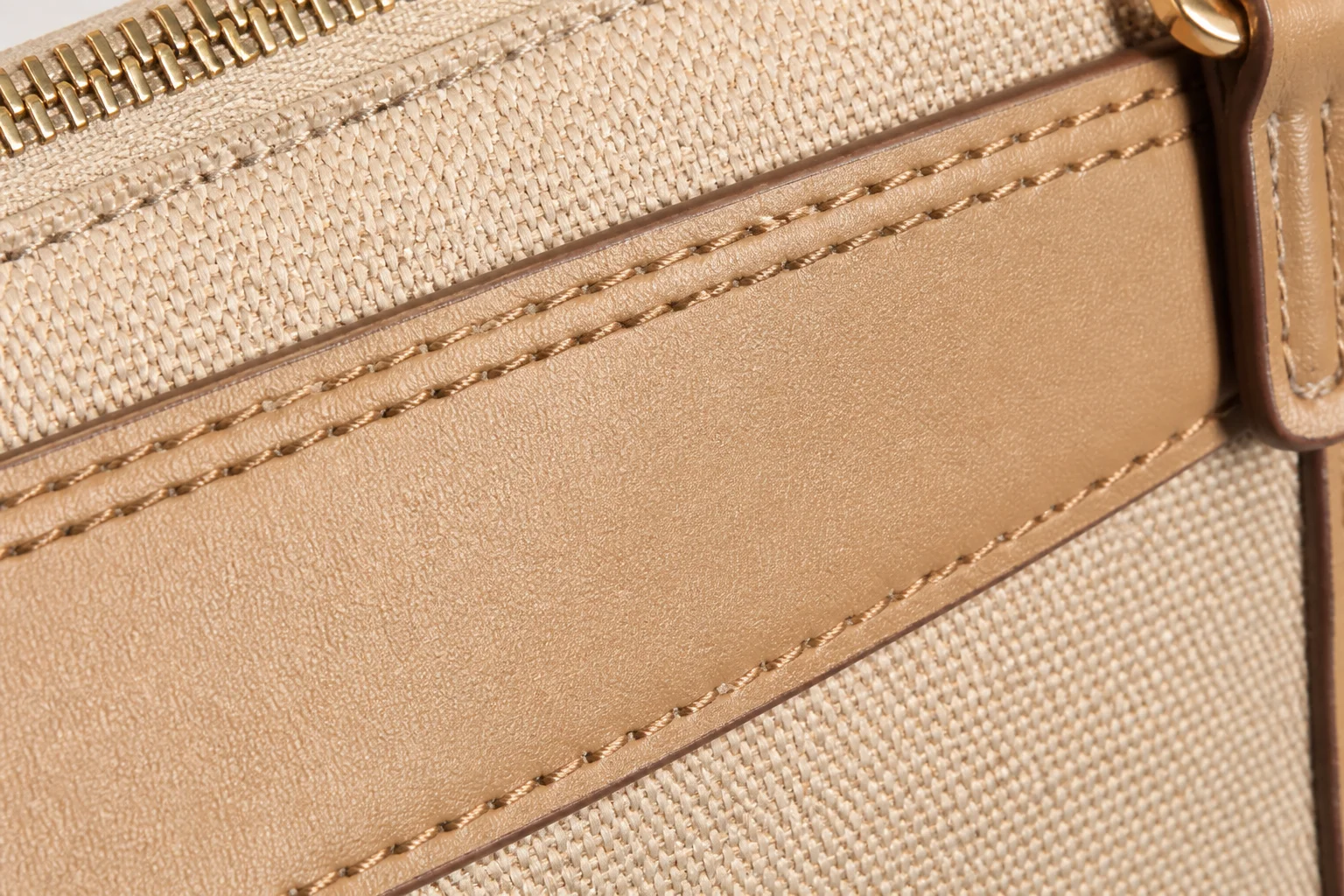
Panels are cut from the pattern, interfaced where structure is needed, then joined with seams that are usually pressed open or bound. Edges are folded, bound or painted, and the assembly is finished with hardware and lining.
The method’s flexibility is that almost any combination is possible: a soft unlined tote and a structured lined briefcase are both sewn products, differing in pattern and interfacing rather than in the basic technique.
Strengths of sewn construction
Sewn bags are repairable, which matters for warranty and for premium positioning. A seam can be re-stitched and a strap replaced, and the materials can be reused rather than scrapped.
They are also the most design-flexible: curves, folds, pleats, multiple compartments and mixed materials are all achievable with patterns and skill rather than with tooling.
Limits of sewn construction
Seams create perforations, so a sewn bag is not inherently water-resistant unless the seams are taped or sealed. Each stitch line also concentrates stress, which is where the first failures appear under heavy loads.
Sewn construction is more labour-intensive than molding, so its cost scales with complexity rather than with volume. A very detailed sewn bag stays expensive at any quantity, while a molded component gets cheaper as volume grows.
Seam types worth knowing
| Seam | Where it is used | Character |
|---|---|---|
| Plain seam, pressed open | Panel joins, gusset | Standard, needs finishing |
| Double-stitched seam | Load-bearing joins | Strong, visible topstitch |
| Bound seam | Interior edges | Clean finish, more labour |
| Flat-felled seam | Exterior joins | Strong, decorative, bulky |
| Lapped seam | Panels on soft bags | Simple, moderate strength |
Specifying the seam per join is what makes a sewn bag reproducible. Left unspecified, the factory chooses the fastest seam rather than the one the design needs.
Molded and Formed Construction
Molded construction creates shape with a mold rather than with seams. It trades flexibility for repeatability, and its economics only work when volume justifies the tooling.
How molded parts are made
A mold is cut from the design, then material is formed in or against it: injection molding for plastic shells, die-casting for metal parts, thermoforming or compression for panels and hard cases.
The result is a part that repeats exactly, with a consistency sewing cannot match. That repeatability is the method’s core advantage, especially for components that must fit together precisely.
Strengths of molded construction
Molded parts are dimensionally exact, structurally rigid and often lighter than an equivalent sewn assembly. Seamless surfaces also resist water and dirt more naturally than stitched ones.
At volume, molding is the cheapest way to produce a complex shape, because the labor per piece is minimal and the mold cost is amortised across the run.
Limits of molded construction
Tooling is expensive and slow to change, so molded products suit long life cycles rather than fast fashion. Small runs carry an uncompetitive per-unit cost, and design changes mean re-cutting the mold.
Molded parts are also difficult to repair — a cracked shell is usually replaced rather than mended — and their hand-feel is colder than leather, which limits their use in premium soft-goods positioning.
Hybrid construction
Many products combine molding with sewing: a molded panel set into a sewn body, a molded handle on a fabric bag, or a thermoformed base inside a soft shell. Hybrids capture the shape precision where it matters and the flexibility elsewhere.
The hybrid approach also spreads the tooling across fewer, more valuable components, which keeps the investment proportionate to the volume risk.
Molding buys precision and repeatability. If your product does not need either at scale, sewing will usually cost less and adapt faster.
Welded and Heat-Bonded Construction
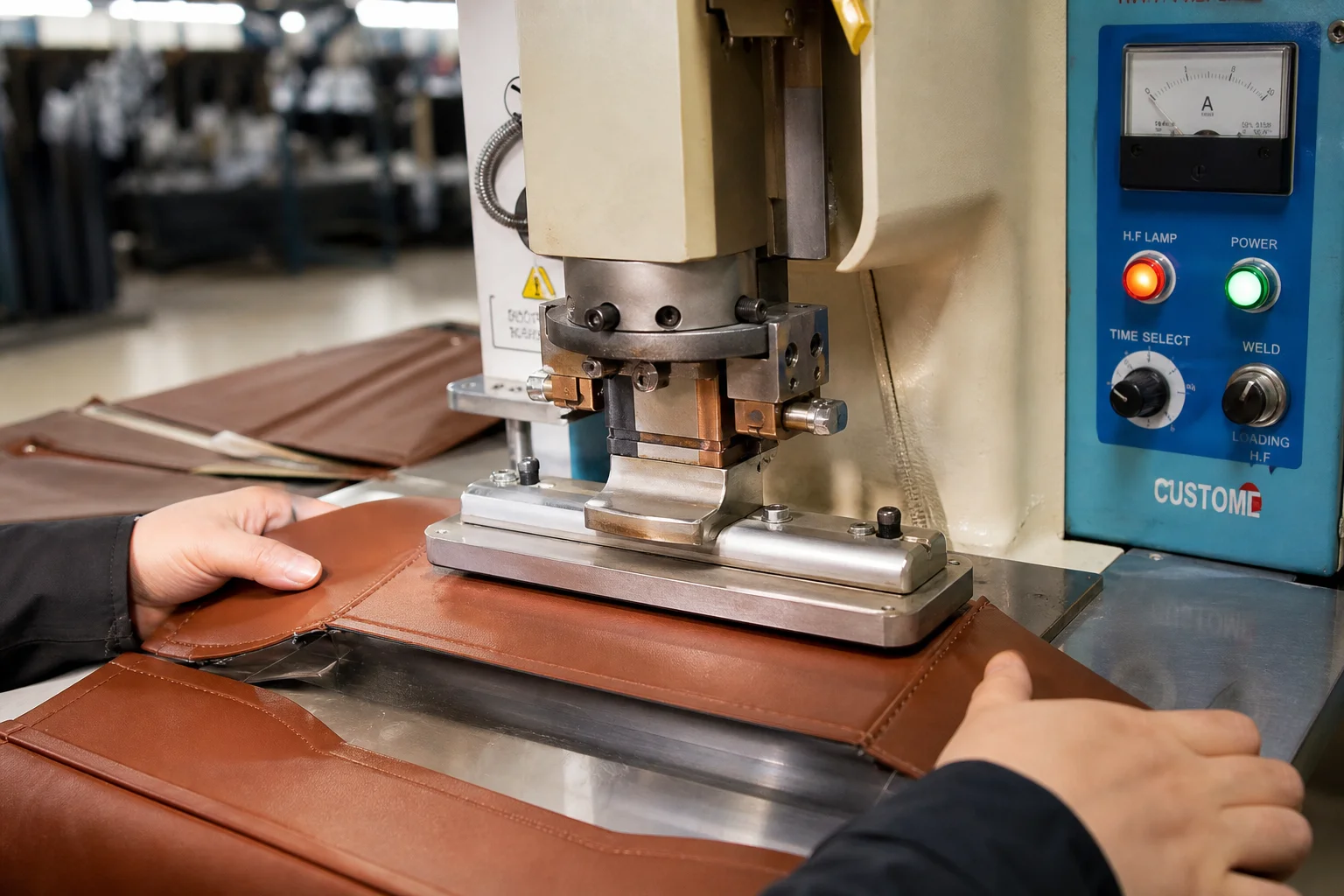
Welded construction fuses material rather than joining it with thread. It produces clean, sealed edges and water-resistant seams, and it is the method of choice where protection matters more than repairability.
How welding and bonding work
High-frequency welding, ultrasonic welding and hot-air sealing all apply energy to bond two layers of compatible material. Adhesive bonding achieves a similar result with chemical rather than thermal energy.
The material must be weldable: PU leather with a compatible backing, PVC, TPU-coated textiles and laminated films. Natural leather and many coated fabrics cannot be reliably welded.
Strengths of welded construction
A welded seam has no needle holes, so water resistance comes from the construction rather than from a coating. That makes welded bags attractive for outdoor, cycling and protective products.
The finish is also cleaner: edges are bonded flush rather than folded and stitched, which produces a modern, minimal look that is difficult to achieve with sewing alone.
Limits of welded construction
Repair is the main weakness. A failed weld is difficult to restore at the same strength, and the process requires equipment and skill that not every factory has.
Welding also imposes a material constraint and a temperature of process: too much energy burns the surface and too little produces a weak bond, so process control matters more than operator judgement.
Where welding wins commercially
| Product type | Why welding fits |
|---|---|
| Water-resistant bags | Seamless, no needle perforations |
| Tech and device sleeves | Clean edges, protective closure |
| Bike and outdoor pouches | Weather exposure, sealed construction |
| Promotional flat packs | Fast assembly, low labour |
In each case the value comes from the property rather than the appearance. If the product does not need sealing, welding adds cost for a benefit the customer will not notice.
Head-to-Head Comparison
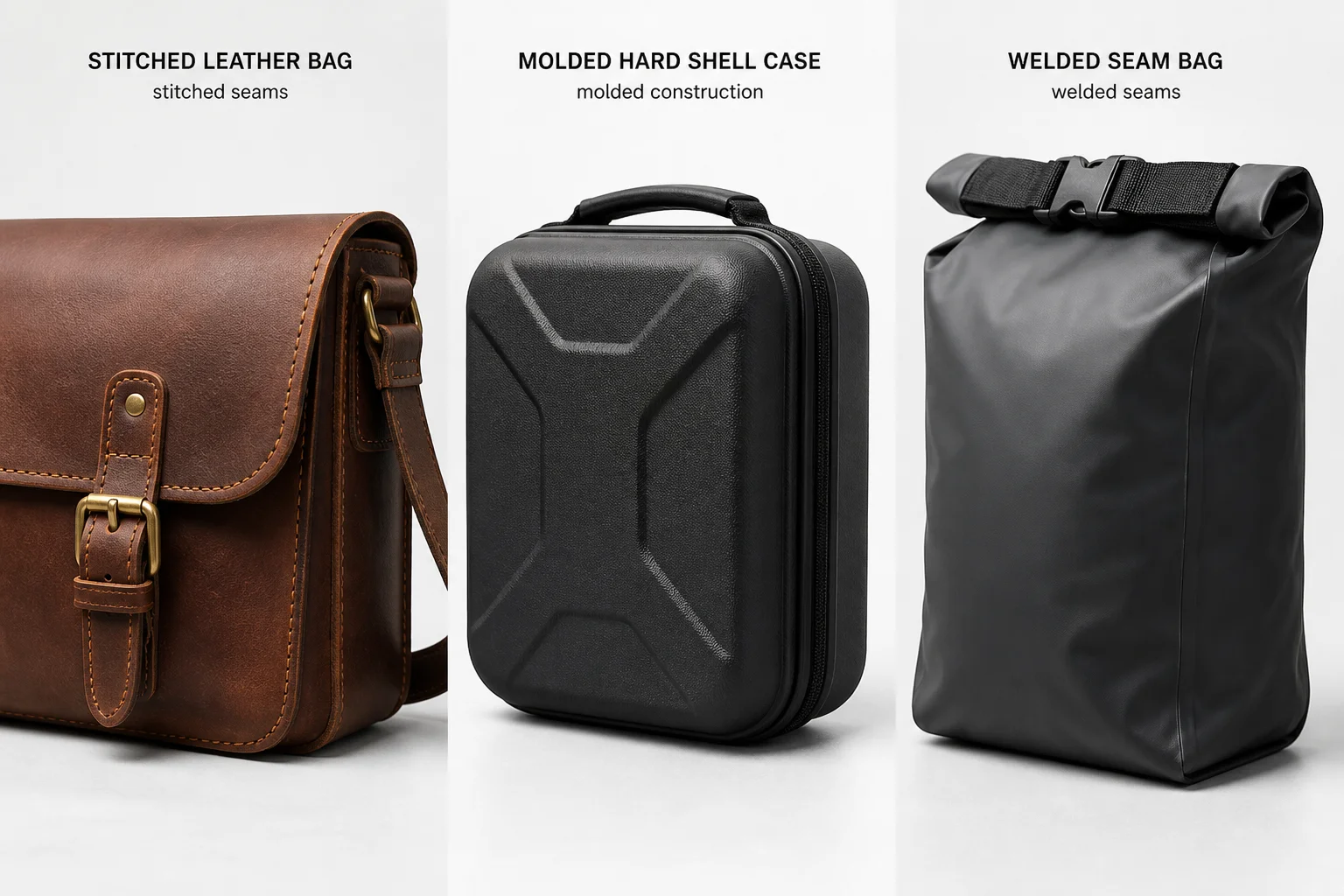
Comparing the three methods across the factors that decide a product brief shows where each one naturally belongs and where a hybrid is the better answer.
The comparison that matters
| Factor | Sewn | Molded | Welded |
|---|---|---|---|
| Water resistance | Low unless sealed | High | High |
| Repairability | High | Low | Low |
| Design flexibility | Highest | Low | Medium |
| Tooling cost | Low | High | Medium |
| Minimum order | Low | High | Medium |
| Per-unit cost at scale | Medium | Low | Medium-low |
| Dimensional consistency | Medium | Highest | High |
| Hand-feel | Warm, soft | Rigid | Firm, clean |
| Lead time for changes | Fast | Slow | Medium |
Reading across the rows shows the trade pattern: flexibility and repairability sit with sewing, precision and sealing sit with the other two, and cost follows volume rather than the method itself.
Where each method wins
Sewing wins when the product is soft, complex, mixed-material or positioned as premium and repairable. It also wins at low volumes, where tooling cannot be amortised.
Molding wins when a precise, rigid, lightweight component must repeat in high volumes. Welding wins when a sealed, clean-edged product is required and the material is compatible.
Why most bags are still sewn
Because sewing is the only method that scales down as well as up. A small brand can start with sewn bags, refine the design over several seasons and only then invest in molded components for the parts that deserve tooling.
The progression from sewn to hybrid is a normal product development path, and it keeps the tooling investment aligned with proven demand rather than with an aspiration.
Combining methods deliberately
A structured briefcase might use a sewn body, a molded handle and welded internal pockets. Each method is applied where its characteristic is worth paying for, rather than uniformly across the product.
Deciding that allocation early avoids the two extremes: an all-sewn product that sags where rigidity was needed, and an all-molded product that feels cold where warmth was the point.
Cost, Tooling and Minimum Order
Construction cost is a function of tooling, labour and volume. Understanding how the three interact prevents the common mistake of choosing a method whose cost structure does not fit the order size.
The three cost drivers
Tooling is a one-time cost for molds, dies and welding fixtures. Labour is the per-unit cost of assembly, which is highest for detailed sewing and lowest for molded parts.
Material consumption belongs to the design rather than the method, but each method consumes differently: sewing needs seam allowances, welding needs overlap, molding needs sprue or trim waste.
Amortising tooling
| Approach | Tooling | Order size fit | Cost behaviour |
|---|---|---|---|
| All sewn, simple | Almost none | Low to high | Linear with labour |
| Sewn with molded trim | Moderate | Medium upward | Tooling amortised on trim |
| Sewn with welded panels | Moderate | Medium | Fixture plus labour |
| Fully molded shell | High | High only | Falls steeply with volume |
The pattern is consistent: tooling buys down the per-unit cost, so it only pays at volumes that justify it. The correct question is not “which is cheaper” but “which is cheaper at my volume”.
Minimum order implications
Molded and welded work usually carries higher minimums because setup is significant relative to run time. Sewn production can start much lower because the setup is a pattern and a sample, not a mold.
For a first order, this difference often decides the method on its own. A brand with a modest opening order should plan to launch sewn and introduce tooled components in a later production run.
Hidden costs to budget for
Sample rounds are more expensive for tooled methods, because each revision may require a mold change. Inspection and testing also differ: welded and molded products often need specific tests for bond strength or dimensional accuracy.
Add the cost of material testing, the risk of tooling modification and the longer development calendar. Each is small individually and material in total.
Durability and Failure Modes
Every construction method fails in a characteristic way. Knowing the failure mode lets a buyer test for it, specify against it and target the warranty accordingly.
How sewn bags fail
Seams fail where stress concentrates: strap anchors, handle joints, base corners and zipper ends. Stitch perforations can also tear a material under repeated load, especially on light PU leather.
Water ingress through seams is the other common failure, appearing as dampness inside a bag that looked waterproof. Taping or sealing seams is the standard remedy and should be specified rather than assumed.
How molded parts fail
Molded components fail at stress risers — sharp internal corners, thin walls and snap features — and under impact rather than through gradual wear. Cold temperatures make many plastics more brittle and accelerate this failure.
Surface failures also occur: scratches, abrasion at contact points and discoloration from UV. These are cosmetic but they drive returns when the product is positioned as premium.
How welded seams fail
A welded seam fails when the process parameters drift: insufficient energy leaves a weak bond, and excessive energy degrades the material around the seam. The failure often appears as peeling rather than tearing.
Contamination is the other cause. Dust, oil or moisture on the bonding surface prevents a proper weld, which makes factory cleanliness part of the quality system rather than a housekeeping detail.
Testing each method
| Method | Test to run | What it reveals |
|---|---|---|
| Sewn | Load and cycle strap anchors | Seam strength and material tear |
| Sewn | Water spray on seams | Ingress through stitching |
| Molded | Drop and cold-impact test | Brittleness and stress risers |
| Molded | Abrasion on contact surfaces | Coating durability |
| Welded | Peel test on welded seam | Bond strength |
| Welded | Water pressure on seam | Seal integrity |
Running the relevant test before production converts an assumption into data. It also produces the evidence a buyer needs if a batch later fails.
What Each Method Allows in Design
Design freedom is not uniform across methods. Understanding the constraints early prevents a design that cannot be built economically in the chosen construction.
Shapes available
Sewing supports almost any shape: soft, curved, folded, gathered and multi-compartment. The only real limits are the pattern maker’s skill and the material’s tolerance for tight curves.
Molding produces exact but constrained shapes — it excels at shells, panels and handles, and struggles with soft draping forms. Welding sits between the two, favouring flat or gently curved panels with clean edges.
Material freedom
Sewing works with almost every bag material: PU leather, fabric, canvas, natural leather, coated textiles and laminates. It is the default precisely because it is material-agnostic.
Welding requires compatible, weldable materials; molding requires material that flows or forms well. Each method therefore narrows the material list before the design is finalised.
Details and finishing
Topstitching, edge paint, piping, contrast thread and rivets are all sewn-construction details. Welded construction replaces them with bonded edges and reveals; molded construction replaces them with surface texture and color.
Choosing a method therefore chooses a design vocabulary. A design brief written in one vocabulary and produced in another always loses something in translation.
Designing for repairability
If after-sales service matters, sewing offers the only practical repair route. Straps can be replaced, seams re-stitched and panels swapped, which extends the product’s life and supports a sustainability claim.
For welded and molded products, plan for component replacement rather than repair: a replaceable strap or a modular insert preserves some serviceability without compromising the construction.
How to Choose for Your Product
Choosing a construction method is a structured decision rather than a preference. Working through the criteria in order usually leaves one or two viable answers.
The decision sequence
Start with the required properties: waterproofing, rigidity, weight, repairability. Then check the material compatibility, then the volume against the tooling, and finally the design vocabulary the method supports.
Most products are resolved by the first two steps. If waterproofing is essential, the answer is welding or molding; if repairability and softness are essential, it is sewing.
Matching method to product position
| Product position | Sensible method | Reason |
|---|---|---|
| Premium soft handbag | Sewn | Craft, repair, hand-feel |
| Mid-market structured bag | Sewn with molded trim | Shape where it shows |
| Outdoor or cycling bag | Welded | Sealing and clean edges |
| Hard protective case | Molded | Rigidity and precision |
| Promotional or retail pack | Welded or sewn simple | Low labour, fast build |
Each row reflects the property the customer actually values, which is a better basis for the decision than the method’s appearance in a photo.
Avoiding the common traps
Do not choose a tooled method for a first order at low volume, and do not choose sewing for a product whose core claim is waterproofing. Both mistakes are structural and expensive to correct later.
Also resist mixing methods for visual variety alone. Every additional method adds tooling, suppliers and quality systems, which raises complexity without necessarily raising value.
Prototyping before committing
Prove the method with a sample before committing to a mold or a welding fixture. A sewn sample is cheap; a molded first article is not, and the cost of finding a fault rises sharply after tooling.
Where the method is new to your brand, produce one sewn prototype and one tooled prototype on a small scale if the factory can support it. The comparison settles questions that drawings cannot.
Pick the method that delivers the property your customer is paying for, then let the design follow. Doing it the other way round produces expensive products nobody asked for.
Maintenance, Repair and After-Sales by Method
Construction method decides what happens after the sale, and that has commercial consequences for warranty cost, customer satisfaction and the sustainability story attached to the product.
Servicing sewn products
Sewn bags are the most serviceable. A split seam can be re-stitched, a worn strap replaced and a broken zipper exchanged, often by a local repairer using standard equipment.
That flexibility supports a longer product life, which is why sewn construction fits premium and repair-friendly positioning. Designing accessible seams rather than concealed ones makes the repair economical.
Servicing molded and welded products
Molded and welded products are usually serviced by replacement rather than repair: a new shell, a new strap or a new module. Designing those components to be removable is what keeps the product serviceable at all.
Warranty cost also differs. A failed weld or a cracked shell typically means replacing the whole unit, so the claim value is higher than for a sewn product where a seam can be repaired.
Planning the after-sales policy around the method
Match the warranty terms to the method’s realistic failure modes: seam and hardware coverage for sewn goods, seal integrity for welded goods, structural integrity for molded parts. Terms that ignore the method invite disputes.
Keep spare components for the parts most likely to fail — straps, pulls, buckles and feet — regardless of the method. Spares are inexpensive and they convert a return into a repair.
Briefing a Factory on Construction
Construction method has to be stated explicitly in the brief and the tech pack. Left implicit, the factory chooses the method it finds easiest, which may not be the one your product needs.
What to put in the brief
State the method per component, the seam type or bond type, the material compatibility requirement and the tests the product must pass. Include the repair strategy if serviceability matters.
Add reference photographs of the construction detail at close range. A picture of the intended seam is more precise than a paragraph describing it.
Questions to ask the factory
Ask which methods it operates in-house and which it subcontracts, what its tooling costs and lead times are, and what process control it applies to welding or molding. The answers reveal capability before sampling.
Ask also for the failure history of similar products it has made. A factory that can describe what goes wrong has usually solved it.
Qualifying the factory for the method
For welding, check the equipment, the process parameters and the operator training. For molding, check the tool maintenance and the dimensional inspection routine. For sewing, check the machine set and the seam specifications.
Capability is method-specific, so a strong sewing factory is not automatically competent at welding. Match the qualification to the method you are buying.
Documenting the approved construction
Record the approved sample, the construction specification and the test results as the reference for production. The document is what makes the second order identical to the first.
Include the approved seam photograph, the bonded-edge appearance and any measured dimensions. Inspection then compares against a record rather than against an impression.
FAQ
What is the most common bag construction method?
Sewn construction is the industry default because it works with nearly every material, needs modest equipment, scales down to small orders and allows repairs. Most handbags, totes, backpacks and pouches are sewn products.
Is welded construction stronger than sewn?
Not in tensile terms — it is chosen for sealing rather than strength. A welded seam has no needle holes and resists water, but it is harder to repair and depends heavily on process control during production.
When does molding become cost-effective?
When volume is high enough to amortise the tooling. Above that threshold the per-unit cost falls well below an equivalent sewn assembly; below it, the mold cost makes the product uncompetitive.
Can I combine sewing with molding or welding?
Yes, and hybrids are common: a sewn body with a molded handle, or welded internal panels inside a sewn shell. Apply each method only where its characteristic is worth paying for.
Which construction is best for waterproof bags?
Welded or one-piece molded construction, because the seams are the weak point in a sewn bag. If the design must be sewn, specify taped or sealed seams and test the finished product with a water spray.
Why do seams fail on load-bearing areas?
Because stress concentrates at strap anchors, handle joints and base corners, and stitch perforations weaken the material. Specify reinforcement, bar tacks or rivets at those points and test them under the intended load.
Does construction method affect the minimum order quantity?
Yes. Sewn production can start at low volumes because setup is a pattern, while molded and welded work carries higher minimums because fixtures and molds must be amortised over the run.
How do I state construction in a tech pack?
Specify the method per component, the seam or bond type, the material compatibility, the reinforcement positions and the tests required. Add close-up photographs of the intended detail as the visual reference.
Can a sewn pattern be used for a welded bag?
Not directly. The seam structures and material consumption differ, so the pattern must be re-drafted for welding, with the bonding overlap replacing the seam allowance and the corner radii adjusted.
Which method supports repair and after-sales service?
Sewn construction, because seams can be re-stitched and components replaced. For molded and welded products, design replaceable components such as straps or modular inserts to preserve some serviceability.
Does construction affect the lead time?
Yes. Sewn products move from brief to sample fastest, while tooled methods add mold or fixture development before sampling begins. Plan the calendar around the method’s setup time.
Next Steps: Choose Construction with the Product in Mind
Construction method determines what your bag can deliver: sewing for softness, flexibility and repair; molding for precision, rigidity and volume economics; welding for sealed seams and clean edges. Decide it first, state it explicitly and prove it with a sample before tooling.
A factory that operates several construction methods can advise on the trade-off rather than advocate for the one it prefers. That is the standard our factory works to — tell us what your product must do and we will tell you how it should be built.
Deciding how your bag should be built? Contact our team at info@gionar.com for construction advice, sampling and production support.
Related reading: our custom bag manufacturing portfolio shows how construction methods, materials and hardware come together in production.