- Why Visit a Bag Factory
- Preparing the Visit
- The Site: Building, Layout and Organisation
- The Production Floor
- Quality Systems in Plain Sight
- The Sample and Pattern Room
- Materials and the Store
- People, Training and Management
- Compliance, Safety and Documents
- Questions to Ask on Site
- Scoring the Visit and Deciding
- FAQ
Why Visit a Bag Factory
A factory visit is the only check that cannot be prepared in advance by the marketing department. What you see on the floor is the same production system that will make your order.
What a visit does and does not prove
A visit proves that the factory exists, that the equipment is real and that the stated headcount and process are plausible. It reveals organisation, housekeeping, supervision and the way people work under normal conditions.
It does not prove that your specific order will be made well, because that depends on the specification, the sampling and the follow-up. A visit reduces risk; it does not eliminate it.
What you are really assessing
| Question | What answers it |
|---|---|
| Can they make my product? | Sample room, machines, similar styles |
| Can they do it repeatedly? | Process control, records, supervision |
| Can they do it on time? | Line loading, work in progress, planning |
| Will quality be consistent? | In-line checks, inspection, measurement |
| Are they safe and compliant? | Working conditions, certificates, safety practice |
| Will they tell me the truth? | How they answer difficult questions |
Those six questions are the purpose of the visit. Everything else observed on site is evidence for or against them.
When a visit is not possible
Travel may be impractical for a first order, and it is not a precondition for buying. A structured video walk-through with a live camera, requested at short notice, is a reasonable substitute for many of the observations below.
The key is that the walk-through is unscripted and live. A pre-recorded video shows what the factory wants you to see; a live call moves where you ask, which is where the information is.
Visiting before or after the first order
Visiting before an order gives you the strongest basis for partner selection, particularly for a programme you expect to run for years. Visiting after a successful first order is cheaper and better informed, because you already know their performance.
Many buyers do both: a video assessment before the first order and a site visit once the relationship has proven itself and volumes justify the trip.
Preparing the Visit
The value of a factory visit is decided largely before arrival. A visitor with defined objectives sees far more than one who arrives to look around.
Set objectives before you travel
Write down the three to five things you must learn on site, such as whether they can build your construction, what their real capacity is, or how they control incoming materials. The visit should answer those questions, not simply confirm the brochure.
Where several people are travelling, divide the objectives. One person focuses on production and equipment while another examines quality records and administration.
Preparation checklist
| Item | Purpose |
|---|---|
| Visit objectives, written | Keeps the day focused |
| Your specification and drawings | Discuss your actual product |
| Sample or reference bag | Compare with their capability |
| Question list | Ensures nothing important is missed |
| Document request list | Certificates, records, reports |
| Camera or phone | Photograph equipment and processes |
| Notebook or scorecard | Records observations while fresh |
| Named contacts | Know who you will meet and why |
Asking in advance which documents can be reviewed on site improves the visit and signals that you are a professional buyer. Factories prepare differently when they know records will be examined.
Who you should meet
Ask for the merchandiser who will handle your order, whoever runs the sample room and, where possible, the production manager. Meeting the people who will actually manage your account is more useful than meeting only the sales team.
If the owner attends, use the opportunity for commercial questions about capacity, priorities and how they handle problems. Operational details are better directed to the people who run the floor.
Timing the visit
Visit on a normal working day during production hours, not during a holiday period or a quiet week. A factory running at partial load will look orderly for reasons that have nothing to do with its systems.
If you can, visit when your own style or a similar one is being produced. Seeing your construction being made by the actual line is the single most informative hour of the trip.
The Site: Building, Layout and Organisation
Before examining any machine, look at the building and how the work flows through it. Layout reveals more about management than equipment does.
The building and its condition
Note the general condition: lighting, ventilation, roof, floor, and whether the space is maintained. A factory that keeps its premises in order usually keeps its processes in order.
Look for signs of recent investment in the parts of the building that affect production, such as extraction, lighting over inspection areas and floor condition in the cutting department.
Layout and material flow
| Observation | What it indicates |
|---|---|
| Material store near cutting | Short travel, less handling damage |
| Cutting adjacent to stitching | Controlled flow, fewer mixed bundles |
| Clear line layout | Defined sequence, easier supervision |
| Finished goods separated | Reduced risk of mixing shipments |
| Inspection stations visible | Quality is part of the flow, not an afterthought |
| Samples kept apart from production | Reference standards protected |
The question to ask yourself is whether the physical layout follows the process. When it does, the factory controls its production; when it does not, problems are solved by carrying things around.
Housekeeping and organisation
Look at how work in progress is stored, whether bundles are labelled, whether tools have defined places and whether aisles are clear. Labelled, orderly work in progress is one of the clearest signals of process discipline.
Where bundles are unlabelled and stacked at random, the risk of mixing sizes, colours or customer orders rises sharply. That risk becomes your quality problem at delivery.
Storage and protection of materials
PU leather is sensitive to light, heat, humidity and compression. Check whether rolls are stored off the floor, away from direct sunlight and protected from crushing, and whether there is a defined location for each material.
Ask how material is issued to the line and whether remnants return to the store. Materials that drift around a factory are materials that cannot be traced to a batch or a customer order.
The Production Floor
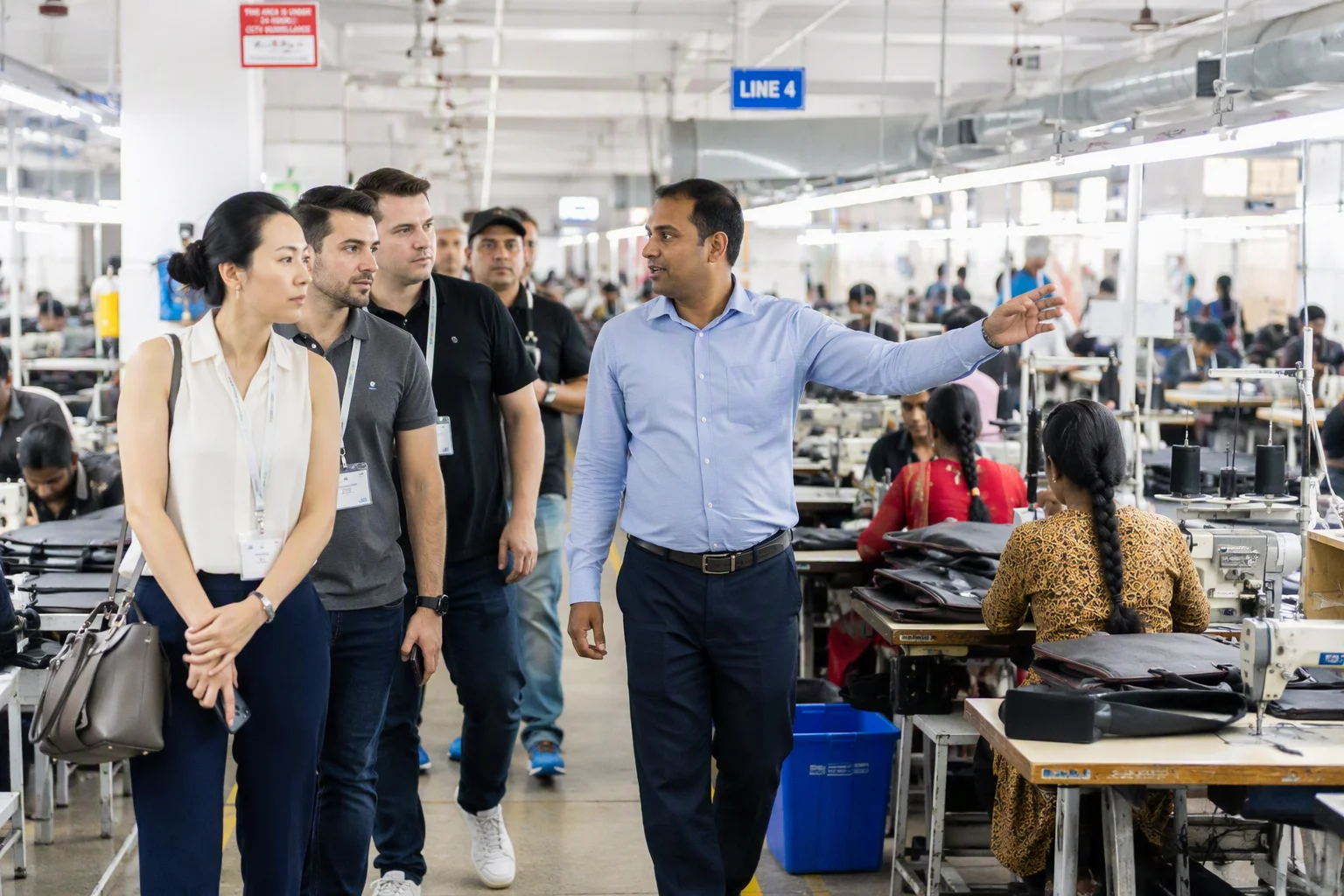
The floor is where the visit earns its cost. What you are assessing is not the number of machines but how consistently the process runs and how obviously it is managed.
Observing the lines
Count the operators actually working and compare that with the machines present. Lines that are staffed and busy across every station suggest real loading; a floor where half the machines are idle tells you about demand rather than capability.
Watch the balance between stations. Where one station holds a large pile of work in progress while the next sits idle, you have found the bottleneck and the limit on that line’s output.
Machine condition and maintenance
| Signal | What it suggests |
|---|---|
| Clean, serviced machines | Maintenance culture is in place |
| Specialist machines on site | Capability in-house, not outsourced |
| Visible maintenance records | Breakdowns are managed, not ignored |
| Spare parts and needles stocked | Downtime is planned for |
| Extraction and fume control | Health and process control are taken seriously |
| Calibrated measuring tools | Quality decisions are based on data |
Ask how often machines are serviced and who does it. A factory that services its own machines has technical depth; one that only calls a technician after a breakdown manages by reaction.
Work in progress and flow
Look at the quantity and condition of work in progress between stations. Small, labelled and moving bundles indicate a controlled flow; large static piles indicate a bottleneck or a scheduling problem.
Check whether pieces are handled in a way that protects them: on racks or trays rather than on the floor, and covered where dust or sunlight is a risk. Handling damage is one of the most avoidable sources of defects.
The cutting department
Cutting is where material cost and dimensional accuracy are decided. Look for pattern files or hard patterns stored properly, a method for ensuring the correct pattern version is used and a check that cut pieces match before they move to the line.
Ask how they prevent mixing of similar shades or sizes when several orders are being cut. The answer tells you whether you can order two colours in the same run without a mix-up.
Finishing, hardware and packing
Examine the stations where hardware is set and where finishing is done. These operations are often manual, so the skill of the operator and the tooling available determine consistency.
At packing, check that the carton specification and marking match the requirements and that finished goods are counted and recorded. Packing errors are visible to your customer immediately, which makes this a high-consequence area.
Supervision and pace
Note how many supervisors are present relative to operators and whether they are moving through the lines or sitting at a desk. Active supervision is one of the strongest predictors of consistent quality.
The pace of the floor is also informative. A factory working steadily with visible rhythm is normally loaded; a floor that stops and starts has scheduling problems upstream.
Quality Systems in Plain Sight
Quality management leaves physical traces. Records, stations, tools and corrective actions can all be seen during a walk-through.
In-line checks and inspection stations
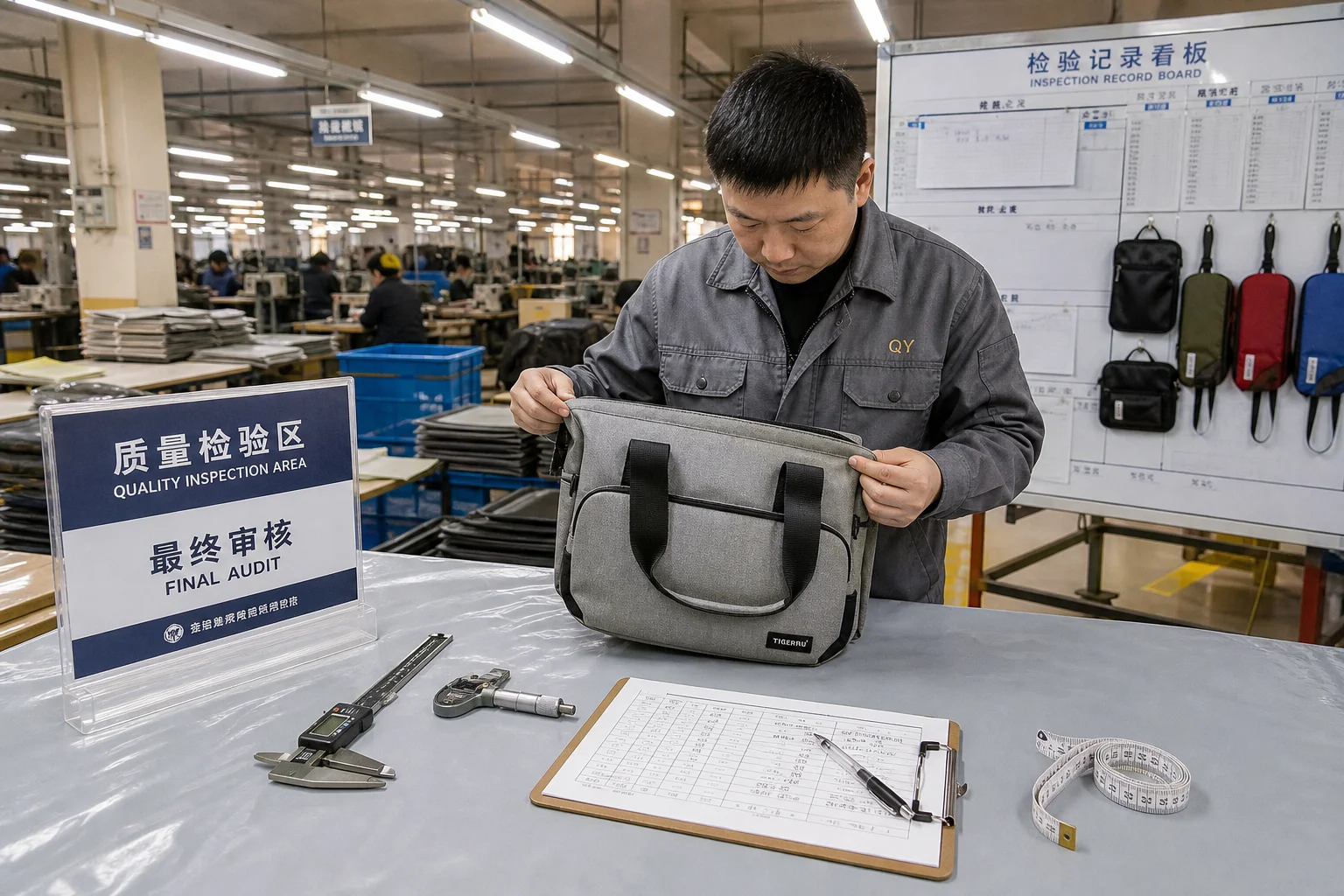
Look for check positions within the line rather than only at the end, and for a defined inspection area with adequate lighting, a flat measurement surface and the tools required by the specification.
Ask what happens to a rejected piece: who records it, where it goes and how the cause is investigated. A factory with a rework bin and a defect log is managing quality; one with a quiet pile behind a machine is not.
Evidence to look for
| Evidence | What it proves |
|---|---|
| Sealed approved samples | A reference standard exists |
| Inspection reports by order | Checks are performed and recorded |
| Defect logs with causes | Problems are analysed, not just sorted |
| Corrective action records | Recurring faults are addressed |
| Calibration records for gauges | Measurements can be trusted |
| Measurement tooling per station | Operators can verify their own work |
Ask to see the inspection records for a recent order of a similar style. Historic records are far harder to produce on demand than a system described verbally.
Standards and specifications on the floor
Check whether the specification, drawings and approved sample are physically available at the relevant stations, or whether operators rely on memory and instructions from a supervisor.
Where a sealed sample sits beside the line with clear photographs and tolerance notes, the standard is visible to the people who need it. That single practice prevents a large share of consistency problems.
How corrective action works
Ask for a recent example of a quality problem and how it was handled: what the root cause was, what changed and whether the change held. A factory that can describe the process in detail has a working system.
A factory that answers only with reassurance, without an example, is describing an intention rather than a practice.
The Sample and Pattern Room
The sample room is the most direct evidence of whether the factory can build your product, and it is frequently the most informative room on the site.
What to look for in the sample room
A well-equipped sample room has its own machines, its own cutting area and the pattern-making equipment needed to develop a style without interrupting production.
Ask how many samples are in progress, how long a sample takes and who builds it. A sample room that is busy with a queue indicates a factory developing business actively; an idle one suggests sampling is treated as an interruption.
Patterns and technical files
| Item | Why it matters |
|---|---|
| Pattern library, organised | Styles can be reproduced accurately |
| Pattern version control | Correct version reaches production |
| Digital pattern files | Faster adaptation and grading |
| Technical packs by style | Specifications are documented |
| Sample approval records | Approved standards are traceable |
| Material swatch library | Material references can be matched |
Pattern control is where many consistent-quality problems are solved or created. A factory that can produce the current pattern for a style from two years ago is a factory you can scale with.
Discussing your own product
Bring your sample or specification and ask the sample room directly how they would build it and what problems they foresee. Technical staff usually give honest answers about difficulty, which is exactly the information you need.
Ask which operation would be hardest, which material would be critical and what tolerance they can realistically hold. The quality of these answers predicts the quality of the sampling process.
Materials and the Store
Material handling determines both cost and consistency. The store and the way material reaches the line deserve a close look.
What the material store reveals
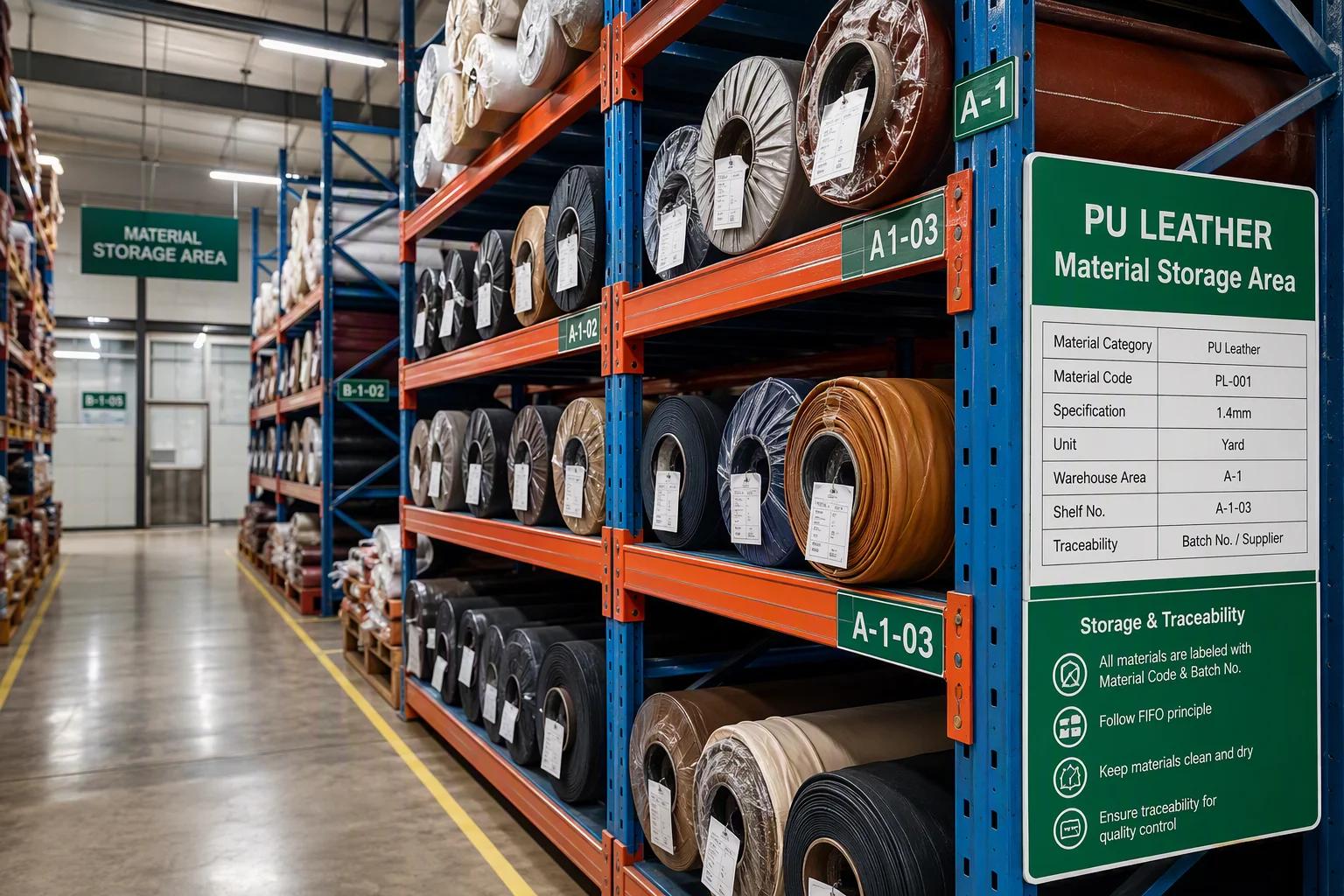
An organised store has labelled locations, materials off the floor and away from sunlight, and a record of what is held and for which order.
Rolls stored upright and unprotected, or materials sitting in open areas where they may be exposed to sun and dust, indicate that material condition is not actively managed. For PU leather, that shows up later as colour variation and surface marking.
Traceability and lot control
| Check | Why it matters |
|---|---|
| Lot or batch labels | Enables tracing an issue to a supply batch |
| Incoming material inspection | Problems caught before cutting |
| Issued quantity recorded | Consumption can be reconciled |
| Material reserved per order | Your order uses the approved material |
| Swatch retained per lot | Colour can be compared later |
| Remnant control | Leftovers do not drift into other orders |
Ask whether incoming material is inspected against a reference and what happens if a batch is out of tolerance. The answer shows whether material variance is caught early or discovered in the finished bag.
Material storage conditions
Check temperature, humidity and light exposure in the store, and whether the conditions are monitored. Many surface defects blamed on production actually originate in storage.
Also look at how materials are moved. Trolleys, racks and protective covers cost little and prevent the handling damage that is otherwise recorded as a cutting or stitching fault.
People, Training and Management
Factories are people doing skilled work under supervision. Headcount and training records are as important as any machine on the floor.
Operators and skill distribution
Ask how many operators are on the floor, how many are skilled on complex operations and how the factory covers absence. A factory with a thin layer of senior operators is fragile at exactly the operations that matter most.
Observe how operators work: whether they check their own output, how they handle a difficulty and whether they are working at a sustainable pace rather than a forced one.
Training and development
| Practice | What it indicates |
|---|---|
| New operator training record | Skill is built deliberately |
| Multi-skilled operators | Flexibility across styles |
| Defined quality induction | Standards are taught, not assumed |
| Skill matrix by line | Capacity is understood internally |
| Retention or tenure data | Stable, experienced workforce |
Staff turnover is worth asking about directly. High turnover erodes quality quietly, because new operators take time to reach the standard and the learning cost is paid by the customer.
Management structure and escalation
Ask who owns your order from confirmation to shipment and who is responsible when something goes wrong. A named chain with clear responsibilities is a sign of a managed organisation.
Also ask how the factory handles a customer complaint: who investigates, how quickly they respond and how they confirm the fix. The answer is a preview of how your own issues would be handled.
Working conditions and stability
Observe lighting, seating, ventilation, noise and access to facilities. Good conditions are not only an ethical matter; they are strongly associated with lower turnover and more consistent output.
A factory that invests in the comfort of its operators is usually a factory that expects to keep them, which matters to a buyer planning a multi-season programme.
Compliance, Safety and Documents
Compliance evidence is a matter of asking directly and reading the answers. Documents that cannot be produced on site should be sent afterwards, with a date.
Documents to request
| Document | Relevance |
|---|---|
| Business licence | Legal identity and scope |
| Quality system certificate | Process management, where applicable |
| Social compliance audit | Labour practice verification |
| Material test reports | Restricted substances, physical performance |
| Export documentation | Ability to ship to your market |
| Insurance and facility records | Risk management |
Ask which certifications are current and for copies with validity dates rather than a list of logos. Expired certificates are common and are easily spotted by asking for the document.
Safety on the floor
Look for guards on moving machinery, clear extraction at cutting and skiving, marked exits and accessible fire equipment. Safety practice is an indicator of general process discipline.
A factory where safety rules are visibly followed is a factory where other procedures are more likely to be followed too. The reverse is equally informative.
Environmental and waste practice
Ask how offcuts, solvent-based adhesives and packaging waste are handled, particularly where your market requires environmental claims to be substantiated.
Increasingly, buyers need evidence for sustainability statements. A factory that can describe its waste streams and material sources is a factory whose claims can survive scrutiny.
Questions to Ask on Site
A prepared question list keeps the visit on track. The following set covers the essential ground and can be adapted to your product.
Capacity and scheduling
How many lines do you run, what is your monthly output for a style like mine, and what is your current loading? When could you start and finish an order of my size, and which operations do you sub-contract?
Who plans the lines, how far ahead is the schedule fixed, and what happens to a confirmed slot when a larger customer requests capacity? That last answer is worth knowing before you commit.
Quality and technical
Who approves samples, how are specifications controlled, which tolerances can you hold and how do you record and act on defects? Can you show me inspection records for a similar recent order?
Which operation in my product do you expect to be most difficult, and what would you change in my design to make it more reliably producible? This question usually produces the most valuable answer of the day.
Commercial and relationship
What are your payment terms, minimum order quantities and tooling charges for my project? Who will handle my order day to day, and how do you prefer to be contacted?
How do you handle a late shipment or a rejected batch, and what is your policy on tooling ownership and specification confidentiality? These answers belong in the commercial discussion, and the visit is the right moment to raise them.
Questions that reveal the most
The most revealing questions are about problems rather than capabilities: what went wrong recently, how it was found, what changed and how they know it will not recur.
Any factory can describe its strengths. The way a team answers a question about a failure tells you how your own difficult moments will be handled.
Scoring the Visit and Deciding
Impressions fade quickly after a visit. Scoring against fixed criteria while the detail is fresh turns a day of observations into a decision.
A practical visit scorecard
| Criterion | What a strong answer looks like |
|---|---|
| Layout and flow | Process order matches physical order |
| Housekeeping | Labelled work in progress, clear aisles |
| Equipment | Serviced, appropriate, in-house capability |
| Line loading | Staffed and steadily busy |
| Quality system | Records, checks, corrective actions |
| Sample room | Equipped, active, patterns controlled |
| Material control | Traceable, protected, inspected |
| People | Skilled, trained, low turnover |
| Compliance | Current documents, safety practice |
| Transparency | Direct answers about problems |
Score each criterion on a simple scale and note the evidence behind the score. The written evidence is what makes the comparison between two factories meaningful.
Signals worth acting on
Strong positives include work in progress that is labelled and moving, an active sample room, sealed approved samples beside the line and a team that answers difficult questions with detail.
Strong negatives include unlabelled production piles, no visible inspection records, materials stored unprotected and answers that consist only of assurances. One negative is a question; several together are a decision.
Turning observations into requirements
Anything that concerned you can be converted into a written requirement or an agreement: material protection, inspection points, records to be shared, notification of sub-contracted steps.
That conversion is what makes a visit useful beyond the day itself. Observations become clauses, and clauses become the standard your order is held to.
When the answer is no
A visit that rules out a factory has done its job. The cost of the trip is small compared with the cost of discovering the same weaknesses across several production runs.
Where a factory is nearly right but has a specific gap, consider whether the gap is fixable and whether the supplier is willing to fix it. Capability problems can sometimes be solved; unwillingness usually cannot.
A factory visit does not tell you whether a supplier will succeed. It tells you which supplier is worth the risk — and which risk is unnecessary.
FAQ
How long should a bag factory visit take?
Half a day is enough for a focused assessment and a full day is better if you want to review records, meet the sample room and discuss your own product in detail.
Should I announce the visit in advance?
Yes, with a written agenda and the documents you would like to review. Surprise visits produce surprise presentations; announced visits allow the people who know the answers to be present.
What is the single most informative thing to look at?
The work in progress between stations. Its quantity, labelling and movement reveal line balance, supervision and process discipline more quickly than any other single observation.
Can I judge quality without opening a single record?
Partly. Housekeeping, sealed samples, visible inspection stations and the condition of finished goods all indicate quality practice. Records confirm whether the practice is systematic.
Which documents should I ask for on site?
The business licence, current quality and social compliance certificates, material test reports and inspection records for a recent similar order. Ask for validity dates, not just a list of logos.
How do I assess capacity during a short visit?
Count working operators, note idle machines and examine work in progress. Then ask for the production schedule and monthly output figures, and check them against the headcount you saw.
Is it normal to be shown only part of the factory?
Most visits cover the main production areas. If access is restricted, ask why and request to see the specific area relevant to your product, such as the sample room or the hardware setting station.
What should I do if the visit raises concerns?
Convert each concern into a written requirement or a question and send it after the visit. The response — specific and prompt, or vague and slow — is itself part of the assessment.
Should I visit more than one factory?
Where the order value justifies it, visiting two or three candidates on one trip gives you a genuine comparison and a negotiating position, because you will have seen the differences directly.
How do I turn a visit into a better order outcome?
Write down what you saw, agree the requirements that follow from it in writing, and reference them in the purchase order. A visit without written follow-up fades within a week.
What if I cannot travel at all?
Request a live video walk-through following the same sequence as this guide, and ask for photographs of the specific areas and records you would have examined. Then rely on a third-party inspection at production.
Next Steps: Prepare the Visit Like a Specification
A factory visit works best as a structured assessment: written objectives, a defined route through the building, a question list, a document request and a scorecard completed the same day.
Used that way, a few hours on site replace months of uncertainty about whether a supplier can build your product repeatedly and tell you the truth about it. That is the standard our factory expects visitors to hold us to.
We welcome buyer visits and video walk-throughs, and we will show you the sample room, the material store and the inspection records that matter to your order. Send us your specification and arrange a visit through the link below.
Planning a factory assessment? Contact our team at info@gionar.com to arrange a visit or a live video walk-through of our bag production lines.
Related reading: our custom bag manufacturing portfolio shows the styles, structures and quality standards you would be assessing on site.