- Why Care Advice Belongs to the Maker
- Understanding the Material You Are Advising On
- Routine Cleaning for PU Leather Bags
- Stain Removal by Type
- What Damages PU Leather
- Storage and Handling
- Care Content for Retailers
- Packaging and Shipping Care
- When Care Cannot Fix It
- Climate and Seasonal Considerations
- FAQ
Why Care Advice Belongs to the Maker
Most care complaints do not start with the material. They start with missing information: a customer who does not know how to clean a coated surface, so tries a household solvent and damages it.
Retailers carry complaints the factory never sees
When a bag is returned or a review mentions a damaged surface, the retailer absorbing the claim rarely knows what caused it. The cause is usually a cleaning method rather than a manufacturing defect, and it was avoidable.
A short, accurate care instruction prevents a large share of these cases. For a brand selling through wholesale channels, it also protects the retailer relationship, because the retailer can answer the question without escalating it.
What PU leather is, in practical terms
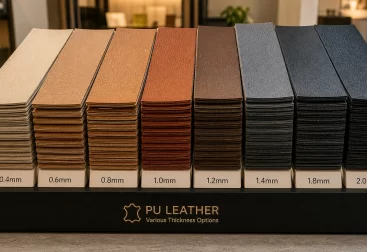
PU leather is a fabric backing coated with a polyurethane layer that carries the colour and surface finish. The coat is the part customers touch; the backing gives strength and shape.
That two-part structure defines the care rules. The coating resists water and stains well, but can be softened, dulled or lifted by solvents, heat and abrasion. Advice that ignores the coating is advice that damages the product.
Where care problems actually originate
| Cause | Typical complaint |
|---|---|
| Wrong cleaning agent | Surface dulled, tacky or discoloured |
| Excess water | Wrinkling, edge lifting, mould in humid climates |
| Heat exposure | Coating softening, print or texture flattening |
| Abrasion | Shiny patches, colour loss at corners |
| Improper storage | Creases, pressure marks, distortion |
| Dye transfer | Staining from clothing or other bags |
All six are preventable with clear guidance, and none of them require a change to the product itself. That makes care advice one of the cheapest quality improvements available to a bag programme.
The commercial case for care instructions
Accurate care advice reduces returns, improves review scores and lowers the support load on both the brand and the retailer. It also lengthens the usable life of the product, which matters increasingly to buyers comparing suppliers.
For a B2B manufacturer, providing care content is part of the service: the brand does not have to commission it, and the retailer receives something it can publish directly on a product page or in a care card.
Understanding the Material You Are Advising On
Care advice is only as good as the specification behind it. Two bags that look similar on a shelf can behave very differently when cleaned, depending on coating chemistry and backing.
The layers and what each one tolerates
The top coat carries the finish and the colour, the middle coat gives the surface its feel and the backing supplies tensile strength. Each layer responds differently to water, solvents, heat and friction.
Where the top coat is a thin, high-gloss finish, it marks and dulls more visibly than a matte, thicker coating. Where the backing is a knit, the material stretches more and tolerates less heat than a woven backing.
Common coated materials and their care tolerance
| Material | Surface behaviour | Care tolerance |
|---|---|---|
| PU coated, woven backing | Durable, holds shape | Good — damp cloth method works well |
| PU coated, knit backing | Softer, more stretch | Moderate — avoid heat and stretching |
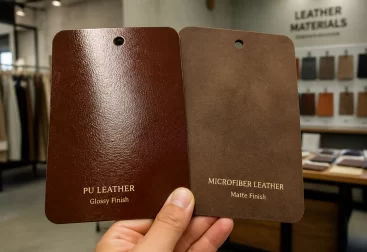
| Microfiber PU | Soft, suede-like hand | Moderate — needs brushing, not wiping |
| PVC coated | High gloss, heavy | Careful — plasticiser migration risk |
| Coated canvas | Firm, structured | Good — avoid soaking the seams |
| Split leather with PU finish | Leather feel, coated face | Moderate — condition edges, not the coat |
The table matters commercially. Advice written for a woven-backing PU bag may be wrong for a microfiber PU bag of the same colour, which is why care content should be tied to the actual specification.
Finishes that need special instructions
Metallic, pearlescent, patent and printed finishes each have a specific sensitivity. Patent-look surfaces can bond to themselves and should not be stored touching; metallic prints can lift at abrasion points.
Where a bag uses these finishes, the care card should say so explicitly. A generic instruction is worse than none when the customer assumes it applies to a delicate surface.
Why specification detail reaches the customer
Ask your manufacturer which coating and backing a style uses and what cleaning method it recommends for that combination. That answer is the raw material for the care card.
Suppliers who cannot state the coating type cannot give accurate care advice, and that gap eventually appears as returns. It is a reasonable question to ask during development, not after the first complaint.
Routine Cleaning for PU Leather Bags
Most cleaning needs are routine: dust, fingerprints, light marks and the general grime of daily use. A simple method handles them safely.
What you need and what to avoid
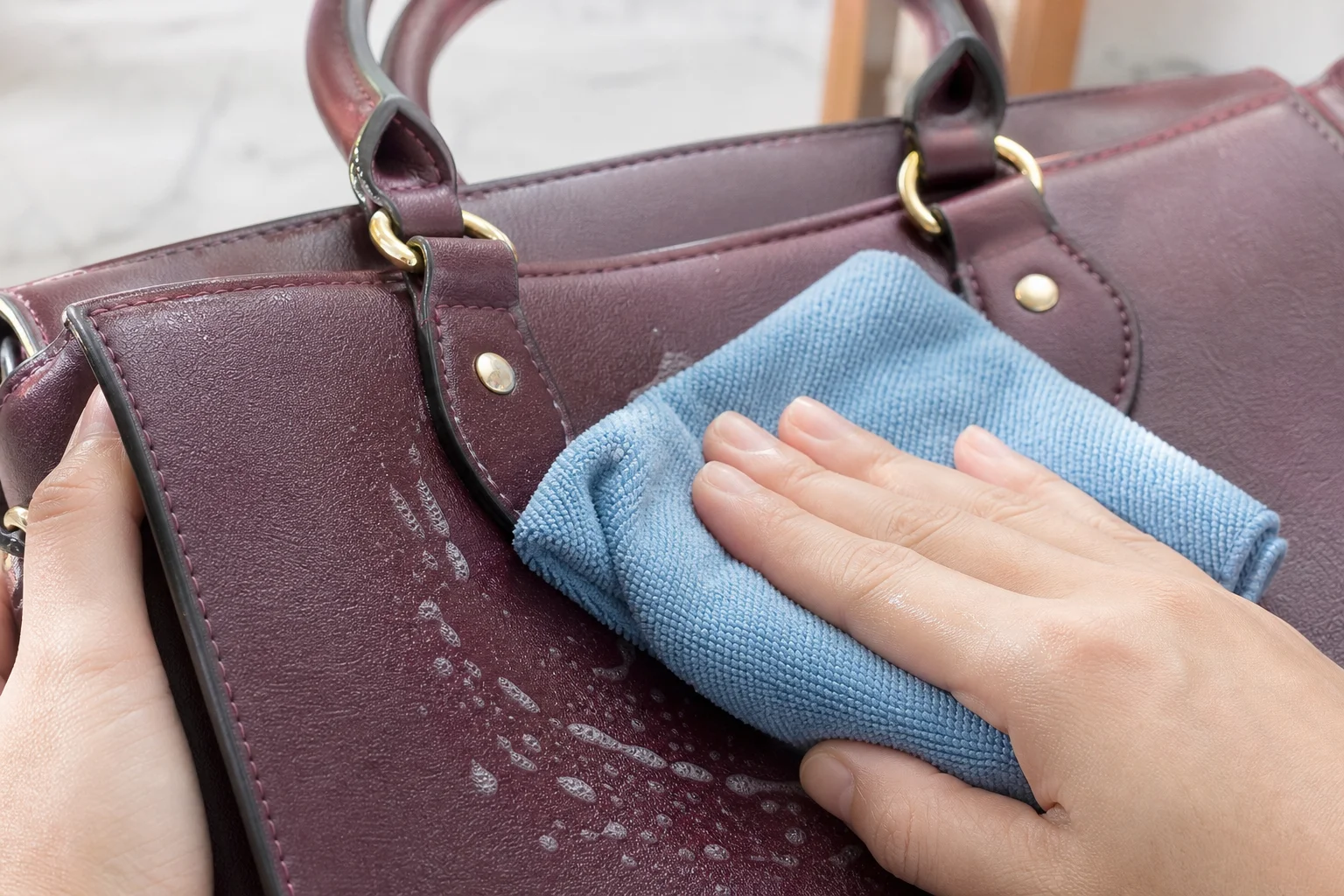
Keep the kit minimal: a soft microfiber cloth, a second clean cloth, lukewarm water with a drop of mild soap, and a soft brush for textured surfaces. Nothing abrasive and nothing solvent-based.
Household products to avoid include alcohol, acetone, bleach, ammonia-based cleaners, abrasive creams and disinfectant wipes with high alcohol content. These strip or soften the coating rather than clean it.
The routine method, step by step
Dust the bag dry with a soft cloth first, working along the surface rather than pressing. Dust removed while dry does not become a scouring paste later.
Dampen the cloth, not the bag, and wipe in one direction with light pressure. Rinse the cloth as it picks up soil, and finish by wiping with a clean, barely damp cloth to remove soap residue.
Let the bag air-dry at room temperature, away from direct sun and away from a heater or hairdryer. Stuffed with clean paper, it holds its shape while drying and the surface dries evenly.
Do and do not
| Do | Do not |
|---|---|
| Test on a hidden area first | Test on the front panel |
| Use a damp cloth | Soak or submerge the bag |
| Wipe with light pressure | Scrub marks aggressively |
| Use mild soap and water | Use alcohol or solvents |
| Air-dry at room temperature | Use heat or direct sunlight |
| Clean the whole panel evenly | Clean one spot, leaving a patch |
| Brush textured surfaces gently | Use stiff brushes or scouring pads |
| Wipe hardware with a dry cloth | Polish hardware with abrasive paste |
Cleaning a whole panel evenly matters more than it sounds. Cleaning only the mark can leave a visible tonal difference, which customers often report as a defect.
Frequency and expectations
Routine cleaning once a month, or as needed, is enough for most bags. Over-cleaning is a real problem: repeated wetting of a coated surface gradually dulls the finish.
Set that expectation in the care card. A customer who cleans weekly with a strong product will shorten the life of the coating regardless of how good the material is.
Stain Removal by Type
Stains are where care advice earns its keep, because the wrong response converts a mark into permanent damage. The method depends on what was spilled.
Act quickly, but not aggressively
Speed matters, yet the most common error is aggressive treatment. Blotting gently within a few minutes is far more effective than scrubbing hard after several hours.
Always work from the outside of the mark towards the centre so the stain does not spread, and change the cloth as it picks up the substance rather than redistributing it.
Methods by stain type
| Stain | Method | Caution |
|---|---|---|
| Water-based spill | Blot, then wipe with damp cloth and mild soap | Never rub while wet |
| Oil or grease | Blot, apply a little cornstarch, brush off after 15 minutes | Do not use dish detergent |
| Ink | Gentle wipe with a slightly damp cloth; refer if it persists | Solvents will lift the coating |
| Ballpoint smear | Light dabbing with a soft eraser, then damp cloth | Erase gently, avoid heat |
| Dye transfer | Damp cloth with mild soap, immediate action | Long exposure may be permanent |
| Scuff mark | Soft cloth with mild soap, then brush textured surfaces | Do not use polish or paste |
| Food or drink | Blot, damp cloth, mild soap, air-dry | Avoid saturating seams |
| Cosmetics | Blot, then wipe with mild soap solution | Avoid oily removers |
Set a clear escalation rule in the care card: if the mark does not respond to the mild method, refer the customer to a professional rather than encouraging a stronger product.
Dye transfer deserves specific attention
Dye transfer from dark clothing onto light PU leather is among the most common complaints, and it is often wrongly attributed to the bag. It happens where a dark garment rubs repeatedly against a light surface, particularly in heat and humidity.
Care advice should name it, explain the cause and give the response: act immediately with a damp cloth and mild soap; expect partial improvement rather than complete removal if the exposure has been long.
What customers should never be told
Do not recommend alcohol wipes, nail polish remover, bleach, abrasive cleaners or machine washing. Each of these works against the coating rather than for it, and the damage appears within a short time.
Where a customer insists on a household product, the honest answer is that the material is not designed for it. Replacing a bag under warranty because a retailer suggested the wrong method is an avoidable cost.
What Damages PU Leather
Damage prevention is simpler to explain than cleaning, because the causes are few and predictable. Knowing them lets a brand write care content that prevents claims rather than answering them.
Heat and light
Coated surfaces soften with heat, which flattens texture and can leave permanent impressions. Sun exposure accelerates fading and can make the coating tacky, and a hot car interior combines both.
Advice should be explicit: keep bags out of direct sun, away from radiators and heaters, and never dry a wet bag with a hairdryer.
Solvents, oils and chemicals
| Exposure | Effect on the coating |
|---|---|
| Alcohol-based sanitiser | Dulling, tackiness, colour loss |
| Acetone or nail polish remover | Dissolves or lifts the surface |
| Hand cream and sunscreen | Gradual marking, oily patches |
| Hairspray and perfume | Spot discolouration |
| Insect repellent | Severe localised damage |
| Abrasive cream cleaners | Scratches and loss of gloss |
Cosmetics and personal care products cause damage that customers rarely connect to the cause, because it appears gradually. Naming them in the care card prevents both the damage and the blame.
Abrasion and pressure
Friction at corners, strap ends and where the bag rubs against clothing wears through the coating first. Pressure in storage leaves creases and flattened texture that cleaning cannot restore.
Reinforcement decisions made during production influence this, which is why care advice and construction choices belong in the same conversation during development.
Water, humidity and mould
Short exposure to rain is generally tolerable; prolonged saturation is not. Water can penetrate at seams and stitch holes, and in humid climates a damp bag stored closed is an ideal environment for mould.
The correct advice is to blot rather than rub, dry at room temperature away from heat, and never store a bag while damp.
Plasticiser migration and contact damage
Coated surfaces can react with other plastics, printed materials and some inks, leaving marks or a sticky patch. Where a bag is stored in contact with a printed carton or a vinyl surface, this becomes likely.
That is why packaging choices and storage guidance are linked. A bag that arrives with pressure marks from its own packaging is a quality complaint created by shipping rather than by the bag.
The Care Kit Worth Recommending
The most effective care instruction is one the customer can follow with items they already own. Where a brand wants to go further, a small kit is easy to specify and inexpensive to source.
What belongs in a basic kit
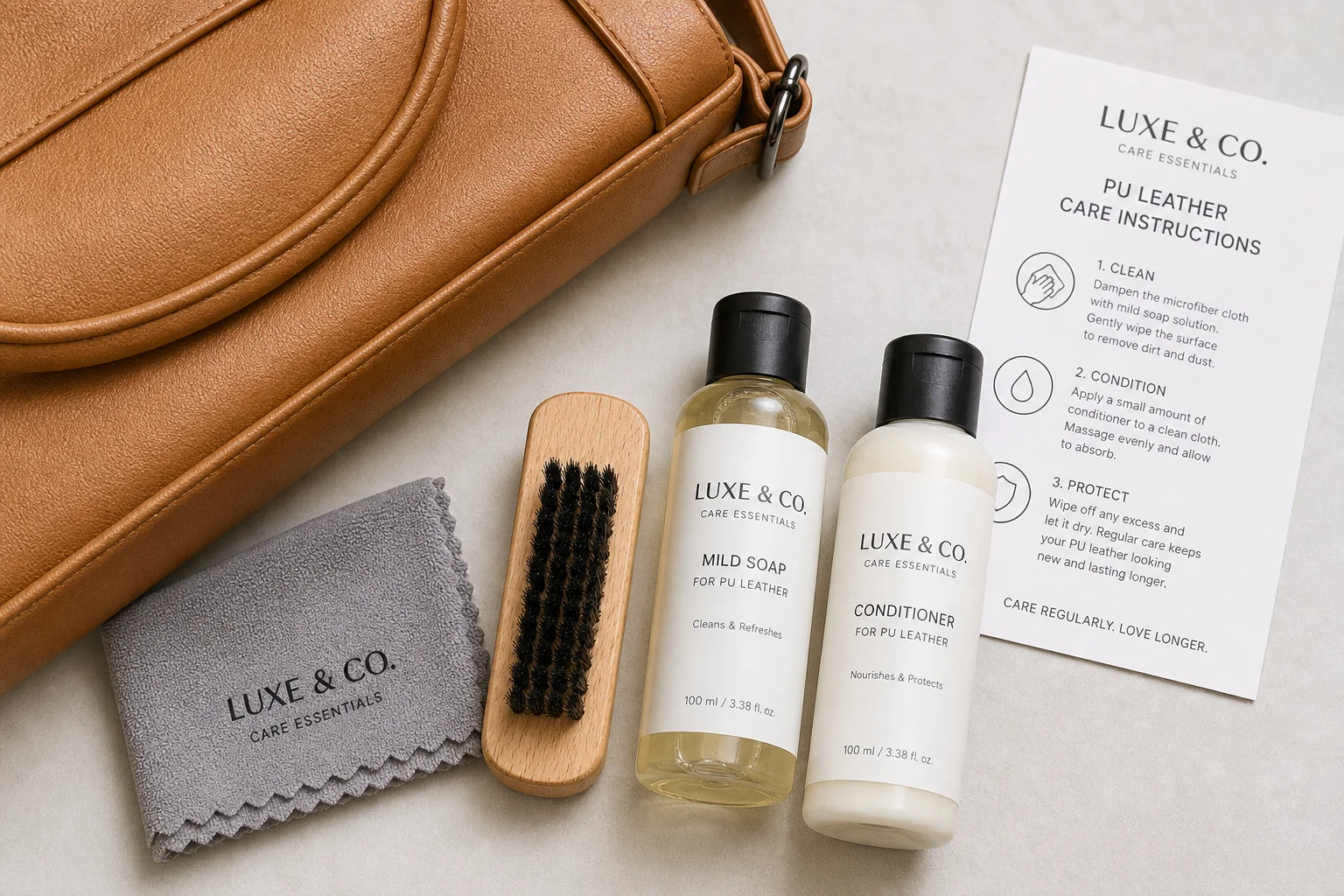
Two soft microfiber cloths, a soft-bristle brush for textured surfaces, a mild neutral soap and a short printed care card. Optional additions include a dust bag and a small quantity of protecting spray suitable for coated surfaces.
If a brand includes a cream or conditioner, the specification matters: products intended for genuine leather are not suitable for coated surfaces and can leave an oily residue.
Kit contents and purpose
| Item | Purpose |
|---|---|
| Microfiber cloths (2) | One for cleaning, one for drying |
| Soft brush | Textured surfaces and dust in seams |
| Mild neutral soap | Safe cleaning agent when diluted |
| Care card | The instruction that prevents claims |
| Dust bag | Storage protection |
| Protecting spray | Optional; must suit coated surfaces |
Each item should have a printed purpose. A kit without instructions still leaves the customer guessing, and a guess can be expensive for the brand.
Branded care kits as a retail feature
A care kit is also a merchandising opportunity. It adds perceived value, supports a premium position and gives the brand a physical touchpoint after the sale.
Because the contents are standardised, a kit is straightforward to specify with a bag order and can carry the brand’s own labelling without changing the bag itself.
Storage and Handling
More PU leather bags are damaged in storage than in use. Creases, pressure marks, distortion and colour transfer all develop quietly on a shelf.
Holding the shape
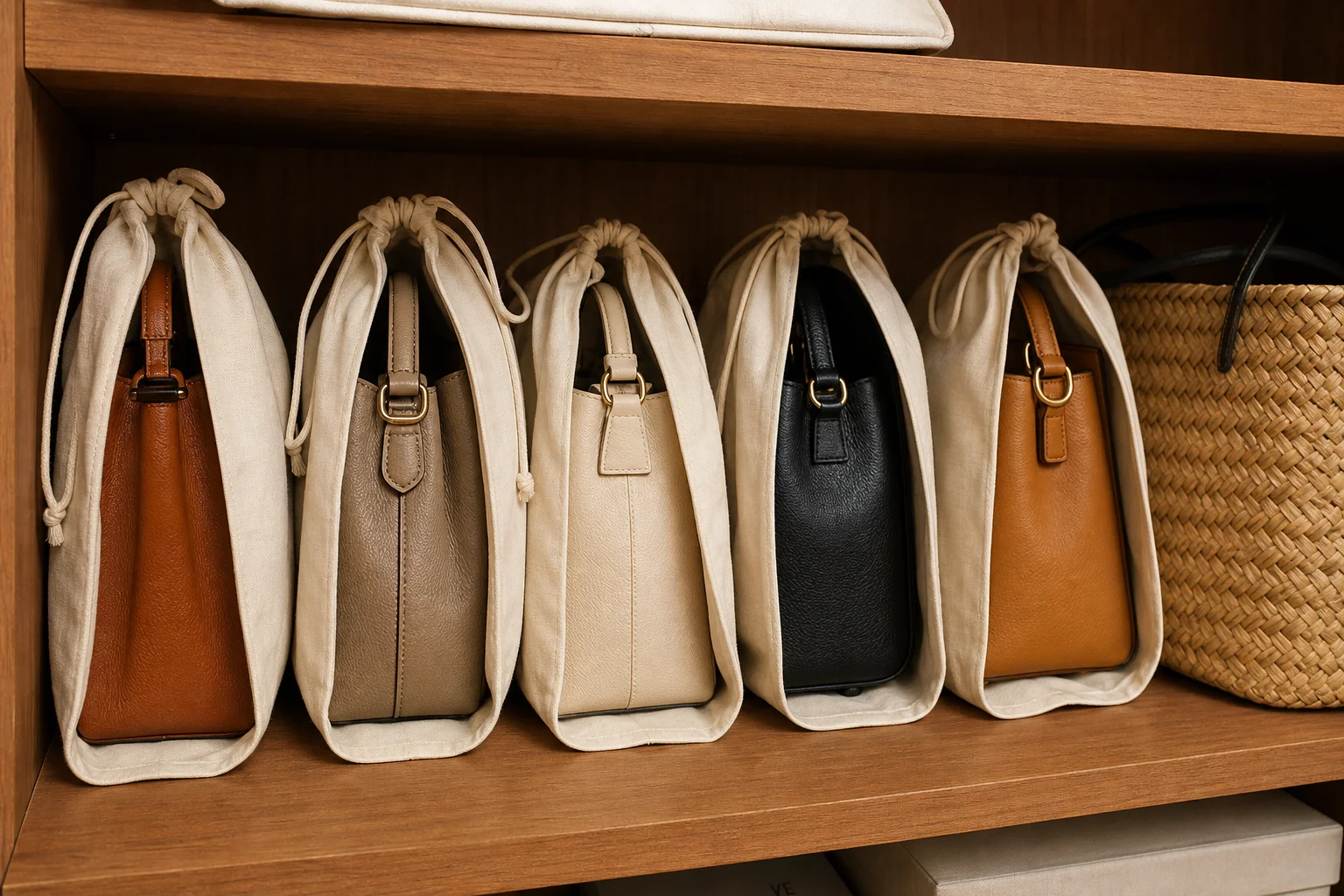
A bag stored empty collapses, and the fold becomes a permanent crease in the coating. Stuffing the bag with clean tissue paper or a soft form keeps the panels in their intended shape.
Avoid newspaper as stuffing: the ink can transfer to a light lining, and the paper itself can mark the interior. Bubble wrap holds shape but can leave patterned impressions under pressure.
Storage rules that prevent damage
| Rule | Reason |
|---|---|
| Stuff the bag to hold shape | Prevents permanent creases |
| Use a breathable dust bag | Protects from dust without trapping moisture |
| Store upright, not stacked | Avoids pressure marks and distortion |
| Keep away from direct sun | Prevents fading and tackiness |
| Keep away from heat sources | Avoids softening and texture flattening |
| Never store damp | Prevents mould and edge lifting |
| Separate light and dark bags | Reduces dye transfer risk |
| Avoid plastic bags for long storage | Trapped humidity and plasticiser contact |
These eight rules are short enough for a care card and specific enough to be followed. Vague advice such as “store in a cool, dry place” is easy to ignore.
Handling in retail stockrooms
Stockrooms create their own risks: bags stacked on top of each other, dust bags discarded to save space, and stock kept against a window or above a heater for months.
Retail guidance should cover how stock is stacked, how long it is held and what to do with packaging removed during display. Display stock handling and customer storage advice belong to the same conversation.
Long-term storage and rotation
For products stored for more than a season, rotate stock so no unit stays at the bottom of a stack for its whole life. Pressure marks develop over months rather than days.
Where a bag is kept for display, remove anything that could transfer colour onto the surface, including printed labels touching a light-coloured panel.
Care Content for Retailers
Care advice only prevents claims if it reaches the customer in a usable form. That means the manufacturer supplies content the brand and retailer can publish without rewriting it.
What to supply with each order
A short care card sized for the bag, a longer version for the product page and a set of FAQ answers covering the most common questions. All three derived from the same specification.
Supplying them as files the retailer can reuse — text, not a photograph of a card — saves the retailer work and increases the chance that the advice is actually published.
Care content elements
| Element | Content |
|---|---|
| Material statement | Coated PU leather with the relevant surface finish |
| Routine method | Damp cloth, mild soap, air-dry |
| Prohibited products | Alcohol, solvents, bleach, abrasives |
| Stain guidance | Short list by stain type |
| Storage guidance | Stuff, breathe, keep out of sun and heat |
| Contact for help | Where to ask when unsure |
The prohibited list is the most valuable part. It is the specific, actionable information that stops a customer from reaching for the wrong bottle.
Product page and packaging copy
On a product page, care content reduces questions and returns, and it supports search visibility because care queries are common. A shop that answers them keeps the customer instead of losing them to a search engine.
On packaging, keep the printed version short: five to six lines that fit the space available, with the full version online. Space constraints should not be allowed to reduce advice to a slogan.
Training retail staff
Most front-line advice is given by retail staff, not by cards. A one-page summary covering the cleaning method, the prohibited products and the escalation rule equips them to answer confidently.
Where staff are taught the difference between a coating mark and a manufacturing defect, the number of claims that reach the brand falls noticeably.
Packaging and Shipping Care
Damage frequently occurs between the factory and the retailer. Packaging is part of the care story, not a separate topic.
What protects a PU leather bag in transit
Individual wrapping that allows the bag to breathe, tissue or paper filling to hold shape, and separation between units so hardware cannot press into a neighbouring surface.
Humidity control matters for long sea shipments. Where cartons spend weeks in a container, the combination of heat and moisture is exactly the environment that promotes mould and edge lifting.
Transit risks and controls
| Risk | Control |
|---|---|
| Pressure marks | Individual wrapping, no direct stacking of hardware |
| Shape distortion | Internal filling, correct carton size |
| Colour transfer | Barrier between light and dark units |
| Mould in humid transit | Desiccant, sealed carton liners, controlled stuffing |
| Surface scuffing | Tissue wrapping and separation |
| Print transfer | Avoid printed material in direct contact with the surface |
These controls are specified during development and cost little. Discovered after arrival, they become a claim and a lost season of stock.
Unpacking instructions worth including
Advise retailers and customers to unwrap promptly, to check for transit marks before display, and to allow a bag that has been compressed to recover its shape before judging it.
Most pressure marks release within a day once the bag is unwrapped and filled. Rejection on arrival, before that recovery, is a preventable loss.
When Care Cannot Fix It
Some problems are manufacturing defects and some are wear. Separating them is what makes a warranty policy credible, and it is easier than it sounds.
Defect or wear: the distinction
A defect appears early, is usually consistent across units or localised to a specific operation, and is not explained by how the product was used. Wear develops gradually and follows the pattern of use.
A seam that opens in the first month is a defect; coating that dulls after a year of daily use is wear. Setting that boundary in writing prevents most disputes before they start.
Typical classification
| Observation | Usually |
|---|---|
| Seam opening in first weeks | Defect — stitching or construction |
| Hardware detaching early | Defect — fixing or material |
| Zipper failing repeatedly | Defect — component or setting |
| Coating lifting from the backing | Defect — adhesion |
| Colour fading after long sun exposure | Wear or use conditions |
| Shiny patches at corners | Wear — abrasion |
| Dye transfer from clothing | Use conditions |
| Marks after solvent cleaning | Improper care |
| Creases from storage | Storage conditions |
| Mould after damp storage | Storage conditions |
Where a case is ambiguous, examine a sample from the same batch. A defect tends to repeat identically; use-related damage varies between units.
Writing a repair or replacement policy
State the period, what is covered, what is excluded and how a claim is raised. Include the care requirements, because a claim made after a solvent wipe is a claim about instructions that were not followed.
A policy that names the care obligations is fairer than one that does not: it protects the customer when the product is genuinely faulty and protects the brand when it is not.
Climate and Seasonal Considerations
Care advice that works in a temperate market can fail in a humid or very dry one. Where a brand sells across regions, the advice needs a note on climate.
Humid climates
High humidity makes mould the dominant risk. The advice shifts towards ventilation, drying before storage, desiccants in storage areas and inspecting stored stock regularly.
Air conditioning helps but is not a substitute for circulation: a sealed wardrobe in a humid room is the worst case, because the air never moves.
Dry and cold climates
In dry conditions, coated surfaces can become slightly stiffer and more prone to cracking at flex points over time, and cold makes some coatings brittle under impact.
The relevant advice is to avoid storing bags against heaters, to allow a cold bag to reach room temperature before handling, and to keep flex points from being repeatedly stressed at low temperature.
Rainy seasons and everyday handling
| Situation | Recommended response |
|---|---|
| Caught in rain | Blot with a dry cloth, air-dry away from heat |
| Wet strap or seam | Blot, allow full drying before storage |
| Beach or sand exposure | Brush dry sand off, then damp cloth |
| Hot vehicle interior | Avoid; store in shade or bring inside |
| Winter salt or grit | Wipe with a barely damp cloth, then dry |
| High-humidity storage | Ventilate, use desiccant, check monthly |
Seasonal handling advice is worth including in the care card because it applies exactly when the customer is most likely to cause damage.
Adapting care content by market
Where a brand sells into several climates, keep one core method and add a short regional note rather than writing separate guides. Consistency keeps the message simple.
Translations should be handled by someone who understands the material, because a care instruction that loses its caution in translation loses its purpose.
Care instructions do not sell a bag, but they decide whether the customer still likes it a year later — and that is what drives repeat orders and retailer confidence.
FAQ
Can PU leather bags be washed in a machine?
No. Machine washing and tumble drying damage the coating and distort the bag’s shape. Cleaning is done by hand with a damp cloth and mild soap, then air-dried at room temperature.
Can I use leather conditioner on PU leather?
Generally no. Products made for genuine leather can leave an oily residue on a coated surface. Where conditioning is recommended, it should be a product specified for coated material.
How do I remove ink marks from PU leather?
Try a slightly damp cloth first and act quickly. If the mark persists, refer it to a professional cleaner rather than applying alcohol or solvents, which lift the coating.
Why did my bag become sticky after cleaning?
Usually because an alcohol-based or solvent product softened the coating. Wipe with a barely damp cloth to remove residue and air-dry away from heat; the finish may not fully recover.
How should I store a PU leather bag for a long period?
Clean it, let it dry completely, stuff it to hold shape and place it in a breathable dust bag, stored upright away from sunlight, heat and humidity.
Is PU leather waterproof?
It resists light rain well, but it is not waterproof. Prolonged saturation can penetrate seams and stitch holes, so blot rather than rub and dry the bag away from heat.
How often should a PU leather bag be cleaned?
Monthly routine cleaning, or as needed after visible soiling. Over-cleaning dulls the finish over time, so there is no benefit in cleaning more frequently than necessary.
What should a care card for a PU leather bag include?
The material, the routine method, the list of prohibited products, guidance by stain type, storage rules and where to ask for help. Five to six lines can cover the essentials.
Can a damaged coating be repaired?
Minor scuffs sometimes improve with gentle cleaning, but coating damage is rarely reversible. Where the coating has lifted or dissolved, replacement or professional assessment is the realistic option.
Does dark PU leather need different care?
The method is the same, but dye transfer is more visible on light bags and fading is often more noticeable on dark ones. Store light and dark bags separately to reduce transfer risk.
How should a brand handle a customer who used the wrong product?
Explain the cause clearly and courteously, offer the correct method for the future and apply the warranty policy as written. Documenting care obligations in advance keeps that conversation straightforward.
Next Steps: Ship Care Advice With Every Bag
The cheapest quality improvement available to a PU leather bag programme is accurate care information supplied with the product: a short card, a longer web version and consistent answers for retail staff.
Written from the actual specification, it prevents the majority of care-related complaints, protects the retailer relationship and extends the working life of the product.
We supply care content with every production order, derived from the coating and backing specified for each style. Send us your style details and we will prepare the care sheet to match.
Need care content, care cards or a care kit specified with your order? Contact our team at info@gionar.com and we will prepare the guidance for your materials.
Related reading: our custom bag manufacturing portfolio shows the PU leather bags, finishes and constructions covered by these care guidelines.