- Why Lining Deserves Specification Attention
- Lining Fabric Types Compared
- Weight, Denier and Construction
- Colour, Colourfastness and Transfer
- Interior Structure, Pockets and Trim
- Cost, MOQ and Availability
- Testing Lining Performance
- Recycled and Sustainable Lining Options
- Writing the Lining Specification
- FAQ
Why Lining Deserves Specification Attention
Lining is often the last line item specified and the first detail a customer notices when they open a bag. It sits on the inside, yet it decides whether the product feels considered or cheap.
The interior is part of the buying decision
When a customer opens a bag in a store or unboxes it at home, the interior is the first thing they see at close range. A shiny, thin lining that rustles reads as a cost-cut even when the outside is well made.
That perception is cheap to manage. Moving one grade up in lining often costs a small fraction of the unit price while changing the impression of the whole product.
What lining actually does
Lining covers the raw interior of the construction, protects the inside of the outer material from abrasion, provides structure for pockets and hides seams, reinforcements and hardware backs.
It also affects how the bag behaves: too stiff and the bag feels rigid and heavy, too flimsy and it collapses and the lining snags on contents.
Where lining problems appear
| Problem | Typical cause |
|---|---|
| Lining tears at the top edge | Lightweight fabric, no reinforcement |
| Colour transfer onto contents | Poor colourfastness, dark lining |
| Sagging interior | Lining too heavy or not anchored |
| Rustling, plastic feel | Low-grade fabric, high stiffness |
| Visible lining at openings | Seam allowance or cut size error |
| Lining pulling away at the zip | Weak seam or wrong needle |
| Pilling and fuzzing | Loose construction, low abrasion resistance |
Every one of these traces back to a specification decision rather than a production mistake, which is why the lining belongs in the technical pack alongside the outer material.
The commercial effect
A good lining supports a higher perceived value and reduces complaints about interior wear, torn pockets and colour transfer. The cost to achieve it is small, and the effect on review content and repeat purchase is disproportionate.
For buyers comparing suppliers, lining is also a useful test of attention. A factory that asks questions about the lining specification is usually a factory that manages the details that are less visible.
Lining Fabric Types Compared
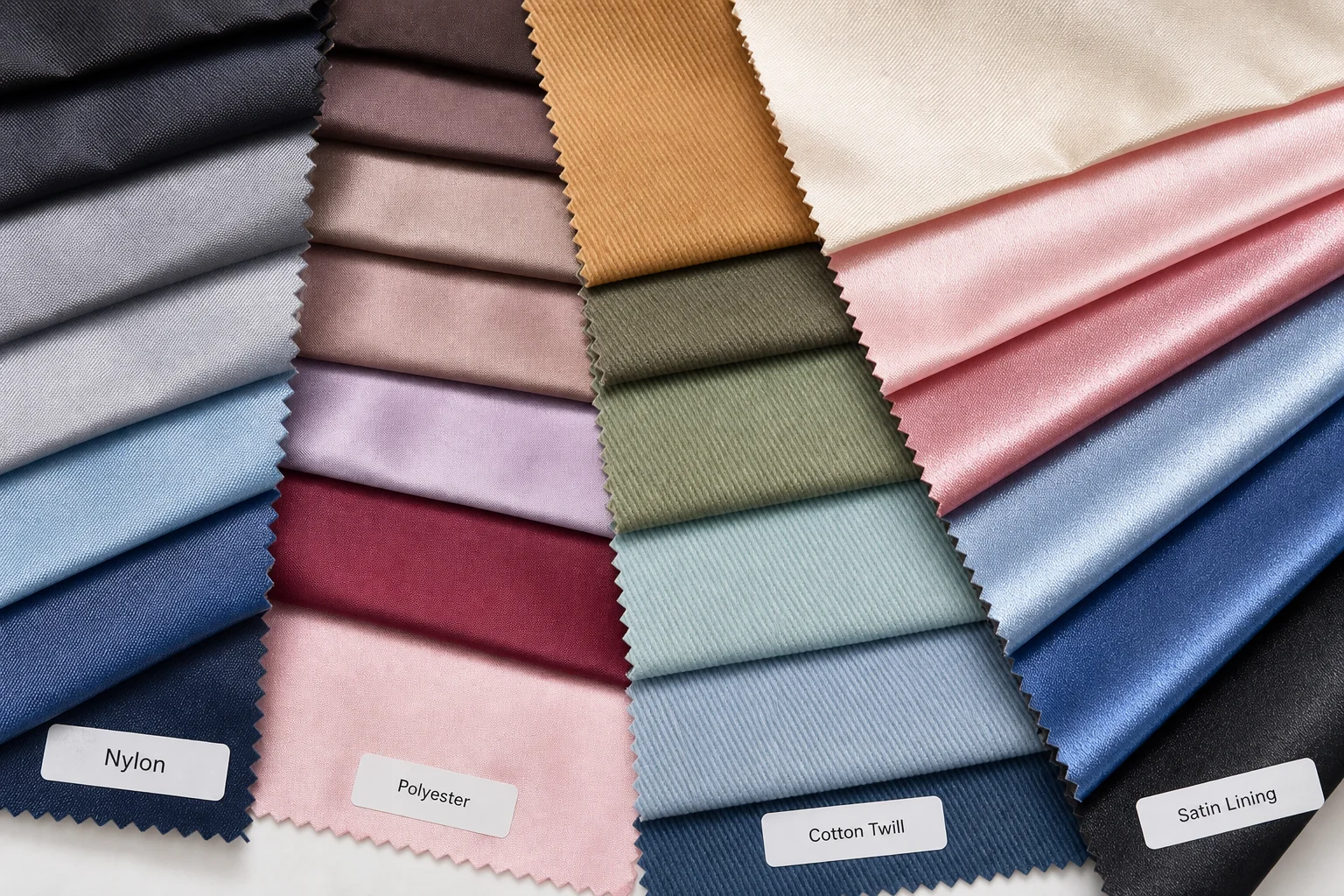
Most bag linings come from a short list of fabrics. Each has a distinct hand, cost and behaviour, and the right choice depends on the bag rather than on fashion.
Nylon lining
Nylon is strong for its weight, resists abrasion well and has a smooth, slightly cool hand. It is the default for technical, travel and outdoor-oriented bags where durability matters more than luxury feel.
It is also relatively expensive compared with polyester, and its shine varies by finish, which is why it appears less often in premium leather-look bags.
Polyester lining
Polyester is the workhorse: economical, colourfast, resistant to stretching and available in a wide range of weights, weaves and colours. Most mid-market bags use some form of polyester lining.
Its weakness is feel. Cheaper polyester taffeta rustles and feels thin, so the grade matters more than the fibre itself.
Cotton and cotton blends
Cotton lining has a soft, natural hand that suits premium and heritage-style bags, and it takes dye in muted, natural tones. It absorbs moisture better than synthetics, which some buyers prefer.
It is less abrasion-resistant, more prone to shrinkage unless pre-shrunk and more expensive than polyester. It also creases more visibly inside a structured bag.
Satin, twill and specialty linings
Satin offers a smooth, luxurious feel and is common in occasion and premium bags, but it marks and snags more easily. Twill gives a matte, structured look. Specialty options include brushed fabrics, suede-like microfibre and recycled blends.
Comparison of common lining fabrics
| Fabric | Hand and feel | Abrasion | Cost | Best suited to |
|---|---|---|---|---|
| Nylon taffeta | Smooth, light rustle | Very good | Medium–high | Travel, technical, outdoor bags |
| Polyester taffeta | Crisp, can rustle | Good | Low | Volume programmes, mid-market |
| Polyester twill | Matte, firmer | Very good | Low–medium | Structured bags, business styles |
| Satin (poly) | Glossy, smooth | Moderate | Low–medium | Occasion and premium bags |
| Cotton poplin | Soft, natural | Moderate | Medium | Heritage, premium leather-look |
| Cotton canvas | Sturdy, matte | Good | Medium | Utility and work bags |
| Microfibre suede | Soft, suede-like | Good | Medium–high | Premium interiors |
| Recycled rPET taffeta | Similar to polyester | Good | Low–medium | Sustainability-led brands |
Read the table alongside the bag’s price position and use case. A luxury-style bag with a crisp polyester taffeta lining contradicts its own positioning, and a hard-wearing utility bag with delicate satin will not survive its owners.
Weight, Denier and Construction
Within one fibre, the specification that changes behaviour most is weight, usually expressed as denier or as grams per square metre.
Reading denier
Denier describes the thickness of the yarn. Higher denier means a heavier, stronger yarn; lower denier gives a finer, lighter fabric. A 210D lining is lighter and softer than a 420D, which is more durable and sturdier.
For most bags, linings fall between roughly 190T and 420D, with taffeta weights described by thread count and twills and oxfords by denier. The two systems are not directly comparable, so specify both the construction and the weight.
Weave and finish
Taffeta gives a smooth, light fabric with a slight sheen. Twill gives a diagonal, matte surface that conceals marks. Oxford is a basket weave, heavier and more durable. Ripstop adds a grid that limits tear propagation.
Finishes matter too: calendered or coated linings resist fraying and pilling, and a water-repellent finish helps where the bag may get damp inside.
Weight guidance by bag type
| Bag type | Typical lining weight | Reason |
|---|---|---|
| Small pouch or clutch | Light taffeta, 190T–210T | Keeps weight and bulk minimal |
| Handbag | 210T–300D taffeta or twill | Balance of feel and durability |
| Tote | 300D–420D twill or oxford | Withstands contents and daily abrasion |
| Backpack | 210D–420D, often ripstop | Strength with low weight |
| Travel bag | 420D–600D oxford | High abrasion resistance |
| Premium leather-look | Cotton poplin or microfibre | Feel and perceived quality |
Weight also affects assembly. Heavier lining takes more space at seams, so allowances, needle size and seam bulk need to be planned together with the outer material.
Weight and the collapse problem
A lining that is too heavy for a soft bag pulls the shape down; one that is too light on a structured bag looks flimsy and fails at the top edge where it takes stress.
The practical approach is to match lining weight to how the bag holds its shape, then to test the assembled bag rather than judging the fabric on a swatch card alone.
Colour, Colourfastness and Transfer
Lining colour is a merchandising decision and a technical one. The wrong colour choice creates complaints that look like quality defects but are actually specification errors.
Choosing the inside colour
Light interiors make contents easy to find, which customers value in larger bags. Dark interiors hide marks and look formal, and they suit business and evening styles.
A common approach is to match the lining to the bag’s trim or to use one signature interior colour across a range, which strengthens brand recognition every time a bag is opened.
Colourfastness matters more inside
Lining rubs against keys, phones and pens constantly, and dark dyes on a poorly fixed lining will transfer onto light-coloured contents. This is one of the most avoidable complaint types in the category.
Rub fastness and water fastness are the relevant test methods, and results should be requested for any dark or saturated lining colour rather than assumed from a swatch photograph.
Colour options and trade-offs
| Choice | Advantage | Risk |
|---|---|---|
| Light neutral | Easy to see contents | Shows marks and soiling |
| Dark solid | Hides marks, formal look | Transfer risk if fastness is poor |
| Brand colour | Recognition each time opened | Must be reproducible across lots |
| Printed lining | Distinctive, hard to copy | Higher cost, print quality control |
| Contrasting trim | Design detail with low risk | Colour matching work at assembly |
| Tonal match | Understated and safe | Fewer design points of interest |
Printed linings are worth considering for brands wanting a signature interior. They cost more and need print registration control, but they make a bag recognisable from the inside out.
Colour consistency between lots
Lining colour must match from order to order. Shade variation between a first order and a repeat is visible to a customer holding a bag they bought earlier, and it is difficult to explain.
Keep a signed master swatch and require the supplier to match against it, with a stated tolerance. Where a lot falls outside tolerance, it should be raised before cutting rather than discovered at packing.
Interior Structure, Pockets and Trim
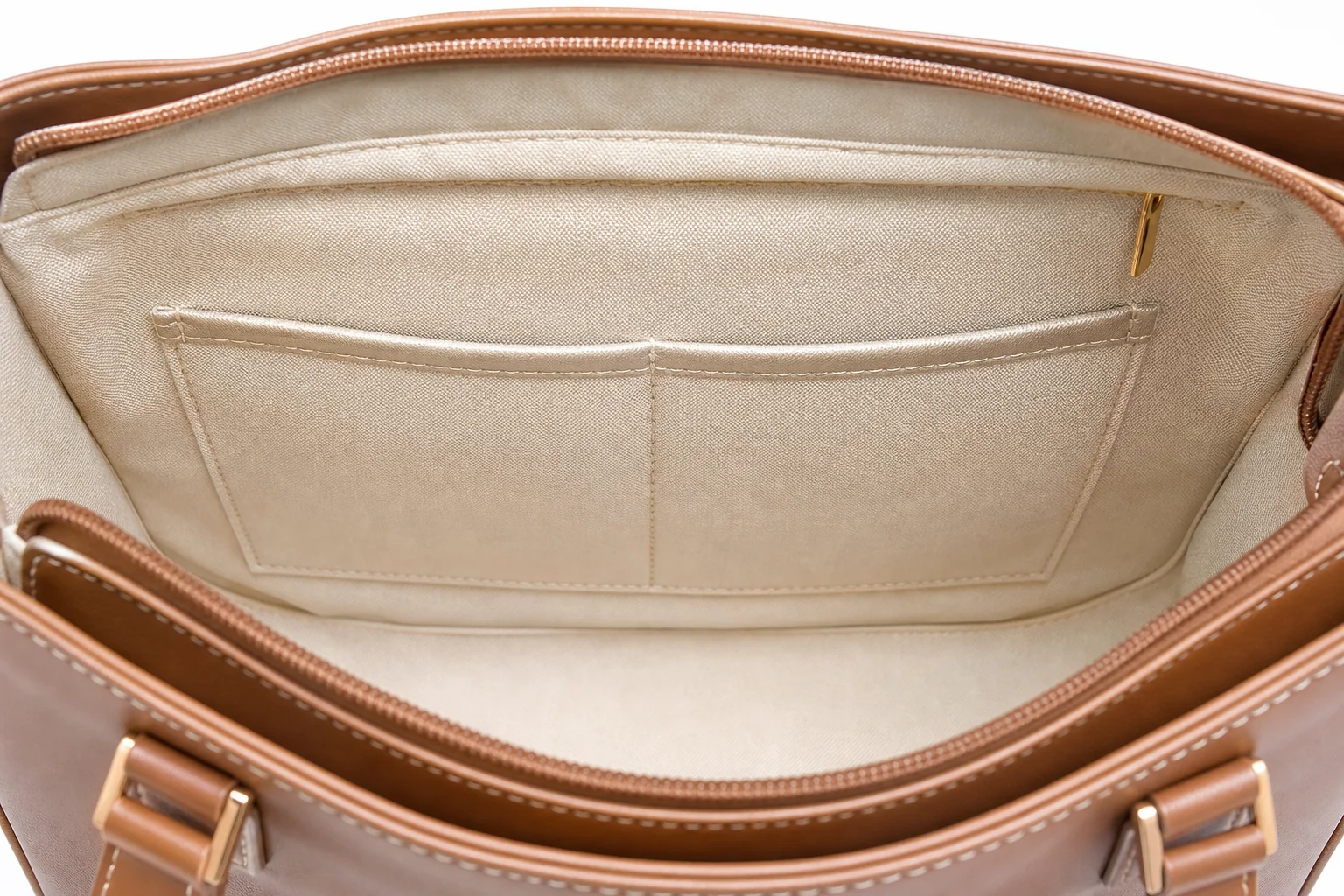
The lining is the platform for the bag’s interior features. Pockets, dividers, zip pockets, key leashes and laptop sleeves all depend on how the lining is cut and assembled.
How pockets are built
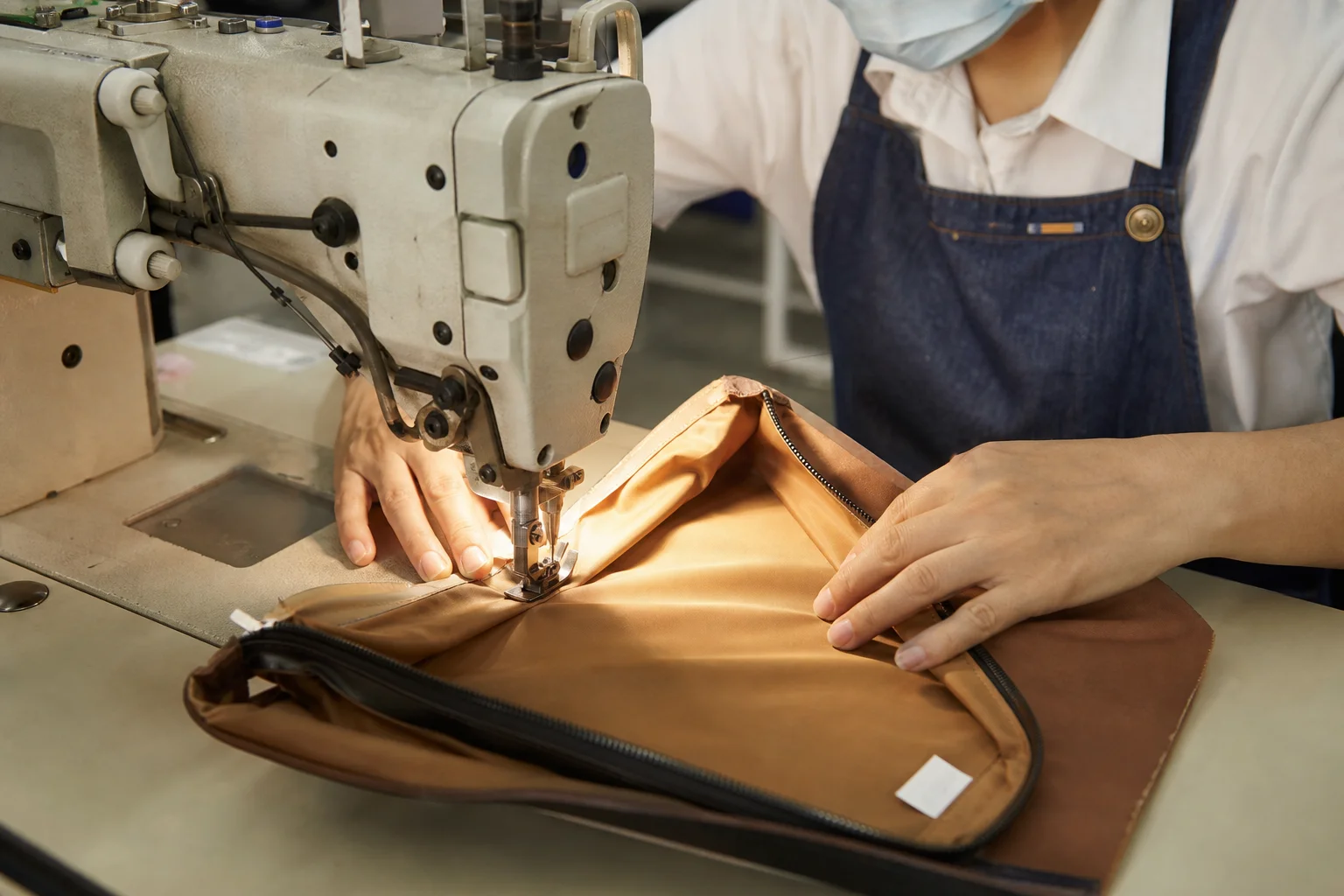
Slip pockets are usually formed by stitching an additional lining layer to the main panel, while zip pockets require a separate opening with a zip set into the lining, sometimes with a facing for strength.
Where a pocket takes weight, such as a laptop sleeve or a bottle pocket, it needs reinforcement and a bar-tack at the load points. Specifying the reinforcement is the difference between a pocket that lasts and one that tears.
Interior features and their requirements
| Feature | What it requires |
|---|---|
| Slip pocket | Consistent cut size, clean top edge |
| Zip pocket | Zip set into lining, facing for strength |
| Divided compartment | Anchored divider, matched to outer panels |
| Laptop sleeve | Padding, reinforced base, bar-tacks |
| Key leash | Metal or fabric loop, secure anchor |
| Phone pocket | Fits actual device sizes, soft edge |
| Pen loops | Elastic or bound loop, reinforced ends |
| Brand label | Placement, backing to prevent show-through |
Device dimensions change, so pocket sizes should be specified to a range rather than to one model. A phone pocket sized to one year’s device will look wrong to the customers who buy the next one.
Seam finishing inside
The interior edge treatment is a quality signal. Bound seams using a strip of lining or tape give a clean, durable finish, while overlocked edges are quicker but can look unfinished on premium products.
Where the top edge of the lining takes repeated contact, a reinforced or folded finish prevents it from fraying. This single detail is visible in most unboxing videos, which makes it worth the small extra cost.
Label placement and show-through
Interior labels need to be positioned so that stitching does not show on the outside. On light linings, a dark label can also show through if the lining is thin, so a backing layer may be required.
Woven labels, printed labels and heat transfers each have different thickness and feel. Specifying the label type and its backing together with the lining avoids a late assembly problem.
Cost, MOQ and Availability
Lining is a small share of the unit cost and a large share of the perceived quality. It is also the component with the most flexibility in sourcing, which makes it a useful lever in both directions.
Where the cost comes from
The price of lining fabric reflects the fibre, the construction, the dyeing method and the finishing. Nylon and microfibre cost more than standard polyester; special finishes and prints add further cost.
Because lining is consumed in smaller quantities than outer material, the effective cost per bag is low relative to the outer shell, even when the upgrade is significant.
MOQ and stock considerations
| Lining option | MOQ behaviour | Lead time effect |
|---|---|---|
| Standard polyester, stock colours | Low, often available by the roll | Minimal |
| Standard construction, custom colour | Moderate, dyed to order | Adds dyeing time |
| Printed lining | Higher, print setup required | Adds design and print approval |
| Nylon or microfibre | Moderate to high | Depends on mill schedule |
| Recycled certified fabric | Moderate, certificate per lot | Adds documentation time |
Where a brand wants a custom interior but has a small order, using a stock lining in a matched colour is usually the pragmatic route. Custom dyeing can follow once volumes support it.
Continuity of supply
Lining colours and constructions are discontinued more often than outer materials, because they are produced in smaller runs. A brand should confirm how long a chosen lining will remain available and keep a backup specification.
Holding a small buffer of lining for repeats protects against a gap, particularly where the interior colour is a signature element of the product.
Testing Lining Performance
Lining performance is measurable, and the tests are inexpensive relative to the cost of a recall or a run of complaints.
The tests that matter
Abrasion resistance predicts how the surface behaves against keys and contents. Colourfastness predicts transfer onto clothing and contents. Seam strength predicts whether pockets and top edges hold.
Shrinkage matters for cotton and for any lining that will be washed or exposed to steam during pressing, and dimensional stability matters for cut-size accuracy.
Test summary and purpose
| Test | What it predicts | Why it matters |
|---|---|---|
| Abrasion resistance | Surface wear over time | Pilling, holes at contact points |
| Colourfastness to rubbing | Dye transfer | Marks on contents and clothing |
| Colourfastness to water | Bleeding when damp | Staining in humid conditions |
| Seam strength | Pocket and edge durability | Split seams, torn pockets |
| Tear strength | Resistance to tearing | Failure at stress points |
| Shrinkage after wash | Dimensional stability | Distortion after cleaning |
| pH value | Chemical residue | Skin contact and odour issues |
Request results for the actual colour and construction being used. A passing result on a light grey taffeta says little about a dark saturated twill from a different mill.
In-production checks
Beyond laboratory tests, inspect the assembled bag: open and close the pockets repeatedly, check the lining at the zip ends, look for puckering at the top edge and confirm the lining does not sag or pull the shape.
These checks catch assembly issues that fabric tests cannot, and they are quick enough to run on every approval sample.
Failure patterns to watch
Common failures include fuzzing at the top edge, tearing where a zip pocket was cut too close to a seam, colour transfer after a few weeks of use and sagging in soft bags with heavy linings.
Each pattern has a specific fix: change the finish, move the pocket position, improve dye fixation or reduce lining weight. Naming the pattern makes the fix fast.
Recycled and Sustainable Lining Options
Sustainability requirements increasingly extend to the interior, and lining is one of the easier places to make a credible change.
Recycled polyester and rPET
Recycled polyester made from post-consumer plastic is widely available in taffeta and twill constructions and behaves much like virgin polyester. It is usually the lowest-friction swap for a brand with sustainability targets.
Certification and traceability documentation are the main additional requirements, and they need to be confirmed per lot rather than assumed from the product description.
Other options and their trade-offs
| Option | Benefit | Consideration |
|---|---|---|
| Recycled polyester (rPET) | Lower virgin plastic use | Certificate per lot |
| Organic cotton | Natural fibre, less pesticide | Higher cost, certification |
| Bamboo or viscose blends | Soft hand, renewable source | Supply chain scrutiny |
| Undyed or natural lining | Avoids dye process | Limited colour palette |
| Solution-dyed fabric | Less water and energy | Higher cost, colour limits |
| Bio-based coating | Reduced petrochemical content | Performance validation needed |
Where a brand makes a sustainability claim, the lining should be covered by the same evidence standard as the outer material. A partially documented claim is a risk rather than an asset.
Communicating it without overclaiming
Interior sustainability is easy to communicate because the customer sees it. A small printed note inside the bag or a line on the product page connects the material choice to the purchase.
Keep the language precise: name the material and the certification rather than using general terms, and make sure the claim can be supported for the whole production run.
Writing the Lining Specification
A lining specification that names the fibre alone leaves too much to interpretation. The complete version is short and unambiguous, and it prevents substitution.
The lines every lining spec needs
Fibre and construction, weight or denier, colour with a reference, finish, width, and the test results required. Add the interior features and the edge treatment, and the specification is complete.
Where a specific mill or quality grade is expected, name it. Leaving the grade open invites the substitution of a cheaper fabric with the same fibre name.
Complete specification template
| Field | Example entry |
|---|---|
| Fibre and construction | Polyester twill |
| Weight | 300D, 110 gsm |
| Colour | Charcoal, master swatch reference |
| Finish | Calendered, anti-pill |
| Width | 150 cm usable |
| Edge treatment | Bound seams, folded top edge |
| Interior features | Two slip pockets, one zip pocket, key leash |
| Label | Woven label, backed to prevent show-through |
| Required tests | Abrasion, rub fastness, seam strength |
| Substitution rule | Written approval required before any change |
The substitution rule is the most important line. Without it, a supplier facing a shortfall may replace the lining with a similar-looking fabric, and the difference appears in the first customer complaint.
What to send with the specification
Send a physical swatch, a colour reference, a photo of the intended interior finish and, where possible, a reference sample of a comparable bag. Physical references remove most ambiguity.
For repeat orders, restate the specification with the approved swatch attached, even when nothing has changed. Short confirmations prevent long disputes.
Questions worth asking your supplier
Ask which lining construction suits the bag’s shape, what weight is recommended for the interior features planned, how the lining behaves at the zip opening and what test results are available for the proposed colour.
The inside of a bag is where a customer decides whether the price was justified. It is also where a specification is most often left incomplete.
Common Lining Mistakes
Most lining problems follow a small number of patterns, and each has a straightforward correction that costs far less than the complaint it prevents.
Specifying by fibre alone
Naming “polyester lining” without construction, weight, colour reference and finish leaves the supplier to fill in the gaps, and the cheapest interpretation usually wins.
The correction is a complete specification with a physical master swatch and an explicit substitution rule. This single change removes most variation between orders.
Treating lining as an afterthought in sampling
Where the lining is chosen after the outer bag is approved, the interior rarely matches the positioning of the product, and structural problems appear late in development.
Deciding the lining at the same time as the outer material allows weight, seam bulk and pocket layout to be planned together, which avoids rework in the sample room.
Mistakes and their fixes
| Mistake | Fix |
|---|---|
| Fibre named without construction or weight | Complete specification with master swatch |
| Lining too heavy for a soft bag | Reduce weight or add structure to the outer |
| Dark lining with weak dye fixation | Request rub-fastness results; change dyestuff |
| Pockets sized to one device | Specify a dimension range instead |
| Raw top edge on a premium bag | Bound or folded finish |
| Label showing through thin lining | Add a backing layer behind the label |
| Zoom pocket cut too close to a seam | Move the pocket, add reinforcement |
Each fix is minor in cost and preventive in effect. Together they remove the lining from the list of recurring quality complaints.
Why the fixes are worth making early
Lining complaints are raised by the end customer, who judges the product after purchase and rarely distinguishes between a material choice and a defect. The brand absorbs the reputational cost either way.
Correcting the specification during development costs nothing; correcting it after a production run costs the inventory, the freight and the credibility.
FAQ
What is the most common lining fabric for bags?
Polyester taffeta and twill in the 210T to 420D range cover most mid-market bags. Nylon is used where durability and low weight matter most, and cotton or microfibre suits premium interiors.
Is nylon lining better than polyester?
Nylon is stronger for its weight and more abrasion-resistant, and it costs more. Polyester is usually sufficient and more economical, so the choice depends on the bag’s use and price position.
What weight lining should I use for a handbag?
A 210T to 300D polyester in taffeta or twill suits most handbags, giving a reasonable feel without adding bulk. The right answer also depends on how structured the bag is.
Why does my lining transfer colour onto my phone?
The dye is not sufficiently fixed for the level of rubbing inside a bag. Specify rub-fastness test results for dark colours and change to a better-fixed or lighter lining if transfer occurs.
Should the lining match the bag colour?
Not necessarily. A tonal match is safe, while a signature interior colour builds recognition. What matters is that the choice is deliberate and consistent across the range.
How do I stop the lining from fraying at the top edge?
Use a bound or folded top edge rather than a raw cut, and consider a slightly heavier lining or a reinforced finish at the opening where contact happens.
Can lining be made from recycled material?
Yes. Recycled polyester from post-consumer plastic is widely available and performs similarly to virgin polyester, and it is usually the simplest sustainability upgrade for a lining.
How should pockets be reinforced inside a bag?
Add reinforcement at the load points and bar-tack the pocket ends, with a padded base for any pocket that carries a laptop or bottle. Specify this rather than relying on default assembly.
Does lining affect the bag’s weight?
It does, though modestly. Heavier linings add weight and can pull soft shapes, while very light linings on structured bags look thin at the top edge.
What tests should I request for a lining fabric?
Abrasion resistance, colourfastness to rubbing and to water, and seam strength are the core set. Add shrinkage testing for cotton and pH for any lining in close skin contact.
Should a bag’s lining be removable or washable?
Removable linings suit travel and utility bags but add cost and complexity. A washable lining requires pre-shrunk fabric and colourfast dye, so confirm both before promising the customer it can be washed.
How many interior pockets are worth specifying?
Two slip pockets and one zip pocket cover most needs without crowding a small interior. On larger bags, sizing one pocket to a laptop or tablet adds real usability at little cost.
Next Steps: Specify the Inside as Carefully as the Outside
Lining is the interior a customer sees first and touches most. Naming the fibre, construction, weight, colour, edge treatment and tests turns it from a leftover line item into a controlled part of the product.
Send us your bag’s use case, price position and interior features, and we will propose a lining specification to match — including the test results behind it.
Planning a new bag programme and not sure which lining to specify? Contact our team at info@gionar.com and we will prepare a lining recommendation for your styles.
Related reading: our custom bag manufacturing portfolio shows the bag constructions, interiors and lining combinations we produce.