Why Straps Decide Whether a Bag Survives
A bag can use excellent material, precise stitching and premium hardware, and still fail in the first month because the strap pulled out. It is the most highly loaded part of the product.
The most stressed component
Every kilogram the customer carries passes through two attachment points. When the bag is lifted, swung or set down, those points see dynamic loads several times the static weight.
That concentration of force explains why handle and strap failures appear early in return data, and why they generate the most damaging customer feedback: a bag that drops its contents is remembered.
How straps fail
| Failure | Typical cause |
|---|---|
| Strap pulls away from the bag | Insufficient stitching, no reinforcement |
| Stitch line tears out | Thin material, dense stitches perforating it |
| Strap stretches permanently | Low-quality webbing or PU, thin cross-section |
| Edge cracks and peels | Unfinished edge, coating failure under flex |
| Hardware opens or deforms | Underrated buckle or swivel |
| Adjuster slips under load | Poor-quality slider, smooth webbing |
| Handle delaminates | Bonded layers separating with heat and use |
Each failure maps to a specific design decision: the material, the number of layers, the attachment method or the hardware grade. None of them are difficult to get right when specified deliberately.
The cost of getting it wrong
A strap failure is rarely a small repair. It usually means a return, a refund and a review that describes the product as poorly made, regardless of how good the rest of the bag is.
Upgrading the attachment construction typically costs a small amount per unit. The comparison is not strap cost against strap cost; it is strap cost against return rate.
Strap Materials Compared
Strap material determines how the product feels in the hand, how it ages and how much load it can carry before deforming.
PU leather straps
PU leather is the most common strap material on fashion and business bags, because it matches the body material and holds a clean, structured shape.
Its weakness is the cut edge and the flex point. PU can crack where the strap bends repeatedly, so grain direction, thickness and edge finishing matter as much as the coating quality.
Genuine leather straps
Genuine leather is strong, ages well and resists the cracking behaviour of PU when the hide is suitable. It is the premium option and carries a corresponding cost.
Quality varies widely with the part of the hide used, the tannage and the thickness, so specifying “genuine leather” without grade leaves the result open to interpretation.
Woven webbing
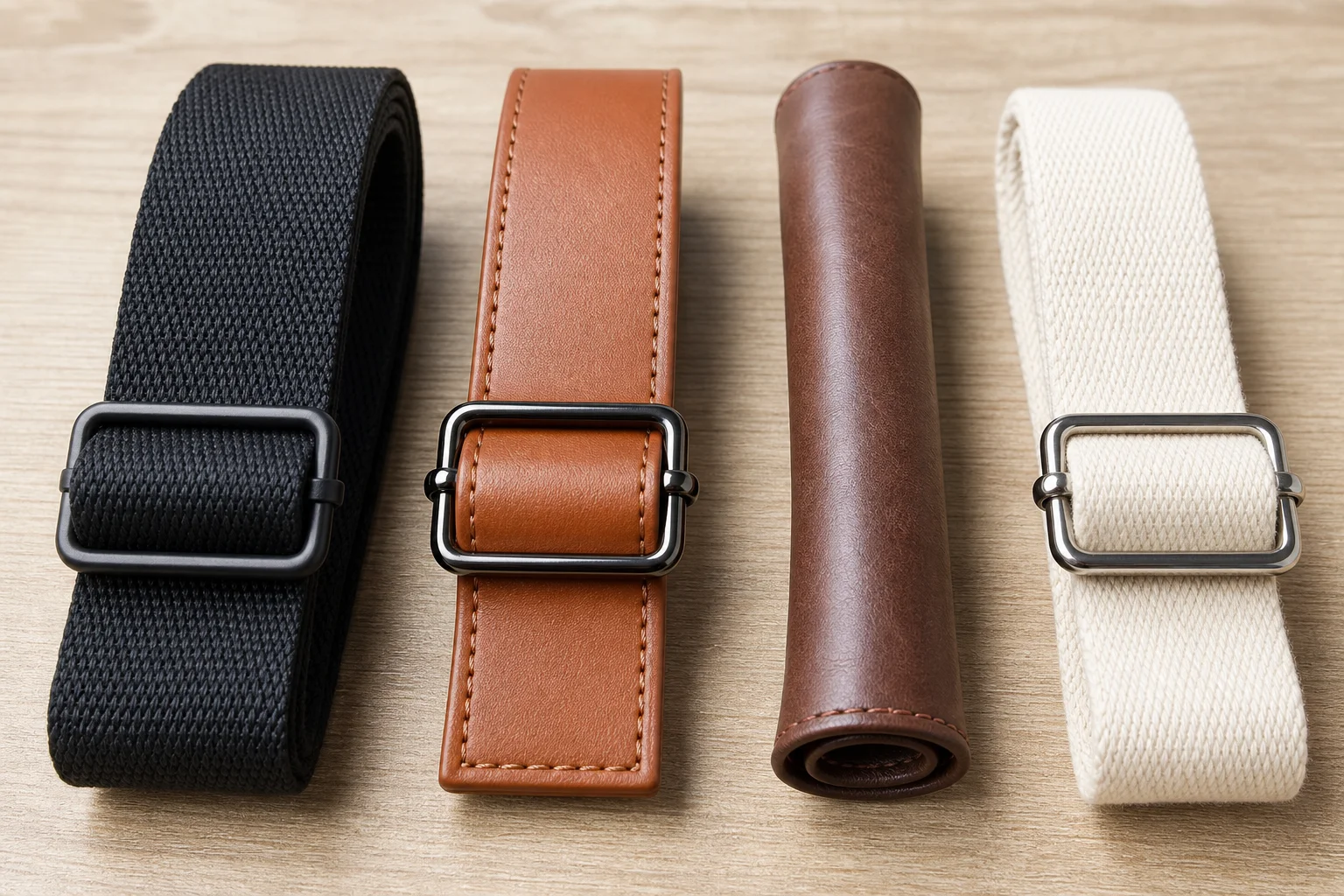
Webbing is woven from PP, nylon or polyester. Nylon webbing is strongest and most abrasion-resistant, polyester webbing is colourfast and economical, and PP webbing is lightest and least durable.
Webbing is the standard for functional bags: backpacks, travel bags, gym bags and utility styles, where strength and adjustability matter more than matching a fashion material.
Cotton webbing and cord
Cotton webbing gives a soft, natural hand that suits casual and lifestyle bags, and it takes dye in muted tones. It is less abrasion-resistant and less dimensionally stable than synthetics.
Cord handles offer a very light option for small bags and pouches, and their load capacity depends on the cord construction and the attachment.
Materials compared
| Material | Strength | Feel | Abrasion | Cost | Best suited to |
|---|---|---|---|---|---|
| PU leather strap | Moderate | Structured, matches body | Moderate | Low | Fashion, business bags |
| Genuine leather | High | Supple, ages well | High | High | Premium bags |
| Nylon webbing | Very high | Technical | Very high | Medium | Backpacks, travel |
| Polyester webbing | High | Technical | High | Low | Volume ranges, colourfast needs |
| PP webbing | Moderate | Light, slightly stiff | Moderate | Low | Lightweight bags |
| Cotton webbing | Moderate | Soft, natural | Moderate | Low–medium | Casual, lifestyle bags |
| Chain or cord | Low–moderate | Decorative | Varies | Low–medium | Occasion, small bags |
Where a bag carries heavy contents, the material choice narrows quickly. Where the bag is light and used briefly, appearance can lead and cost can stay low.
Matching strap to body
A PU body with a nylon webbing strap reads as a technical bag; a nylon body with a leather strap reads as a hybrid. Both can work, provided the combination is intentional.
Matching the strap to the body material is the safer route for a coordinated range, and using a contrasting strap is a deliberate design decision rather than a default.
How a Strap Is Built
Two straps of the same material can perform very differently. The construction inside the strap determines its strength and how long it keeps its shape.
Single versus double layer
A single-layer strap is lighter and cheaper. A double-layer strap, where two plies are stitched or bonded together, resists stretching and holds its shape far better under load.
For any bag expected to carry significant weight, a doubled or reinforced strap is the practical minimum, particularly where the strap is also the adjustment element.
Padding and lining
Padded shoulder straps distribute pressure and are standard on bags designed for heavy or prolonged carrying. The padding must be paired with a strong outer layer, since padding alone adds no strength.
Where padding is used, its position matters: it should sit where the strap contacts the shoulder, not where it happens to be easiest to insert.
Edge treatment and finishing
Cut edges are the most vulnerable part of a PU or leather strap. Painted, folded, burnished or bound edges resist cracking and look deliberate; a raw edge looks unfinished and fails first.
On webbing, heat-sealing the cut end prevents fraying, which is a small step with a visible effect on durability.
Construction choices and their effect
| Construction choice | Effect |
|---|---|
| Single layer | Light, economical, stretches under load |
| Double layer | Stronger, holds shape, higher cost |
| Padded shoulder section | Comfort under load, adds bulk |
| Painted or folded edges | Resists edge cracking, looks finished |
| Heat-sealed webbing ends | Prevents fraying |
| Stitched reinforcement panel | Spreads load at the attachment |
| Internal stiffener | Keeps shape on structured handles |
These details are inexpensive at the sample stage and difficult to add once production is running, which is why they belong in the technical pack from the beginning.
Stitching direction and pattern
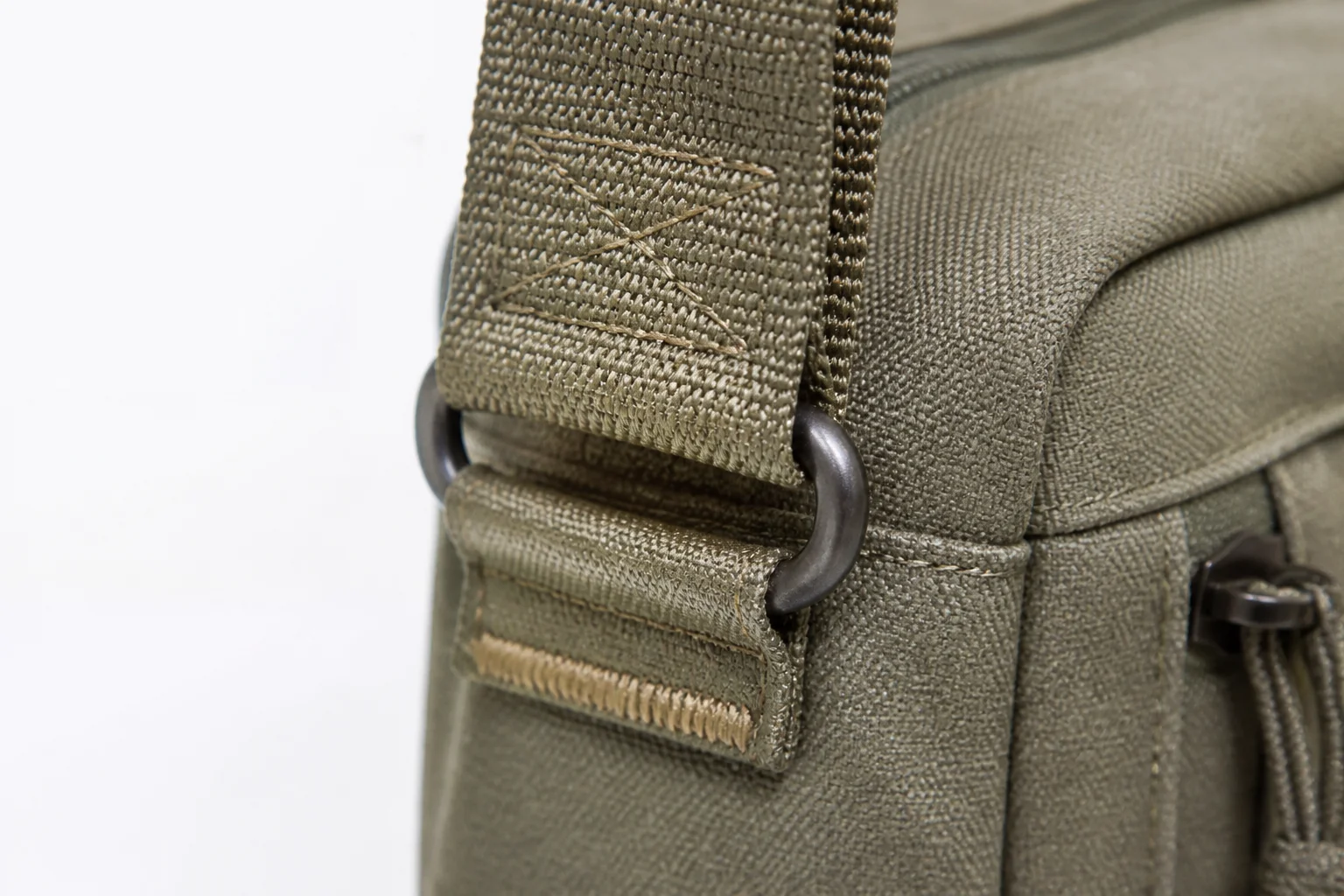
Stitch direction affects how a strap behaves under load. Box-and-cross patterns spread force over a wider area than a single line, and they are the standard approach at attachment points on load-bearing bags.
Stitch density matters too: too few stitches reduce strength, while extremely dense stitching perforates thin material and can cause tearing rather than preventing it.
Attachment Points: Where Bags Break
The strap is usually strong enough. The connection between the strap and the bag is what fails, because that is where force concentrates on a small area.
Stitched anchors
Stitching the strap directly to the bag body is simple and inexpensive, but it depends entirely on the strength of the body material. Thin or weak material tears at the stitch line regardless of how strong the strap is.
Adding a reinforcement patch behind the stitching spreads the load over a larger area and is the single most effective upgrade at this point.
Rivets, plates and rings
Rivets and metal plates transfer load through the material rather than along it, which suits leather and heavy materials. A poorly set rivet, however, works loose and enlarges its hole with use.
D-rings and loops provide a mechanical connection that distributes load, and they allow the strap to be replaced if it wears out.
Attachment methods compared
| Method | Load capacity | Considerations |
|---|---|---|
| Stitched direct to body | Depends on body material | Economical, weakest on thin material |
| Stitched with reinforcement patch | Good | Small cost, large benefit |
| Box-and-cross stitching | Good | Spreads load, slower to sew |
| Rivets through material | Good on leather | Can loosen, needs correct setting |
| Metal plate and screws | Good | Replaceable, visible hardware |
| D-ring through a loop | Good | Replaceable strap, extra hardware cost |
| Welded or bonded anchor | Varies | Suits coated materials, hard to repair |
Where a bag is expected to carry weight repeatedly, the combination of a reinforcement panel, box-and-cross stitching and a ring-based connection covers the load path at every stage.
Positioning the attachment
Attachments placed near a seam concentrate stress on the seam, which is already a weak line. Moving them away from seams, or reinforcing the seam itself, avoids combining two weaknesses.
On soft bags, an attachment point also needs structure behind it. A reinforcement panel or a stiffener inside the body prevents the material from deforming around the anchor.
Load, Weight and Safety Factors
Load capacity is the number that connects the design to the customer’s expectation. A bag sold for a laptop and a day’s equipment needs a very different specification from a decorative clutch.
Static and dynamic load
Static load is the weight at rest. Dynamic load is the force created when a bag is lifted quickly, swung onto a shoulder or dropped; it can be several times the static weight.
Designing for static load alone is the most common mistake. Real use includes repeated dynamic events, and the attachment must survive the peak rather than the average.
Safety factors
Industry practice is to design the load-bearing elements with a safety factor above the expected maximum load, commonly two to three times for consumer bags, applied consistently to the strap, the stitching and the hardware.
Applying a factor to the strap but not to the buckle achieves nothing, because the bag fails at the weakest element in the chain.
Load targets by bag type
| Bag type | Typical working load | Design consideration |
|---|---|---|
| Pouch or clutch | Light | Appearance may lead; small cord capacity |
| Handbag | Moderate | Top handles carry most load |
| Tote | Moderate to high | Wide handles, reinforced anchors |
| Laptop bag | High, concentrated | Padded strap, strong anchors |
| Backpack | High | Load spread across two shoulder straps |
| Travel or duffel | Very high | Both handles and shoulder strap reinforced |
| Utility or tool bag | Very high | Heavy webbing, plated anchors, tested |
Writing the expected working load into the specification gives the factory a target and gives the quality team something to test against.
Where load concentrates
On a tote, the two handle anchors take nearly the entire load. On a backpack, the load splits between shoulder straps and the attachment at the top of the body.
Understanding where the load concentrates allows reinforcement to be placed where it is needed rather than applied uniformly, which keeps cost proportionate to benefit.
Handle and Strap Types
Handle configuration is a usability decision as much as a design one. The right combination depends on how the bag is carried and how heavy it gets.
Top handles
Top handles are the primary carrying method on handbags and totes. They carry the full load and therefore need the strongest attachment and the most comfortable grip.
Rolled, padded and shaped handles all affect comfort; a narrow flat handle digs into the hand as load increases.
Shoulder and crossbody straps
Shoulder straps distribute load across the shoulder, which makes them suitable for heavier contents. Crossbody straps distribute across the torso and require a length that keeps the bag in a comfortable position.
Adjustability matters more than many buyers expect: a fixed length that suits one user may be uncomfortable for another, which affects reviews.
Types and their characteristics
| Type | Strength requirement | Notes |
|---|---|---|
| Fixed top handle | High | Primary load path on handbags |
| Rolled handle | High | Comfortable grip, more material |
| Shoulder strap, fixed | High | Simple, no adjuster to fail |
| Shoulder strap, adjustable | High | Adjuster is a potential failure point |
| Crossbody strap | Moderate to high | Length range critical |
| Detachable strap | Moderate | Clips add hardware risk |
| Backpack shoulder straps | Very high | Padded, load spread, adjusters |
| Wrist strap or cord | Low | Light use, appearance-led |
Detachable straps add flexibility for the customer and a hardware failure point for the manufacturer. Where they are used, the clips are worth specifying to a rated load rather than selected by appearance.
Combining handles
Many bags use both a top handle and a shoulder strap. In that case both must be designed for the full load, because customers use whichever is convenient and the bag will be lifted by either.
Speccing the top handle lightly because a shoulder strap exists is a common and avoidable error.
Comfort and Ergonomics
Comfort is a specification, not an opinion. Strap width, padding, drop length and shape can all be defined and checked.
Strap width and pressure
Pressure on the shoulder is a function of load divided by contact area. A wider strap distributes the same load over more area, which is why backpacks and laptop bags use wider straps than handbags.
Narrowing a strap to suit a visual design directly reduces comfort for the same contents, and customers notice this quickly on heavier loads.
Padding placement and thickness
Padding should sit where contact occurs, and it should be thick enough to matter without being bulky. A thin foam layer positioned accurately outperforms a thick layer in the wrong place.
Padding also needs a durable outer layer, because the padded section is typically the first to abrade against clothing and surfaces.
Comfort parameters and practical ranges
| Parameter | Light load | Heavy load |
|---|---|---|
| Strap width | 15–20 mm | 25–40 mm |
| Padding | Optional or none | Recommended, 5–10 mm foam |
| Handle grip | Flat is acceptable | Rolled or padded preferred |
| Drop length, shoulder | Shorter is fine | Adjustable range needed |
| Edge finish | Painted or folded | Bound or padded edges |
| Crossbody length | Fixed acceptable | Adjustable essential |
These ranges are starting points. The right figures follow from the expected load and how long the bag is carried, which is worth stating in the brief.
Drop length and fit
Drop length determines where the bag sits against the body. Too short a shoulder drop makes the bag awkward over a coat; too long a crossbody strap places it below the hip and swings when walking.
Because body sizes vary, an adjustable range usually serves more customers than a single fixed length, and it reduces the number of fit-related complaints.
Hardware for Straps
Strap hardware is a load path, and its rating should match the strap rather than be selected for appearance alone.
Adjusters and sliders
The adjuster holds the strap length under load, and it depends on friction between the slider and the webbing. Smooth webbing and a loose slider combine to slip, which customers experience as a strap that will not stay put.
Where the strap must hold a set length reliably, a slider with a positive grip or a locking mechanism is the appropriate choice.
Clips, swivels and rings
Clips and swivels allow the strap to detach, which adds convenience and a failure point. Their rated load should be well above the expected maximum, and their attachment should be smooth enough not to abrade the strap.
Sharp or roughly finished ring edges cut into webbing over time, which is a slow failure that appears well after delivery.
Hardware items and considerations
| Item | Function | Key consideration |
|---|---|---|
| Slider or adjuster | Sets strap length | Grip under load, edge finish |
| D-ring | Strap anchor point | Rated load, smooth inner surface |
| Swivel clip | Detachable connection | Load rating, spring durability |
| Lobster clasp | Detachable, decorative | Load rating, size of opening |
| Buckle (side release) | Backpack closure | Rated load, webbing compatibility |
| Rivet or plate | Anchor to body | Setting quality, material thickness |
| Strap keeper | Holds excess strap | Fits strap width |
Mixing hardware from different sources is common and workable, provided each item’s rating is known and the whole chain is tested together.
Finish and appearance
Hardware finish affects perceived quality and wear: plated finishes wear through at the highest-contact points, and the colour should be consistent across all strap hardware on one bag.
Mismatched finishes between the strap and the bag body are visually obvious, which makes hardware consistency an easy quality check.
Testing Straps and Handles
Strap testing is straightforward and inexpensive, and it converts a design assumption into a documented result.
Pull and static load tests
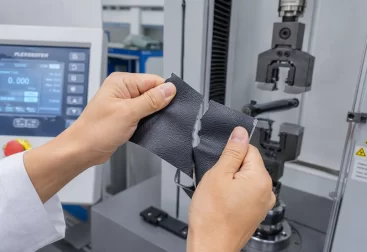
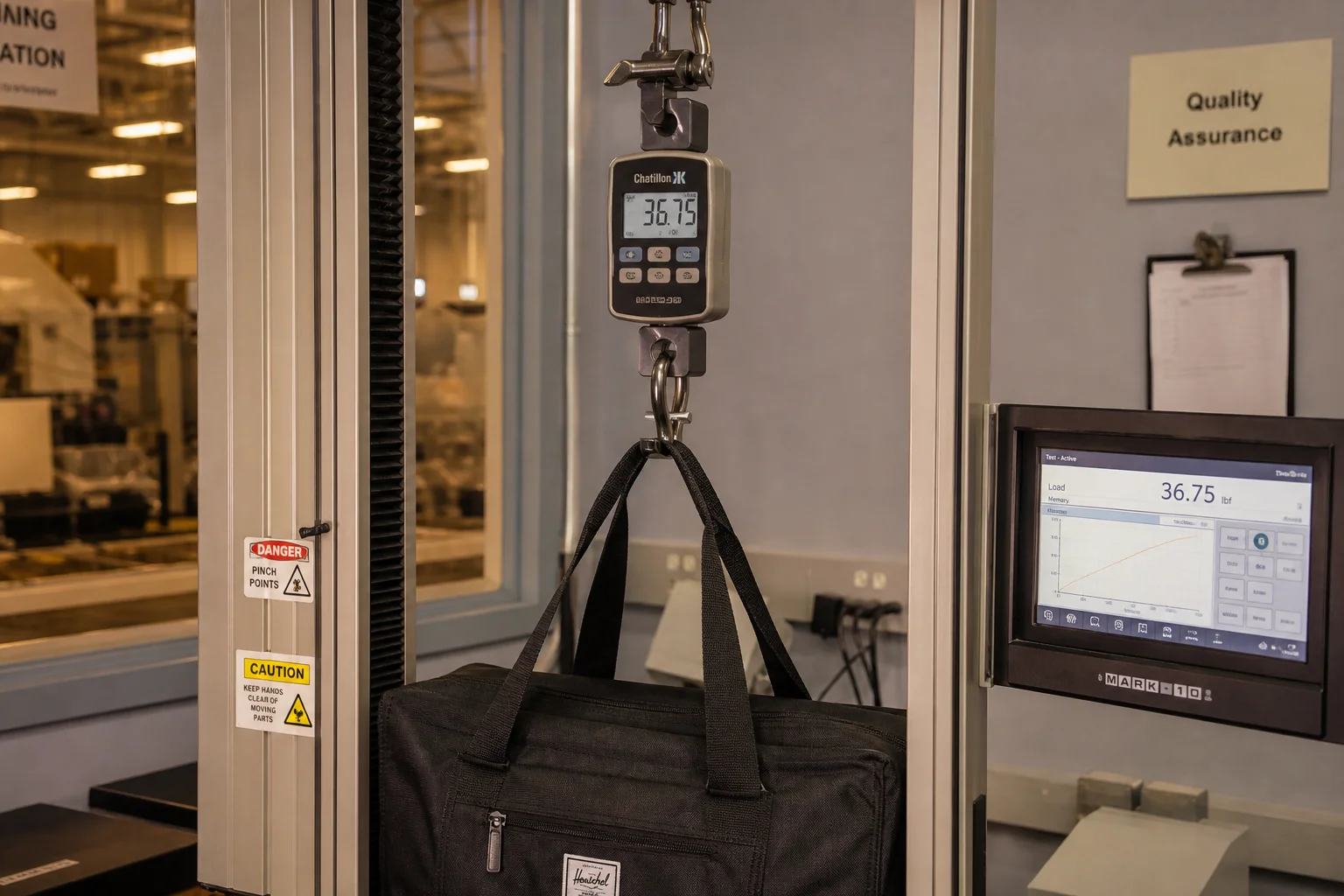
A pull test applies increasing force to the strap until failure, recording the load reached. Comparing that number against the expected working load confirms whether the safety factor is present.
A static load test suspends the bag with a defined weight for a defined period, then inspects the stitching and anchor for deformation or tearing.
Cyclic and functional testing
A cyclic test lifts and lowers the loaded bag repeatedly, which reveals fatigue at the attachment points that a single pull test misses. It is the closest test to real use.
Functional testing covers the adjuster and clips: does the slider hold length, does the clip release and close repeatedly, does the swivel rotate freely without wearing the strap.
Tests and what they reveal
| Test | What it shows |
|---|---|
| Pull to failure | Peak load capacity of strap and anchor |
| Static load hold | Deformation and tearing under sustained load |
| Cyclic lift test | Fatigue at attachment points |
| Adjuster slip test | Whether length holds under load |
| Clip cycle test | Hardware durability over use cycles |
| Abrasion test | Edge and surface wear on the strap |
| Flex test at the bend | Coating cracking on PU straps |
Running these on the approved sample establishes a baseline. Repeat testing on production units confirms the baseline was maintained.
Recording results for the brand
Test results are useful marketing material as well as quality evidence. A stated load capacity, supported by a test report, is a concrete claim that competitors relying on adjectives cannot match.
Keeping the reports also creates a record for repeat orders, so performance can be compared across production runs rather than assumed.
Specifying Straps and Handles
A complete strap specification is short, and it removes the ambiguity that leads to a bag failing where it is loaded.
The lines that matter
Name the material and its construction, the width and thickness, the layer count, the edge treatment, the attachment method and the required test. Add the hardware rating and the load target, and the specification is complete.
Where a specific load is expected, write it as a number. “Strong handle” is not a specification; “withstands a 15 kg static load with no deformation” is.
Specification template
| Field | Example entry |
|---|---|
| Material | PU leather strap, matching body |
| Width and thickness | 25 mm wide, 1.2 mm |
| Layer construction | Double layer, bonded and stitched |
| Edge treatment | Painted edges, colour matched |
| Attachment | Reinforcement panel, box-and-cross stitch |
| Anchor hardware | D-ring, 20 mm, rated |
| Adjuster | Slider with positive grip |
| Load target | 15 kg static, cyclic test 500 lifts |
| Required test | Pull test report with sampling plan |
The test line is what makes the rest verifiable. Without it, the specification describes an intention rather than a product.
Questions to ask your supplier
Ask which attachment method suits the body material, what load the proposed hardware is rated for, how the strap behaves after repeated lifting and what test data exists for comparable products.
Those four answers distinguish a supplier who has tested similar construction from one who has not, and they cost nothing to ask at quotation stage.
A bag is judged by what it carried, not by what it was made of. The strap and its attachment are where that judgement is earned or lost.
FAQ
What is the strongest strap material for a bag?
Nylon webbing is the strongest and most abrasion-resistant option commonly used. For leather-look straps, a suitably thick genuine leather outperforms PU, which is more prone to cracking at flex points.
Why did my bag handle pull out?
Usually because the attachment relies on stitching into unsupported material. A reinforcement panel and box-and-cross stitching spread the load and are the standard fix.
How wide should a shoulder strap be?
Around 25 to 40 mm suits heavier loads, while 15 to 20 mm is adequate for light bags. Wider straps reduce pressure but change the visual balance.
Should I use rivets or stitching for strap anchors?
Stitching with a reinforcement panel works across most materials; rivets suit thicker leather and are quick to apply. Well-set rivets are strong, but poorly set ones loosen and enlarge their holes.
How do I stop an adjustable strap from slipping?
Use a slider with a positive grip and webbing with enough texture to hold. Very smooth webbing combined with a loose slider is the usual cause of slipping.
What safety factor should a bag handle have?
Two to three times the expected maximum load is a common approach for consumer bags, applied consistently to the strap, stitching, anchors and hardware.
Can padded straps be used on a handbag?
They can, though padding adds bulk and changes the silhouette. On a handbag, a rolled or shaped handle usually delivers comfort with better proportions.
How are bag straps load tested?
A pull test measures peak capacity, a static load test checks deformation over time, and a cyclic lift test reveals fatigue at the attachment. All three are worth running on the approved sample.
Do detachable straps weaken a bag?
They add hardware that can fail, rather than weakening the bag itself. Specifying rated clips and rings keeps the risk proportionate to the convenience.
How should PU strap edges be finished?
Painted, folded or bound edges resist cracking and look purposeful. A raw cut edge on a PU strap cracks first and looks unfinished.
What load should a travel bag handle be designed for?
Travel and duffel bags carry concentrated loads, so their handles and anchors should be designed for the highest expected contents plus the dynamic force of lifting, then verified by test.
Which strap material suits a laptop bag?
A padded polyester or nylon webbing strap handles the concentrated weight best, with a wide contact area and reinforced anchors. A PU strap can work if it is doubled and well anchored at both ends.
How do I make a top handle more comfortable?
Roll or pad the grip, widen the contact area slightly and finish the edges so they do not cut into the hand. Comfort matters most on the handle that carries the whole load.
Should strap hardware be tested separately from the bag?
Hardware can be rated by its supplier, but the assembled strap should still be tested as a system. A rated clip in a weak anchor fails exactly like an unrated one.
Next Steps: Design the Load Path, Then Test It
Strap and handle performance comes from four decisions made together: the material, the strap construction, the attachment method and the hardware rating. Specifying the load target and testing the approved sample turns them into a verifiable claim.
Tell us what your bag is expected to carry and how it will be used, and we will propose the strap, attachment and hardware combination to match — with the test results behind it.
Designing a bag range and need the load-bearing construction specified properly? Contact our team at info@gionar.com and we will prepare the strap and handle specification for your styles.
Related reading: our custom bag manufacturing portfolio shows the straps, handles and attachment constructions we produce.