- Why Crossbody Design Is Harder Than It Looks
- Shape, Capacity and Proportions
- The Strap: Length, Drop and Adjustment
- Strap Attachment and Hardware
- Flap and Closure Design
- Interior Organisation
- Body Construction and Shape Retention
- Wearability and Contact Points
- Materials for Crossbody and Shoulder Bags
- Testing and Quality Control
- Cost Drivers and Specification Choices
- FAQ
Why Crossbody Design Is Harder Than It Looks
A crossbody bag looks like the simplest product in a bag range. It is small, it has few components and it does not need a harness or a frame. Yet it is the category where small design errors are felt most often in daily use.
A bag that is worn, not just carried
A tote is set down and picked up. A crossbody bag stays on the body for hours, moving with the wearer, swinging when they walk and resting against clothing. Every design choice is experienced continuously.
That changes the priority list. Weight, strap comfort, closure security and how the bag sits when the wearer moves matter more than surface decoration, because the customer notices them within minutes.
The variables that decide whether it works
Crossbody performance comes down to four decisions: size and depth, strap drop and adjustability, closure security and weight distribution. Each is a specification decision taken before production.
Getting all four right produces a bag that disappears into daily life. Getting one wrong produces the specific complaint the brand receives: it hangs too low, it swings, it opens, or it is too heavy for its size.
Design variables and their consequences
| Variable | Correct specification | If wrong |
|---|---|---|
| Body size | Fits intended contents with small allowance | Too small to be useful or too bulky to wear |
| Depth | Enough for contents without bulging | Bulges when full, looks flat when empty |
| Strap drop | Suits the intended wear position | Hangs too low or sits too high |
| Adjustability | Range covering the target wearers | Does not fit most of the market |
| Closure | Secure but quick to open | Contents spill, or the bag is awkward |
| Strap width | Comfortable at the loaded weight | Digs into the shoulder |
| Hardware weight | Proportionate to the body | Heavy bag for its capacity |
| Attachment method | Allows the strap to sit flat | Strap twists or kinks in wear |
Because each of these is visible in the sample, approaching them in this order during development is faster than adjusting them after the first tooling round.
Why the category keeps growing
Crossbody bags suit a wide range of price points, are efficient to ship because they are small, and offer a large number of design variations from a compact panel set.
They are also one of the most versatile products for a brand: the same base construction supports casual, business and travel positioning with changes to material, hardware and interior only. That efficiency is why the details are worth specifying carefully.
Shape, Capacity and Proportions
Crossbody design begins with deciding what the bag must hold, because the intended contents determine the size far more precisely than a style preference does.
Starting from the contents
A typical daily set — phone, card wallet, keys, a small power bank and perhaps glasses — defines a minimum interior volume. Working from that list avoids the two most common errors: a bag that cannot close once filled, and a bag that is larger than its contents need.
Interior dimensions matter more than exterior dimensions. A bag with generous outside measurements but a shallow, rounded interior holds less than its size suggests.
Depth, not just width and height
Depth is the dimension most often reduced to keep a bag slim, and the one that causes the most complaints. Insufficient depth means the bag bulges once filled, which distorts the silhouette and stresses the closure.
A small increase in depth usually has less visual impact than the bulge it prevents, which makes it an efficient design decision.
Typical crossbody dimensions by use
| Use case | Interior size guide | Depth | Notes |
|---|---|---|---|
| Phone and cards only | Fits a large phone plus cards | Shallow | Minimal, close to the body |
| Everyday small | Phone, wallet, keys, glasses | Moderate | Most common retail size |
| Everyday large | Adds a small bottle or umbrella | Moderate to deep | Better weight distribution needed |
| Travel crossbody | Documents, passport, device | Moderate | Security pockets, zip closure |
| Evening | Phone, cards, lipstick | Very shallow | Chain or slim strap |
| Camera crossbody | Body plus one lens | Deep | Padding and structured walls |
These are starting points for a development conversation, not fixed rules. What matters is that the interior dimensions are derived from a contents list rather than from appearance alone.
Proportion and balance
Proportion affects both appearance and how the bag hangs. A very wide, shallow body tends to tilt when loaded on one side, while a deep, narrow body sits more stably but holds less usefully.
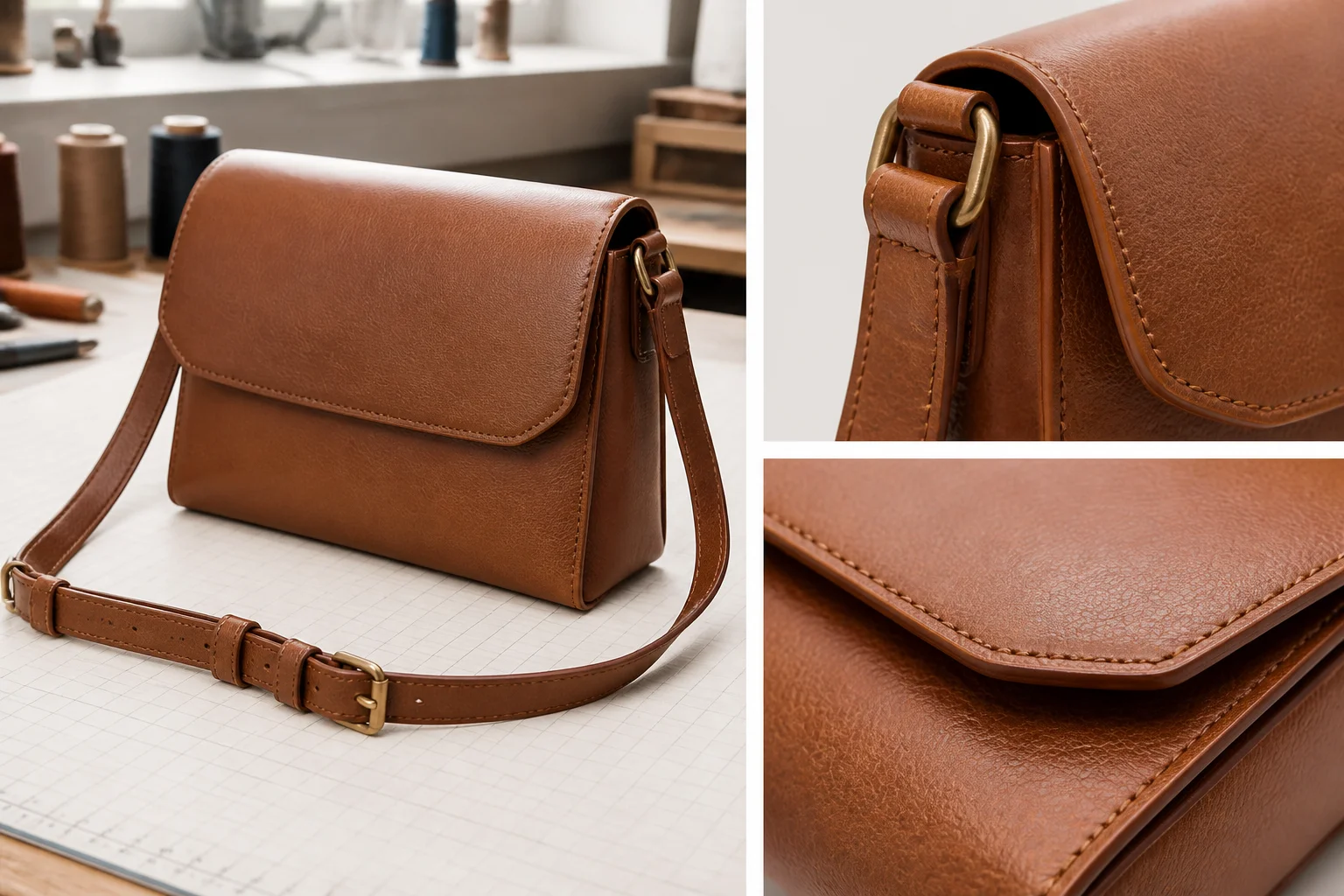
The position of the strap attachment relative to the bag’s centre of gravity determines how it hangs when filled. Attaching slightly above the midpoint usually produces the most stable result.
Weight as a design target
Crossbody bags are worn, so their own weight matters. Hardware and lining are usually the heaviest components relative to their contribution, and both can be reduced without affecting durability.
Setting a target weight during development, then weighing the sample, is a simple control that prevents a bag from becoming uncomfortable before anyone notices why.
The Strap: Length, Drop and Adjustment
The strap decides where the bag sits, and where the bag sits decides whether the customer finds it comfortable. This is the single most consequential specification in the category.
Drop length and wear position
Drop length is the distance from the top of the bag to the highest point of the strap when worn. It determines whether the bag rests at the hip, at the waist or across the body.
A shoulder bag and a crossbody bag differ mainly in drop length, not in body construction. Specifying a drop range rather than a single number accommodates the variation in body size across a market.
How adjustment is achieved
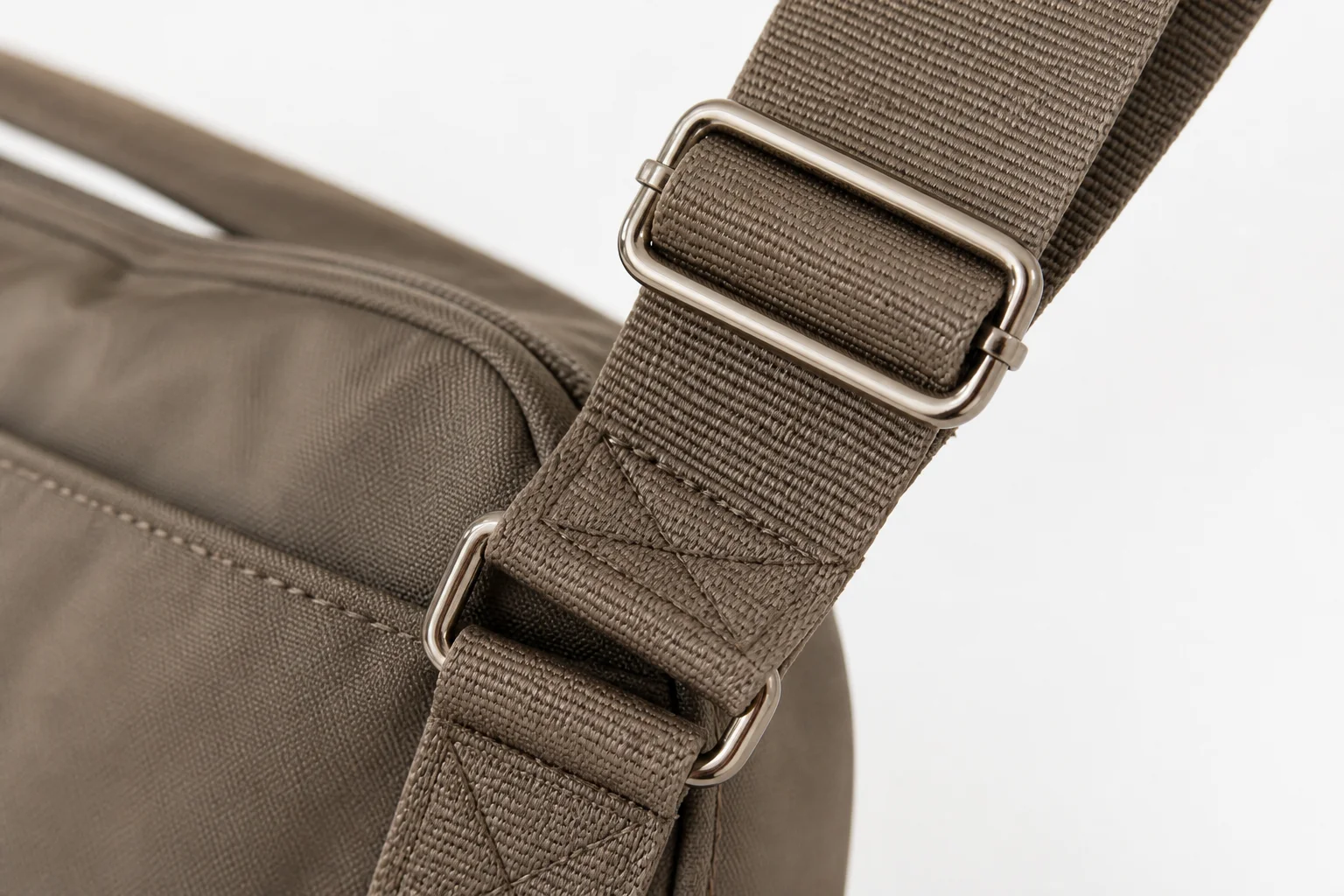
Adjustability can be built into the strap with a sliding buckle or a series of holes and a pin. A sliding adjuster offers continuous adjustment with no holes; a pin-and-hole arrangement is simpler but offers fixed positions.
For crossbody wear, continuous adjustment is generally preferred, because the correct length varies more between wearers than it does for a shoulder bag.
Strap systems compared
| System | Adjustment | Complexity | Best for |
|---|---|---|---|
| Fixed length | None | Lowest | Defined wear position |
| Sliding buckle adjuster | Continuous | Moderate | Crossbody, wide range of wearers |
| Pin and holes | Stepped | Low | Shoulder bags, simple styles |
| Two-piece with clip | Detachable, adjustable | Moderate | Convertible wear |
| Chain with adjuster | Continuous, decorative | Higher | Evening and fashion |
| Double strap | Fixed hand or shoulder | Moderate | Multi-mode carry |
The choice is a trade between cost, appearance and the range of wearers the bag fits. A continuous adjuster adds hardware but widens the addressable market considerably.
Strap width and comfort
A narrow strap on a loaded crossbody bag concentrates pressure on a small area of the shoulder or chest. Widening the strap spreads the same load and is the simplest comfort improvement available.
For light contents a narrow strap suits the design. Once the bag carries a bottle, a device or documents, a wider strap becomes a practical requirement rather than a stylistic choice.
Strap length and material consumption
A crossbody strap is one of the longest continuous components in a bag range, often exceeding the length of the body panels. Its width and length therefore have a direct effect on material consumption.
Because the strap is cut from long, uninterrupted lengths of material, it should be planned in the cutting layout early. Poor planning here produces either waste or joins, and joins in a strap are a visible quality problem.
Strap comfort details
| Detail | Effect on comfort |
|---|---|
| Width | Distributes load across a larger area |
| Edge finish | Rounded or painted edges do not cut into the shoulder |
| Padding | Improves comfort under heavier loads |
| Material softness | Softer straps conform better to the body |
| Weight of hardware | Heavy adjusters add weight at the contact point |
| Strap shape | A contoured strap sits better than a flat one |
These details are inexpensive individually and are what separate a bag that can be worn all day from one that is taken off after an hour.
Strap Attachment and Hardware
Where the strap meets the bag determines how the bag hangs, whether the strap twists and how long the product lasts.
Direct attachment versus rings
A strap can be sewn directly to the body, attached through a D-ring or sewn to a metal plate. Direct stitching is the strongest and cheapest, but it fixes the strap angle, which can cause the bag to hang awkwardly.
Rings and plates allow the strap to rotate, so the bag settles naturally when worn. That movement improves comfort and reduces twisting, at the cost of additional hardware and a second stitching operation.
Attachment methods compared
| Method | Strength | Movement | Notes |
|---|---|---|---|
| Direct stitched | Very high | None | Cheapest, fixed angle |
| D-ring and loop | High | High | Common, allows rotation |
| O-ring | High | High | Simple, decorative |
| Rectangular ring | High | Moderate | Keeps a flat strap flat |
| Swivel clip | Moderate to high | Full rotation | Detachable strap |
| Metal plate and screws | High | None | Repairable, design feature |
| Chain and ring | Moderate | High | Evening styles, light loads |
Rectangular rings are particularly useful where the strap is flat, because they hold it in the correct orientation and prevent the twisting that a round ring allows.
Hardware weight and proportion
Hardware is the densest part of a small bag. Oversized rings, heavy adjusters and thick plating add weight that the wearer feels, particularly in a bag that is carried all day.
Hardware should also be proportionate visually: heavy hardware on a small body reads as mismatched, just as light hardware on a substantial bag reads as underbuilt.
Preventing strap twist
Twisting usually comes from three sources: a round attachment ring, a strap that is not symmetric, or a strap whose lining is attached unevenly. Each has a straightforward fix.
Using a rectangular ring, keeping the strap construction symmetrical and checking that the lining does not pull to one side during assembly removes most cases before they reach the customer.
Detachable straps and multi-mode carry
Swivel clips let a strap be removed and replaced, which supports a hand-carry mode, a longer crossbody strap or a decorative alternative. Each additional strap is a separate product with its own cost.
Where a detachable system is specified, the clips and their attachment points must be rated for the load, because they become the weakest link in the chain.
Flap and Closure Design
The closure is where security meets convenience, and on a crossbody bag it is used dozens of times a day. It is also the feature most likely to generate a complaint.
Why the flap matters structurally
A flap does more than close the bag. It stiffens the front, protects the closure from rain and abrasion, and defines the bag’s visual identity. Its stiffness determines whether the bag keeps its shape or slumps.
A stiff flap with a light body produces an unbalanced bag; a soft flap on a structured body looks inconsistent. Flap and body should be specified together.
Closure options
A turn-lock is secure and feels premium but requires hardware with a precise alignment. A magnetic snap is fast and simple, though its holding strength is limited. A zip is the most secure and works best where the bag is used in crowded or travel situations.
Drawstring and buckle closures suit softer, more casual styles but are slower to operate, which becomes noticeable when the bag is used many times a day.
Closure options compared
| Closure | Security | Speed | Notes |
|---|---|---|---|
| Magnetic snap | Low to moderate | Fastest | Alignment must be precise |
| Zip | Very high | Moderate | Adds construction steps |
| Turn-lock | High | Moderate | Premium hardware, alignment critical |
| Press stud | Moderate | Fast | Simple, lower perceived value |
| Buckle and strap | High | Slowest | Adjustable closure |
| Drawstring | Moderate | Slow | Soft, casual styles |
| Double closure | Very high | Slower | Zip under flap, travel use |
A frequent and effective compromise is a zip closure concealed beneath a flap, which combines security with a clean exterior and protects the zip from weather.
Closure placement and alignment
The closure must sit where the wearer’s hand naturally reaches, and it must engage without the wearer looking. If the flap must be held flat to close, the customer will notice immediately.
Alignment is a production issue: a magnetic snap whose two halves are set a few millimetres apart will not hold reliably, and the fault appears only after assembly. Checking alignment on the sample and at in-line inspection is essential.
Reinforcing the flap
Because the flap is opened repeatedly at the same point, the area around the closure needs reinforcement. Without it, the material stretches, the closure loosens and the flap no longer sits flat.
A small interlining patch behind the closure hardware is inexpensive and prevents the most common flap fault in the category.
Interior Organisation
Interior design decides how the bag is used day to day, and it is where a modest product can feel considered rather than basic.
Sizing pockets to real contents
A pocket that fits the intended object is useful; one that fits nothing in particular is clutter. Card slots, a phone slip, a zip pocket for coins and a key leash each correspond to a specific daily need.
Because these objects have known dimensions, pockets can be specified precisely and verified by inserting the actual items into the sample.
Common interior features
| Feature | Purpose | Construction impact |
|---|---|---|
| Card slots | Cards without a wallet | Multiple small panels and stitching |
| Phone slip pocket | Quick access | One panel, sized to device |
| Zip pocket | Coins and small valuables | Prepared zip opening |
| Key leash | Keys without searching | Small strap plus hardware |
| Divider | Separation and structure | Additional panel and seams |
| Exterior slip pocket | Phone or tickets | Extra panel, edge finish |
| Hidden back pocket | Security storage | Rear panel assembly |
| Detachable pouch | Versatility | Separate product inside |
The value of these features depends on the use case. A travel crossbody benefits from a hidden pocket and a zip; an evening bag usually needs none of them.
Lining and interior finish
A crossbody bag’s interior is small and frequently opened, so the lining is seen constantly. A lightweight lining that snags or creases quickly undermines the impression created by the exterior.
Small bags are also harder to turn and finish, which makes an accurately cut lining more important here than on a larger product. The allowance between lining and outer is a pattern decision that should be checked on the sample.
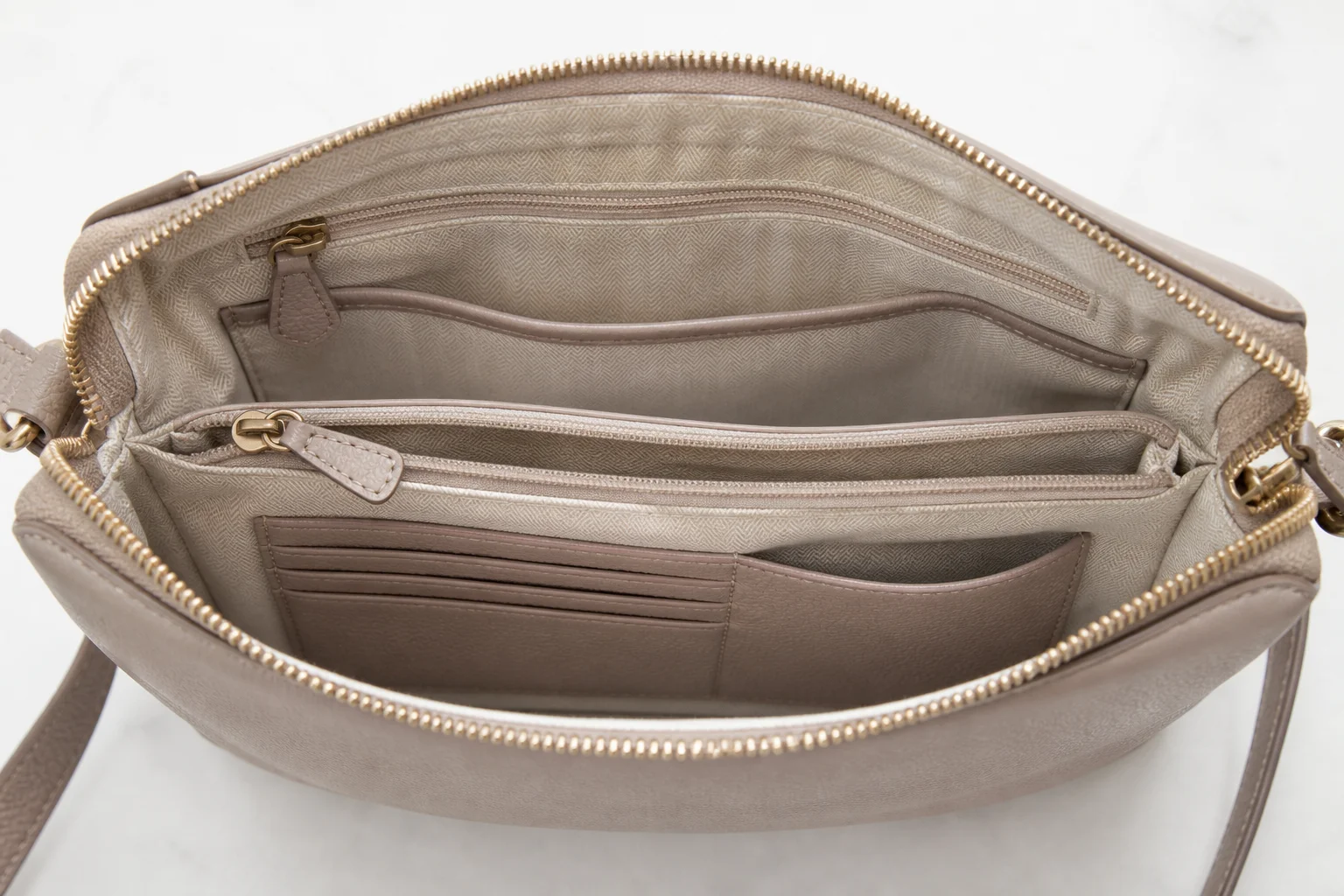
Working around small interiors
In a compact bag, every pocket reduces usable space. Pocket placement should therefore follow how the bag is packed: the most-used items at the top, less-used items at the back or beneath.
Where space is extremely limited, a single well-placed slip pocket and one zip pocket often serve better than a full organiser, because the organiser occupies the volume it is meant to organise.
Hardware inside the bag
Zips, snaps and key leashes inside the bag should be chosen with the same attention as exterior hardware. A zip with a rough slider damages the lining and the contents, and the interior of a small bag is where this is noticed first.
Lightweight, smooth-running zips in a matching colour generally give the best result inside a compact bag, and they keep the interior weight down.
Body Construction and Shape Retention
A small bag has a large surface area relative to its volume, so its shape is highly visible. Structure is what keeps the silhouette the designer intended.
Panel construction
Most crossbody bodies use a front, a back, two sides and a base, or a gusset that forms the sides and base together. A continuous gusset produces a cleaner profile and fewer interior seams, which matters more in a small bag where the interior is always in view.
Piping along the seams gives a crisp edge and reinforces the panel junction. It is one of the most effective ways to make a small bag look structured, and it also protects the seam from abrasion.
Interlining and stiffening
Interlining in the body and flap controls the shape and prevents collapse. In a compact bag, a light interlining is usually sufficient; heavier stiffening makes the bag unyielding and adds weight.
The flap benefits from the firmest interlining, since it is the panel that most affects the perceived quality of the bag.
Structure choices by style
| Style | Structure | Effect |
|---|---|---|
| Soft slouchy | Minimal interlining | Casual, conforms to the body |
| Structured flap bag | Interlined body and flap | Holds shape, formal look |
| Camera style | Foam plus interlining | Protects contents, keeps shape |
| Box body | Rigid panels | Strong silhouette, less capacity |
| Evening clutch-style | Light stiffening, thin body | Elegant, minimal internal space |
The reference point is whether the bag looks the same full as it does empty. If the silhouette changes significantly when loaded, the structure or the size needs revisiting.
Base and corners
A crossbody bag rests against the body more than it rests on the ground, so the base needs less abrasion resistance than a tote’s. Corners still benefit from reinforcement, since they are the points where the material folds and creases.
Seam finishing inside a small bag
In a small bag the interior is fully visible whenever it is open, which makes seam finishing part of the visible design rather than hidden construction. Bound seams look deliberate; raw or frayed seams look unfinished.
This is one area where a compact product can cost more per unit than a larger one, because the same finishing standard applies to a much smaller volume.
Wearability and Contact Points
Because a crossbody bag is worn rather than carried, its contact points with the body and with clothing determine the daily experience.
Where the bag touches the wearer
The strap crosses the shoulder and torso, and the bag rests against the hip or chest. Every edge in those areas should be smooth, and every surface that moves against clothing should be free of hard or abrasive elements.
Hardware at the strap adjuster sits directly on the shoulder in most wear positions, which makes its shape and finish a comfort consideration as well as a visual one.
Friction against clothing
| Contact point | Risk | Mitigation |
|---|---|---|
| Strap edges on the shoulder | Discomfort, marking | Painted or rolled edges |
| Adjuster hardware | Pressure on the shoulder | Compact, smooth-edged adjuster |
| Body corners against the hip | Wear on clothing | Soft or rounded corner treatment |
| Zip pulls on the torso | Abrasion | Protected or concealed pulls |
| Metal hardware against fabric | Snagging | Smooth plating, no sharp edges |
| Back panel against clothing | Colour transfer risk | Colourfast material, neutral lining |
Colour transfer is a particular risk where a dark bag is worn against light clothing, or the reverse. Material selection and dye fastness testing address it before it becomes a complaint.
Fit across wearers
Crossbody fit varies more between individuals than shoulder fit does, because the strap passes across the torso. A specification that suits one body type may sit uncomfortably on another.
Addressing this through a wider adjustment range is more effective than trying to find a single ideal length, and it is also easier to verify with a small group of test wearers.
Movement while walking
A bag that swings excessively while walking is a common complaint. The causes are usually a strap that is too long for the wearer, a body that is too light for its hardware, or attachment points placed where they encourage rotation.
Testing the sample while walking, rather than only holding it in front of a mirror, reveals this before production.
Materials for Crossbody and Shoulder Bags
Material choice for a small bag is a balance of appearance, weight and durability, and small bags expose material quality more than larger ones.
PU leather and coated materials
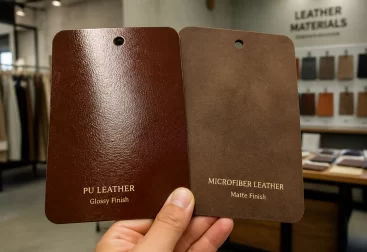
PU leather is the dominant material in this category because it holds a crisp shape, accepts a wide range of finishes and can be cleaned easily. Its constraints are at cut edges and fold points, where the coating can crack if the material is stiff or the radius is too tight.
Coated canvas offers good abrasion resistance and a more casual look, while delivering similar working properties.
Weight considerations
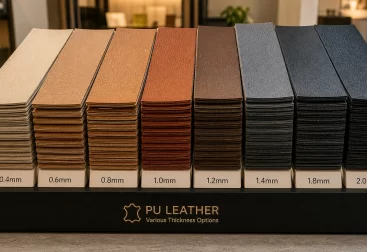
In a compact bag, material weight is a significant share of the finished weight. A heavier material that would be appropriate for a tote may make a small crossbody bag uncomfortable to wear.
Because of this, lighter linings and proportionately thinner body materials are usually the right choice in this category, provided the structure still holds.
Material selection by style
| Style | Body material | Lining | Weight focus |
|---|---|---|---|
| Everyday crossbody | PU leather or coated canvas | Polyester or nylon | Moderate |
| Business | PU leather, fine grain | Woven lining | Moderate |
| Evening | Soft PU or satin | Lightweight satin | Very light |
| Travel | Coated fabric, abrasion resistant | Durable woven | Durability first |
| Camera | Coated fabric | Padded lining | Protection first |
Fabric face and hardware finish should be chosen together, since mismatched finishes are more noticeable on a small surface area than on a large one.
Trims that matter most
On a small bag, zips, rings and closure hardware occupy a large proportion of the visible surface, so their quality is proportionally more important. A well-made body with poor trims produces a disappointing product in this category.
Specifying trims with a named supplier or reference sample, and approving physical samples, keeps the delivered product consistent with what was presented.
Testing and Quality Control
Crossbody bags are used constantly, so function tests matter more here than durability tests carried out over weeks. Most faults appear in the first day of real use.
Wear testing on a person
Wearing the sample for a full day with the intended contents reveals issues that no inspection table can: strap discomfort, swinging, closure access, and whether the bag sits where it was designed to sit.
This is inexpensive, it takes a day, and it is the most effective single test in the category.
Function and strength checks
| Check | Method |
|---|---|
| Strap adjustment range | Operate from minimum to maximum |
| Adjuster holding | Load the bag and check the strap does not slip |
| Closure engagement | Close and open repeatedly, check alignment |
| Attachment strength | Pull test on the anchor per sampling plan |
| Hardware rotation | Confirm rings swing freely without twisting the strap |
| Zip function | Full travel, no catching, slider correct |
| Interior pockets | Insert the intended contents |
| Weight | Weigh against the development target |
Running these checks on the pre-production sample establishes the reference, and repeating the function checks at final inspection keeps the run consistent.
Defects that reach the customer
The most frequent field complaints in this category are a strap that slips, a closure that does not align, a strap that twists, and a bag that hangs too low or too high. All four are detectable before shipment.
Including them explicitly in the inspection routine is more effective than adding general appearance checks, because each corresponds to a specific construction decision.
A crossbody bag is a product the customer wears rather than carries. Design decisions that seem minor on the drawing board are felt within the first hour of wearing.
Cost Drivers and Specification Choices
Crossbody bags are compact, so material cost is low and labour and hardware dominates the price. That makes specification choices more consequential than material savings.
Where the cost sits
Hardware, strap construction, closure installation and interior organisation account for most of the labour. Material consumption per unit is small compared with a tote or a backpack.
This is why the strap and closure tier chosen for a design moves the price more than the choice of material within a similar grade.
Specification choices and their cost effect
| Choice | Cost effect | Customer impact |
|---|---|---|
| Continuous strap adjuster | Hardware plus steps | Fits more wearers |
| Detachable strap | Clips, rings, extra assembly | Versatility |
| Zip closure under flap | Zip prep and alignment | Security |
| Full interior organiser | Multiple panels and stitching | Organisation, less space |
| Piping on seams | Extra step and material | Crisper appearance |
| Reinforced flap closure | Small patch and step | Long-term alignment |
| Heavier hardware | Material cost and weight | Premium feel, more weight |
| Exterior hidden pocket | Extra panel assembly | Security, convenience |
The pattern is consistent: the choices the customer experiences daily are the ones that cost money, and the ones that can be economised are in material efficiency rather than function.
Building a range efficiently
Crossbody ranges are efficient to develop because a single body construction supports several styles. Sharing panels, straps and hardware across a range reduces tooling, sampling and inventory complexity.
The savings are largest when the shared elements are defined first and the variations are applied around them, rather than designing each style from scratch.
Sampling priorities
The first sample should verify strap drop, adjuster function, closure alignment, interior fit and weight. Those five checks catch nearly every issue that would otherwise appear in the market.
FAQ
What strap drop should a crossbody bag have?
It should place the bag at the hip for most wearers when worn across the body. Specifying an adjustment range rather than a single length accommodates the variation between wearers.
Why does my crossbody strap keep twisting?
Usually a round attachment ring, an asymmetric strap or an unevenly attached lining. A rectangular ring and symmetric strap construction resolve most cases.
Is a magnetic snap secure enough for daily use?
For light contents and casual use it is adequate. Where security matters, a zip closure beneath a flap is a more reliable choice and protects the closure from weather.
How wide should a crossbody strap be?
Wider straps distribute pressure better. For light contents a narrow strap suits the design; once the bag carries a device or a bottle, a wider strap becomes a practical requirement.
What is the most common crossbody design mistake?
Insufficient depth. A bag that is wide and tall but shallow bulges once filled, which distorts the shape and stresses the closure.
Should a crossbody bag have a reinforced flap closure?
Yes. The area around the closure is opened repeatedly and will stretch without a small interlining patch, causing the flap to stop sitting flat.
How heavy is too heavy for a crossbody bag?
There is no fixed number, but a bag that feels heavy when empty will be uncomfortable when worn all day. Reducing hardware size and lining weight is usually the most effective correction.
Are detachable straps worth offering?
They add versatility and support multi-mode carry, but they introduce clips and rings that become the load path. The attachment hardware must be rated for the contents.
How do I prevent colour transfer onto clothing?
Choose colourfast materials, test dye fastness with a rub test and consider a neutral lining. Dark bags worn against light clothing are the highest-risk combination.
What should the first sample verify?
Strap drop and adjustment range, adjuster holding under load, closure alignment, interior pocket fit and total weight. These five checks catch most issues that would reach the market.
Can one body construction serve several crossbody styles?
Yes. Sharing panels, straps and hardware across a range is efficient, provided the strap drop and closure suit each style’s intended use.
Which material suits a travel crossbody bag?
A coated, abrasion-resistant fabric with a durable woven lining and a secure closure. Protection and security take priority over surface refinement in that use case.
Next Steps: Decide the Four Variables First
Size and depth, strap drop and adjustment, closure security and weight. Those four decisions determine whether a crossbody bag works in daily life, and all four are settled before production begins.
Send us your design and intended use, and we will propose the proportions, strap system, closure and interior specification for that specific brief.
Developing a crossbody or shoulder bag range and want the details specified properly? Contact our team at info@gionar.com and we will prepare the design specification for your styles.
Related reading: our custom bag manufacturing portfolio shows the crossbody and shoulder styles we produce.