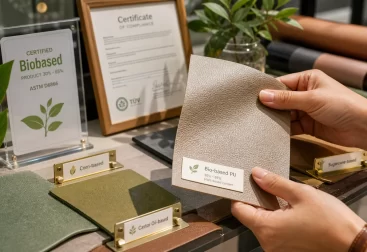
Sustainability is now a line item in almost every bag quotation, but the numbers rarely arrive clearly labelled. Buyers are told a material is eco-friendly, that a factory is certified, or that a finish is bio-based, without a clear view of what each claim adds to unit cost or what it actually changes about the product.
That ambiguity creates two opposite failures. Some buyers accept a premium without knowing what they are buying, paying more for a certificate that no customer will ever see. Others refuse the category entirely because the first quotation looked expensive, and lose access to markets where compliance is now an entry requirement rather than a differentiator.
This guide approaches the subject from the production side. It breaks down where sustainability costs actually appear in a PU leather bag programme, which premiums are unavoidable, which are optional, and how to decide where spending delivers a verifiable result rather than a marketing statement.
The central argument is that sustainability is not a single purchase. It is a set of separate decisions — material content, certification, documentation, construction efficiency, packaging and end-of-life — each with its own cost and its own return. Treated together as one vague commitment, they become expensive. Treated separately and deliberately, most programmes can achieve credible results on a manageable budget.
- What “Sustainable” Means in Bag Manufacturing
- The Real Cost Structure of Green Materials
- Recycled PU Leather: Where the Premium Comes From
- Bio-Based and Plant-Derived Materials
- Certification and the Hidden Documentation Cost
- What Buyers Can Realistically Claim
- Designing for Lower Impact Without Higher Cost
- Repairability and End-of-Life Options
- Building a Costed Sustainability Plan
- FAQ
What “Sustainable” Means in Bag Manufacturing
The word sustainable describes at least five different things in the bag industry, and they are not interchangeable. Confusing them is the main reason sustainability budgets are misallocated.
Five distinct meanings
The first meaning is material content: how much recycled or bio-based feedstock a material contains. The second is process impact: energy, water and waste in manufacturing. The third is chemical safety: which restricted substances are absent. The fourth is product life: how long the bag lasts and whether it can be repaired. The fifth is documentation: whether any of the above can be evidenced to a third party.
A programme can be strong in one and weak in another. Material with high recycled content can still contain a restricted adhesive. A durable, repairable bag can use entirely conventional materials. Treating these as one scale produces claims that cannot be supported.
Why the market has moved to evidence
Regulation and retail policy have shifted the basis of the conversation from intent to proof. A supplier statement is no longer sufficient for many destinations and retailer programmes; what is required is documentation that maps a claim to a component, a batch and a test.
This is the most consequential change of the past few years. It moved sustainability from a communications function into a quality and procurement function, and it made record-keeping a production requirement rather than an administrative one.
The expensive part of sustainability is rarely the material. It is proving what the material is.
The four levels of commitment
In practice, buyers commit at one of four levels, and each carries a different cost profile. Level one is compliance: meeting mandatory chemical and labelling requirements. Level two is verified content: using materials with documented recycled or bio-based content.
Level three is process and certification: factory-level audits and management-system certification. Level four is lifecycle: design for durability, repair and take-back. Most programmes should fund levels one and two fully, then choose selectively from three and four.
| Level | What it covers | Typical cost profile |
|---|---|---|
| 1. Compliance | Chemical limits, labelling, origin | Low per unit, unavoidable |
| 2. Verified content | Recycled or bio-based material documentation | Moderate, material-linked |
| 3. Process certification | Factory audits, management systems | Fixed cost, shared across volume |
| 4. Lifecycle design | Durability, repair, take-back | Design cost, often cost-neutral |
Where the money actually goes
In a typical PU leather bag programme, sustainability spending concentrates in three places: the main material, the documentation and testing that supports claims, and the packaging. Hardware, thread and adhesives are smaller line items but carry disproportionate compliance risk.
Understanding this distribution matters, because the largest visible cost — the material premium — is not always where the greatest risk or the greatest return sits. A programme that upgrades its main material but cannot document its adhesive has bought an expensive claim and left a compliance gap open.
The Real Cost Structure of Green Materials
Green material premiums are frequently quoted as a single percentage, which hides the fact that they come from several separate sources with very different behaviour as volume changes.
Where a material premium comes from
Four cost components typically drive a sustainable material premium. Feedstock cost is the first: recycled and bio-based inputs are often more expensive per kilogram than virgin equivalents, particularly when demand exceeds supply.
The second is processing cost. Recycled feedstock varies more than virgin material, so mills run slower, reject more and accept lower yield to hold a consistent specification. The third is colour and finish availability, because sustainable grades are usually produced in a narrower range, so any non-standard colour becomes a special run.
The fourth is documentation. Certified content requires chain-of-custody records, batch separation and periodic audits — an overhead that appears in the material price whether or not the buyer ever asks for the paperwork.
Why the premium falls unevenly
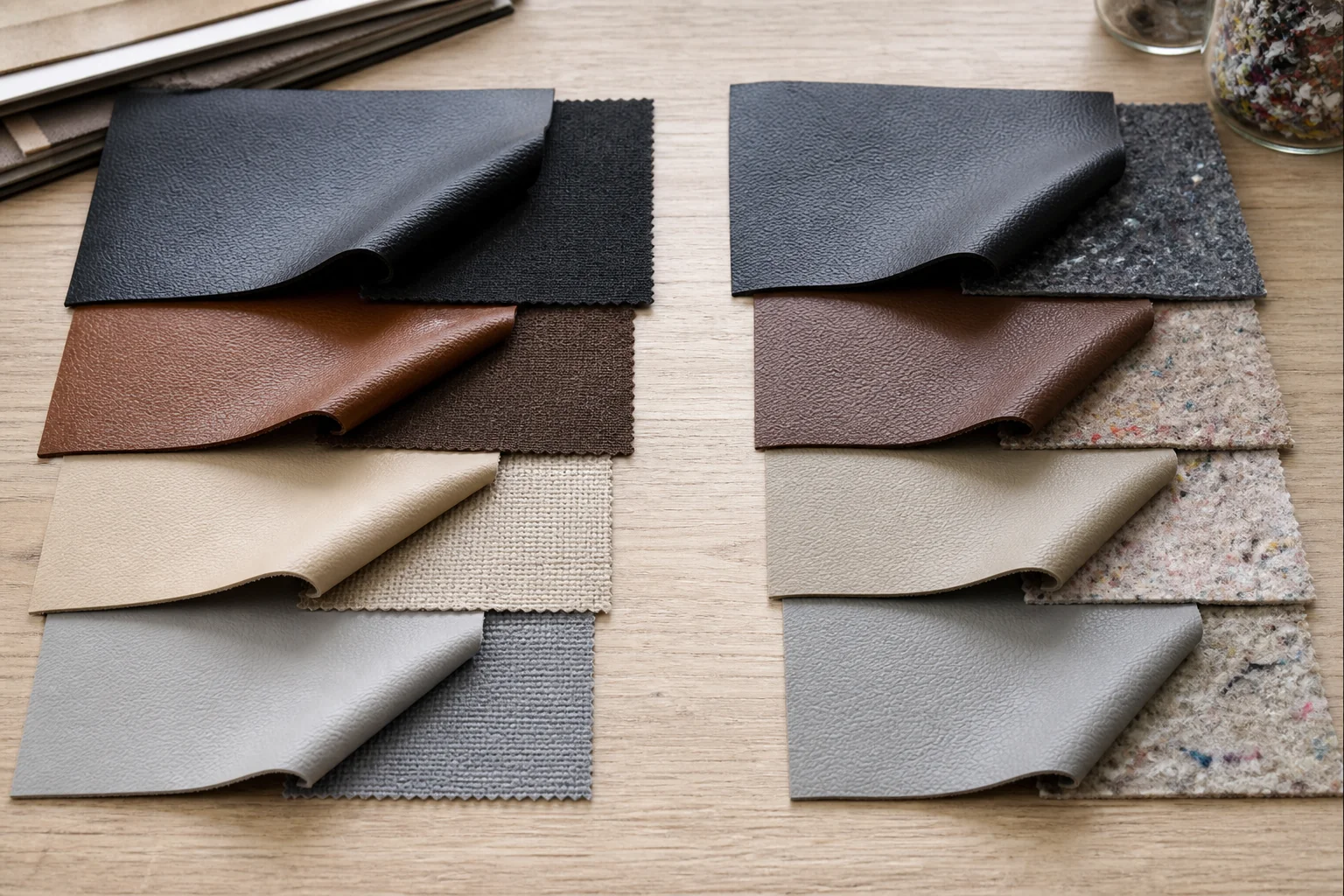
The premium is not uniform across a material range. Standard colours in high-volume grades often carry a modest uplift, because the mill already runs them frequently and the marginal cost of certification is low.
The same content in an unusual colour, a specialist thickness or a low-volume backing can carry a far larger premium, because the entire special run must be certified and documented. This is the single most useful fact for budget planning: choosing a standard colour can reduce a sustainable material premium substantially.
| Cost component | Behaviour as volume rises | Buyer lever |
|---|---|---|
| Feedstock | Falls slowly, market-driven | Choose high-volume grades |
| Processing | Falls with order size | Consolidate orders |
| Colour and finish | Falls sharply in standard colours | Avoid custom colourways |
| Documentation | Fixed, shared across the run | Reuse certificates across styles |
The comparison that matters
When comparing a sustainable quotation against a conventional one, the useful question is not what the material costs but what the finished bag costs. Premiums on the main material are diluted by labour, hardware, packaging and overhead that do not change.
As a rule of thumb, a material premium applied only to the main body affects a smaller share of the finished cost than buyers expect, while premiums applied to several components at once compound quickly. Isolating the premium to one visible component is usually the most efficient way to make a verifiable claim.
Costs that are not on the material invoice
Two further costs rarely appear in a material quotation. The first is testing, which is charged per component per standard and must be repeated when a supplier or material changes. The second is administrative: someone must collect, store, verify and forward documentation for each order.
Both are real and both are manageable, but they penalise small, fragmented orders. A programme that places five small orders with five suppliers pays for testing and administration five times.
Recycled PU Leather: Where the Premium Comes From
Recycled PU leather is the most requested sustainable option in the bag category, and the one most often misunderstood. There is no single recycled material; there are several, with different content, performance and price.
Recycled content enters at different points
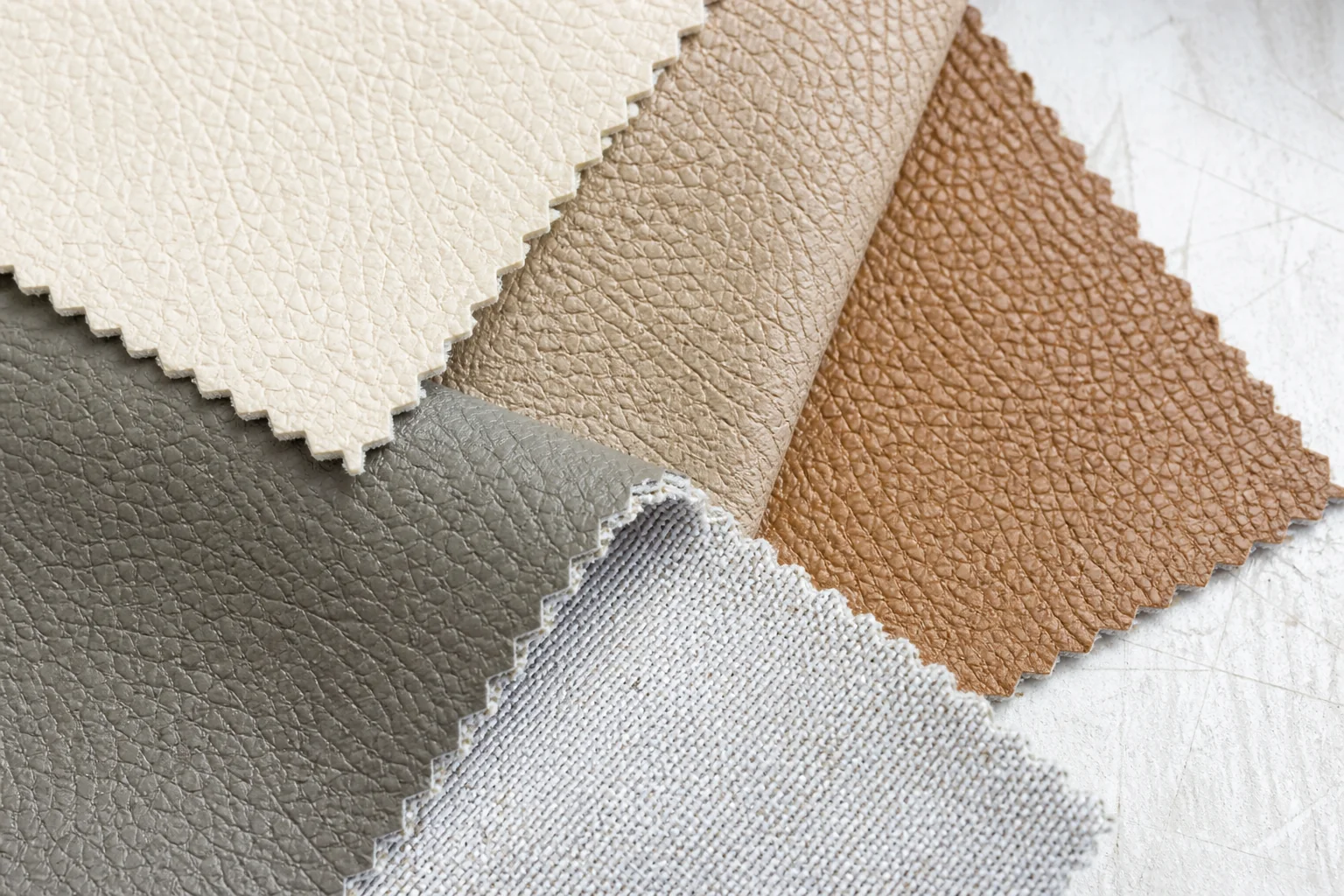
Recycled material can enter a PU leather construction in three places. The backing fabric may use recycled polyester. The coating may incorporate recycled polymer. The surface finish may use recycled or bio-based chemistry.
These are not equivalent. Backing fabric is the most common and usually the cheapest place to introduce recycled content, and it is also the least visible to a customer. Coating content is more expensive and harder to verify. A material can legitimately claim recycled content while using mostly conventional coating.
Performance differences to verify
Recycled content changes performance in ways that must be tested rather than assumed. Tensile and tear strength can differ, particularly when the backing fabric changes. Colour consistency across batches is usually tighter on virgin material, and surface adhesion can vary with coating chemistry.
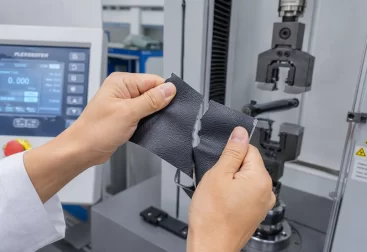
The practical instruction is to test the recycled grade on the same criteria you would apply to any new material: seam strength at the load path, flex and abrasion resistance, colour under controlled light, and performance after the bag is loaded and used. A material that passes an appearance check but fails a load test is not a saving.
| Where recycled content sits | Typical cost impact | Verification difficulty |
|---|---|---|
| Backing fabric | Lowest | Straightforward |
| Coating polymer | Moderate to high | Requires mill documentation |
| Surface finish chemistry | High | Hardest to verify |
| Lining fabric | Low | Straightforward |
| Packaging and inserts | Low | Straightforward |
A pragmatic approach to recycled content
A workable structure is to place verified recycled content where it is both meaningful and visible, and keep conventional materials on internal components where verification adds cost without changing what the customer experiences.
For example, recycled backing on the main body and recycled lining fabric deliver a documented claim across most of the bag’s surface area, while adhesive, thread and small hardware remain conventional but compliant. This keeps the premium controlled and the claim defensible.
Availability is the binding constraint
The most common project failure in this category is designing around a material that cannot be supplied in the required colour and thickness at the required time. Recycled grades have narrower ranges and longer lead times than conventional equivalents.
Before committing a range, confirm availability for every colourway in the plan, and confirm it for the full order quantity rather than for a sample. A sample delivered from stock is not evidence that a production run can be supplied.
Bio-Based and Plant-Derived Materials
Bio-based materials attract strong buyer interest and carry the widest gap between marketing language and technical reality. Understanding the distinction prevents both overpaying and overclaiming.
What bio-based actually means
Bio-based means a proportion of the carbon in the material originates from plants rather than fossil sources. It says nothing about biodegradability, recyclability or end-of-life behaviour.
This distinction matters commercially. A material can be substantially bio-based and still be non-biodegradable, because the polymer structure rather than the carbon source determines how it breaks down. Buyers who assume the opposite can find themselves making a claim that a test will contradict.
Performance trade-offs
Plant-derived coatings and substrates typically differ from conventional equivalents in three ways. They may absorb moisture more readily, which affects dimensional stability. They may be more sensitive to heat during lamination and embossing. And they may age differently, with colour change or surface dulling over time.
None of these are disqualifying, but all of them require testing in the actual construction. A material that performs well as a flat sample can behave differently once it is laminated, cut and sewn into a loaded bag.
| Material type | What it claims | What to verify |
|---|---|---|
| Plant-derived PU | Bio-based carbon content | Content percentage and moisture behaviour |
| Water-based coatings | Reduced solvent use | Adhesion and flex performance |
| Natural-fibre composites | Renewable feedstock | Strength, moisture, consistency |
| Recycled textile backing | Recycled content | Traceability and batch colour |
| Bio-based lining | Renewable content | Abrasion resistance and pilling |
Choosing where bio-based adds value
The strongest case for bio-based materials is where the customer is likely to notice and value the material, and where the performance requirement is moderate. Lining fabrics, interior panels and packaging are usually easier places to adopt them than a load-bearing main body.
For structural components, conventional high-performance material is often the better engineering choice, with the sustainable claim carried elsewhere. This is not a compromise; it is an accurate allocation of the material to the job it does best.
Certification and the Hidden Documentation Cost
Certification is where sustainability budgets most often exceed expectations, because the costs are fixed, recurring and invisible in a unit price.
What certification actually covers
Certification falls into three groups. Material certification confirms the content of a specific material and is issued against a batch. Factory certification assesses management systems, chemical handling, effluent or social conditions at the production site. Test reports confirm that a specific component meets a specific standard.
Each is purchased separately, has its own validity period, and applies to a defined scope. A factory certificate does not certify a material, and a material certificate does not cover the adhesive used to bond it.
The recurring costs buyers underestimate
The first underestimated cost is repeat testing. Tests are normally tied to a material, colour, supplier and sometimes a production site. Change any one of those and a new report is needed, regardless of whether the product itself changed.
The second is scope creep. A programme that adds a new supplier to reduce cost often adds three new test requirements with them. The third is administration: certificates must be requested, checked for scope and validity, stored and forwarded to the customer’s own compliance team.
| Item | Cost behaviour | How to reduce it |
|---|---|---|
| Material content certificate | Per material, per colour | Limit colourways and grades |
| Component test reports | Per component, per standard | Confirm at sampling stage |
| Factory certification | Fixed, periodic | Choose an already-certified supplier |
| Repeat testing | Triggered by change | Freeze suppliers mid-programme |
| Document administration | Per order | Consolidate orders |
Working with an already-certified supply chain
The most efficient approach for most buyers is to work with a factory that already holds the certifications relevant to the target market, and use materials from mills that already publish content documentation.
The premium for doing so is usually lower than the cost of certifying a cheaper but undocumented alternative, because the fixed costs are already amortised across the supplier’s other customers. Buyers should ask early which certifications exist, what they cover, and whether they extend to the specific materials and colours being proposed.
A supplier with current, in-scope documentation is usually cheaper than a cheaper supplier who must obtain it.
What Buyers Can Realistically Claim
Most sustainability problems at retail are not production problems. They are claim problems: a statement made in marketing that the documentation does not support.
The claim hierarchy
Claims can be sorted by how easy they are to defend. At the base are factual material statements, such as a stated recycled content percentage on a named component. These are straightforward to support with a certificate.
Above that sit comparative claims, which assert a product is better than an alternative. These require a defined baseline and are the most commonly challenged. At the top sit broad environmental claims about the product as a whole, which are difficult to substantiate and increasingly restricted.
For most bag programmes, staying at the base with precise, component-specific statements is the lowest-risk and often most credible position. Precision reads as competence; vagueness reads as risk.
Language that creates exposure
Certain words invite scrutiny regardless of intent. Terms such as fully green, zero impact, completely biodegradable and planet-friendly are difficult to evidence on a manufactured bag with mixed materials and are best avoided.
A safer pattern is to describe the specific component and its verified attribute: a main body in material with a stated recycled backing content, a water-based coating on a named panel, packaging from recycled fibre. Each is checkable, and together they create a more credible story than one sweeping adjective.
| Claim type | Evidence required | Risk level |
|---|---|---|
| Component content percentage | Material certificate | Low |
| Restricted substance compliance | Component test reports | Low |
| Recycled packaging | Supplier declaration | Low |
| Comparative environmental claim | Defined baseline study | Medium to high |
| Product-wide green claim | Lifecycle assessment | High |
| Biodegradable | Standard-specific test evidence | High |
How to document without overbuilding
A practical documentation set for a bag programme is smaller than most buyers expect. It typically consists of a material content certificate for each grade used, component test reports covering the relevant restricted substances, a supplier declaration for packaging, and a record linking each to the styles it applies to.
The discipline is keeping that set current and scoped. A certificate that has expired, or that covers a colour no longer used, provides no protection. Reviewing the documentation set at each production cycle is cheaper than rebuilding it during a customer audit.
Designing for Lower Impact Without Higher Cost
Not every sustainability gain requires a new material. Several of the most effective measures are design and production decisions that reduce waste and improve durability at little or no additional cost.
Material efficiency as the cheapest win
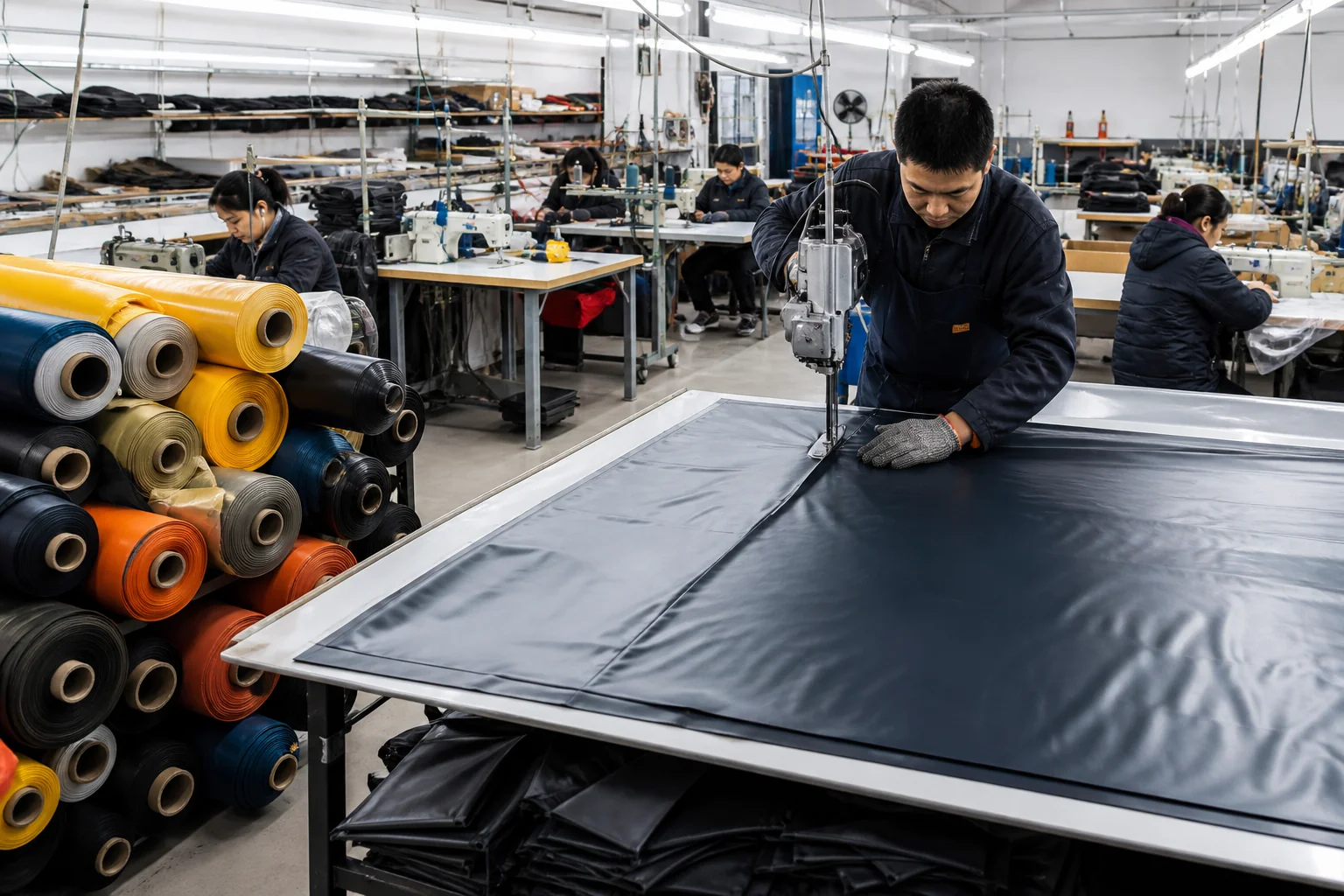
The single largest environmental lever in bag production is material yield. Cutting patterns to use more of each roll reduces waste directly, and it also reduces cost, because material is the largest purchased input.
Nesting efficiency, panel orientation and cutting tolerances all affect how much of a roll becomes product versus offcut. Improving yield by a few percentage points is often worth more, in both cost and waste terms, than the entire material premium debate.
Durability as the primary environmental strategy
A bag that lasts twice as long delivers roughly half the impact per year of use, without any material change. Durability is therefore the highest-return sustainability investment available to a manufacturer.
In practice this means reinforcing the load path rather than the whole bag, specifying hardware that will not fail early, and testing seams and attachments before production. These are engineering decisions with modest costs and large effects on product life.
Where design decisions reduce cost
Several sustainable design choices are also cost reductions. Fewer material types on one bag reduces cutting complexity, inventory and offcut variety. Fewer colourways improves material pricing. Simplified construction reduces labour and defect rates.
The overlap is genuine, which is why sustainability and cost reduction are often compatible when approached through design rather than through material substitution.
| Design measure | Environmental effect | Cost effect |
|---|---|---|
| Improved cutting yield | Less material waste | Decrease |
| Fewer material types per style | Less variety in offcuts | Decrease |
| Reinforced load path | Longer product life | Small increase |
| Standardised hardware | Simpler repair | Decrease |
| Recycled packaging | Lower packaging impact | Near neutral |
| Reduced packaging volume | Lower freight emissions | Decrease |
Repairability and End-of-Life Options
End-of-life is the newest area of buyer interest and the least developed in practice. It is also where claims are easiest to make and hardest to prove.
Designing for repair
Repairability is achieved through a small number of decisions: detachable straps, replaceable hardware, closures that can be exchanged without dismantling the bag, and construction that allows a stitching line to be opened and resealed.
These add modest cost in the form of small hardware and additional assembly steps, and they extend the usable life of the product. For premium positioning, they also support a service proposition that differentiates a brand without requiring a new material claim.
The limits of recycling a mixed-material bag
A finished bag is a composite: coated material, textile lining, metal hardware, plastic components and adhesive. Separating those materials at end-of-life is labour-intensive, and most municipal systems are not set up to do it.
This is why take-back schemes and recyclability claims deserve careful scrutiny. A programme should be able to describe what happens to a returned bag — who collects it, how it is dismantled and where each material stream goes. Without that chain, a take-back commitment is a gesture rather than a process.
A realistic position for most brands
For most brands, the defensible position is durability plus repair plus responsible packaging, with material content documented where verified. That combination can be evidenced, implemented at a manageable cost, and explained honestly to a customer.
It is also more durable commercially than a bold recyclability promise, because it does not depend on recycling infrastructure that may not exist. Claims that outrun the system are the ones that eventually attract attention.
Building a Costed Sustainability Plan
A sustainability plan becomes actionable when each element has an owner, a cost and a date. The following sequence reflects how programmes that stay on budget are actually structured.
Step one: decide the claims before the materials
Start with the claims you intend to make in market, then work backwards to the evidence each requires. This reverses the usual order, in which materials are chosen first and claims are written afterwards from whatever the material happened to offer.
Deciding claims first prevents two common wastes: paying for certified content on a component no customer will see, and discovering late that a claim cannot be supported without changing a material already in production.
Step two: segment the product by claim
Apply documented sustainable content to the components that carry the claim, and keep conventional compliant materials elsewhere. A typical allocation is verified recycled content on the main body and lining, compliant conventional materials on internal structure, and recycled packaging.
This concentrates spending where it is visible and verifiable, and it keeps the premium confined to a predictable share of the bill of materials.
Step three: budget the fixed costs separately
Testing, certification and documentation are fixed or semi-fixed costs, so they should be planned separately from unit cost and reviewed as a programme-level budget rather than absorbed into a unit price.
Buyers who track these separately usually find that limiting colourways and freezing suppliers mid-programme removes a significant share of the total without touching product quality.
| Plan element | Cost type | Control lever |
|---|---|---|
| Material content | Per unit | Limit to one or two components |
| Colour range | Per colourway | Use standard mill colours |
| Testing | Fixed per component | Test at sampling, then freeze |
| Certification | Fixed per site | Use a certified supplier |
| Documentation handling | Per order | Consolidate orders |
| Packaging | Per unit | Recycled fibre, reduced volume |
Step four: measure yield, not just content
Material yield deserves a place in any sustainability plan alongside content. Two programmes using identical material can differ substantially in waste, and therefore in effective impact, purely because of cutting efficiency.
Requesting yield figures alongside material certificates gives a more complete picture and often identifies savings that fund the material premium. Waste reduction is the rare sustainability measure that improves both environmental performance and margin.
The cheapest sustainability measure available to a bag programme is using less material to make the same product.
FAQ
How much more do sustainable bags cost to manufacture?
There is no single figure, because the premium depends on where sustainable content is applied. Verified recycled content on the main body may add a modest uplift, but applying it across every component compounds quickly. Restricting the upgrade to one or two visible components keeps the premium controlled and predictable.
Is recycled PU leather as strong as conventional PU leather?
It can be, but it must be tested rather than assumed. Recycled backing fabrics and coating chemistry can change tensile strength, flex resistance and colour consistency. A recycled grade should pass the same load, abrasion and flex tests applied to any new material before it is approved for production.
Does bio-based mean biodegradable?
No. Bio-based describes the origin of the carbon in the material, not how it behaves at end-of-life. A material can be substantially plant-derived and still non-biodegradable, because breakdown depends on polymer structure rather than carbon source. The two claims require separate evidence.
What certifications should a bag factory hold?
It depends on the destination market. Most buyers look for restricted substance compliance, a chemical management or environmental management system, and traceability for any recycled content claim. The important question is not whether certificates exist, but whether their scope covers the materials and processes your order actually uses.
Can I claim a bag is eco-friendly if only the lining is recycled?
You can claim that the lining contains verified recycled content, which is a specific and defensible statement. A broad product-level environmental claim would not be supported by that alone. Precise component-level claims are both safer and more credible than sweeping product claims.
Why is testing such a large part of the cost?
Because tests are scoped to a material, colour, component and supplier. Changing any one of those usually requires a fresh report even if the product itself is unchanged. This makes supplier changes mid-programme expensive and rewards consolidating materials and suppliers before production begins.
Do sustainable materials take longer to source?
Often yes. Recycled and bio-based grades are produced in narrower colour and thickness ranges, and low-volume grades may be made to order. Confirm availability for every colourway in the range and for the full production quantity, not just for the sample, before committing the design.
What is the cheapest way to reduce a bag’s environmental impact?
Improving material yield. Cutting patterns to use more of each roll reduces waste and lowers material cost at the same time, and it requires no material change, no certification and no additional testing. Durability improvements are the next most effective measure.
Are water-based coatings a good option for PU leather bags?
They reduce solvent use in the coating process and are increasingly available in durable grades. The main considerations are adhesion and flex performance, which vary by construction, so they should be tested on the specific base material and embossing pattern rather than approved on general specification alone.
How do take-back schemes work for bags?
A working scheme needs collection, dismantling into material streams, and a confirmed destination for each stream. Many brands announce collection without the dismantling step, which limits the actual recovery. Ask what physically happens to a returned bag before promoting a scheme.
Can sustainability reduce manufacturing cost instead of increasing it?
In some areas, yes. Better cutting yield, fewer material types per style, standardised hardware, reduced packaging volume and fewer colourways all lower cost while reducing impact. Material substitution is usually the only sustainability decision that necessarily raises unit cost.
How should I compare a sustainable quotation with a conventional one?
Compare finished unit cost rather than material cost. A premium on the main material is diluted by labour, hardware, packaging and overhead that do not change, so its effect on the finished bag is smaller than the material uplift suggests. Watch instead for premiums applied across several components at once.
Looking for a PU leather bag manufacturer?
We manufacture PU leather bags in Guangzhou on OEM and ODM programmes, including recycled and compliant material options, documentation support, tooling, sampling, bulk production and inspection. Send your requirements to info@gionar.com, or review our custom bag manufacturing capabilities.