The question sounds simple and is usually answered badly. The common responses are either a confident number offered without reasoning, or a non-answer that says it depends. Both leave a new retailer without a basis for a decision that will shape cash flow for the next six months.
A workable answer is that a first order should carry as few styles as the retailer can credibly present, with enough depth in each to sell properly. For most small retailers that lands between four and eight styles, depending on how the products are displayed, how many customer types they serve, and how much cash they can tie up in stock without strain.
The reasoning behind that range matters more than the range itself. A first order is not a range-building exercise; it is a demand test with a financial ceiling. Every style added increases the number of things that can go wrong, divides the buying budget more thinly, and makes it harder to read what actually sold.
Depth is what sells. A customer deciding between two bags in the last unit of stock is a lost sale. A shelf with eight styles and one unit each looks full and sells poorly, because there is nothing to replace what leaves and nothing to offer a customer who wants a different colour or a replacement.
This guide sets out why narrow first ranges outperform broad ones, offers a framework for settling on a number, explains the depth-versus-breadth trade-off in financial terms, and shows how to build a range on shared components so that a small order still reaches sensible price tiers.
- Why the First Range Size Matters More Than Later Ones
- The Case for a Narrow First Range
- A Working Framework for Choosing a Number
- Depth Versus Breadth: The Financial Trade-off
- Choosing Which Styles to Include
- Building the Range on Shared Components
- Testing Demand Without Overcommitting
- Planning the Second Order From First-Run Data
- FAQ
Why the First Range Size Matters More Than Later Ones
Later orders are corrective. If a range proves too broad or too narrow, the next order adjusts for it. The first order has no such information behind it, which is why it carries disproportionate risk.
Every style is a separate bet
Each style carries its own material commitment, its own size curve, its own colour mix and its own minimum order quantity. Adding a style does not spread risk; it multiplies the number of independent commitments being made simultaneously.
This is the opposite of how diversification works in an investment portfolio, where uncorrelated assets reduce variance. A first order made without demand data produces a set of bets that are all uninformed, so more bets means more exposure rather than less.
Cash is the binding constraint
Most new retailers are limited by working capital rather than by ambition. Every additional style converts cash into inventory and reduces the amount available for marketing, staff or the next order.
Style count and depth compete for the same money. A retailer with a fixed budget can have more styles at lower depth or fewer styles at higher depth, and the second option almost always sells more.
The first order sets the supplier relationship
A first order also establishes how the supplier reads the buyer. An order made of many small quantities across many styles is harder to manufacture, generates more set-up cost, and tends to produce a less favourable price position for the second order.
A narrower first order that runs cleanly gives the supplier a reason to offer better terms next time. The relationship benefit is real and rarely factored into the decision.
The Case for a Narrow First Range
The instinct to offer choice is understandable and usually wrong at the first order. The evidence from retail practice points consistently in the other direction.
A full-looking shelf is not a selling shelf
A display with many styles and few units each looks complete but behaves badly. The best-selling style sells out first, leaving a shelf of the styles customers did not want, and the retailer has no cash left to restock the winner.
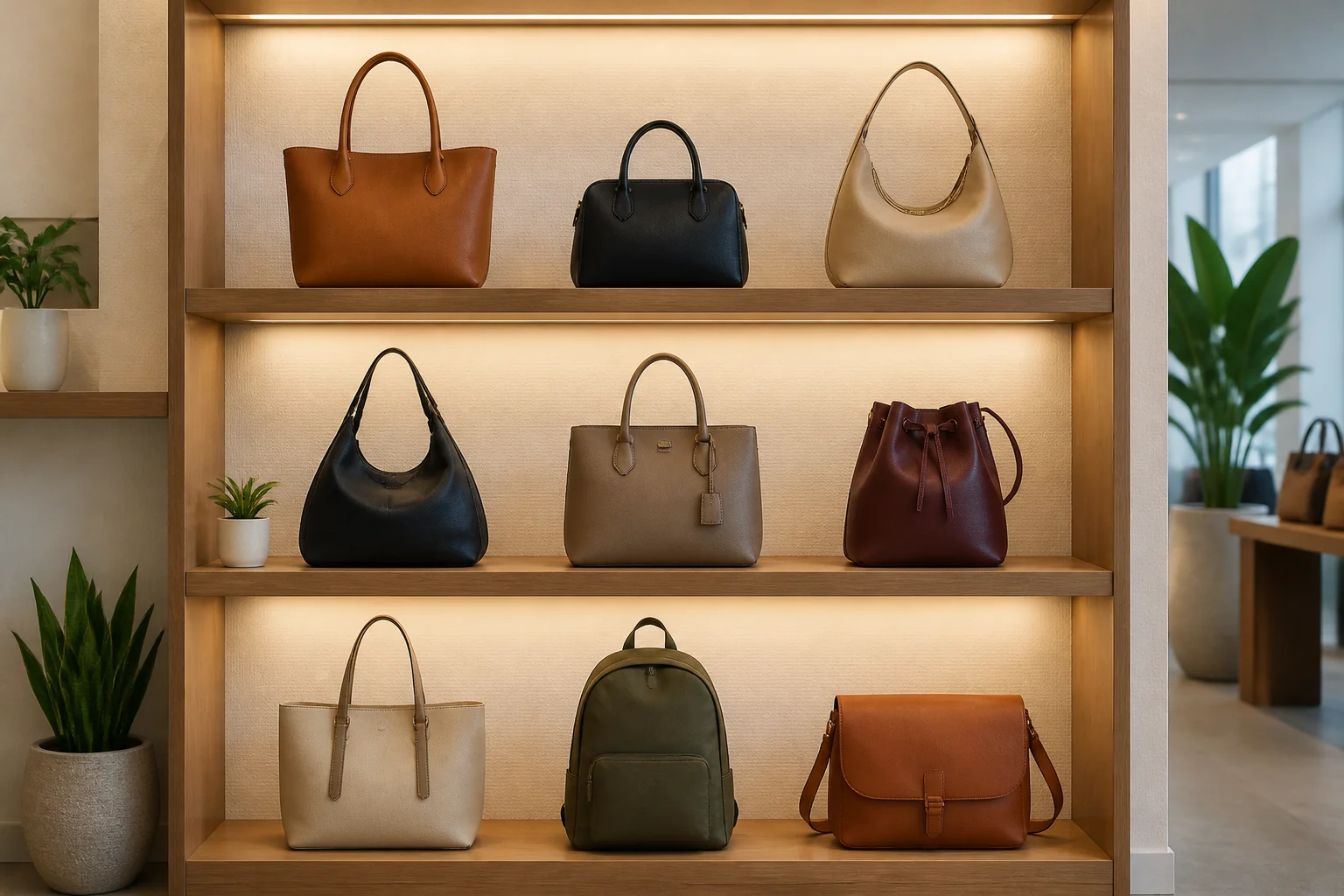
A narrower range with real depth keeps the winner in stock, which is where the repeat purchase comes from. The repeat customer is worth more than the browsing customer, and only depth serves them.
Reading demand requires repetition
Selling two units of a style tells a retailer almost nothing. Selling fifteen units tells them the colour that moved, the price point that worked and the customer type that bought. That information is only available where depth exists.
Broad, shallow orders produce a set of single data points. The buyer learns that everything sold a little and nothing definitively, which is the least useful outcome for planning the second order.
| Range shape | What it costs | What it teaches |
|---|---|---|
| Many styles, low depth | High stock risk, weak sell-through | Almost nothing |
| Many styles, high depth | Very high capital requirement | Reliable but unaffordable |
| Few styles, low depth | Stock-outs on winners | Little, and it frustrates the display |
| Few styles, high depth | Concentrated risk on those styles | Clear signals on colour, price and customer |
The exception: genuinely distinct customer groups
There is a legitimate case for a slightly broader first range where the retailer serves clearly different customer groups with little overlap — for example commuters and parents, or students and travellers. In that situation each group needs at least one credible option.
Even then the principle holds. Two customer groups justify perhaps one or two styles each with real depth, not a sprawling selection that serves neither properly.
Why suppliers prefer focused orders
A focused order produces less set-up time, better material utilisation and simpler quality control. Factories price accordingly, and a buyer who understands this can often trade a narrower range for a better unit price.
This is one of the few places where commercial and operational interests align perfectly. The retailer reduces stock risk and the factory reduces cost, and the saving is available to share.
A Working Framework for Choosing a Number
The right number comes from four inputs rather than from a rule of thumb. Working through them produces a defensible answer instead of a guess.
Input one: how the range will be displayed
Display capacity sets a soft ceiling. A single wall bay with three shelf levels usually presents three to five styles well; a crowded bay sells worse than a sparse one, because the customer cannot see the product.
Online-only retailers have no such constraint, which is why they can carry more styles. The trade-off returns as photography cost and as the difficulty of describing a large range convincingly.
Input two: how many customer types are served
Count the genuinely distinct customer groups and give each one a route into the range. Three groups typically need no more than four or five styles between them, because a style can serve more than one group if it is chosen carefully.
Where the retailer cannot name the customer groups, that is the problem to solve before ordering. A range built without them is a collection of preferences rather than a commercial proposition.
| Input | What it pushes toward | Practical effect |
|---|---|---|
| Display capacity | Fewer styles | Usually caps the range near what fits well |
| Number of customer groups | One to two styles per group | Prevents gaps in coverage |
| Buying budget | Fewer styles or lower depth | The hard constraint in most cases |
| Reordering speed | Fewer styles, higher depth | Slow restocking rewards depth |
Input three: the buying budget
The budget decides the total units, and the framework decides how to divide them. A useful starting point is that no style should hold less than enough stock to sell for roughly two months at the expected rate.
If the budget does not allow that depth across the styles being considered, the range is too broad. Reducing the style count is the correct response, not accepting thin stock across more options.
Input four: how quickly stock can be replenished
Restocking lead time determines how much safety stock is needed. Where a repeat order takes weeks to arrive, understocking costs sales; where it arrives quickly, depth can be lower.
New retailers usually underestimate lead time on the first order, because it includes sampling and approval as well as production and freight. Assuming the same lead time as a future repeat order is a common and expensive error.
Putting the inputs together
A retailer with one small display bay, two customer types, a limited budget and a long restocking lead time should be planning four or five styles with real depth. The same retailer selling mainly online with a larger budget might reasonably carry eight.
The number is an output, not a target. Starting with a desired figure and making the inputs fit produces a range that is coherent on paper and unworkable in practice.
Depth Versus Breadth: The Financial Trade-off
Depth and breadth consume the same money, so the decision is a genuine trade-off rather than a matter of having both. Comparing them on financial terms makes the choice clearer.
The cost of a stock-out
A stock-out costs the sale and often the customer. A buyer who comes looking for a specific bag and finds it unavailable may not return, and the acquisition cost already spent on attracting them is lost with the sale.
Because acquiring a customer is expensive, the value of a lost sale is higher than the margin on the unit. This asymmetry is the strongest financial argument for depth over breadth.
The cost of dead stock
Breadth creates dead stock, which ties up cash and eventually has to be discounted. The cost is not just the tied-up capital but the markdown required to clear it and the space it occupies while waiting.

Dead stock is also slow to identify. A style that sells two units in three months may still be selling one unit a month, which is enough to defer the decision and enough to keep consuming space.
| Scenario | Cash tied up | Lost sales risk | Markdown risk |
|---|---|---|---|
| Few styles, deep stock | Concentrated | Low | Low if styles are well chosen |
| Many styles, shallow stock | Spread thin | High on winners | High across the tail |
| Few styles, shallow stock | Low | Very high | Low |
| Many styles, deep stock | Very high | Low | Moderate to high |
Stock turn as the deciding measure
The measure that captures both sides is stock turn: how many times the inventory is sold and replaced within a period. Higher turn means the same cash generates more sales.
Depth improves turn when it prevents stock-outs, and reduces turn when it creates surplus. The aim is not maximum depth but the depth at which a style rarely runs out and rarely leaves a remainder.
A simple depth rule
A practical rule is to hold enough units to cover expected sales for the replenishment period plus a margin, and no more. Where the expected sales rate is unknown, the first order should be treated as the experiment that establishes it.
Breadth buys options. Depth buys sales. On a first order, only one of those produces the data needed to order again well.
Choosing Which Styles to Include
Once the count is settled, each slot should be filled deliberately. A first range needs roles, not a collection of individual preferences.
Give every style a role
A workable structure is one hero style, two or three supporting styles, and one test style. The hero carries volume, the supporting styles cover the main customer groups and price points, and the test style probes demand without much exposure.
When every style has a role, cuts become easier. If a style has no clear role, it is the one to drop when budget is tight, rather than a style whose role is simply less exciting.
Cover price points, not just products
Customers shop within a price band, and a range that clusters at one price point leaves gaps. Covering an entry, a middle and an upper point serves the same customer at different budgets and captures trade-up.
The upper point does not need depth. Its function is to make the middle look reasonable and to give willing customers somewhere to go; it sells fewer units but improves the average.
| Role | Function | Typical share of units |
|---|---|---|
| Hero style | Drives volume and recognition | Largest single share |
| Supporting styles | Cover customer groups and price points | Spread across two or three |
| Entry style | Opens the price point | Moderate |
| Upper style | Captures trade-up | Smallest, held in low depth |
| Test style | Probes an unproven direction | Minimal by design |
Prefer styles that share materials
Where two styles can be made in the same material and colour, choosing both reduces the material variety the factory must buy and improves the chance of reaching a purchase threshold. This is a design decision as much as a buying one.
The benefit compounds with the shared-component approach described below. Both choices make a small order behave more like a larger one, which is the central problem a first order has to solve.
Avoid styles that repeat each other
Two styles that serve the same customer at the same price point in the same material compete with each other and halve the depth available to both. The range looks broader without being broader in any useful sense.
The test is whether a customer would plausibly choose one over the other for a reason other than the other one being out of stock. If not, only one belongs in the first range.
Building the Range on Shared Components
A small range can still reach sensible price tiers if it is designed around shared components. This is the most practical way to reconcile a narrow first order with wholesale minimums.
How sharing changes the economics
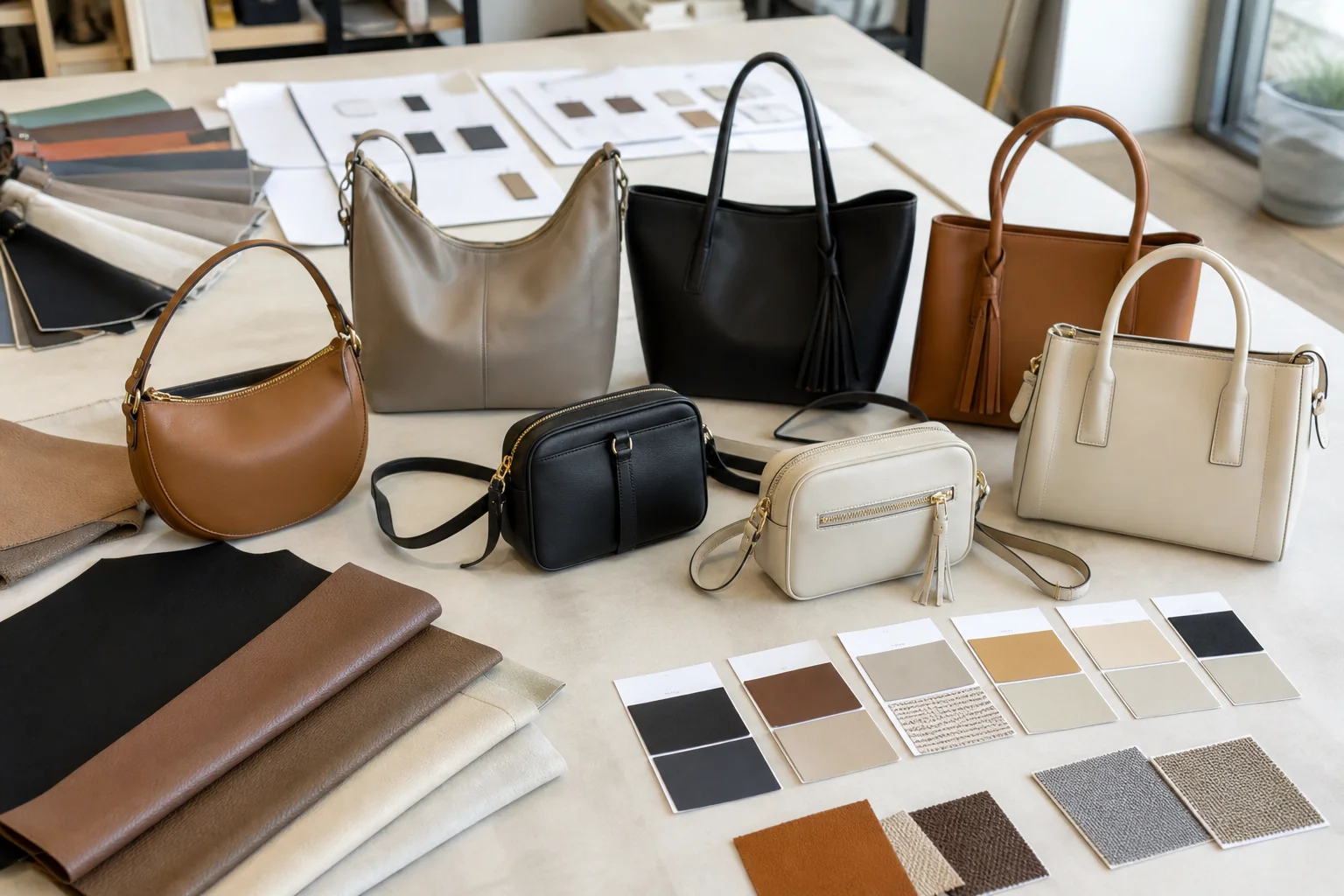
When several styles use the same coated fabric, lining, zip and hardware, the factory can buy those items in a single consolidated quantity. Combined volume crosses material and component thresholds that no individual style would reach alone.
The effect on price is direct, and it applies at the very first order rather than waiting for volume to build. This is the main reason a carefully designed narrow range can be cheaper per unit than a broader one.
What to share and what to vary
The productive split is to share the material platform and vary the silhouette, size and detailing. Customers perceive different products while the factory sees one material stream and one hardware family.
Sharing the silhouette while varying only colour is the opposite approach and generally performs worse. It reduces perceived choice while doing little for manufacturing efficiency, because the same panels are simply cut in different materials.
| Element | Share or vary | Effect |
|---|---|---|
| Coated fabric | Share | Larger material purchase, better tier |
| Lining and interlining | Share | Fewer items to stock and inspect |
| Zips and hardware family | Share | Component threshold easier to reach |
| Silhouette and size | Vary | Perceived range breadth |
| Detailing and trim | Vary selectively | Distinctiveness at low cost |
| Colour | Vary within a limited palette | Choice without material fragmentation |
Limiting the colour palette
Colour multiplies material commitments. Three styles in four colours is twelve material positions, which is the same complexity as twelve styles. A first range is usually better served by three styles in two or three colours.
A limited palette also improves colour consistency, because fewer coating runs are involved. The benefit is not only commercial; it reduces the chance of visible shade differences between styles sitting side by side.
Agreeing the platform with the factory
Sharing must be agreed explicitly rather than assumed. The right moment is during sampling, when materials can be fixed across the whole range instead of decided style by style.
Confirming that all styles will use the same material and hardware family also allows the factory to quote the range as a single programme, which is a better basis for price negotiation than a set of separate enquiries.
When sharing is not appropriate
Sharing fails where the range genuinely serves different functions. A commute bag and a travel bag have different structural needs, and forcing a shared material can compromise both.
The judgement is whether the shared element is a platform or a compromise. Shared fabric and hardware are usually a platform; shared dimensions and structure are usually a compromise.
Testing Demand Without Overcommitting
A first order is a test, and it can be designed to produce better information for the same money. A few adjustments turn a blunt experiment into a useful one.
Vary one thing at a time
If every style differs in material, size, colour and price point simultaneously, the results cannot be attributed to anything. Varying one dimension while holding the others constant produces an interpretable result.
The most useful variable to isolate on a first order is usually price point, because it has the largest effect on sell-through and the clearest implication for the second order.
Set a review point in advance
Deciding in advance when the range will be reviewed prevents the common pattern in which slow sellers are defended indefinitely. A fixed point, such as eight weeks after launch, makes the decision routine rather than personal.
At that review, the useful question is which styles earned their shelf space. Styles that did not should be replaced rather than deepened, because depth amplifies a demand signal that does not exist.
| Decision point | Signal to act on | Typical response |
|---|---|---|
| Four weeks | Early sell-through differences | Reallocate display space |
| Eight weeks | Clear winners and laggards | Reorder winners, plan to replace laggards |
| Sixteen weeks | Repeat purchase behaviour | Commit to a narrower, deeper second range |
| End of season | Full margin and markdown result | Set the next season’s style count |
Use low-cost tests before committing stock
Some demand questions can be answered before the order is placed. A small pre-order or deposit campaign establishes interest in specific styles, and a photographed sample can be tested with existing customers at very low cost.
These tests do not replace the first order, but they can decide which styles belong in it. Reducing the range on the basis of a real signal is better than reducing it on the basis of intuition.
Keep a small reserve
Holding back part of the buying budget for a mid-season top-up is more valuable than spending everything at launch. If a style outperforms, the reserve allows a fast response while the demand still exists.
The reserve is also a hedge against a range that proves too narrow. Being able to add a style in season is a better position than waiting for the next full order cycle.
Planning the Second Order From First-Run Data
The second order is where a retailer converts a test into a business. The data from the first order determines how far the range can be broadened safely, if at all.
Let sell-through set the count
If most styles performed similarly, the range was probably too narrow and can be broadened. If a small number carried the volume, the range can stay narrow and deepen instead.
Both outcomes are common and both are useful. What matters is that the decision follows the data rather than the original ambition for a larger collection.
Deepen before broadening
Where a style sold well and repeatedly, the highest-return action is more depth in that style, and possibly in adjacent sizes or colours. Depth in a proven style carries far less risk than depth in an unproven one.
Broadening should follow only when proven styles are fully stocked. Adding new styles while a winner runs out is the most common way a promising first order is wasted.
| First-run outcome | Second-order action |
|---|---|
| One or two clear winners | Deepen winners, replace laggards |
| Even spread across styles | Broaden slightly with real depth |
| Uniformly slow | Revisit price point and audience, not style count |
| Stock-outs on winners | Increase depth on those styles first |
| Markdowns on the tail | Cut the tail, reduce style count |
Reuse the platform
Where the first range was built on shared materials and hardware, the same platform should carry into the second order. It preserves the material threshold already reached and keeps consistency across styles.
Changing the platform between orders resets the purchasing advantage and risks visible shade differences between the old and new stock. Continuity is worth more than the variety it appears to cost.
Confirming the supplier relationship
By the second order the retailer knows how the factory performs on timing, quality and communication. That is the moment to negotiate for the volume tier, because the order history supports the request in a way a first enquiry never can.
A narrow first range answers a question. A well-planned second order acts on the answer. Retailers who do the first without the second end up repeating the experiment.
FAQ
How many bag styles should a new retailer order first?
Most small retailers are best served by four to eight styles with real depth in each. The number comes from four inputs: display capacity, the number of distinct customer groups, the buying budget, and how quickly stock can be replenished. Where the budget cannot fund two months of cover per style, the range is too broad.
Is it better to order more styles or more units per style?
More units per style, in almost every case. Depth prevents stock-outs on the styles customers want and produces the repeated sales that generate usable demand data. A shelf of many styles with one or two units each looks full and sells poorly, because the best seller is gone first.
What is the minimum depth I should hold per style?
A practical starting point is enough stock to sell for roughly two months at the expected rate, plus a margin to cover the replenishment lead time. If the budget does not stretch that far across the styles under consideration, reduce the style count rather than accepting thin stock everywhere.
Will a narrow range hurt my price per unit?
It can, because smaller total volume may miss a purchase threshold. This is largely solved by building the range on shared materials and hardware, which lets combined volumes reach the same thresholds. A well-designed narrow range often prices better than a broad one made from unrelated components.
Should every style be a different price point?
Not every style, but the range should cover an entry, a middle and an upper price point. Customers shop within a price band, and a range clustered at one point leaves gaps. The upper point needs only low depth; its role is to capture trade-up and make the middle option look reasonable.
How do I decide which styles to cut from the first order?
By role rather than by preference. A workable structure is one hero style, two or three supporting styles and one test style. Any style without a clear role is the one to drop when budget is tight, and any two styles that serve the same customer at the same price point in the same material should be reduced to one.
Can I start with a very small order to test the market?
You can, but below the supplier’s minimum the unit price rises sharply and some factories decline the order. Where a small test is essential, accept stock materials and simpler packaging to reduce the set-up burden, or buy samples rather than attempting a small production run.
How long before I know which styles are working?
Early differences usually appear within four weeks and become clear by about eight. A fixed review point set in advance keeps the decision routine. The most useful variable to isolate on a first order is price point, because it has the largest effect on sell-through.
Should I hold budget back for a mid-season top-up?
Yes. A reserve allows a fast response when a style outperforms while demand is still live, and it hedges against a range that turns out to be too narrow. Spending the entire budget at launch removes both options and is a common cause of missed sales on the strongest style.
What if all my styles sell at a similar rate?
An even spread suggests the range was slightly too narrow rather than that the styles were poorly chosen. The reasonable second-order response is a modest broadening with real depth maintained. An even spread across a broad range with thin stock usually means the range should be cut instead.
Should the second order repeat the same materials?
Yes, where the first range was built on a shared material platform. Reusing it preserves the purchasing threshold already reached and keeps colour consistent between old and new stock. Changing the platform resets the volume advantage and risks visible shade differences on the shelf.
When should I negotiate a better price with my supplier?
On the second order, once there is a performance history on timing, quality and communication. A volume-tier request supported by order history is far stronger than the same request on a first enquiry, and the supplier has a genuine reason to protect a proven account.
Planning your first wholesale range of PU leather bags?
We manufacture PU leather bags in Guangzhou on OEM, ODM and wholesale programmes, and we will quote your range as a single programme built on shared materials so that a focused first order still reaches sensible pricing. Send your range plan to info@gionar.com, or review our custom bag manufacturing capabilities.