What Does the Shift to Smaller Bags Mean for Bag Manufacturers?
Ask a room of wholesale buyers what changed in the last two seasons and the answer is rarely a material or a colour. It is size. Ranges that were built around one tote and one shoulder bag now carry five smaller shapes, and the volume line has moved from something that holds a laptop to something that holds a phone, a card case and a key.
For a factory, this is not a design preference passing through. It changes material yield, operation counts, machine setup, inspection method and freight economics. A small bag is not a large bag reduced: it is a different production problem, and the programmes that go wrong are usually the ones planned as if the only difference were the pattern.
What “smaller” means in practice
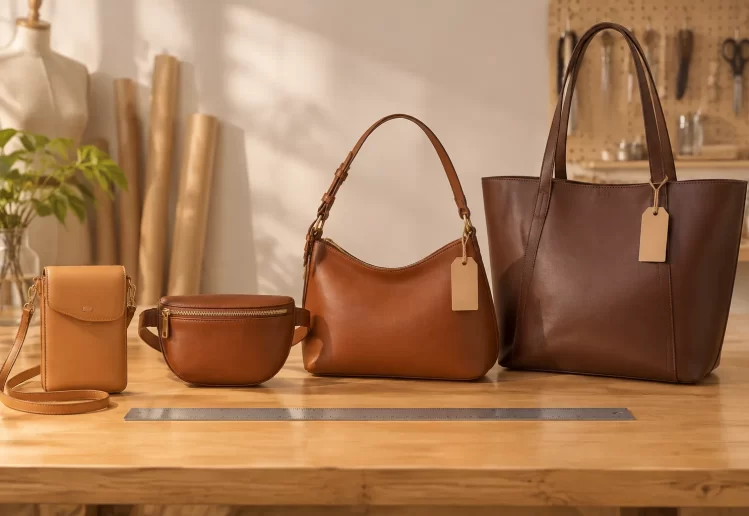
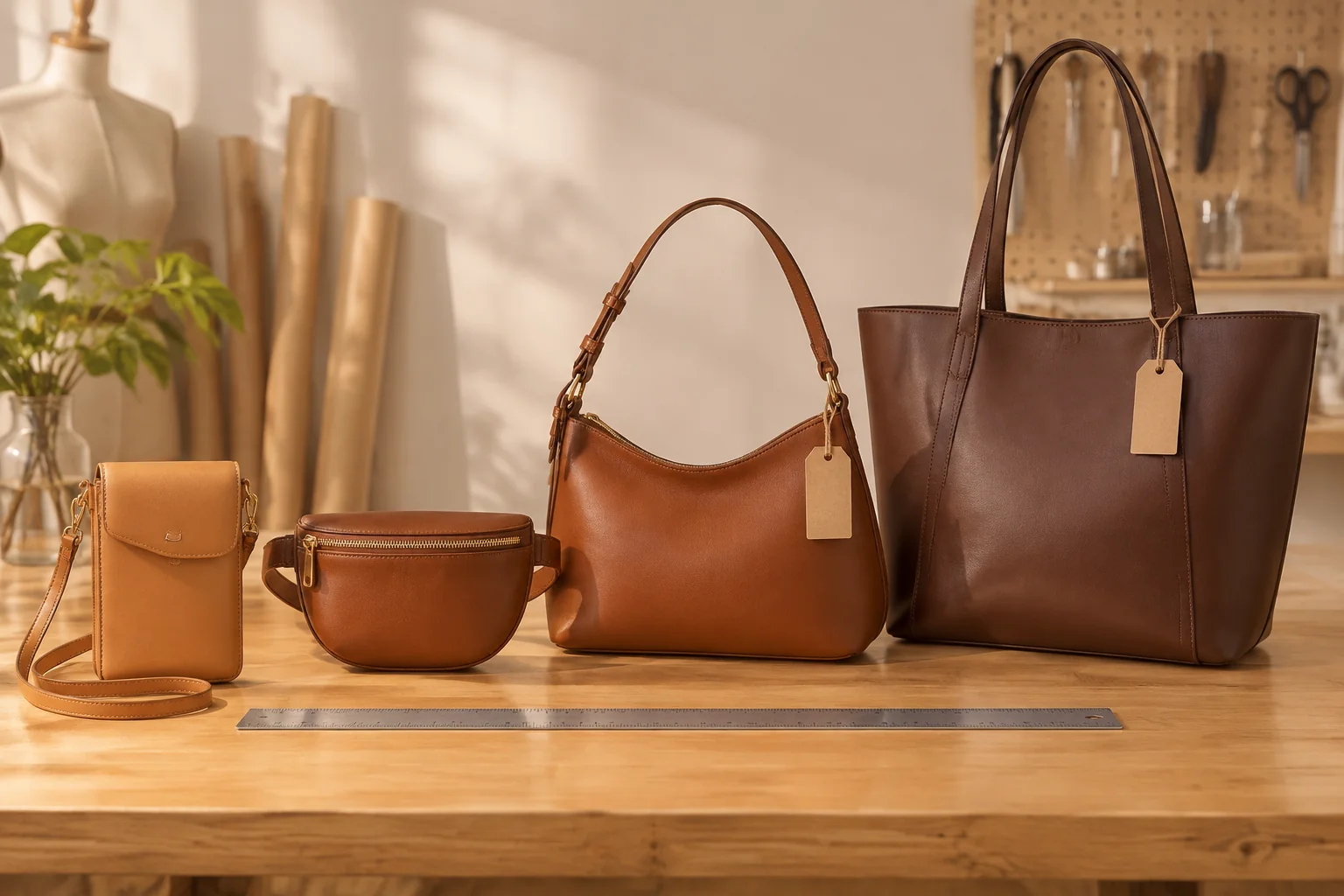
Most of the shift sits in the 18 to 26 centimetre width band: phone crossbodies, belt bags, compact shoulder shapes, mini totes and structured pouches. They carry proportionally more hardware per square metre and far less surface area for the same number of operations.
Why it matters commercially
Retail price does not fall in proportion to size. A bag using a third of the material often retains half to two-thirds of the price, which is attractive for a brand and awkward for a factory quoting on material cost alone.
What this article covers
The manufacturing consequences of the size shift, section by section: unit economics, cutting yield, sewing operations, hardware and edge work, load paths, tooling, labour skill, inspection, packing and MOQ. It closes with the questions buyers should put to suppliers before committing a small-bag programme.
- What Is Driving the Shift
- Unit Economics of a Small Bag
- Cutting Efficiency and Material Yield
- Sewing: More Operations, Shorter Runs
- Hardware and Tighter Tolerances
- Small-Radius Edge Finishing
- Interior Complexity in Compact Shapes
- Load Paths in Small Bags
- Pattern Making and Sample Iterations
- Machine and Attachment Requirements
- Skill Mix and Operator Training
- Inspection at Small Scale
- Packing, Cartons and Freight
- MOQ and Colour Mix Pressure
- Costing a Small-Bag Programme
- Capacity Planning
- Quality Risks Specific to Small Goods
- What Buyers Should Ask Suppliers
- Where the Trend Goes Next
- Material Efficiency and Waste
- Returns and Repair Behaviour
- Inventory and Reorder Dynamics
- Writing a Small-Bag Brief
- Reading a Small-Bag Quote
- Prototyping Timeline for Small Bags
- Small-Bag Production Checklist
- FAQ
What Is Driving the Shift
Carry habits changed before the ranges did
Cards, keys and a phone cover most daily carrying, and the laptop moved to a separate sleeve or stayed at home. Once the daily load shrank, the bag that matched it shrank with it.
Price architecture
A smaller bag at a similar price point improves margin per unit of material. Brands discovered this independently, and the result is a range structure where small shapes carry the volume and large shapes carry the image.
Cost of living pressure
Where customers trade down, they often trade to a smaller item at a lower absolute price rather than to a cheaper version of the same size. That keeps the price acceptable and the margin workable.
Resale and versatility
Small bags photograph well, convert across day and evening use, and are easier to resell because condition loss is concentrated in fewer places. The trend and the resale conversation reinforce each other.
Unit Economics of a Small Bag
Material falls faster than labour
A bag at half the surface area uses roughly half the material but keeps most of its operations: cutting, skiving, lining, zip, hardware setting, edge work, cleaning and packing all remain. Labour share therefore rises sharply.
Hardware density doubles
Two D-rings, a zip, a clasp and a strap adjuster on a small bag is the same component count as on a tote that uses three times the material. Hardware and its attachment labour become the dominant cost driver.
Quoting on material alone understates it
Buyers who benchmark a small bag against a large one per square metre will find quotes that look expensive. Benchmark per piece and per operation instead, and the numbers become comparable.
Where the margin hides
Small bags are economical to produce when operations are simplified rather than scaled down. Reducing component count is the main lever, and it is a design decision rather than a factory one.
Cutting Efficiency and Material Yield
Small parts, more offcuts
Small panels leave more waste per roll because the marker cannot nest as tightly. Yield on a small-bag programme is typically several percentage points worse than on a large-bag programme in the same material.
Nesting quality decides the quote
Two suppliers quoting the same small bag can differ mainly in how well they mark. Ask for the nesting efficiency figure; a supplier who cannot state it is estimating rather than costing.
Direction and grain alignment
Small panels forgive less in grain direction, especially on curved fronts where a misaligned panel is immediately visible. Cutting discipline matters more, not less, when the panels are small.
Strip cutting and pre-cutting
Straps, gussets and small trims can be pre-cut in batches and stored flat, which improves yield and speeds assembly. It also creates a component control problem if the batches are not labelled.
Sewing: More Operations, Shorter Runs
Operation count does not drop with size
A compact crossbody can carry twenty to thirty operations. The same bag scaled up carries roughly the same number, so the sewing time per unit falls far less than the material cost does.
Tighter spaces, slower handling
Sewing inside a small opening is slower than sewing a large panel. Handling time per operation rises, and the learning curve for an operator is longer because visibility is limited.
Turned versus bound construction
Small bags often use turned construction to hide seams, which requires precise seam allowances and careful turning. Bound construction is faster but shows more, and the choice changes both cost and appearance.
Line balance is harder
With many short operations, balancing a line becomes delicate: one slow station holds the whole flow. Small-goods lines usually need more operators per hundred units than large-bag lines.
Hardware and Tighter Tolerances
Small hardware, small margins for error
On a 20 millimetre strap, a one millimetre misalignment is visible. Tolerances that are acceptable on a tote become defects on a mini, and the inspection standard has to reflect that.
Component sourcing narrows
Miniature buckles, small D-rings and short zips come from a smaller supplier pool with fewer finish options. Availability constrains design more than it does on large bags.
Attachment methods change
Rivets replace some stitched junctions, and rivet placement is unforgiving. A misplaced rivet on a small panel cannot be hidden by a seam, so setting accuracy becomes a quality gate.
Weight and balance
Hardware proportionally heavy on a small bag affects how it hangs and how the strap behaves. Testing the assembled bag, not the components, is the only reliable check.
Small-Radius Edge Finishing

Curved edges punish paint systems
Edge paint on a small radius has to bend further than on a straight panel. Systems that pass on a tote crack on a compact curve, and the failure shows within weeks of use rather than at inspection.
More edge length per unit area
A small bag has proportionally more edge to finish: proportionally more handling time, more drying space and more opportunity for an uneven finish.
Fold-over edges need thinner skiving
Folding a small panel requires thinner skiving, which weakens the edge if taken too far. The balance between a clean fold and adequate strength is tighter on small goods.
Drying and rack space
Painted edges need drying space, and many small units consume more rack space per hundred pieces than fewer large ones. Factories without that space rush the drying, which is where cracking begins.
Interior Complexity in Compact Shapes
Small interiors hide less
Lining seams, raw edges and thread ends are more visible in a compact interior because the opening is small and the customer looks closely. Neatness standards rise even though the panel is smaller.
Card slots and organisation
Interior organisation is a selling point on small bags, and each slot adds operations. Two card slots and a zip pocket can add more labour than the exterior panels.
Lining material choice
Lighter linings reduce bulk in a small bag, but thinner linings tear at zip ends. The trade-off has to be settled with a test, not with a swatch in hand.
Turn-through limits
The smaller the bag, the harder it is to turn through the opening during assembly. Pattern makers compensate with a slightly larger opening or a bound finish, and both decisions affect appearance.
Load Paths in Small Bags
Small bags are often worn across the body
Crossbody wear puts load on one strap and one set of anchors, repeatedly, at an angle. Reinforcement at both ends matters more than the total weight carried.
Strap width versus hardware
A narrow strap concentrates load at the buckle and the D-ring. On a 15 to 20 millimetre strap, the hardware becomes the weak point rather than the leather.
Zip pressure at the ends
A small bag is usually filled to capacity, which loads the zip ends every time it is closed. Zip-end reinforcement and a slightly longer zip opening prevent the most common functional failure.
Testing to failure
Static load tests on the anchors and a repeated open-close cycle on the zip reveal small-bag weaknesses quickly. Both are cheap and both belong in the pre-production meeting.
Pattern Making and Sample Iterations
Small patterns are less forgiving
A two millimetre pattern error on a tote is invisible; on a compact bag it changes the proportion. Pattern accuracy requirements rise with the size reduction.
More iterations, not fewer
Buyers often assume a small bag needs fewer samples. In practice proportions are harder to judge, and three or four iterations are common before a shape settles.
Blocking and reinforcement
Structured small bags rely on interlinings and board to hold shape in a small volume. The blocking choice defines the silhouette, and it is a pattern decision made early.
Scale models help
Producing one prototype in a neutral material at correct scale reduces the number of colour and material iterations later. It is the cheapest way to settle proportion.
Machine and Attachment Requirements
Post-bed machines become essential
Sewing around a small opening requires a post-bed machine with a narrow arm. Flat-bed machines cannot reach the interior of a compact bag, and factories without post-bed capacity subcontract the assembly or refuse the style.
Small attachments and folders
Specialised folders and binders for narrow straps and small curves speed up consistent work. A factory that has them quotes lower and delivers more consistently than one improvising at the machine.
Needle and thread sizing
Fine thread and smaller needles suit small panels but reduce seam strength. The specification has to name both, because a factory defaulting to heavy thread will produce visible holes and a stiff seam.
Press tooling for small hardware
Setting miniature snaps and rivets needs dedicated dies. Hand setting on small panels produces deformation that is immediately visible, and the tooling cost per style is small.
Skill Mix and Operator Training
Fewer operators can make a whole style
Small goods concentrate skill: one operator may complete a whole sub-assembly. That makes the line flexible and simultaneously vulnerable, because the skill sits in a few people.
Training time is longer per operation
Handling small parts accurately takes practice. A new operator on small goods reaches target output more slowly than on large panels, which affects the ramp-up plan at the start of a programme.
Skill matrix by sub-assembly
Record who can build each sub-assembly and at what rate. This is the only way to plan around absence or a surge without discovering the gap during production.
Retention matters more
Where a style depends on two skilled operators, turnover is a production risk rather than an HR metric. Buyers should ask how long the assigned operators have been on similar work.
Inspection at Small Scale
Higher sampling density
Defects on small bags are distributed across more units per carton, so a sample of the same size covers proportionally less of the lot’s appearance. Many programmes inspect the same number of pieces but examine more points per piece.
Measurement points multiply
Compact shapes need measurements at more points relative to their size: width at opening and base, depth at three positions, strap drop and hardware spacing. A three-point check is not enough.
Symmetry is the first visual check
Small bags are judged on symmetry, because the eye can compare left and right halves at a glance. Flap alignment, strap attachment height and pocket centring are the first three checks.
Function testing per unit
Zip operation, clasp engagement and strap adjustment should be exercised on every inspected piece. Functional failures on small goods are usually assembly errors rather than material faults.
Packing, Cartons and Freight
More units per carton, more handling
A carton that held forty totes may hold two hundred minis. Handling per unit falls but counting, checking and packing accuracy risks rise, and a miscount is discovered at the destination.
Protection per unit is harder
Small structured bags deform easily under compression. Individual wrapping, dividers or inserts add cost that is proportionally larger on a low-material item.
Freight economics improve
Cartons cube out well before they weigh out, which lowers freight cost per unit substantially. This is one of the few genuine cost advantages of the size shift and it should appear in the landed cost.
Retail-ready packing
Where bags ship retail-ready, each unit needs a tag, a poly bag and often a hanger. Per unit packing labour rises even as freight falls, and both belong in the same calculation.
MOQ and Colour Mix Pressure
Minimums are set per colour, not per unit
A colour minimum of 300 pieces is a harder constraint on a small bag than on a large one, because a small-bag range usually carries more colourways to look complete. The mix, not the total, becomes the binding limit.
Material minimums behind the style minimum
A factory can only cut a colour if the mill will supply it at a workable quantity. Small bags consume less material per piece, which means more pieces are needed to consume a roll and the material minimum bites earlier.
How buyers work around it
Sharing a material across two or three shapes in the same colour is the standard answer. It keeps the colour story coherent and lets a range hit minimums without inflating any single style.
What to negotiate explicitly
Negotiate the colour minimum, the per-style minimum and the shipment minimum separately, in writing. Factories that quote one blended minimum will apply the strictest interpretation when the order arrives.
Costing a Small-Bag Programme
Cost per operation, not per square metre
Build the quote from an operation list with time per operation. Material is a smaller share than on a tote, so an error in the labour estimate is proportionally more damaging.
Tooling and dies as one-off items
Embossing plates, cutting dies, hardware setting dies and any custom buckles are one-off costs. On a small bag they are spread over fewer material dollars, so list them separately rather than amortising them invisibly.
Freight savings belong in the sheet
Cartons cube out earlier and freight per unit falls. A landed cost comparison that ignores this will make small bags look more expensive than they are relative to large ones.
Sample and iteration costs
Expect more sample rounds and budget for them. Three to four iterations is normal, and each consumes a factory slot that has to be scheduled.
Capacity Planning
Capacity is measured in pieces, but planned in operations
A line that produces 800 totes a day may produce only 1,200 minis, not 3,000, because operations per piece have not fallen in proportion. Capacity assumptions from large-bag programmes overstate small-bag output.
Line assignment matters
Small goods suit lines with post-bed machines, fine-thread capability and operators used to tight handling. Moving a style to a line without those conditions produces both slower output and more defects.
Peak season behaviour
Small bags are often gifting items with concentrated demand. The four weeks before a peak are when capacity disappears, and a schedule that assumes steady output will slip.
Plan around the bottleneck station
Identify the slowest operation, usually edge work or interior assembly, and plan output around it. Every other station will idle to its rhythm regardless of how fast it is.
Quality Risks Specific to Small Goods
Symmetry and alignment
Flap alignment, strap height and pocket centring are the three defects that show first and are hardest to correct after assembly. They should be checked at the sub-assembly stage, not at final.
Edge cracking on curves
Small radii crack where large ones do not. A flex test on the finished edge before bulk production is the only reliable predictor.
Hardware seating
Undersized or over-pressed rivets split the material or leave it loose. Setting depth should be verified on the first fifty pieces of each lot.
Handling damage
Small structured bags mark easily during internal transport. Trays, dividers and defined stacking reduce a defect category that has nothing to do with construction.
What Buyers Should Ask Suppliers
Post-bed capacity and small-goods experience
Ask how many post-bed machines the line has and which small shapes the factory has run in the last year. A factory with no recent small-goods programme will underestimate both labour and sample rounds.
Edge system and flex testing
Ask which edge system is proposed for the radius in your design and whether it has been flex tested. This one question separates factories that have produced small goods from those that have only seen photographs of them.
Hardware availability at size
Ask for the miniature component range with finishes and minimum quantities. Design decisions should be made against what exists, not against what a catalogue suggests might exist.
Nesting efficiency and yield
Ask for the marker efficiency figure for your style. A supplier who quotes without it is guessing at a cost item that materially changes the price of a small bag.
Where the Trend Goes Next
Size stabilises, complexity rises
The average size is unlikely to fall much further; what changes is interior complexity and hardware detail. That direction raises labour again, which keeps the manufacturing pressure on.
Modular and convertible shapes
Straps that convert, pouches that detach and inserts that move between bags add components and operations. They are commercially attractive and manufacturing-heavy, and the cost has to be quoted operation by operation.
Material efficiency as a selling point
Less material per bag is an easy sustainability narrative, and buyers will use it. Factories that can evidence yield and waste figures will be asked for them in tenders.
The large-bag counter-trend
Oversized shapes return periodically, and ranges will carry both ends simultaneously. Factories with flexible line assignment across sizes will absorb that swing better than those specialised in one.
Material Efficiency and Waste
Less material, more offcut
The size shift lowers material per bag but raises the offcut ratio, so the sustainability story is more nuanced than “smaller uses less”. Reporting both figures is more credible than reporting only the first.
Where waste actually occurs
Most waste in a small-bag programme sits in cutting offcuts, edge trimming and rejected sub-assemblies. The first is a marker problem, the second a skill problem, and the third a training problem.
Reuse of offcuts
Small trims, tabs and card slots can often be cut from what would otherwise be waste. Programmes that design for offcut reuse improve yield without changing the material.
What buyers should ask for
Yield per style, offcut percentage and the destination of offcuts. Factories able to answer all three are measuring, and measurement is the precondition for any credible claim.
Returns and Repair Behaviour
Smaller units, different return reasons
Small bags are returned more often for size disappointment than for defects, because the customer’s expectation is harder to judge online. That is a photography and dimension-listing problem as much as a production one.
Repair economics favour small goods
Replacing a strap or a clasp on a small bag is cheap relative to its value, which makes repair viable. Programmes offering repair keep more units in use and reduce returns pressure.
Handling damage in transit
Compression and creasing account for a meaningful share of small-bag returns. Dividers and adequate carton fill prevent damage that is otherwise attributed to the factory.
What the data should feed
Return reasons should split between expectation gaps and construction faults. The first is fixed in the listing, the second in the specification, and conflating them fixes neither.
Inventory and Reorder Dynamics
Lower unit cost, higher unit count
A small-bag order at the same value contains far more pieces. Warehouse space, counting time and picking errors all increase even though the total spend has not.
Faster sell-through, shallower cover
Small bags often sell in higher unit volumes at lower prices, which shortens the reorder cycle. Buyers used to seasonal large-bag cycles need a faster replenishment rhythm.
Colour depth versus width
With more colourways in a range, stock per colourway is thinner. That improves presentation and worsens the risk of a single colour breaking and looking incomplete on shelf.
Reorder quantities and minimums
Reorders on small bags hit factory minimums sooner in absolute value. Planning two or three styles on one material is the practical way to keep replenishment economic.
Writing a Small-Bag Brief That Works
Lead with operations, not dimensions
A brief that lists dimensions and a photo produces a quote built on the factory’s guess. A brief that lists components, operations and tolerances produces a quote that can be compared and defended.
State the tolerance per part
Small bags need part-level tolerances, not one blanket figure. Strap width, hardware spacing and flap alignment each need their own number, because each fails differently.
Name the test, not the adjective
“Durable edge” means nothing on the floor. “Edge system flex tested to 20,000 cycles at the smallest radius” means something, and it can be verified on a sample before bulk production.
Reading a Small-Bag Quote
Check what is excluded
Tooling, dies, sampling, inspection and packing are frequently excluded and then added. A quote is only comparable once the excluded list is written down on both sides.
Compare operation counts
Two quotes for the same style that differ by twenty percent almost always differ in operation count or in hardware specification. Ask both suppliers for their operation list.
Ask for the marker figure
Material cost in a small bag is driven by yield. A supplier quoting without a nesting efficiency figure is estimating, and the estimate is usually optimistic.
Prototyping Timeline for Small Bags
Why the calendar stretches
Sample rounds multiply, hardware has to be sourced at size and edge trials need drying time. A small-bag development that looks like a two-week job is commonly four to six weeks from brief to approved sample.
Sequence the risky parts first
Build the first prototype around the smallest radius and the tightest hardware spacing, not around the easiest panel. If those two work, the rest of the bag will follow; if they fail, everything downstream changes.
Freeze hardware before patterns
Miniature components constrain panel dimensions. Approving the pattern before the hardware is confirmed is the most reliable way to require a second tooling round.
Plan production around sample approval
Bulk material should not be ordered until the edge system and hardware setting are proven on a finished sample. The saving from ordering early is small compared with the cost of re-cutting.
Small-Bag Production Checklist

Twelve items to confirm before a small-bag programme is released to production. Each addresses a point where the size reduction changes the manufacturing problem rather than simply scaling it.
| Item | What to confirm |
|---|---|
| Operation list | Time per operation, not cost per square metre |
| Nesting efficiency | Marker yield figure for the actual panels |
| Hardware range | Miniature components, finishes, minimums |
| Setting tooling | Dedicated dies for snaps and rivets |
| Edge system | Flex-tested on the smallest radius in the design |
| Interior specification | Slots and pockets counted as operations |
| Reinforcement | Anchors and zip ends specified by type |
| Machine assignment | Post-bed capacity and needle/thread size |
| Skill matrix | Named operators per sub-assembly |
| Inspection plan | Sample size plus points per piece |
| Packing method | Dividers or inserts to prevent compression |
| Colour minimum | Stated per colour and per material |
A small bag is not a large bag made cheaper. It is the same number of operations applied to less material, which is why the cost per piece falls far less than the buyer expects and the defect profile changes entirely.
FAQ
Why does a small bag cost almost as much to make as a large one?
Because material is a small share of total cost. Cutting, sewing, hardware setting, edge finishing, inspection and packing are all still required, and several take longer per piece on small panels. The material saving is real but modest.
Do small bags need different machines?
Usually yes. Post-bed machines with a narrow arm are needed to sew inside a compact opening, and small hardware requires dedicated press dies. Factories without that equipment subcontract or struggle.
Is material yield worse on small-bag programmes?
Typically several percentage points worse, because small panels leave more offcut per roll. The exact figure depends on the marker, which is why nesting efficiency should be requested rather than assumed.
What is the most common defect in small bag production?
Asymmetry: flap alignment, strap attachment height and pocket centring. The eye compares the two halves of a small bag at a glance, so small misalignments read as obvious faults rather than tolerances.
Does the size shift reduce freight costs?
Substantially per unit, because cartons cube out before they weigh out. That improvement belongs in the landed cost comparison; excluding it makes small bags appear more expensive than they are.
How many sample rounds should I budget for?
Three to four is common, more than for large bags. Proportions are harder to judge at small scale, and each iteration consumes a sample slot that has to be scheduled into the factory’s calendar.
Why are colour minimums a bigger problem on small bags?
A small-bag range usually needs more colourways to look complete, while the colour minimum stays the same in pieces. Sharing one material across two or three shapes is the usual way to satisfy both.
Which edge finish works best on tight curves?
One that has been flex tested on the actual radius in the design. Systems that perform on a tote can crack on a compact curve, and the failure shows after weeks of use rather than at inspection.
Should small bags be turned or bound?
Turned construction hides seams and suits the category, but demands precise allowances and is harder to turn through a small opening. Bound construction is faster and more visible, and the choice affects both cost and appearance.
How does capacity planning change?
Output per line falls far less than the size suggests, because operation counts stay similar. Planning from large-bag throughput rates overstates capacity and produces schedules that slip in peak season.
Are small bags harder to inspect?
They need more measurement points relative to their size and a function test on every piece. The number of pieces per carton also rises, so counting and packing accuracy need their own check.
What should a buyer ask before committing a small-bag programme?
Post-bed capacity, recent small-goods experience, the proposed edge system and its flex test, miniature hardware availability with minimums, and the marker efficiency figure. Five questions, and each one changes the quote.
Will the shift to smaller bags continue?
Average size is likely to stabilise rather than keep falling, while interior complexity and hardware detail increase. That continues to raise labour content, so the manufacturing pressure does not ease even if the trend flattens.
How does this affect a factory’s range of capabilities?
It rewards factories that can run both small and large shapes on flexible lines, hold miniature hardware stock and test edge systems. Single-specialisation factories lose tenders that mix sizes.
Planning a small-bag range and need a production view, not a catalogue?
Send your designs and target quantities to info@gionar.com. We will return an operation-based cost breakdown, the edge system we recommend for your smallest radius, and the colour minimums that actually apply.