The bag your customer carries is only as good as the materials it is built from — and the materials are only as trustworthy as the tests that prove them. A bag can look perfect on the shelf and fail in the world: the color fades in the sun, the coating cracks in the cold, the strap stretches under weight, the zipper teeth wear, the surface flakes off against a desk. These failures are not design flaws or factory mistakes — they are material properties that were never tested, and the buyer who skipped the testing discovered the properties the expensive way, in returns, refunds and reviews.
This guide covers bag material testing from the buyer’s decision outward: why material testing matters and when it pays for itself, the core tests every bag material should pass (physical, color, chemical and functional), the international standards that define the methods and the limits, how to read a test report and what the numbers mean, and how to build material testing into the sourcing process — from material selection through the approved sample to the production lot. Whether you source PU, genuine leather, fabrics or coated materials, the testing framework in this guide is the professional standard that separates a brand that verifies from a brand that hopes.
- Why Material Testing Matters
- The Testing Framework at a Glance
- Physical Tests: Strength, Wear and Behavior
- Color Tests: Fastness, Fading and Crocking
- Chemical Tests: Safety and Compliance
- Functional Tests: Components and Assembly
- Standards: The Language of Test Reports
- Reading a Test Report Like a Professional
- Building Testing into Your Sourcing Process
- FAQ
Why Material Testing Matters
Material testing exists because the properties that determine a bag’s real-world performance cannot be seen, felt or guessed — they must be measured. The material’s strength under load, its resistance to abrasion, its color stability under light, its chemical composition, its behavior at temperature extremes: every one of these is invisible on the shelf and decisive in use. The sample’s beautiful surface tells you nothing about whether the surface will still be beautiful after a season in the sun or a thousand miles against a shoulder. Testing is the instrument that turns the material’s promises into numbers — and the numbers are what the brand can rely on.
The economics of testing are the same as every verification: a test costs a small fraction of the order, and it retires risks that a failure would price at multiples. Consider the arithmetic of a color-fastness failure: a batch of bags whose coating fades after three months of sun, returned across every channel, refunded, discounted, and removed from shelves — the cost is the order value several times over, plus the brand damage that no invoice captures. The color-fastness test that would have caught it costs tens of dollars on a material sample. Testing is not a laboratory luxury; it is the cheapest form of product insurance the buyer can buy, and it compounds across every order that inherits the tested materials.
Testing also changes the supplier relationship in the same way inspection does: a factory whose materials are tested to written standards, with reports on file, is a factory that selects materials for performance rather than price — and the buyer who demands tests shifts the factory’s incentive at the material-selection stage, where the product’s quality is actually decided. The factory without tests is not necessarily bad; it is simply unknown, and the buyer who carries the unknown is carrying the risk. The testing framework that follows is how the unknown becomes known.
“A material is not what it looks like. It is what it measures. The test report is the material’s biography — and the buyer who does not read it is buying a stranger.”
The Testing Framework at a Glance
Bag material testing organizes into four families, and each family answers a different question about the material. The framework below is the map; the sections that follow walk through each family in detail.
| Test family | Question it answers | Typical tests |
|---|---|---|
| Physical | Will it hold up in use? | Tensile, tear, seam strength, abrasion, flexing |
| Color | Will it keep looking right? | Color fastness to light, washing, rubbing (crocking) |
| Chemical | Is it safe and compliant? | Heavy metals, phthalates, formaldehyde, REACH/CPSIA |
| Functional | Do the components work? | Zipper cycling, hardware strength, strap load, coating adhesion |
The framework’s logic: physical tests protect the product’s function, color tests protect its appearance, chemical tests protect the users and the brand’s legal standing, and functional tests protect the whole assembly. A complete material program runs tests from each family on the material samples — usually at material selection, again at the approved sample, and periodically on production lots — and the results accumulate into a material dossier that travels with the product. The buyer who knows the four families can read any test report, ask the right questions at any material decision, and build a testing program matched to the product’s real risks — not a generic list.
Physical Tests: Strength, Wear and Behavior
Physical tests measure how the material behaves under the forces of real use — the load of the contents, the wear of daily handling, the flexing of hinges and corners. They are the first family because they protect the product’s core promise: that the bag holds.
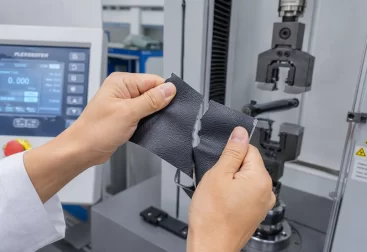
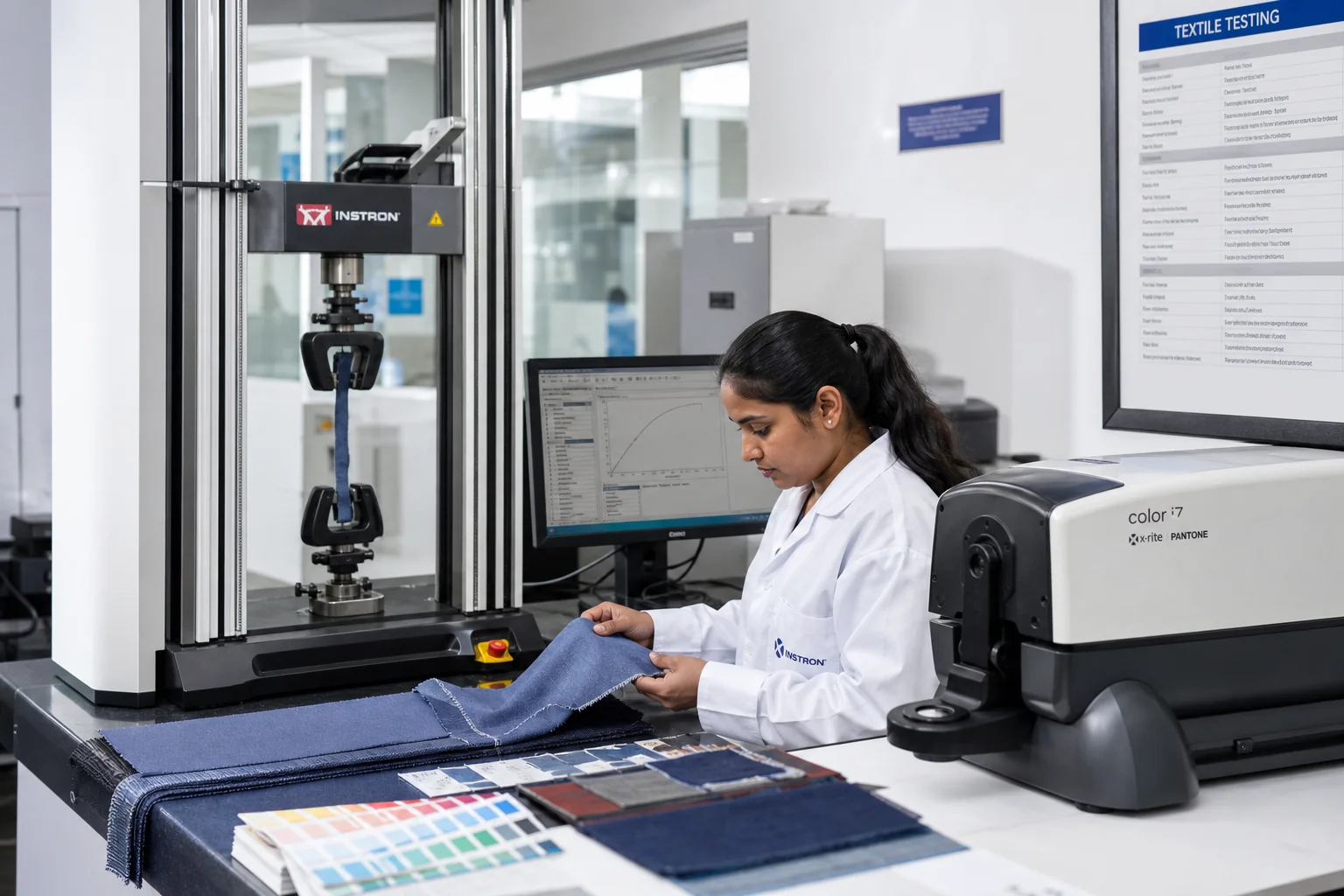
Tensile strength measures the material’s resistance to being pulled apart — the force at which it breaks — and it matters wherever the bag carries load: the strap, the handles, the body panels. The test stretches a cut strip to breaking and records the force; the result, in newtons (N), sets the material’s honest load limit. Tear strength measures resistance to a propagating tear — the rip that starts at a puncture or a seam stress point — and it matters because bags fail by tearing far more often than by clean breaking: a tear test that records a low value warns that a snag becomes a hole. Seam strength tests the assembly rather than the material — the force a sewn seam withstands before the stitches or the material give way — and it is the test that catches both weak thread and weak materials at their junction.
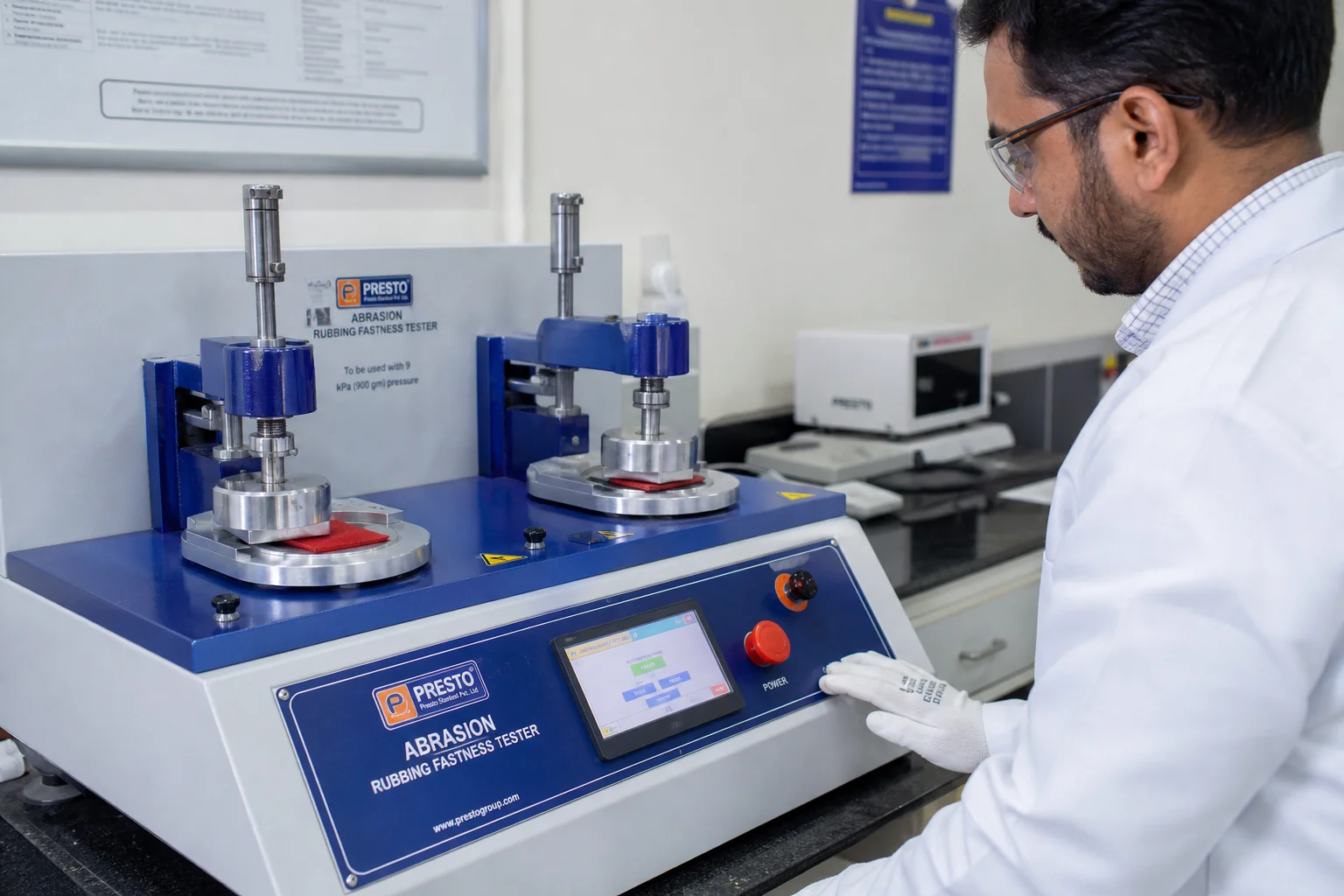
Abrasion resistance measures the surface’s survival under rubbing — the Martindale or Taber test cycles an abrading head over the material and assesses the wear. For PU and coated materials, abrasion is the test that predicts the flaking and scuffing that age a bag in use; a low cycle count warns that the surface will not survive a season against desks, cars and shoulders. Flexing measures the material’s survival under repeated bending — the flexometer folds the sample thousands of times — and it matters at the corners, hinges and closures where bags bend most. For coated materials, flexing is the test that catches the cracking that appears after months of folding. Each physical test maps to a real failure mode, and the material that passes them is a material whose promises have been measured.
Color Tests: Fastness, Fading and Crocking
Color tests protect the appearance — the second promise of a bag, and the one customers notice first. A bag can be functionally perfect and commercially dead if its color fades, bleeds or rubs off, and the tests below are how that fate is measured in advance.
Color fastness to light measures resistance to fading under illumination: the sample is exposed to a xenon lamp for a defined period and compared against the blue-wool scale, rated 1–8 with 8 the most resistant. For bags that live in shop windows and sunlight — and for every bag, eventually — the light-fastness rating sets how long the color survives before the customer perceives fading. Color fastness to rubbing (crocking) measures transfer: a dry and a wet cloth are rubbed over the surface and the staining is rated 1–5. The test matters most for dyed materials and dark colors, where crocking stains clothes, hands and other surfaces — the failure that turns a sale into a complaint within the first week.
Color fastness to washing measures how the color survives cleaning — the wash test in warm water with detergent — and matters for bags that will be cleaned or that face rain and moisture. Color fastness to perspiration covers the acid and alkaline conditions of human sweat, relevant for materials that touch skin, wrists and shoulders. The fastness ratings are the language of the test report, and the buyer’s standard should be written into the material spec: for a typical bag program, light fastness of 3–4 (or higher for premium), crocking of 3–4 dry and 2–3 wet, and washing fastness appropriate to the product’s care expectations. The ratings are not abstractions — they are the measured prediction of how the bag will look next season, and the buyer who sets them deliberately is buying the appearance they expect.
Chemical Tests: Safety and Compliance
Chemical tests verify what the material contains — and they are the family where the brand’s legal exposure lives, because chemical failures are not merely quality problems, they are compliance failures with regulatory consequences.
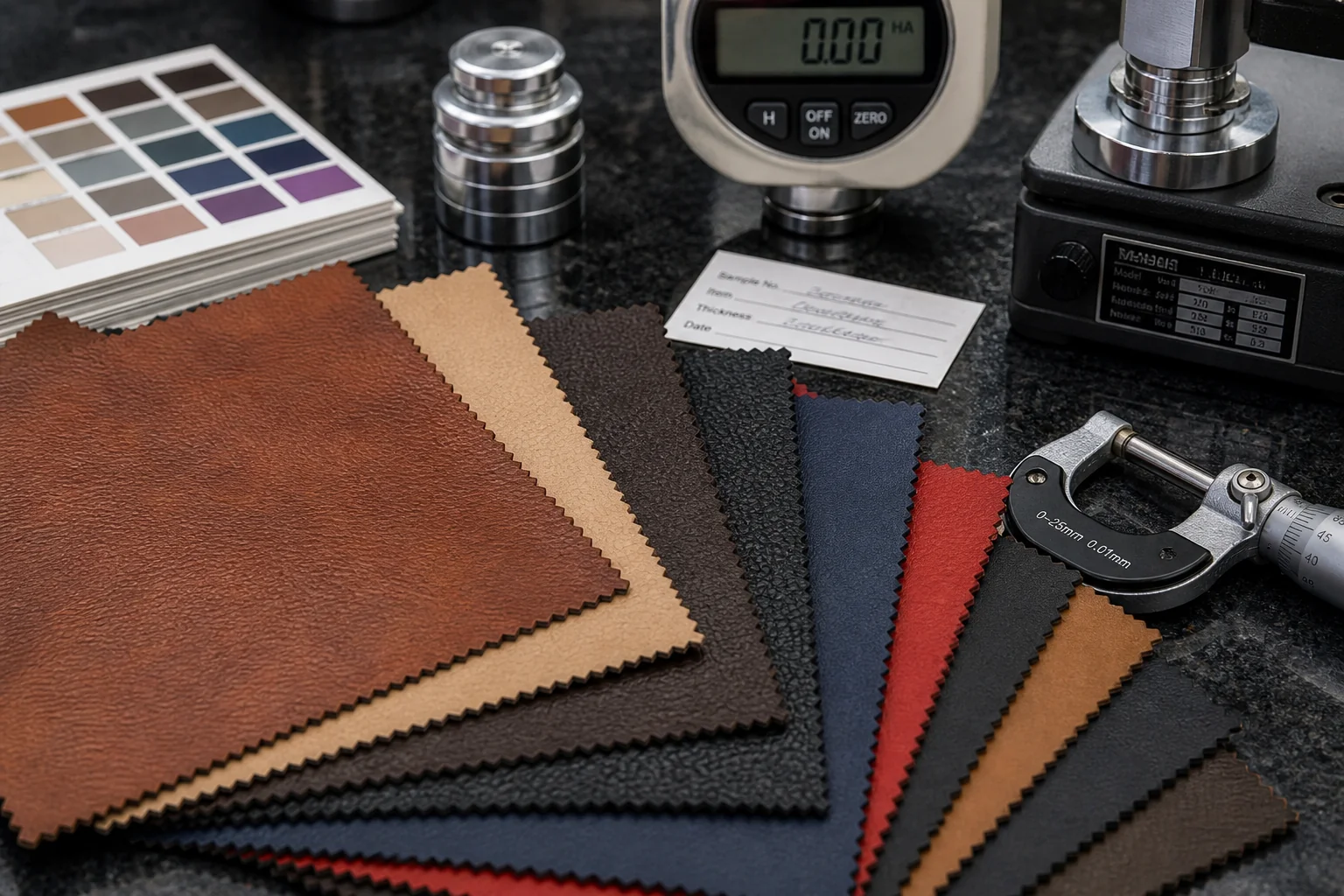
The core chemical tests cover the substances that regulations restrict: heavy metals (lead, cadmium, nickel — nickel being the classic hardware allergen trigger), phthalates (plasticizers restricted in children’s products and some apparel), formaldehyde (restricted in textiles and leather in many markets), and azo dyes (carcinogenic amines banned in most regulated markets). The compliance framework is regional: the EU enforces REACH (with its restricted substance list and the high-priority SVHC list) and the Toy Safety Directive for children’s products; the US enforces CPSIA (lead and phthalate limits, mandatory testing for children’s products) and California’s Proposition 65; other markets have their own regimes. The common thread: the buyer’s destination market defines the chemical standard, and the material’s test report must prove compliance with that standard, not a generic “tested” claim.
The practical program: request chemical test reports from the material supplier for the restricted substances in your market, have the reports verified by an independent laboratory on the first order, and re-verify periodically or when the material source changes. Two realities temper the program: a certificate is a point-in-time document for a specific lot (verify the lot number matches your material), and the cost of a chemical test panel is small against the cost of a recall or a customs rejection. The chemical family is the testing layer where the buyer protects the brand’s legal standing — and where “we have always used this material” is the answer that has ended more than one importing career.
Functional Tests: Components and Assembly
Functional tests verify the components and the assembly — the zippers, hardware, straps and coatings whose failure breaks the bag even when the material itself is sound. They close the gap between “the material passed” and “the product works.”
Zipper testing cycles the zipper — opening and closing it thousands of times — and assesses the slider, the teeth and the tape under the cycling, plus the strength of the slider pull. The cycle count and the condition at the end predict the zipper’s honest life; a zipper that fails at 5,000 cycles is a zipper that fails mid-season for a daily-use bag. Hardware strength and finish testing verify the buckles, D-rings, snaps and magnetic closures: the load they withstand (a strap attachment must hold the strap under its rated load), the finish’s resistance to corrosion and abrasion, and the function’s reliability over repeated use. Strap and handle testing applies the rated load — often with a multiplier — and checks elongation, attachment security and stitching integrity; the test catches the strap that stretches, the attachment that pulls out and the seam that gives way under a full bag.
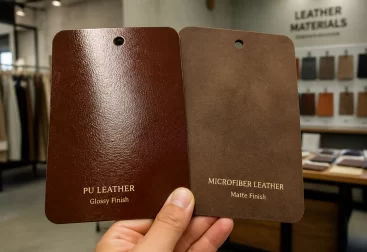
Coating adhesion testing verifies that the coating layer — the surface of a PU material, the finish on a hardware piece — stays bonded under use: a cross-hatch tape test scores how well the coating resists peeling, and a flex or abrasion pass confirms the bond survives real handling. For PU bags, coating adhesion is the test that predicts the flaking that makes a bag look prematurely old. Each functional test maps to a component the customer touches daily, and the program that includes them converts the material dossier into a product dossier — the complete evidence that the assembled bag, not just its materials, will survive its intended life.
Standards: The Language of Test Reports
Every test runs to a standard — the documented method that defines how the test is performed and how the result is graded — and the standard is the language in which test reports are written. Knowing the standards is the difference between reading a report and understanding one.
The international framework is ISO (the ISO 105 series for color fastness, ISO 13934/13937 for tensile and tear strength, ISO 12947 for abrasion via Martindale), with ASTM as the parallel US system (ASTM D5034 for tensile, D2261 for tear, D4966 for abrasion), and national variants such as GB (China), DIN (Germany) and JIS (Japan). For compliance, the chemical standards come from the regulations themselves — REACH’s restricted list, CPSIA’s lead and phthalate limits, Prop 65’s chemical list — and the test methods follow the regulatory protocols (EN 71-3 for migration of heavy metals in toys, for example). The report’s value depends on the standard being named: a result without a method is a number without meaning, and the buyer should always ask which standard produced the number.
Two practical notes complete the standard’s use. First, the standard determines comparability: a tensile result under ISO and under ASTM are different numbers, and comparing them directly is a mistake — the report must be read with its standard attached, and the buyer’s spec should name the standard explicitly (“tensile ≥ 400 N per ISO 13934-1”) rather than a bare number. Second, the standard sets the acceptance level: many standards define both the method and the grading scale (the blue-wool scale for light fastness, the grey scales for staining), and the buyer’s requirement is expressed in that scale. The spec that names the standard and the level — “light fastness ≥ 4 (ISO 105-B02), crocking dry ≥ 4 (ISO 105-X12)” — is the spec a laboratory can execute and a buyer can enforce; the spec without standards is a wish.
Reading a Test Report Like a Professional
The test report is the deliverable, and the professional reading starts with the basics, moves to the numbers, and ends with the exceptions. Each layer protects against a different failure of understanding.
Start with the report’s identity: the laboratory (is it accredited — ISO 17025 — or in-house?), the test date, the sample identification (does the lot or sample number match the material you actually sourced?), and the standards used. An accredited third-party report is the gold standard; an in-house or supplier report is a claim, useful as a screen but verified on the critical items. Then read the numbers against your spec: each test result compared to your requirement, with the pass/fail verdict the report states or the comparison you make yourself. The verdict you care about is not “the material passed” but “the material meets my spec” — and the difference is your standard, not the laboratory’s.
Then read what the report does not headline: the test conditions (the temperature, humidity and pre-conditioning that can shift results), the notes and exceptions (deviations from the standard method, samples that behaved unusually), and the scope (which properties were tested and which were not — a report that tested strength and color but not chemicals is not a chemical clearance, and the buyer who reads it as one has made the report’s quietest error). Finally, keep the reports: the material dossier accumulates order after order, and the trend — improving, stable, or declining test results across lots — is the material supplier’s real quality history. The single report qualifies the lot; the dossier qualifies the relationship.
Building Testing into Your Sourcing Process
Material testing works when it is built into the sourcing process at three decision points — material selection, the approved sample, and production — and skipped when it is treated as an afterthought at shipping.
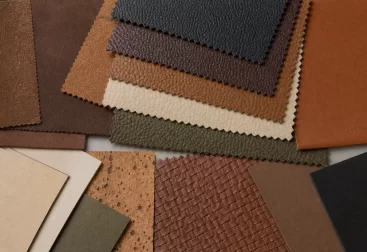
At material selection, test the candidate materials before committing: the physical and color tests on the material swatches decide which material makes the product, and the chemical tests confirm the material can legally enter your market. This is the cheapest testing point — a few samples, a modest panel — and it is where the product’s quality is actually decided: the material chosen here inherits every future order. At the approved sample, test the actual materials used in the sample against the spec, and confirm the test results match the selection-stage results: the sample is the first assembly of the real materials, and its testing catches the substitution or lot variation that selection could not. At production, re-verify on a defined frequency — every lot, every N lots, or on change (a new material batch, a new supplier, a process change) — because materials drift, and the drift is visible only in the numbers.
The discipline across all three points is the same: the spec names the tests and the standards; the reports are independent and filed; and the failures are acted on — a material that fails at selection is replaced, one that fails at the sample is re-sourced, one that fails at production is rejected. The buyer who runs testing at all three points buys materials by evidence; the buyer who tests only at shipping buys materials by hope and discovers the evidence when it is too late.
Common Material Testing Mistakes Buyers Make
Testing programs fail in recognizable patterns, and each pattern costs money or time that the checklist prevents. The mistakes below are the ones professional buyers have made and learned from.
Mistake 1 — Testing only the pretty things. A program that tests appearance (color, surface) but skips the physical and chemical families has verified the visible and ignored the consequential. The flaking coating, the failing strap and the non-compliant chemical are invisible in the appearance tests — the program must cover all four families.
Mistake 2 — Trusting the supplier’s report without verification. The supplier’s test report is a claim about its own material, and the professional program verifies the critical items — especially chemical compliance — with an independent accredited laboratory. The unverified supplier report converts the buyer’s legal exposure from the supplier’s problem into the brand’s.
Mistake 3 — Testing the sample but not the lot. A report on the selection-stage sample describes that sample; the production lot may be a different batch with different properties. The spec must re-test at production and on material change — the drift between lots is exactly where surprises live.
Mistake 4 — Specifying numbers without standards. “Tensile ≥ 400 N” without a named method is a number without meaning — ISO and ASTM produce different numbers for the same property. The spec names the standard, and the report is read with its standard attached.
Mistake 5 — Reading the verdict instead of the details. The report’s headline — pass or fail — hides the distribution and the conditions. The professional reads the numbers against the spec, the test conditions, the exceptions and the scope — because the details are where the next failure is already visible.
Mistake 6 — Treating testing as a one-time event. Materials drift, suppliers change and processes evolve; the single test at selection describes the material then, not forever. The defined frequency — at selection, sample and production, plus on change — is what keeps the dossier current and the risk retired.
Each mistake is a small gap in the program, and each gap is closed by the same habit: treating the material dossier as a living document — named standards, independent verification, re-testing on change, and the details read alongside the verdicts.
FAQ
Which material tests are most important for a bag?
The core set: tensile and tear strength (will it hold), abrasion resistance (will the surface survive), color fastness to light and rubbing (will it keep looking right), zipper cycling and strap load (will the components work), and the chemical compliance panel for your market. The priority weights shift with the material and the product — a PU tote and a genuine-leather travel bag emphasize different tests.
How much does material testing cost?
A basic physical-and-color panel runs from tens to a few hundred dollars depending on the tests and the laboratory; a full compliance panel (heavy metals, phthalates, formaldehyde) adds to the cost. Against the cost of a material failure — returns, refunds, recalls — the testing fee is the cheapest insurance in the sourcing chain.
Can I rely on the factory’s or supplier’s test reports?
As a screen, yes; as the final evidence, no. A supplier report is a claim about its own material, and the professional program verifies the critical items with an independent accredited laboratory (ISO 17025) — especially the chemical compliance tests, where the legal exposure is yours. Verify the lot number on the report matches your material.
What chemical tests do I need for the EU and the US?
For the EU, REACH compliance covers restricted substances, with specific limits for heavy metals, phthalates and formaldehyde; for children’s products, the Toy Safety Directive adds its own limits. For the US, CPSIA governs lead and phthalates (mandatory testing for children’s products), and California Prop 65 adds its own chemical list. Your destination market defines the panel.
What do color fastness ratings mean?
Ratings are measured on defined scales: light fastness 1–8 (8 = most resistant, blue-wool scale), crocking and washing fastness 1–5 (5 = best, grey scales). For a typical bag program, light fastness 3–4 or higher and crocking 3–4 dry / 2–3 wet are common starting requirements; premium programs tighten them.
How often should materials be re-tested?
Test at the three decision points — material selection, the approved sample, and production — plus whenever the material source, batch or process changes. Materials drift between lots, and the drift is visible only in the numbers, so a defined re-testing frequency is part of the spec.
Do I need tests for every component?
Not every component, but the ones that carry risk: zippers (cycling life), hardware (strength and finish), straps and handles (load), and coatings (adhesion). The functional family covers exactly these, and the tests should match the product’s intended use — a heavy travel bag needs stronger strap and hardware tests than a light evening clutch.
What is the difference between ISO and ASTM test methods?
ISO is the international framework (ISO 105 color fastness, ISO 13934/13937 strength) and ASTM is the parallel US system (D5034 tensile, D4966 abrasion). They measure the same properties with different methods, and their results are not directly comparable — the report must be read with its standard attached, and your spec should name the standard explicitly.
Next Steps: Test Before You Trust
The material is the product’s foundation, and testing is how the foundation is verified — physical tests for the strength, color tests for the appearance, chemical tests for the compliance, functional tests for the assembly, all read against written standards and built into the sourcing process at selection, sample and production. The brands that ship materials they have verified do not fear the test; they schedule for it. The materials that fail in the market are the ones that were never tested — and the difference is a decision the buyer makes long before the product ships.
Selecting materials for a bag program and want the testing framework applied to your project? Contact info@gionar.com and ask about our material selection, our test reports and our compliance documentation — we build products from tested materials, not promises. Explore our custom bag manufacturing services and custom backpack manufacturing to see how a testing-driven factory sources.