- Why the Metal-or-Plastic Question Matters
- Metal Hardware: Alloys and Properties
- Plastic Hardware: Types and Grades
- The Head-to-Head Comparison
- Where Metal Wins
- Where Plastic Wins
- Cost, Weight and Positioning
- Durability and Failure Modes
- Making Plastic Look Like Metal
- Mixing Materials in One Bag
- Specifying Hardware Materials
- Common Selection Mistakes
- FAQ
Why the Metal-or-Plastic Question Matters
Hardware material is one of the few specification decisions that changes a bag’s weight, cost and perceived quality at the same time. Choosing between metal and plastic is therefore a commercial decision wearing a technical costume.
The decision buyers underestimate
Many buyers treat hardware material as a factory detail, then wonder why a sample feels lighter or cheaper than the design intended. The material sets the sound, the weight and the shine — the three signals customers read without thinking.
Changing the material late costs more than specifying it early: the sample, the tooling, the color approval and the testing all move. The material decision belongs at the start of the style, next to the material choice for the body.
What the material signals to customers
Customers cannot name the alloy, but they feel it. A metal buckle clicks with authority and adds a reassuring weight; a plastic buckle clicks softly and keeps the bag light. Both can be right — for different products and different customers.
The signal interacts with price. At a premium price point a light plastic buckle reads as cost-cutting; at a value price point a heavy metal buckle may read as unnecessary weight. Match the signal to the positioning.
The three variables you are really choosing
Every hardware decision trades between three variables: weight, durability and appearance. Metal delivers durability and appearance at more weight and cost; quality plastic delivers lighter weight and lower cost with less of the premium feel.
Choosing well means deciding which of the three your bag’s customer values most — and then specifying the family of parts that delivers it consistently across the whole bag.
Metal Hardware: Alloys and Properties
Metal hardware is not one material but a small family, each with its own casting behaviour, weight and corrosion profile. Knowing the three main alloys explains most of the price and performance differences.
Zinc alloy: the casting workhorse
Zinc alloy dominates bag hardware because it casts beautifully into complex shapes at reasonable cost. Clasps, buckles, logo plates and decorative pieces usually begin as zinc alloy, then take a plating that defines their final look.
Its weakness is corrosion if the plating is thin or damaged, and it is heavier than plastic. With a proper plating grade, zinc alloy performs well for years in normal use — which is why it remains the industry default.
Brass: weight and warmth
Brass hardware offers a warm tone and a solid weight that premium bags use deliberately. It machines and casts well, takes plating and antique finishes beautifully, and ages in a way that some brands market as character.
Brass costs more than zinc and is softer, so it belongs on parts where feel and finish matter more than structural load. Designers choose it for the statement it makes, not for its mechanical advantage.
Stainless steel: the corrosion answer
Stainless steel resists corrosion without plating, which makes it the choice for parts that face weather, sweat or salt — feet, rings and marine-adjacent products. It is strong and heavy, and its clean silver look suits technical products.
The trade-off is cost and limited finish options: stainless does not take the wide palette of platings that zinc and brass do. Use it where corrosion resistance is the priority and the silver look fits the design.
Plastic Hardware: Types and Grades
Plastic hardware spans a wide quality range from brittle economy parts to engineered components that outperform metal in specific jobs. The grade matters more than the category.
The common plastic families
Acetal (POM) is the workhorse of quality plastic hardware — tough, dimensionally stable and self-lubricating, which makes it excellent for buckles and adjusters. ABS and nylon appear in parts where cost or flexibility dominates.
Recycled and bio-based plastics are entering the hardware market and appeal to sustainability-led brands. Their performance varies by formulation, so they need the same sample and test discipline as any other material.
Why plastic is not automatically bad
Plastic outperforms metal in some jobs: it does not corrode, it stays quiet, it flexes without denting and it keeps weight off a bag that already carries plenty. Sport and travel products often choose plastic deliberately, not cheaply.
Quality plastic hardware also allows color matching to the bag material, which creates a seamless look that metal cannot. For minimalist or color-driven lines, that is a design advantage, not a compromise.
The grades that separate quality from economy
The difference between good and poor plastic hardware lies in the grade, the molding quality and the wall thickness. Quality parts flex and recover; economy parts crack at the stress points within months.
Ask for the plastic specification — material family, grade and any test data — rather than accepting “plastic buckle” as a description. The same word covers parts that last a decade and parts that last a season.
| Material | Weight | Corrosion | Feel | Cost |
|---|---|---|---|---|
| Zinc alloy | Heavy | Needs plating | Premium | Mid |
| Brass | Heavy | Tarnishes, ages warm | Premium warm | High |
| Stainless steel | Heavy | Excellent | Clean technical | High |
| Acetal (POM) | Light | None | Functional | Low-mid |
| ABS / nylon | Light | None | Economy | Low |
The Head-to-Head Comparison
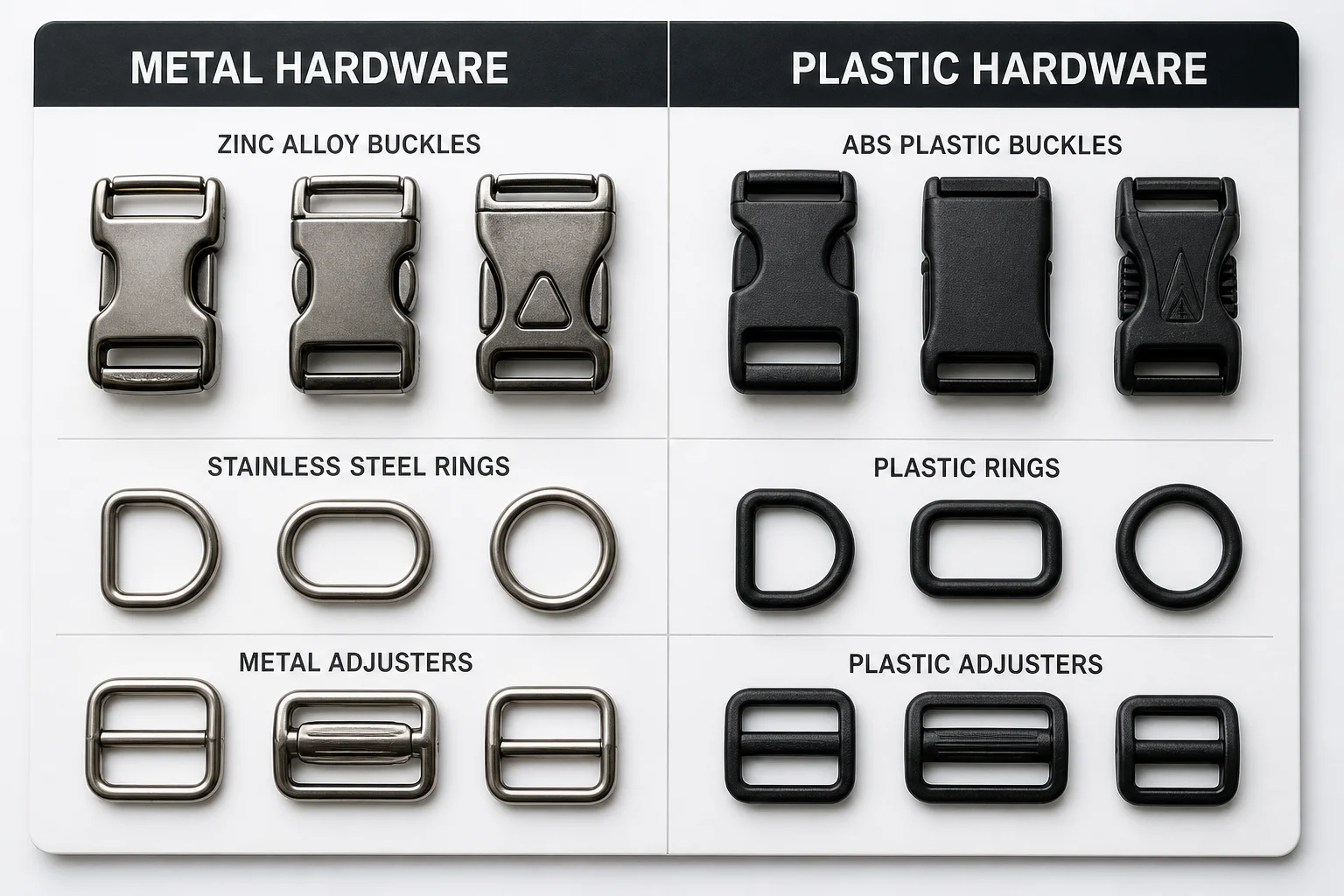
Side by side, metal and plastic hardware differ on more axes than most buyers track. The table below compares the factors that actually change a product decision.
The comparison that matters
| Factor | Metal hardware | Plastic hardware |
|---|---|---|
| Perceived quality | High — weight and click | Lower — light and soft |
| Weight added | Significant | Minimal |
| Corrosion risk | Depends on plating | None |
| Breakage mode | Dents, bends, plating flakes | Cracks at stress points |
| Color options | Plating palette | Any color, matched |
| Cost per piece | Higher | Lower |
| Tooling for custom shapes | Higher mold cost | Lower mold cost |
The table is the raw material for the decision: read down the column that matches your product’s priorities and the answer usually becomes obvious.
Where the difference disappears
In a few situations, material choice barely shows. Parts hidden inside a bag — structural rings, internal stiffeners — can be plastic without the customer ever noticing, saving cost and weight with no visible downside.
Finishes also close the gap for visible parts: plated plastic can look convincingly metallic at arm’s length, though it reveals itself in weight and in the sound when tapped. The customer’s distance from the part decides how much the difference matters.
Where Metal Wins
Metal hardware earns its cost in specific roles where load, wear or perceived value dominate. Recognising them prevents both under-specifying a premium bag and over-specifying a value one.
Load-bearing connections
Strap attachments, shoulder-ring anchors and clasps that carry the bag’s contents should be metal in most cases. Metal handles the cyclic load of a full bag without creeping, cracking or fatiguing the way even good plastic eventually can.
When a bag carries weight daily, the failure of a plastic connector is a matter of time and use patterns rather than luck. The metal upgrade at these points is the cheapest insurance in the hardware budget.
Premium positioning and touch points
Where the customer’s hand rests, metal delivers the weight and click that premium positioning requires. Zipper pulls, front clasps, handle rings and decorative plates are the parts that sell the bag in the fitting room.
The principle is to spend metal where it is touched and plastic where it is hidden. A bag with metal touch points and plastic internals costs less than an all-metal bag and feels nearly as good.
Long-life and repairable products
Products intended to last years — travel bags, work bags, heritage lines — benefit from metal because the parts can be repaired or replaced without compromising the structure. Metal also ages visibly, which durable-goods customers read as honesty.
Repairability extends the product’s life and the brand’s reputation. A metal buckle that can be re-stitched or re-riveted keeps a bag in service that a cracked plastic one would retire.
Where Plastic Wins
Plastic is the better engineering answer in several common situations, and specifying it deliberately is a sign of maturity rather than cost-cutting.
Lightweight and sport products
When the product’s promise is lightness — sports bags, kids’ bags, travel organisers — every gram matters, and quality plastic delivers strength without weight. Metal here would make the product heavier and no better.
Plastic also absorbs impact rather than transferring it, which suits products that get thrown about. A dropped bag with plastic buckles may survive where metal would dent or bend out of alignment.
Color matching and design freedom
Plastic can be molded in any color, letting hardware disappear into the bag or become an intentional accent. For color-blocked designs, monochrome minimalism or playful ranges, plastic offers design freedom metal cannot match.
It also allows larger shapes without the weight penalty, which suits bold buckles and modern silhouettes where proportion matters more than shine.
Weather, water and corrosion-sensitive uses
Plastic never corrodes, which makes it the safe choice for products used in humid, coastal or wet environments. Beach bags, outdoor gear and market totes often last longer with plastic than with thinly plated metal.
Where the product combines water exposure with price sensitivity, plastic hardware closes the gap between durability and cost more effectively than any metal option.
Cost, Weight and Positioning
Material choice changes the bill of materials, the shipping weight and the price the customer is willing to pay. The three move together, and the arithmetic is worth doing before the sample is made.
Reading the cost difference
Metal hardware typically costs more per piece than plastic — the gap widening with size, finish complexity and custom tooling. On a bag with several hardware points, the difference adds up to a visible line in the cost sheet.
The comparison is not the per-piece price alone but the price against the value delivered. A premium metal clasp that lifts the retail price by more than its cost is a good buy; an invisible metal internal that changes nothing is not.
The weight math
Weight affects freight, customer experience and the bag’s feel. On a volume order the extra grams of metal hardware multiply into shipping cost, and on some products — travel, outdoor — the customer notices the weight in use.
Run the math per style: hardware grams times quantity, against the freight rate. The result is often surprising, and it explains why lightweight lines standardise on plastic even when they could afford metal.
Positioning the bag with hardware
| Positioning | Recommended hardware | Rationale |
|---|---|---|
| Mass market / value | Quality plastic, minimal metal | Cost and weight control |
| Mid market | Plastic internals, metal touch points | Value perception balance |
| Premium / fashion | Metal throughout visible parts | Weight, feel, finish |
| Sport / outdoor | Quality plastic, stainless where needed | Light, corrosion-free |
The table is a starting framework; the traffic the bag sees and the customer it serves refine it. What matters is choosing the pattern deliberately rather than letting the factory’s stock decide.
Durability and Failure Modes
Metal and plastic fail differently, and knowing the failure modes lets you specify for the right risk. The material that fails gracefully usually beats the one that fails suddenly.
How metal fails
Metal hardware typically fails through plating wear, corrosion at scratches, dents that misalign a mechanism or bends that open a clasp beyond recovery. These failures are usually gradual and visible before they become dangerous.
The mitigation is finish quality and metal thickness. A heavier plating and a slightly thicker casting turn a two-year part into a ten-year part for a small cost increase.
How plastic fails
Plastic fails through cracking at stress points, creep under sustained load and UV degradation outdoors. Unlike metal, these failures can be sudden — the buckle that snaps after months of looking fine.
The mitigation is grade, wall thickness and design: stress points should be radiused, not sharp, and the part should be tested under load rather than merely inspected.
Testing both materials properly
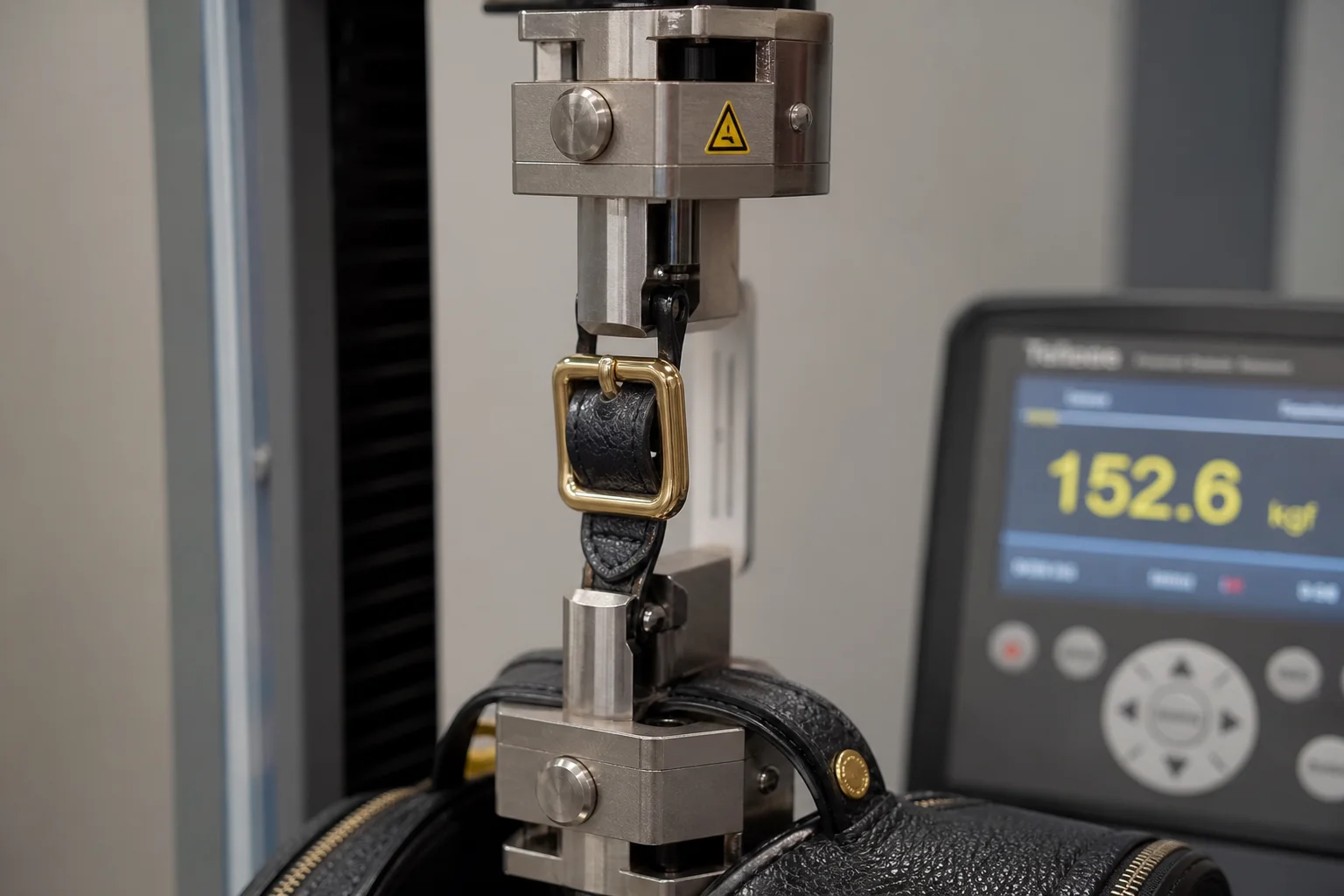
Test metal for plating abrasion, salt spray and load; test plastic for load, fatigue cycles and impact. Both materials should be tested on the assembled bag, where the interaction between part, material and stitching shows the real behaviour.
Ask the factory for the test results it holds on the hardware grades it uses. A factory with data has made the material choice; a factory without data is guessing on your behalf.
Making Plastic Look Like Metal
Plated plastic is one of the industry’s most useful compromises: the look of metal with much of plastic’s weight and cost advantage. It works well within limits that buyers should understand.
How plated plastic works
Plastic parts are electroplated or vacuum-metalised to take a metallic surface. The result photographs convincingly and reads as metal at a distance, which is why it appears on mid-market bags where the price point cannot carry solid metal.
The limits are weight and wear: the plated part still feels light in the hand and the coating can wear through at high-contact edges. It belongs on parts that are seen rather than gripped repeatedly.
Physical vapour deposition and painted finishes
Vacuum metalising and physical vapour deposition give a thin, bright metallic layer to plastic at low cost. Painted and lacquered finishes offer a wider color range and can mimic antique or brushed effects that plating struggles to hold.
Each finish has a different abrasion profile. Ask for the abrasion test result on the finish you choose, and confirm it on the sample with a rub test at the edges where wear begins.
When plated plastic is the right answer
Plated plastic fits mid-market bags, decorative parts and low-touch points where the look matters and the load does not. It is the wrong choice for strap anchors, clasps under load or anything the customer grips daily.
The honest rule: use plated plastic to create the visual language, and solid metal to carry the mechanical job. That combination delivers the look at a fraction of the all-metal cost.
Mixing Materials in One Bag
Most commercial bags already mix materials, usually by accident. Doing it deliberately produces better products at better costs than choosing one material for everything.
The mixed-material principle
Assign each hardware position to the material that serves it best: metal where load and touch dominate, plastic where weight, color and corrosion resistance matter more. The result is a bag that performs and prices well.
Visually, the mix needs to look intentional. Consistent finish language, matched tones and a clear hierarchy — metal for the hero closure, harmonised finishes elsewhere — keep the bag reading as one design.
Where the mix goes wrong
A mixed bag fails visually when the materials clash: a bright metal clasp against a flat plastic buckle, or a warm brass ring beside a cool chrome one. Finish consistency matters more than material consistency.
It fails mechanically when a plastic part carries a metal part’s job — a plastic strap anchor on a bag that gets filled. The mix must respect the load map, not just the cost sheet.
A practical mix for each positioning
| Positioning | Hero closure | Internals | Strap points |
|---|---|---|---|
| Value | Plated plastic | Plastic | Reinforced plastic |
| Mid market | Solid metal | Plastic | Metal |
| Premium | Solid metal | Metal or premium plastic | Metal |
Read the table as a template and adjust for the bag’s use. A mid-market travel bag may push metal into the strap points; a mid-market tote may keep them plastic to protect the weight.

Specifying Hardware Materials
The hardware material specification turns the decision into an order the factory can execute and you can verify. It is short, and it prevents the substitution that would otherwise arrive unnoticed.
What to write for each part
For every hardware item record the function, the material family and grade, the finish, the size, the load it must carry and the test it must pass. Add the brand or supplier where one is specified, and a photo of the part in position.
The load column is what most specs miss and what most failures trace back to. Writing “strap anchor, metal, load 25 kg” gives the factory a number to design to instead of an adjective to interpret.
Approving and referencing samples
Approve hardware on the assembled bag, in daylight, under the intended load. Keep the approved sample sealed as the reference for production, with the finish and weight recorded so drift is detectable.
Weigh the sample hardware and record the number. Weight is the fastest way to detect a material substitution — a plastic part masquerading as metal shows up on a scale before it shows up in a customer’s hands.
Controlling substitution
Require written confirmation before any change of material, grade, finish or supplier. Silent substitution from metal to plated plastic is one of the most common cost cuts in bag production, and the weight check catches it immediately.
Decide the hardware material by the job it does: metal where load and touch matter, plastic where weight, color and corrosion resistance matter — then write both into the specification and verify them on the scale.
Common Selection Mistakes
Hardware material choices go wrong in predictable ways. The four mistakes below account for most of the mismatch between what a buyer intended and what the sample delivered.
Mistake one: all-metal by default
Buyers who equate quality with metal over-specify, adding weight and cost to bags that would be better and cheaper with plastic internals. The result is a heavier bag with no additional customer value and a thinner margin.
The correction is the load map: identify the parts that must be metal and let the rest be chosen on weight, cost and appearance.
Mistake two: all-plastic by cost
The opposite error is chasing the cheapest bill of materials and putting plastic at load points. The savings are real until the first cracked strap anchor, after which the returns erase them.
The correction is treating load-bearing hardware as a fixed cost of quality rather than a variable to minimise. Failures are always more expensive than the parts that prevent them.
Mistake three: ignoring finish consistency
A bag with three different metal tones looks like three different bags stitched together. Buyers who specify materials without specifying finishes create the mismatch themselves.
The correction is a finish standard applied across every hardware part — one plating language, one tone family, approved under daylight on the sample.
Mistake four: no weight or test reference
Without a recorded weight and test result, the approved sample cannot be enforced. The production hardware drifts lighter and cheaper, and nobody notices until the customer does.
The correction is documentation: weight per part, finish standard and test results filed with the style, and checked against the delivery before sewing begins.
FAQ
Is metal hardware always better than plastic?
No — they solve different problems. Metal wins on load-bearing parts, touch points and premium feel; plastic wins on weight, corrosion resistance, color matching and cost. The best line usually mixes both deliberately.
Which hardware parts should always be metal?
Strap anchors, shoulder-ring attachments and clasps carrying the bag’s weight should generally be metal. These points face cyclic load where even quality plastic can eventually creep or crack.
Can plated plastic pass as metal?
Visually yes, at arm’s length and in photographs; tactually no — the weight and sound give it away. Use plated plastic for seen-but-not-gripped parts, and solid metal for anything under load or daily contact.
How much weight does metal hardware add?
It depends on the part, but the difference is measurable per bag — which matters on volume freight and on lightweight products. Weigh the sample hardware: it is the fastest way to quantify the trade-off and to detect substitutions.
Do plastic buckles crack quickly?
Economy plastic can crack at stress points within months, but quality acetal (POM) parts last years when they are properly designed and molded. The grade, the wall thickness and the radius at stress points decide the outcome.
Should I use the same hardware material across my whole line?
Consistency helps brand recognition and buying volume, but the material should serve each product’s job — a travel bag and a clutch may need different hardware. Keep the finish language consistent even when the materials differ.
How do I check that the factory used the specified material?
Weigh the part against the approved reference and inspect the finish in daylight. For metal, a magnet and a scratch test on a hidden area help; for critical orders, ask for the material certificate from the supplier.
Is stainless steel worth the extra cost?
For products facing moisture, salt or heavy use, yes — stainless resists corrosion without plating and holds its look. For indoor fashion bags, zinc alloy with a good plating delivers similar performance for less.
What tests should hardware pass before production?
Load tests at the strap and clasp points, plating abrasion and salt spray for metal, and load plus fatigue cycles for plastic. Test on the assembled bag so the interaction with stitching and material is included.
Can I change hardware material after the sample is approved?
You can, but expect cost and timeline consequences — the sample, tooling, color approval and testing may need to be repeated. Confirm any change in writing and re-approve the sample rather than accepting a verbal promise.
Does hardware material affect the bag’s retail price?
It can, and it should be a deliberate part of the pricing story. Metal at visible touch points supports a higher price; plastic internals protect the margin without harming perception. Specify each part to earn its place in the price.
Are bio-based or recycled plastics suitable for hardware?
They are entering the market and suit sustainability-led brands, though performance varies by formulation. Treat them like any new material: sample them, test the load and fatigue behaviour, and confirm the supply before committing to production.
How do I brief a factory on hardware material choice?
Give the factory the load map and the positioning: which parts must carry weight, which are visible touch points and which are hidden. Ask for the material and grade it recommends per part, with the test data behind each recommendation.
Next Steps: Choose Hardware by Design
Hardware material is a design decision with a cost and a customer consequence: map the load, assign the material per part, standardise the finish, approve physically and verify the delivery. The system takes an afternoon per style and protects the whole season.
A factory that works with both metal and quality plastic hardware and documents the grades it uses makes the decision easy and the verification possible. That is the standard our factory works to — ask us how we select, sample and test hardware materials on every order, from first sample to final inspection.
Choosing hardware for your next bag line? Contact our team at info@gionar.com for material selection and testing support.
Related reading: our custom bag manufacturing portfolio shows how hardware, materials and construction come together in production.