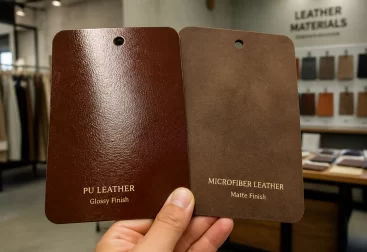
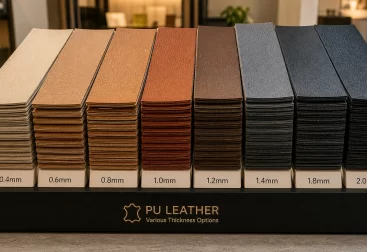
Why Quotations Are Hard to Compare
A bag factory quotation rarely arrives in a standard format. Two suppliers quoting the same product can reach very different numbers because each one priced a slightly different product.
The three quotation formats you will meet
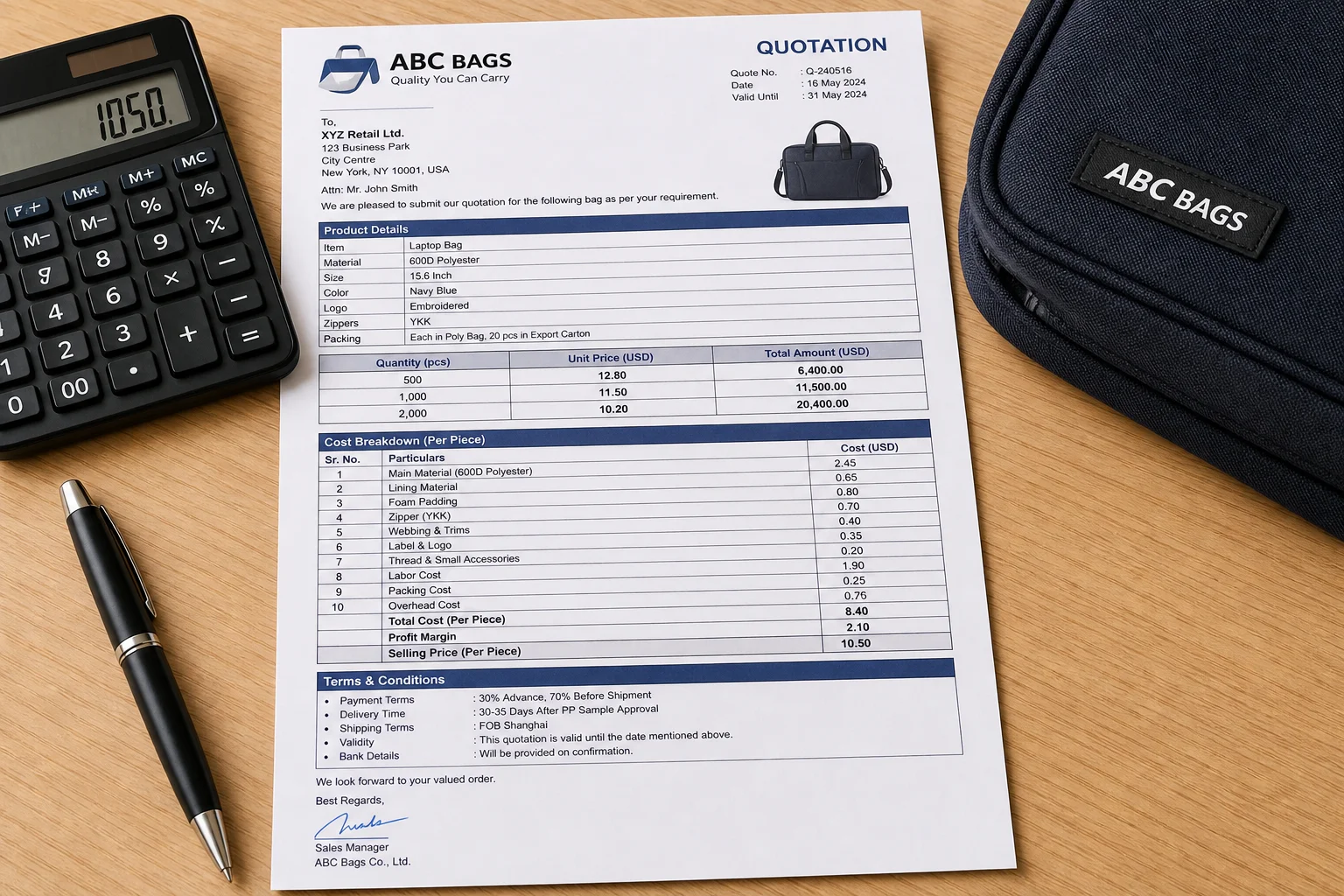
The first format is a single unit price, often given in a message rather than a document. The second is a structured quotation listing materials, labour and overhead separately. The third is a full cost sheet opened in front of you during negotiation.
Only the second and third can be compared meaningfully. A single unit price tells you nothing about what is included, which is why the first question to any supplier is what the number covers.
What a usable quotation contains
| Element | Why it matters |
|---|---|
| Material specification | Determines most of the cost difference |
| Unit price at stated quantity | Price only means something with a volume |
| Incoterm | Defines who pays freight, insurance and duty |
| Tooling and setup charges | One-time costs, sometimes refundable |
| Sample charges | Frequently offset against the order |
| Payment terms | Affects cash flow and effective price |
| Lead time | Part of the value, not a separate issue |
| Validity period | Material prices move; quotes expire |
A quotation missing three or more of these rows is a starting point for a conversation, not a basis for a purchase order. Ask for the missing items before comparing prices.
The apples-to-apples problem
The most common comparison error is matching a quotation for a specified product against one for a vaguely described product. The cheaper number usually reflects fewer materials, a lighter lining or a simpler construction.
The remedy is to send every supplier the same specification — ideally a tech pack — and to require a line-by-line response. Once both quotes describe the same product, the comparison becomes meaningful.
The Cost Components of a Bag
A bag’s unit price is built from four blocks: materials, labour, trim and hardware, and overhead with margin. Understanding their proportions is what makes a quotation readable.
Materials
Body material, lining, interlining and reinforcement usually represent the largest single cost block for a PU leather bag. Material consumption depends on the pattern, and waste from cutting adds several percent on top of the net area.
Material cost is also the most volatile input, moving with polymer and coating prices. That volatility is why quotations carry validity periods and why long production runs are sometimes quoted with a material escalation clause.
Labour
Labour reflects the number of operations and the minutes each one takes: cutting, skiving, stitching, hardware setting, final assembly and packing. Complex designs with many pieces and detail work carry proportionally higher labour.
Labour cost per minute varies by region and by factory skill level, which is why two factories with identical material costs can still differ substantially on the same design.
Trim and hardware
Zippers, buckles, rings, snaps, rivets, feet, labels and thread are bought-in components. Their cost depends on the grade specified: a branded zipper or custom-molded buckle can multiply the trim line by several times.
Trim also carries the substitution risk. If the specification is vague, a supplier can meet the price by using a cheaper component that looks similar in a photograph.
Overhead, margin and the rest
| Component | Typical share | What drives it |
|---|---|---|
| Materials | 35–50% | Material grade, consumption, waste |
| Labour | 20–35% | Operation count, skill, region |
| Trim and hardware | 8–18% | Grade, branding, tooling |
| Packaging | 2–5% | Polybag, hangtag, carton |
| Overhead and margin | 10–20% | Factory efficiency, order size |
The ranges are indicative rather than fixed, and they shift with the product: a heavily detailed bag pushes labour up, while a hardware-rich bag pushes trim up and materials down as a share.
Reading the Unit Price Line
The unit price is the number everyone compares and the one that most often hides qualification. Reading it properly means asking three questions about scope, volume and terms.
What the price includes
Confirm whether the unit price covers the bag alone or the bag with packaging, labels and testing. Many quotations exclude retail packaging, which then appears as a separate line later in the process.
Also confirm whether the price reflects the approved specification or an assumed substitute. A price quoted against a suggested material is not the price of the product you designed.
Incoterms and what they add
| Incoterm | Supplier covers | Buyer covers |
|---|---|---|
| EXW | Production only | Inland, export, freight, duty |
| FOB | Production, inland, export clearance | Freight, insurance, duty |
| CIF | FOB plus freight and insurance | Duty, inland delivery |
| DDP | Everything to the destination | Nothing further |
Comparing an EXW price with a DDP price is one of the most common sources of apparent savings that disappear once logistics are costed. Always normalise quotations to the same Incoterm before comparing.
Price breaks by quantity
Quotations usually present several quantity tiers with different unit prices. The gaps between tiers show how much of the cost is fixed per order — setup, tooling, sampling and inspection — versus how much is truly per unit.
Reading the tiers also reveals the factory’s preferred run length. A steep fall from 500 to 1,000 and a flat line thereafter suggests the optimal run is around 1,000 units.

Tooling, Sampling and One-Time Charges
One-time charges sit outside the unit price and are where first orders are most often misjudged. They deserve the same scrutiny as the per-unit number.
Sample charges and their refundability
Factories usually charge for samples, and the charge varies with complexity and whether custom materials must be sourced. Some factories refund the sample cost against the production order, which effectively makes it a deposit.
Ask two questions: what the sample charge covers, and whether it is credited on the order. A sample charge that is credited is a much smaller commitment than one that is not.
Tooling for custom components
Molds, dies and fixtures for custom hardware, embossed logos or welded panels are one-time investments. Their cost depends on the component, the material and the required precision.
Confirm who owns the tooling, where it is stored and what happens if you change supplier. A tool you paid for but do not own is a liability rather than an asset.
Development and artwork fees
| Charge | Typical trigger | Refundable? |
|---|---|---|
| Sample fee | New style or revision | Often credited on order |
| Pattern development | New design without a pattern | Rarely |
| Hardware mold | Custom buckle, pull or plate | No — tool retained |
| Emboss or foil die | Custom logo impression | No — die retained |
| Logo digitising | Embroidery artwork | No — file retained |
| Test and certification | Market compliance requirement | No |
Treating these as part of the product development budget rather than as incidental costs makes the total investment visible before the order is placed.
Amortising one-time costs correctly
Divide each one-time charge by the volume it will serve, not by the first order alone, if the style will be repeated. A mold used across three seasons costs a third as much per season as it does on a single run.
Conversely, do not amortise tooling across volumes that have not been committed. A mold justified by an optimistic forecast is a cost carried by the first order alone.
Hidden Costs Buyers Miss
The unit price is not the landed cost. Several categories sit between the quotation and the money that actually leaves the business, and each is easier to plan than to discover.
Packaging, inspection and testing
Retail packaging, hangtags and branded cartons are often excluded from the unit price. Third-party inspection and any required testing add further fixed costs that scale per order rather than per unit.
Decide early whether you will inspect pre-shipment and whether the destination market requires specific tests. Both should appear in the quotation rather than in a later invoice.
Freight, duty and warehousing
| Cost | Basis | Why it surprises buyers |
|---|---|---|
| Freight | Volume or weight | Bags are bulky relative to value |
| Import duty | Product code and value | Rate depends on classification |
| Customs clearance | Per shipment | Fixed cost per entry |
| Warehousing | Pallet or cubic metre | Continues after delivery |
| Inland delivery | Distance and volume | Excluded from most quotes |
Bags are a volume-heavy product, so freight often represents a larger share of landed cost than buyers expect. Comparing two quotations without normalising freight can reverse the ranking.
Payment and currency costs
Bank charges, transfer fees and currency conversion margins are small individually and material in total. A quote in a currency you hold removes conversion cost but exposes you to the supplier’s exchange-rate buffer.
Payment terms also carry an implicit cost. A deposit-heavy schedule ties up working capital, and a price that assumes early payment is not the same as one that allows terms.
Building the landed cost sheet
Total the unit price, packaging, inspection, freight, duty, clearance, inland delivery and finance charges to get the landed cost per unit. That figure is the only one that can be compared with a retail or wholesale price.
Buyers who calculate landed cost before committing avoid the classic outcome of a well-priced order that turns out to have a thin margin once it reaches the warehouse.
Volume, MOQ and Price Breaks
Volume changes price in a predictable way. Understanding the shape of that curve lets a buyer choose an order quantity deliberately rather than by convenience.
How price falls with volume
| Quantity | Index price | What is happening |
|---|---|---|
| 300 units | 142 | Setup spread over few pieces |
| 500 units | 128 | Tooling amortising |
| 1,000 units | 112 | Material buying improves |
| 2,000 units | 104 | Line efficiency gains |
| 5,000 units | 100 | Reference price |
The index shows the typical shape: the largest falls come early, and the curve flattens as volume grows. Beyond a certain point, additional volume buys little further discount.
Where the minimum order comes from
MOQ reflects the smallest run a factory can produce without losing money on setup: cutting, line changeover, quality control and packaging. Custom hardware pushes the minimum higher because the tooling must be amortised.
Ask what drives the minimum for your specific product. Sometimes it is the material — a custom-dyed PU with its own mill minimum — and sometimes it is simply the factory’s scheduling.
Choosing your order quantity
Balance the price benefit against the risk of unsold inventory and the cost of holding it. A lower unit price achieved by doubling the order only helps if the extra units sell.
For a first order, a smaller run at a slightly higher unit cost often produces a better outcome than a large run that ties up capital and warehouse space.
Negotiating on volume structure
Where the total volume is uncertain, ask for a price structure across tiers with a single tooling charge, and commit to a first tranche with options on the remainder. This preserves the discount path without committing to the full quantity.
Factories usually accept this arrangement because it improves their planning without requiring them to hold stock.
Cost Drivers You Can Change
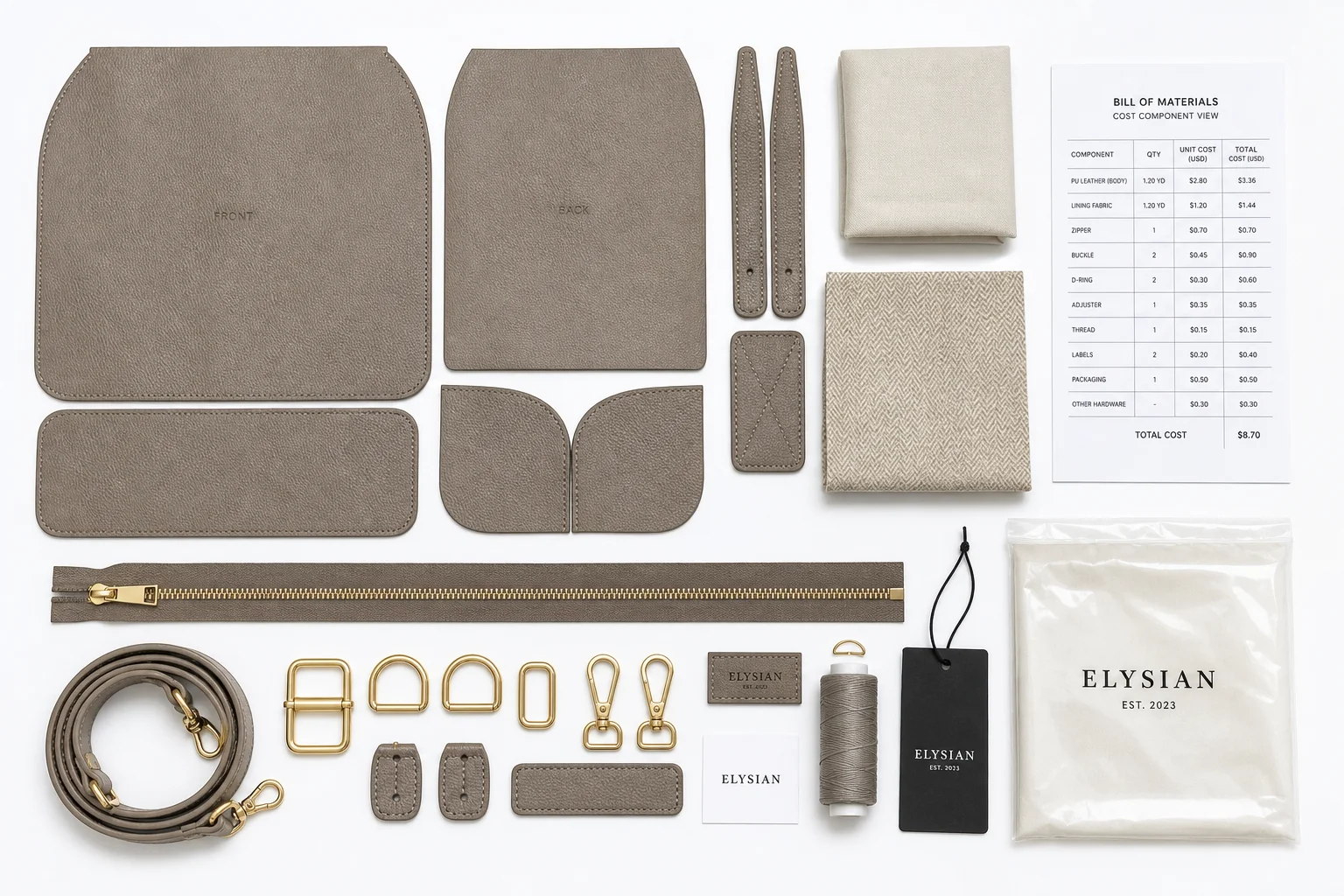
Once a quotation is broken into components, cost reduction becomes a series of specific decisions rather than a single negotiation. Some levers reduce price without touching the design; others require a deliberate trade.
Material and trim levers
Material grade is the largest single lever. Moving from a premium PU to a mid-grade with a similar appearance can change the material line substantially, provided the durability claim is not compromised.
Trim offers similar scope: a branded zipper in place of a premium brand, a custom mold replaced by a standard part with laser etching, or a simplified logo treatment. Each maintains the look while reducing the bought-in cost.
Design and construction levers
| Lever | Typical effect | Trade-off |
|---|---|---|
| Reduce panel count | Lower cutting and stitching labour | Simpler silhouette |
| Simplify lining | Fewer operations | Less interior function |
| Standardise hardware | Lower trim cost, no tooling | Less exclusive look |
| Reduce detail stitching | Clear labour saving | Less visual richness |
| Simplify packaging | Lower packaging and freight | Weaker unboxing |
| Increase order volume | Lower unit price | Capital and stock risk |
Choose levers that the target customer will not notice. A simplified lining or a standardised zipper is usually invisible in use, while removed topstitching may be the detail that justified the price.
Negotiating scope rather than price
Asking for a lower price on the same specification usually produces either a refusal or a hidden substitution. Asking which specification changes would reduce the cost by a defined amount produces information you can act on.
The second approach also keeps the relationship commercial rather than adversarial, which matters when you need support during production.
Where not to cut
Do not reduce structural reinforcement, seam specification or hardware grade on load-bearing positions. Savings there convert directly into returns and warranty cost.
Do not remove the testing or inspection budget on a first order either. The information those steps produce is worth more than their cost.
Benchmarking and Negotiation
A quotation can be assessed against an expectation built from its own components. That expectation is what turns negotiation from a guess into a discussion.
Building a should-cost estimate
Estimate the material consumption from the pattern, apply a current material price, add a labour estimate based on operation count and add a margin. The result is a rough should-cost, useful as an order-of-magnitude check.
The estimate does not need to be exact to be valuable. A quotation far outside the expected range deserves a question about which component differs.
Comparing quotations fairly
Normalise every quote to the same specification, the same quantity, the same Incoterm and the same packaging. Then compare the component lines rather than the totals.
Where two totals differ, the line detail usually shows why: one factory priced a lighter lining, another assumed a standard zipper, a third excluded the hangtag.
What to negotiate
| Item | Usually negotiable | Notes |
|---|---|---|
| Unit price at volume | Yes | Best lever; needs committed quantity |
| Tooling ownership | Yes | Ask for it explicitly in writing |
| Sample charge credit | Often | Credit against the production order |
| Payment terms | Sometimes | Tied to the price offered |
| Lead time | Sometimes | Rush orders usually carry a premium |
| Inspection access | Usually | Confirm pre-shipment inspection rights |
Prioritise the items that change the total cost materially and accept the standard position on the rest. A negotiation that wins every small point often costs goodwill that is needed later.
Keeping the relationship workable
Suppliers extend better terms to buyers who are clear, consistent and pay on time. Reliability is a negotiable asset too, even though it does not appear on the quotation.
Where a price increase is unavoidable — material costs move — a factory that communicates early is more valuable than one that absorbs the increase and then substitutes quietly.
Quotation Red Flags
Certain patterns in a quotation predict problems later. Recognising them early avoids a costly order.
A price far below the others
A quote well below the field usually means a different specification rather than a more efficient factory. Ask which material, lining and hardware the price assumes before treating it as a saving.
Vague specification lines
Lines such as “PU leather, good quality” or “metal hardware” cannot be verified and cannot be enforced. A quotation without specification detail is an invitation to substitute.
Missing one-time charges
A quotation with no tooling, sample or test line is either incomplete or planning to add those costs later. Ask for them upfront so the total investment is visible.
Other warning signs
| Red flag | What it suggests |
|---|---|
| No Incoterm stated | Landed cost cannot be calculated |
| No validity period | Price may change without notice |
| No MOQ per tier | Price may not be achievable at your volume |
| Unwillingness to specify materials | Substitution likely |
| No reference samples offered | Unproven capability |
| Payment terms heavily front-loaded | Cash flow and delivery risk |
None of these signals is fatal on its own. Together they describe a supplier whose quotation cannot be relied on as a basis for a production commitment.
A good quotation is not the cheapest one. It is the one whose components you can read, verify and hold the factory to.
Documenting the Agreed Price
Once a price is agreed, the agreement needs a written form precise enough to be enforced at delivery. The unit price alone is not sufficient.
What the purchase order must reference
Reference the approved specification or tech pack version, the agreed quantity and tier, the Incoterm, the packaging requirement, the tooling ownership and the payment schedule.
Attach the approved sample photographs and the material references. Those attachments are what allow an incoming inspection to reject a non-conforming shipment objectively.
Price validity and material clauses
Record the validity period and, for longer programmes, how material price movements will be handled. A clause that requires notice and evidence before any increase is more workable than one that allows silent adjustment.
Where the currency is not your own, state the exchange-rate basis and what happens if it moves beyond an agreed band.
Keeping the cost model current
Revisit the cost model each season or whenever the specification changes. Material prices, labour rates and freight all move, and a model that has not been updated stops being a negotiating tool.
Recording the actual landed cost of each production run also builds the reference data that makes the next quotation easier to assess.
Payment Terms and Their Real Cost
Payment terms are part of the price even though they do not appear in the unit cost. A deposit-heavy schedule consumes working capital and changes when the order actually has to be funded.
Typical payment structures
Most first orders follow a deposit-and-balance pattern: a percentage on order, the remainder before shipment or against the bill of lading. Established relationships often move toward more favourable terms over time.
Ask what each milestone unlocks, because the schedule should track progress: a deposit funds materials, a mid-payment funds production and a balance releases the shipment.
The cash flow effect of a quotation
| Structure | Cash flow impact | Typical when |
|---|---|---|
| 30% deposit, 70% before shipment | Capital committed early | First order, unproven relationship |
| 30% deposit, 70% against bill of lading | Balances slightly later | Repeat orders |
| Letter of credit | Bank cost, protected both ways | Larger orders |
| Open account terms | Best for the buyer | Long-established partnership |
The structure changes the working-capital cost of an order even when the unit price is identical, so it belongs in the landed cost calculation rather than in a separate conversation.
Reducing payment risk
Start with a modest first order where a deposit is an acceptable risk, and use pre-shipment inspection to confirm the product before the balance is released. Inspection converts the final payment into an informed decision.
Where the order value is significant, a letter of credit protects both sides at a known bank cost, which is usually cheaper than the risk it removes.
FAQ
What should a bag factory quotation include?
Material specification, unit price at a stated quantity, Incoterm, tooling and sample charges, payment terms, lead time and a validity period. A quote missing several of these is a starting point for discussion rather than a basis for an order.
Why is one factory much cheaper than the others?
Usually because it priced a different product: a lighter lining, a standard zipper or simplified construction. Ask for the material and trim specification behind the price before treating the difference as a saving.
How do I compare quotes on different Incoterms?
Convert every quote to the same Incoterm by adding the missing freight, insurance and duty components. EXW prices consistently look lowest until logistics are costed in.
Are sample charges refundable?
Often they are credited against the production order, which makes the sample effectively a deposit. Ask explicitly whether the charge is refundable and confirm the answer in the purchase order.
Who owns the tooling I pay for?
Whoever the agreement states. Put ownership, storage location and permitted use in writing before payment, and confirm what happens to the tool if you move to another supplier.
How much should I expect price to fall with volume?
The largest falls come at the lower end of the range, after which the curve flattens. Request a tiered price structure so you can see where the meaningful savings stop for your product.
What is a landed cost and why does it matter?
The total cost per unit delivered to your warehouse, including packaging, inspection, freight, duty, clearance and finance charges. It is the only figure that can be compared with a selling price.
How can I reduce the unit price without changing the design?
Increase the committed volume, standardise the hardware, simplify packaging or ask the factory which specification changes would reduce cost. Each lever has a measurable effect you can evaluate.
Why do quotations have a validity period?
Because material and freight prices move. A quote is a snapshot of input costs, and the validity period states how long the factory can hold that price before re-quoting.
What are the warning signs of a risky quotation?
No specification detail, no Incoterm, no validity period, missing tooling lines, unwillingness to provide reference samples or heavily front-loaded payment terms. Each undermines your ability to hold the supplier to the agreed product.
How much should the deposit be on a first order?
A deposit covering materials and initial production is conventional on a first order, with the balance released after pre-shipment inspection. What matters most is that each payment milestone tracks real progress on the order.
Do payment terms affect the unit price?
Usually yes, indirectly. A supplier offering longer terms builds the financing cost into the price, so a lower price with a heavier deposit schedule is not automatically the better commercial outcome.
Should I ask a factory to quote several quantities at once?
Yes. A tiered quote shows how much of the cost is fixed per order and where the meaningful savings stop, which helps you choose an order quantity deliberately instead of by convenience.
How often should I re-benchmark a price I have accepted?
Each season and whenever the specification or material changes. Material, labour and freight rates all move, so a price checked against yesterday’s input costs is no longer a reliable benchmark.
Next Steps: Read Every Quotation the Same Way
A quotation becomes useful when its components are visible: material, labour, trim, overhead, one-time charges and the terms that surround them. Compare like with like, calculate the landed cost and negotiate scope rather than only price.
A factory that quotes line by line and states its assumptions is telling you how it will behave during production. That is the standard our factory works to — send us your specification and we will quote it in a form you can check.
Comparing bag suppliers or reviewing a quotation? Contact our team at info@gionar.com for a line-by-line cost breakdown.
Related reading: our custom bag manufacturing portfolio shows the products behind our costing, from materials to finished production.