Choosing a bag factory in China is the single highest-stakes decision in the entire sourcing journey — bigger than the design, bigger than the price negotiation, because every later stage inherits the factory’s capabilities, discipline and honesty. A good factory turns a mediocre design into a sellable product; a bad one turns a great design into returns, delays and disputes. Yet most buyers choose their factory the way they choose a restaurant on vacation: on photos, promises and one conversation, with no systematic way to compare the options in front of them.
This guide replaces guesswork with method. It walks through why factory selection decides everything downstream, then presents the twelve-point checklist that professional buyers use to evaluate a bag factory — covering credentials, capability, quality systems and commercial terms — with what to ask, what to verify and what each answer means. It closes with how to verify a factory when you cannot visit, the red flags that should end a conversation, and a decision framework that turns twelve checklist items into one clear choice. Written from inside the industry, it is the checklist we would want a buyer to run on us — and the one we run on ourselves.
Why Factory Selection Decides Everything
Every quality problem, delay and cost surprise in a bag order traces back to the factory — not to the material, the design or bad luck. The factory’s equipment determines what constructions are possible; its operators’ skill determines what stitch quality looks like at scale; its quality system determines how many defective pieces reach the carton; its management determines whether commitments are kept; and its honesty determines whether problems surface early or arrive as surprises. Choose the factory, and you have largely chosen the outcome.
The economics make the point concrete. The cost difference between a competent factory and a marginal one is usually a few percent of the order value — a modest line item. The cost of a failed order — dead stock, missed launch, returns, refunds, damaged brand — is often the entire order value or more, and it multiplies across every future order that inherits the relationship. Selecting carefully is the highest-return activity in sourcing: it costs days of research and saves multiples of the order value in avoided failure. And unlike price, which is negotiated once per order, the factory relationship compounds — a good partner improves every year, a bad one degrades every order.
Selection also sets the ceiling on what your brand can promise. A factory with strong sampling discipline lets you offer custom development with confidence; one with weak QC forces you to under-promise on quality or over-spend on inspection. A factory that communicates honestly lets you plan launches with real dates; one that disappears under pressure forces you into constant firefighting. The checklist that follows is the practical instrument for finding the factory whose ceiling is above your ambition — because the factory you choose is, in every real sense, the brand you ship.
The 12-Point Checklist at a Glance
The twelve points group into four blocks — credentials, capability, quality systems and commercial terms — and each point has a concrete verification method, not just a question to ask.
| # | Checklist point | What it verifies | Method |
|---|---|---|---|
| 1 | Business license and legal identity | The company exists and matches its claims | Request license, match name and address |
| 2 | Export qualification | It can legally export your goods | Check export license / customs registration |
| 3 | Audit reports and certifications | Independent verification exists | Review BSCI / SEDEX / ISO / factory audit |
| 4 | Category specialization | It builds bags like yours, not “everything” | Compare portfolio and references |
| 5 | Production equipment and capacity | It can actually make and deliver at your scale | Verify equipment list, lines, output |
| 6 | Design and development capability | It can sample and iterate, not just copy | Assess sample room, pattern team, proto speed |
| 7 | Quality control system | Defects are caught before shipping | Review QC process, AQL, inspection points |
| 8 | Sample quality | The proof is in the product | Order and scrutinize a sample |
| 9 | Material sourcing and traceability | Materials are real, consistent and documented | Check swatches, supplier base, documentation |
| 10 | Pricing transparency | The quote is honest and itemized | Request cost breakdown, compare across items |
| 11 | Communication and responsiveness | You can work with them under pressure | Time their replies, test technical depth |
| 12 | Contract and terms discipline | Commitments are written and kept | Review payment terms, lead times, MOQ, clauses |
The order of the checklist matters: credentials first (the company must exist and be legal), then capability (it must be able to do the work), then quality (it must do the work well), then commercial (it must be a workable partner). A factory can fail at any block and the evaluation ends there — no amount of cheap pricing repairs a missing export license or a nonexistent quality system.
Credentials: Points 1–3
Point 1 — Business license and legal identity
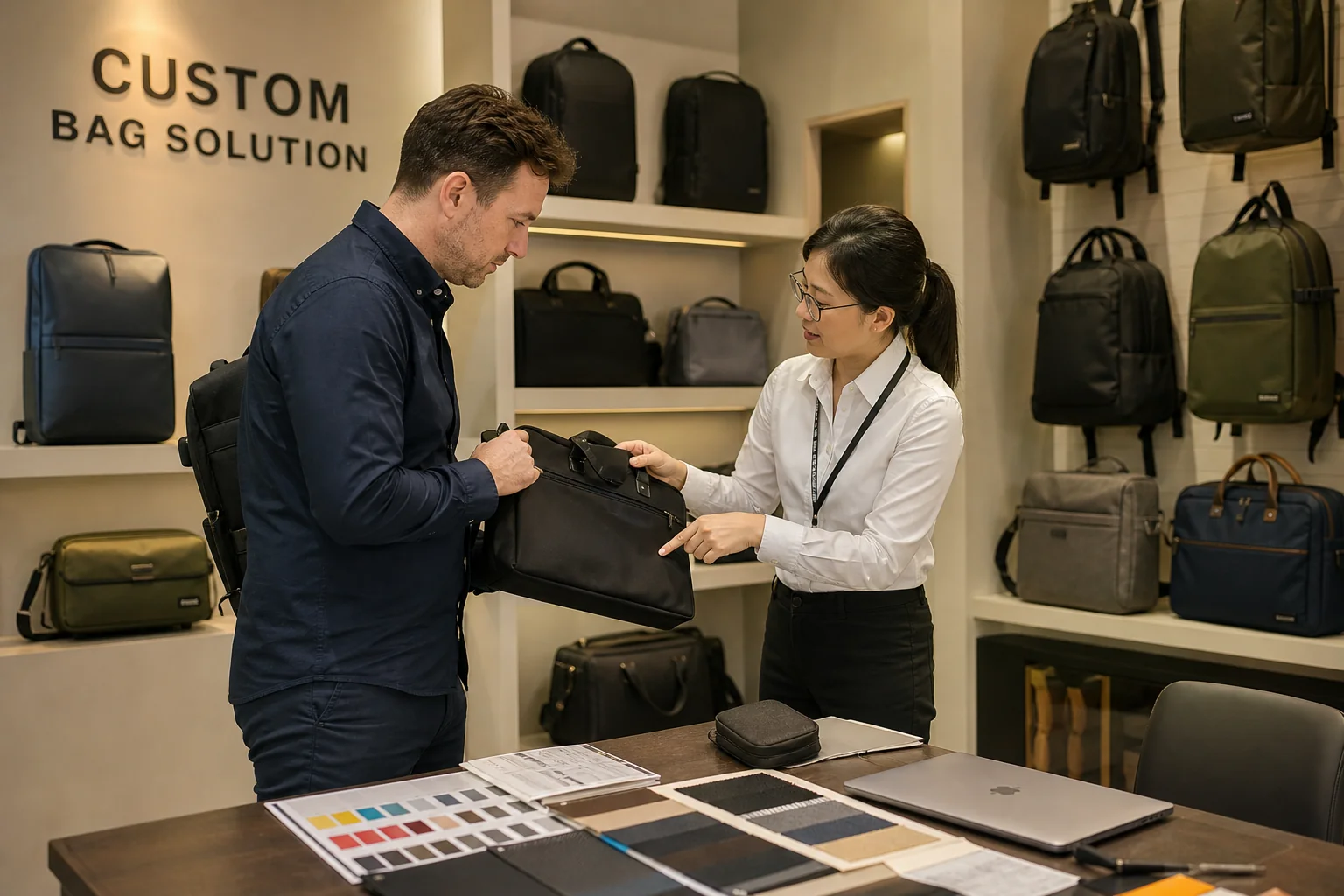
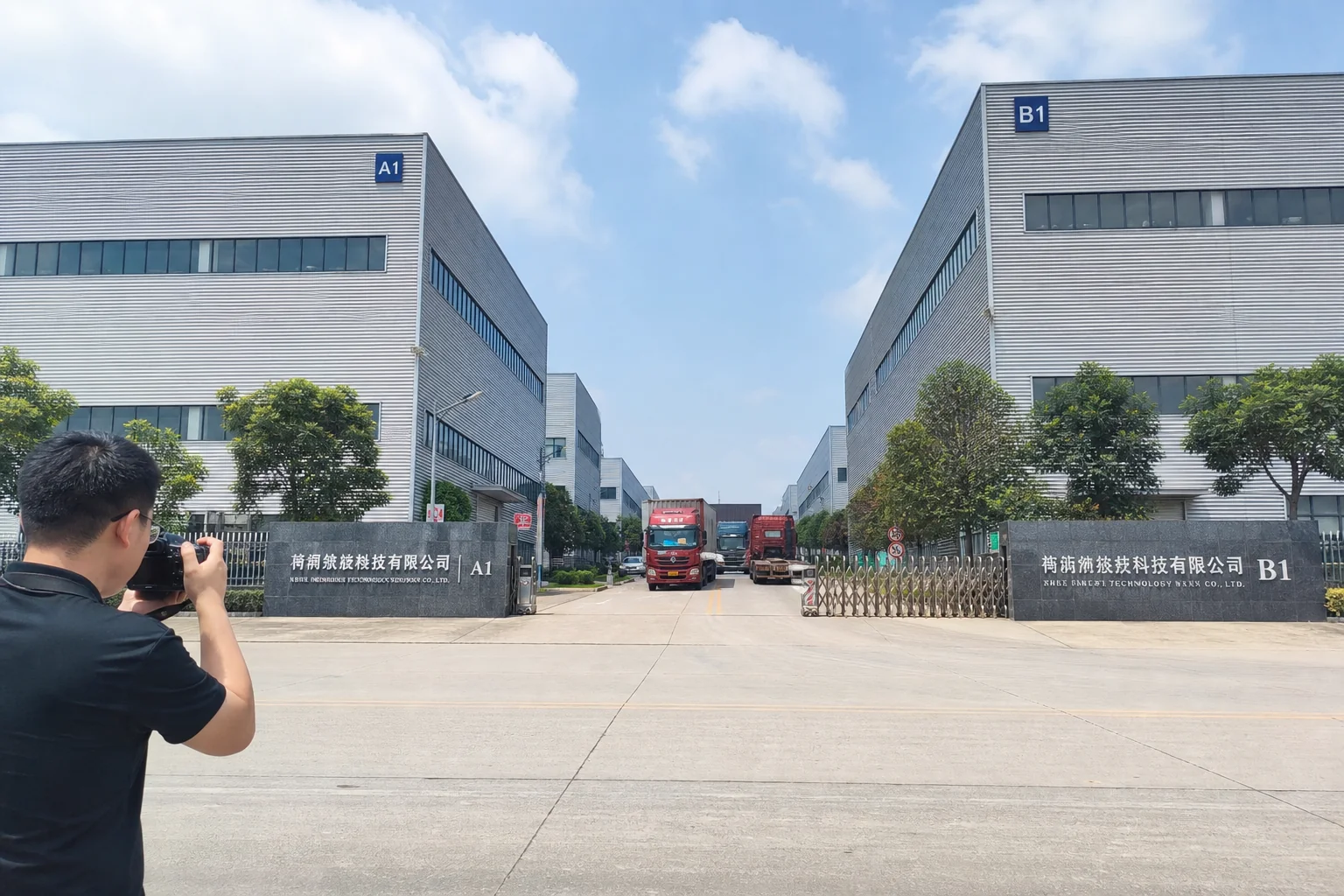
The first verification is the cheapest and the most skipped: does the company legally exist, under the name it presents, at the address it claims? Request the business license and check three things: the registered name matches the company you are dealing with, the legal representative’s identity is consistent across documents, and the registered address is in the same city the factory claims to be in. A license whose address is hundreds of kilometers from the “factory” you are talking to is the first signal that you may be dealing with a trading company presenting as a factory — which is not illegal, but it must be disclosed and priced accordingly.
Point 2 — Export qualification
The factory must be able to move your goods out of the country legally. Verify its export qualification: an export license or customs registration number, a track record of export documentation, and the ability to issue the commercial invoices, packing lists and certificates your destination market requires. A factory without export capability will route your order through an agent — adding a layer of cost, opacity and risk. Ask directly how the factory exports, and ask to see a recent export document (with commercial details redacted). The answer tells you whether the factory is the entity that will actually ship your goods, or a middleman in the chain.
Point 3 — Audit reports and certifications
Independent verification is worth more than any factory’s self-description. Ask for third-party audit reports — BSCI, SEDEX/SMETA, WCA or a client-commissioned audit — and for certifications relevant to your market: ISO 9001 for quality management, ISO 14001 for environment, and compliance certificates (such as REACH for the EU or CPSIA for the US) for the materials in your product. Two notes of realism: a certificate is a point-in-time document, so check the audit date and the scope (which facility, which processes); and the absence of certificates is not automatically disqualifying — small competent factories may not have paid for certification — but the factory should then be willing to undergo an audit you commission, and the answer to that request tells you a great deal.
Credentials are the gate: three failures here and the evaluation ends regardless of everything downstream. They are also the easiest block to verify — largely document-based, largely checkable from your desk — so there is no excuse for skipping them. A factory that is slow to provide its license, its export documents or its audit reports is telling you something; listen.
Capability: Points 4–6
Point 4 — Category specialization
A factory that builds bags like yours is worth ten that build “everything.” Category specialization means the factory owns the right machines, the right skills and — critically — the right quality bar for your product type: handbags demand different construction logic than backpacks, which demand different stress engineering than totes. Ask for their portfolio and references in your category, verify the years they have spent in it, and check whether their existing clients sell into your market segment (branded retail, wholesale, promotional). The factory’s specialty is the ceiling of what they can do well for you; the generalist’s ceiling is lower everywhere.
Point 5 — Production equipment and capacity
Capability is physical: it lives in machines, lines and operators. Verify the equipment list against what your product needs — the sewing machines (flatbed, post-bed, cylinder-bed for curves), the cutting equipment, the hardware-press capacity, the automated options (laser cutting, ultrasonic welding) that your design may require — and verify capacity against your order size: how many lines, how many operators per line, what monthly output, and how much of it is already committed. The two numbers that matter most are the factory’s realistic monthly output in your category and its current load — the first tells you if they can produce your order, the second tells you when. A factory that cannot show you its floor — by video, by live walk-through, by photos with today’s date — is not a factory you can verify, and unverifiable is the same as unproven.
Point 6 — Design and development capability
For custom work, the development capability is the whole game. Assess the sample room: how many sample makers, how many pattern masters, how fast a development sample ships, and how the factory handles revisions. The sample room is the factory’s R&D department, and its quality determines how many rounds your development takes — which determines your timeline and your sample budget. Probe the depth with a technical question in your category (a seam stress point, a material behavior, a hardware integration), and judge the answer’s specificity: a factory that answers with experience (“we handle that on the post-bed with a double row”) is a real developer; one that answers with reassurance (“no problem, we can do it”) is a promise without content.
Quality Systems: Points 7–9
Point 7 — Quality control system
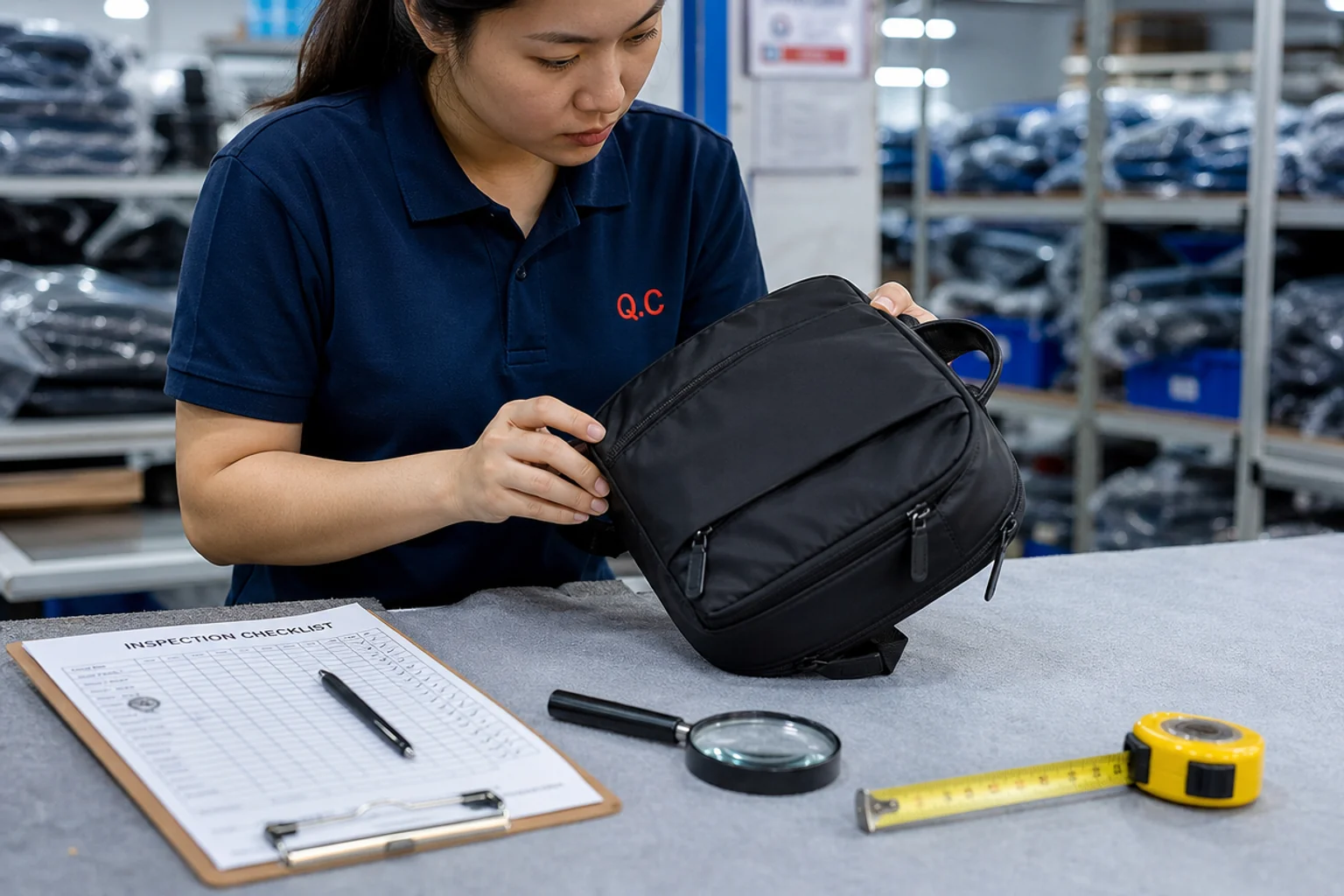
Quality at scale is a system, not an intention. Ask how QC is organized: incoming material inspection, in-process checks (at cutting, sewing, hardware setting), final inspection with an AQL sampling plan, and what happens to rejected pieces. The professional answer names the inspection points, the AQL level (commonly AQL 2.5 or 1.5 for critical attributes) and the rework process; the vague answer says “we check everything carefully.” Ask also whether third-party inspection is welcomed — a factory confident in its system welcomes AQL inspection by SGS, Bureau Veritas or your own inspector; a factory that resists inspection dates is telling you why it resists.
Point 8 — Sample quality
The proof is in the product: order a sample of the exact type of bag you plan to source, ideally a custom development sample, and scrutinize it with the full checklist — dimensions against spec, stitch density and alignment, hardware function, edge treatment, materials against references. The sample is the single densest piece of evidence about the factory: it reflects the pattern team’s accuracy, the sample room’s skill, and the factory’s understanding of your requirements. Two samples are better than one, and a sample ordered after the evaluation conversation tests both the product and the process — how fast it ships, how the factory handles the brief, how it reports issues. A factory that delivers a poor sample with good excuses will deliver poor production with better ones.
Point 9 — Material sourcing and traceability
Your product’s materials — the PU, the lining, the hardware, the zippers — are the largest quality variable after the factory itself, and the factory is the gatekeeper of that variable. Verify how materials are sourced: direct from mills and brand-name suppliers (YKK zippers, brand-name PU producers) or from the spot market, where quality is variable. Request material certifications for your destination market — REACH, CPSIA, prop-65 — and check whether the factory can document material batches (the lot, the test report) for traceability when a problem surfaces. The honest answer to “where do your materials come from?” is a supplier name and a certificate; the evasive answer is “we have good materials.” The factory that controls its materials controls your product’s consistency — and the one that does not is the one where the surprise will come from.
Commercial Terms: Points 10–12
Point 10 — Pricing transparency
The quote is the factory’s honesty made visible. Ask for an itemized cost breakdown — materials, labor, hardware, packaging, overhead, margin — and compare it across items: a breakdown that is consistent and plausible (materials dominate for most bags, hardware is priced per piece, labor scales with complexity) is a factory that understands its costs; a flat single number is a factory that prices by guesswork or by market — and a flat number that is suspiciously low is the classic entry point to a low-quality or bait-and-switch relationship. Ask also what is and is not included: sampling fees, tooling, packaging, inspection, freight. The question that sorts honest factories: “if I change X, how does the price change?” — the answer shows whether the pricing is built from components or pulled from thin air.
Point 11 — Communication and responsiveness
Sourcing is a relationship conducted in messages, and responsiveness is the relationship’s health signal. During the evaluation itself, measure it: how quickly does the factory reply, how specific are the answers, do they volunteer relevant information or only answer what is asked, and do they report problems proactively? The factory that replies in hours with technical specifics will handle your production crisis with the same discipline; the one that replies in days with generic reassurances will be silent at the moment you need them most. English proficiency matters less than precision — a short, exact answer beats fluent vagueness — and the presence of a dedicated account manager or international sales team is a structural sign that the factory treats overseas buyers as a core business, not an afterthought.
Point 12 — Contract and terms discipline
The final block is the paper: payment terms, MOQ, lead times, sampling fees, quality standards, dispute resolution. The professional factory proposes written terms quickly and sticks to them; the marginal one keeps terms vague and flexible — because vagueness is where costs and excuses hide. Scrutinize the payment terms (the industry norm for first orders is typically 30% deposit with the balance against documents or after inspection — terms that demand full payment upfront, or that shift all risk to you, deserve suspicion), the MOQ against your realistic order size, the lead time with its assumptions, and whether the quality standard (AQL, the approved sample as reference) is written into the contract. The factory that drafts a clear contract is protecting the relationship; the one that resists writing things down is protecting something else.
Verifying Without a Visit
Most first evaluations happen without a physical visit, and remote verification is entirely feasible when done systematically. The toolkit has five instruments, and they work in combination.
Live video walk-through: ask for a live video tour of the factory floor, the sample room and the warehouse — a live call cannot be staged the way a recorded video can. A factory that refuses a live walk-through, or offers only polished videos, is hiding the floor; the professional factory shows it freely because it is its own best evidence.
Third-party inspection: commission an independent factory audit or inspection service to verify the factory physically — its existence, its equipment, its workforce, its working conditions. For a first order, a pre-production inspection and a final AQL inspection cost a fraction of the order value and convert the factory from a claim into a verified fact.
Trade references: ask for existing clients — ideally in your market and category — and actually contact them. The reference call asks three questions: does the factory deliver on time, is the quality consistent, and how does it behave when something goes wrong? The third question is the most revealing; every factory has problems, and the reference reveals whether problems are solved or fought.
Document verification: run the credential documents through independent checks — confirm the business license against public registries, verify certifications against the issuing bodies, and check the factory’s claimed history against its actual export record. Documents are the cheapest verification layer and the one most buyers skip.
The sample as evidence: the custom development sample ordered during evaluation is itself a remote verification instrument — its speed, its accuracy and its construction quality are the factory’s capabilities made physical. Combine the five instruments, and the remote evaluation reaches most of the confidence of a visit — with the visit itself reserved for the moment before the first large order.
Red Flags That End the Conversation
Some signals are not warnings to weigh — they are conversations to end. The list below is the professional buyer’s hard-stop list.
- Refusal to share basic documents — license, export records, audit reports. A legitimate factory shares its identity; reluctance is the first evidence of something to hide.
- Unverifiable identity — a “factory” that cannot show its floor live, a company name that does not match the license, an address that does not match the claimed city.
- Price that defies physics — a quote far below the material cost of the product is not a bargain; it is a promise that will be broken somewhere (materials, labor, quality, or an “upgrade” later).
- Refusal of third-party inspection — a factory confident in its quality welcomes inspection; refusal is an admission.
- Pressure and urgency — demands to pay now, to skip samples, to decide before “the price changes” are engineered to bypass your checklist.
- Vagueness under questioning — technical questions answered with reassurance instead of specifics; pricing without breakdown; terms without writing.
- Reports problems only when asked — a factory that hides small problems will hide big ones. The evaluation phase is the cheapest time to discover the communication pattern.
Each red flag is cheap to detect and expensive to ignore. The professional response is not to argue or negotiate with the flag — it is to move on. The market has enough competent factories that the evaluation should be a filter, not a gamble.
From Checklist to Decision
The twelve points produce a comparison, and the decision framework turns the comparison into a choice. Score each candidate factory on the four blocks — credentials, capability, quality, commercial — on a simple scale, and apply three rules.
First, the blocks are gates, not scores: a failure in credentials or a hard red flag ends the candidacy regardless of the other numbers. Second, within the passing candidates, weight by your actual requirements: a brand launching custom designs weights capability and quality systems highest; a brand reordering proven styles weights capacity and terms; a first-time buyer weights communication and contract discipline above the last percent of price. Third, the tie-breaker is the sample and the conversation: the factory that delivered the better sample, answered faster and reported issues proactively is the partner who will behave the same way during production.
| Your priority | Weight the blocks | Decision bias |
|---|---|---|
| Custom development | Capability 40%, Quality 30%, Credentials 20%, Commercial 10% | Sample room depth, pattern skill |
| Consistent reorders | Quality 40%, Commercial 30%, Capability 20%, Credentials 10% | QC system, terms discipline |
| First-time sourcing | Commercial 35%, Communication 30%, Credentials 20%, Quality 15% | Written terms, responsiveness |
| Large-volume scale | Capability 40%, Commercial 30%, Quality 20%, Credentials 10% | Capacity, transparency at scale |
The final discipline: never select on price alone, never select on a single video, and never skip the sample. The twelve-point checklist exists because the cost of a wrong factory is paid for years — and the time to pay attention is before the first order, not after the first disaster.
FAQ
What is the most important thing to check when choosing a bag factory?
The most important single check is the custom sample in your category, supported by live verification of the factory floor — the sample proves capability and the live tour proves existence. After those, the quality control system and written contract terms carry the most weight.
How can I verify a factory without visiting China?
Use the five-instrument remote toolkit: a live video walk-through, a third-party factory audit or inspection, trade references you actually contact, document verification against public registries, and the custom development sample as physical evidence. Combined, they reach most of the confidence of a visit.
Are trading companies acceptable as suppliers?
Yes, if disclosed and priced honestly — a good trading company adds value in sourcing, coordination and quality management. The problem is a trading company presenting itself as a factory, because that misrepresentation will surface in pricing and accountability. Verify the license and factory address, and price accordingly.
What certifications should a bag factory have?
Quality management (ISO 9001), social compliance audits (BSCI, SEDEX), and environmental (ISO 14001) are the common ones, plus material compliance certificates for your market (REACH for the EU, CPSIA for the US). Check the audit date and scope — certificates are point-in-time documents.
Should I choose the cheapest factory?
No — price is the last variable, not the first. A price far below material cost is a red flag, and the factory that wins on price alone usually costs more in quality, delays and rework. Score the twelve points, filter by gates, then let price decide among the passing candidates.
How many factories should I evaluate before choosing?
Three to five candidates is the practical range: fewer and you have no comparison baseline; more and the evaluation effort outweighs the benefit. Shortlist from research, run the twelve-point checklist on each, and take the best two through the sample stage before deciding.
Is it worth paying for a third-party inspection on the first order?
Yes — a pre-production inspection and final AQL inspection cost a small fraction of the order value, and on a first order they convert an unverified factory into a verified one. The inspection also signals to the factory that your quality standard is real, which improves their behavior from the start.
What payment terms are normal for a first bag order?
Typically a deposit (commonly 30%) with the balance against documents or after inspection. Be wary of full upfront payment or terms that place all risk on you — and get the terms, the quality standard and the lead time in writing before production begins.
Next Steps: Run the Checklist Before You Commit
Choosing a bag factory is the decision that shapes everything downstream — and it is the decision most within your control. Run the twelve-point checklist, verify what can be verified remotely, end the conversations that hit red flags, and let the sample and the terms make the final call. The factory you choose carefully is the one that delivers on time, at the agreed quality, for years — and the selection discipline is the cheapest quality insurance in the entire sourcing process.
Looking for a bag factory you can verify, not just trust? Contact info@gionar.com and ask us the twelve questions directly — we will answer them all, and show you the floor live. Explore our custom bag manufacturing services and custom backpack manufacturing to see how a checklist-compliant factory works.