How Can You Reduce Bag Manufacturing Costs Without Losing Quality?
Cost reduction is sold as a simple exercise: ask for a lower price, accept a lower specification, and watch the margin improve. In bag manufacturing that sequence usually produces the opposite of what was intended.
The reason is structural. A bag is a stack of decisions, and the cheapest decision at any single point is rarely the cheapest decision overall. Saving on lining thickness can double returns. Trimming inspection can turn a small defect rate into a shipment rejection.
What separates buyers who reduce cost successfully from those who simply reduce price is that they know where the money actually sits. In a typical PU leather bag, material dominates the cost structure, labour comes second, and hardware, packaging and freight follow. Cutting in the wrong place removes value the customer notices; cutting in the right place removes cost the customer never sees.
There is also a timing dimension that most cost exercises ignore. The cheapest savings are made before the first sample is approved. Once tooling exists, patterns are cut and a purchase order is issued, the room for genuine reduction narrows sharply.
This article sets out where bag costs actually come from, which levers protect quality and which quietly destroy it, how to reduce material, construction, labour, hardware and freight costs in practice, how volume and order rhythm change the arithmetic, how to negotiate without damaging a working relationship, and how to verify that a saving was real rather than deferred.
- Why Cost Reduction Usually Fails
- Mapping the Cost Structure
- Material Levers That Protect Quality
- Simplification Buyers Cannot See
- Hardware and Component Decisions
- Reducing Operations, Not Wages
- Packaging and Freight Levers
- Where Cutting Cost Destroys Value
- Volume, Consolidation and Rhythm
- Negotiating Without Damage
- Measuring Whether a Saving Was Real
- Supplier Selection as a Cost Lever
- Cost Levers by Lifecycle Stage
- Building a Cost Reduction Program
- FAQ
Why Cost Reduction Usually Fails
Most cost reduction efforts fail for reasons that have nothing to do with the factory’s willingness to cooperate.
Cutting the visible instead of the expensive
Buyers tend to attack the items they can see and describe: thread, lining, packaging. These are rarely the largest cost lines, and they are often the ones a customer notices immediately.
The largest lever is usually material utilisation, which is invisible in the finished bag and rarely discussed.
Confusing price with cost
Price is what the invoice says. Cost is what the bag costs to buy, ship, sell and support. A supplier that quotes less but ships later, or packs worse, can cost more overall.
Buyers who track only the invoice price rarely see where the difference went.
Treating a one-time saving as a permanent one
Negotiating a discount on one order produces a saving on that order. Changing a construction that removes an operation produces a saving on every order afterwards.
The second is worth far more over a season, and it costs more effort to find.
Optimising a single bag instead of a range
Redesigning one style to be cheaper can increase total cost if it breaks shared components across a range. Common linings, common hardware and common packaging hold costs down across the whole programme.
A cost reduction that only works once is a discount. A cost reduction that works every order is a design change.
Mapping the Cost Structure
Before reducing anything, it helps to know the relative weight of each cost line.
Typical proportions
For a mid-range PU leather bag, material is usually the largest single component, labour the second, with hardware, packaging, overhead and freight completing the picture.
These proportions shift with design. A heavy hardware bag carries more cost in components; a multi-panel structured bag carries more in labour.
Why proportions matter
A ten percent saving on a line that represents a small share of cost is negligible. The same percentage on the dominant line changes the unit price materially.
Effort should follow proportion, not visibility.
Where the money is not
Thread, labels, hangtags and polybags attract attention because they are easy to list. Together they rarely amount to a meaningful share of unit cost.
Time spent renegotiating them is time not spent on nesting, panel count or carton dimensions, where the money actually is.
Fixed versus variable cost
Tooling and development are fixed costs paid once. Material, labour and freight are variable and recur per unit.
Reducing a fixed cost helps the first order; reducing a variable cost helps every order. Both are legitimate, but they are not interchangeable.
| Cost line | Typical weight | Recurs per order | Best lever |
|---|---|---|---|
| Material | Largest | Yes | Utilisation and specification |
| Labour | Second | Yes | Operation count |
| Hardware | Moderate | Yes | Catalogue parts |
| Packaging | Small to moderate | Yes | Right-sizing |
| Freight | Varies by mode | Yes | Volume and consolidation |
| Tooling and development | Fixed | No | Reuse and simplification |
Getting the breakdown from the factory
Most factories will provide a cost breakdown on request, at least at category level. A factory that refuses entirely is telling you something useful about how it prices.
You do not need exact figures. Relative weight is enough to direct effort.
Material Levers That Protect Quality
Material is usually the largest line, and most of the saving available here comes from how material is used rather than from what material is bought.
Cutting efficiency and nesting
Panels are laid out on a sheet to minimise waste. A small change in panel shape or orientation can move yield significantly, and yield is pure margin.
This is the single most underused lever in bag cost reduction, because it requires no change to the product the customer receives.
Panel size and shape discipline
Curves that look elegant on a drawing consume more material than straight edges. Reducing a curve radius slightly can improve nesting without a visible difference after assembly.
Specification where it counts
Where material thickness or grade is visible and handled daily, keep it. Where it is internal, structural or hidden behind lining, a lower grade may be indistinguishable.
Grading material by position rather than uniformly across the bag is a legitimate engineering decision, not a cost trick.
| Material lever | Saving potential | Quality risk | When to use |
|---|---|---|---|
| Nesting optimisation | High | None visible | Always |
| Panel shape discipline | Moderate | Low | At design stage |
| Grade by position | Moderate to high | Low if hidden | Internal panels only |
| Wider material roll | Moderate | None | When factory supports it |
| Standard colour range | Moderate | Low | Where colour is not signature |
| Thinner face material | Moderate | High | Rarely advisable |
Standard colours and stock material
Custom colours carry minimum quantities and slower supply. Choosing from a factory’s stocked range can reduce both cost and lead time, at the price of differentiation.
What not to trade away
Face material thickness, coating quality and backing integrity determine how the bag ages. These are the wrong places to save, because the customer experiences the consequence directly and repeatedly.
Simplification Buyers Cannot See
Construction changes are where the largest quality-neutral savings sit, because they remove work without removing anything the customer perceives.
Fewer panels, fewer operations
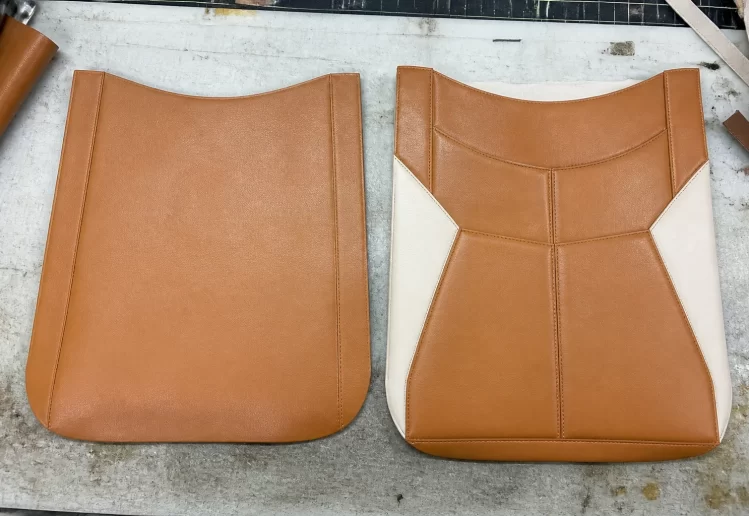
Each panel needs cutting, edge preparation, assembly and often topstitching. Merging two panels into one removes several operations at once.
The bag looks the same from outside. The cost structure is materially different.
Simplifying internal organisation
Internal pockets, dividers and elastic loops all consume labour. Reducing the internal layout to what buyers actually use cuts cost without affecting the exterior.
This is also a product improvement in many cases, since over-complicated interiors are rarely used as designed.
Standardising seam allowances and turnings
Non-standard allowances slow operators and increase error rates. Aligning to the factory’s standard reduces both cost and defect risk.
Reducing decorative stitching
Decorative topstitching is expensive because it is slow and visible. Reducing it to the lines that carry visual intent, rather than covering every seam, saves time without looking cheaper.
| Construction change | Operations removed | Visible impact | Verdict |
|---|---|---|---|
| Merge two panels | Cut, prep, join, topstitch | None from outside | Strong saving |
| Simplify interior | Pockets, dividers, binding | Internal only | Usually positive |
| Fewer decorative stitches | Machine time | Slight | Judgement call |
| Standard allowances | Rework and errors | None | Always |
| Remove lining pocket | Cut, sew, attach | Internal only | Check buyer need |
| Drop edge paint | Painting and drying | Visible on raw edges | Risky |
When simplification goes too far
Simplification crosses a line when the bag starts to feel hollow. Removing structure changes how a bag holds its shape, and that is immediately perceptible in the hand.
The test is whether the change is visible or tactile. Invisible is fair game; tactile is not.
Hardware and Component Decisions
Hardware is a smaller cost line, but it carries disproportionate influence on perceived quality and on failure risk.
Catalogue versus custom
Catalogue hardware costs less per unit and carries no tooling. Custom hardware costs more before production and adds lead time.
Custom is justified when the fitting is a visible brand element. For internal or functional parts, catalogue is almost always the better trade.
Fewer, better fittings
Reducing the number of fittings simplifies assembly and lowers both component and labour cost. A bag with four well-chosen attachment points is stronger and cheaper than one with eight marginal ones.
Finishing consistency
Mixed finishes across a bag — some bright, some brushed — read as an assembly error to customers. Specifying one finish family reduces cost through standardisation and improves perception.
| Hardware decision | Cost effect | Quality effect | Recommendation |
|---|---|---|---|
| Catalogue part | Lower | Reliable, proven | Default |
| Custom mould | Higher upfront | Brand differentiation | Only if visible |
| Fewer fittings | Lower | Simpler, stronger | Audit the count |
| Single finish family | Lower | Coherent look | Always |
| Cheaper plating | Lower | Corrosion risk | Avoid |
| Plastic replacement | Lower | Perceptible downgrade | Only internal |
Where hardware substitution fails
Substituting a lighter-gauge fitting saves a small amount and shortens the bag’s working life. Zips and strap anchors are the two places where this shows up first.
The saving per unit is minor. The return rate consequence is not.
Reducing Operations, Not Wages
Labour cost is a function of operation count, cycle time and rework. Only one of those is about pay rates.
Operation count is the real lever
Every additional step — cut, edge, fold, stitch, attach, trim, inspect — adds time. Removing a step removes cost permanently.
Buyers often assume labour cost is fixed and negotiate price instead. Designers who count operations find more room than negotiators do.
Cycle time and handling
Panel handling between operations consumes time that never appears on a cost sheet. Reducing panel count also reduces handling, which is why construction simplification compounds.
Tolerance-friendly design
A design that requires precise alignment on every unit consumes skilled labour on every unit. Allowing a slightly wider tolerance band lets standard operators achieve the same appearance faster.
The finished bag looks identical, and the operation becomes repeatable rather than dependent on individual skill.
Rework is the hidden cost
Defects consume labour twice: once to make, once to fix or scrap. A design that is easy to sew correctly is cheaper than one requiring skilled correction.
This is why tolerance-friendly design lowers cost without any compromise to the finished product.
| Labour lever | Mechanism | Risk | Priority |
|---|---|---|---|
| Fewer operations | Less time per unit | Low | Highest |
| Fewer panels | Less handling | Low | High |
| Design for easy sewing | Less rework | Low | High |
| Jigs and templates | Faster, consistent | None | High |
| Pressuring pay rates | Squeezes margin | High | Avoid |
| Skipping inspection | Hides defects | Very high | Never |
Why wage pressure backfires
Pressing a factory on labour rates affects the people making the product, not the process. The visible result is often higher turnover, less care and more defects.
The cost reappears as rework and returns, which are harder to see and harder to price.
Packaging and Freight Levers
Packaging and freight sit outside the unit price but inside the landed cost, and they are frequently overlooked.
Right-sizing cartons
A carton that is slightly too large wastes volume on every shipment. Reducing carton dimensions to fit the packed bag snugly increases units per container measurably.
The saving is in freight and in packaging material simultaneously.
Reducing packaging layers
Bags are often wrapped, bagged, boxed and then cartoned. Each layer costs money and volume. Layers that protect nothing useful can be removed.
Protection that prevents scuffing during transit should stay. Decorative packaging that the customer discards immediately is a candidate for reduction.
Packaging specification creep
Packaging tends to accumulate: an inner bag, a tissue layer, a box, a carton and a pallet wrap. Each addition was justified once and never reviewed.
Auditing the packaging specification line by line usually finds at least one layer that protects nothing the customer values.
Consolidation and timing
Shipping two half loads costs more than one full load. Consolidating orders across styles and aligning production so they finish together reduces freight per unit.
This requires planning, not negotiation, and it is one of the easiest structural savings available.
| Freight lever | Saving | Risk | Notes |
|---|---|---|---|
| Carton right-sizing | Moderate | None if done correctly | Recalculate per style |
| Fewer packaging layers | Moderate | Transit damage if overdone | Test one shipment |
| Order consolidation | High | Scheduling complexity | Plan production together |
| Mode shift | High | Longer lead time | Depends on urgency |
| Pallet optimisation | Moderate | Low | Check stacking limits |
| Removing inner boxes | Moderate | Scuffing risk | Verify with samples |
Volume and dimensional weight
Carriers charge by whichever is greater, actual weight or dimensional weight. Reducing packed volume reduces chargeable weight even when the product weight is unchanged.
This is why carton dimensions are a cost decision, not an administrative one.
Where Cutting Cost Destroys Value
Some savings are genuinely free. Others transfer cost from the buyer to the customer, and the transfer is always more expensive than the original saving.
Thinner face material
Reducing coating or face thickness shortens the period before the bag shows wear. The customer experiences it within weeks, not years.
Cheaper lining and backing
Lining failure — tearing at seams, delamination, colour transfer — is one of the most common causes of returns, and it is entirely hidden at purchase.
Reduced edge finishing
Raw or minimally finished edges fray and look unfinished quickly. Edge treatment is labour-intensive, which makes it a frequent target and a frequent regret.
Inspection and packing compression
Cutting inspection time raises the defect escape rate. Compressing packing time raises transit damage. Both create cost downstream that exceeds the saving.
| Cost cut | Immediate saving | Downstream cost | Verdict |
|---|---|---|---|
| Thinner face material | Moderate | Early wear, returns | Avoid |
| Cheaper lining | Small | Seam failure, returns | Avoid |
| Reduced edge finishing | Moderate | Fraying, perceived cheapness | Avoid |
| Less inspection | Small | Defect escape, rejection | Never |
| Faster packing | Small | Transit damage | Never |
| Lighter hardware | Small | Fitting failure | Avoid |
The test for any saving is simple: does the customer experience the difference within the life of the product? If yes, the saving is a loan that will be repaid with interest.
Why these cuts persist
They persist because the cost appears immediately on the buyer’s ledger while the consequence appears later on the customer’s. The gap in time hides the trade.
Buyers who track returns by component close that gap quickly.
Volume, Consolidation and Rhythm
Order structure affects unit cost as much as design does, and it is often easier to change.
Quantity breaks
Larger runs spread setup time, tooling and material purchasing over more units. The reduction is real but not linear, and it flattens at a point.
Asking for the break structure rather than assuming a straight-line discount produces more useful numbers.
Fewer styles per order
Styling complexity is a cost driver independent of volume. Five styles at two hundred units each cost more per unit than one style at a thousand, even at identical total quantity.
Order rhythm
Predictable, repeated orders let a factory plan material purchasing and line scheduling. Unpredictable orders force expedited material and less efficient scheduling, which is paid for in price.
A committed annual plan with scheduled releases is often worth more in price terms than a single large order placed late.
| Order structure change | Cost effect | Trade-off |
|---|---|---|
| Higher quantity | Lower unit cost | Capital and storage |
| Fewer styles | Lower unit cost | Narrower range |
| Predictable releases | Lower unit cost | Forecast commitment |
| Consolidated shipment | Lower freight | Scheduling discipline |
| Longer lead time accepted | Lower cost | Less flexibility |
| Rush orders | Higher cost | Occasional only |
The cost of urgency
Rush orders carry expedited material, overtime and air freight. The premium is substantial and entirely avoidable with planning.
Most buyers who believe their factory is expensive are paying an urgency premium rather than a margin premium.

Negotiating Without Damage
Negotiation has a place, but it works differently in manufacturing than in commodity purchasing.
Negotiate scope, not just price
Asking for a lower price on identical scope pushes the factory to recover margin somewhere invisible. Adjusting scope in exchange for price keeps the arrangement honest.
Bring data
A request supported by a target cost, a volume commitment or a design change is easier to accommodate than a bare demand. Factories respond to arithmetic.
Protect the relationship
A factory that is squeezed on a first order will price the second order defensively, or decline it. The cheapest long-term supplier is usually the one that made a fair margin on the first order.
| Approach | Short-term result | Long-term result | Verdict |
|---|---|---|---|
| Price-only pressure | Discount | Hidden cost recovery | Avoid |
| Scope exchange | Fair reduction | Sustainable | Recommended |
| Volume commitment | Better rate | Planned capacity | Recommended |
| Design change | Structural saving | Compounds | Best |
| Payment term improvement | Cash benefit | Neutral to factory | Useful |
| Multiple quotes as leverage | Marginal | Erodes trust | Use sparingly |
When to walk away
A quotation far below the market is not a bargain; it is a specification you have not yet discovered. The gap is usually in material grade or inspection scope.
Comparing itemised breakdowns exposes the difference faster than comparing totals.
Measuring Whether a Saving Was Real
A saving that is not measured is a belief. Several common savings evaporate on inspection.
Landed cost, not unit price
Unit price excludes tooling, freight, duty, packaging and inspection. A lower unit price with higher freight can be a net increase.
Every comparison should be on total landed cost for the same quantity and delivery terms.
Defect and return rates
A cost reduction that raises returns has not reduced cost. Tracking return reasons by component shows which savings were real.
Attribution and the control group
Where a change affects only part of a range, keeping the rest unchanged provides a natural comparison. The unchanged styles act as a baseline for defect and return rates.
Without a comparison group, a seasonal shift in returns can be mistaken for the effect of a cost change.
Time-based comparison
Compare like for like across the same season and volume. A saving measured against an unusually expensive prior order is not a saving at all.
| Measurement | What it reveals | Watch for |
|---|---|---|
| Landed cost per unit | True cost | Excluded fees |
| Material yield | Real material saving | Different roll widths |
| Operation count | Labour saving | Hidden rework |
| Defect rate | Quality cost | Inspection scope change |
| Return reasons | Customer impact | Lag of one season |
| Freight per unit | Logistics saving | Mode changes |
Setting a baseline
Record the current landed cost, yield, operation count and defect rate before changing anything. Without a baseline, improvement cannot be demonstrated and regression cannot be detected.
Building a Cost Reduction Program
Cost reduction works better as a repeatable process than as an annual negotiation.
Start before sampling
The largest savings are available at design stage, when panels, operations and materials can still change without cost. After tooling, the same change costs money to implement.
Rank by value and visibility
List candidate changes and score each on saving size and customer visibility. Implement the high-saving, low-visibility items first.
Change one variable at a time
Changing material, construction and packaging simultaneously makes it impossible to attribute the result. Sequential changes produce knowledge as well as savings.
| Program step | Action | Timing | Output |
|---|---|---|---|
| Baseline | Record landed cost, yield, defects | Before changes | Reference point |
| Map | Get cost breakdown by category | Before changes | Where money sits |
| Ideate | List levers with visibility rating | Design stage | Prioritised list |
| Test | Change one variable per order | One order | Attributable result |
| Verify | Compare landed cost and returns | After delivery | Confirmed saving |
| Standardise | Lock the change into specification | Next order | Permanent saving |
Auditing an existing product
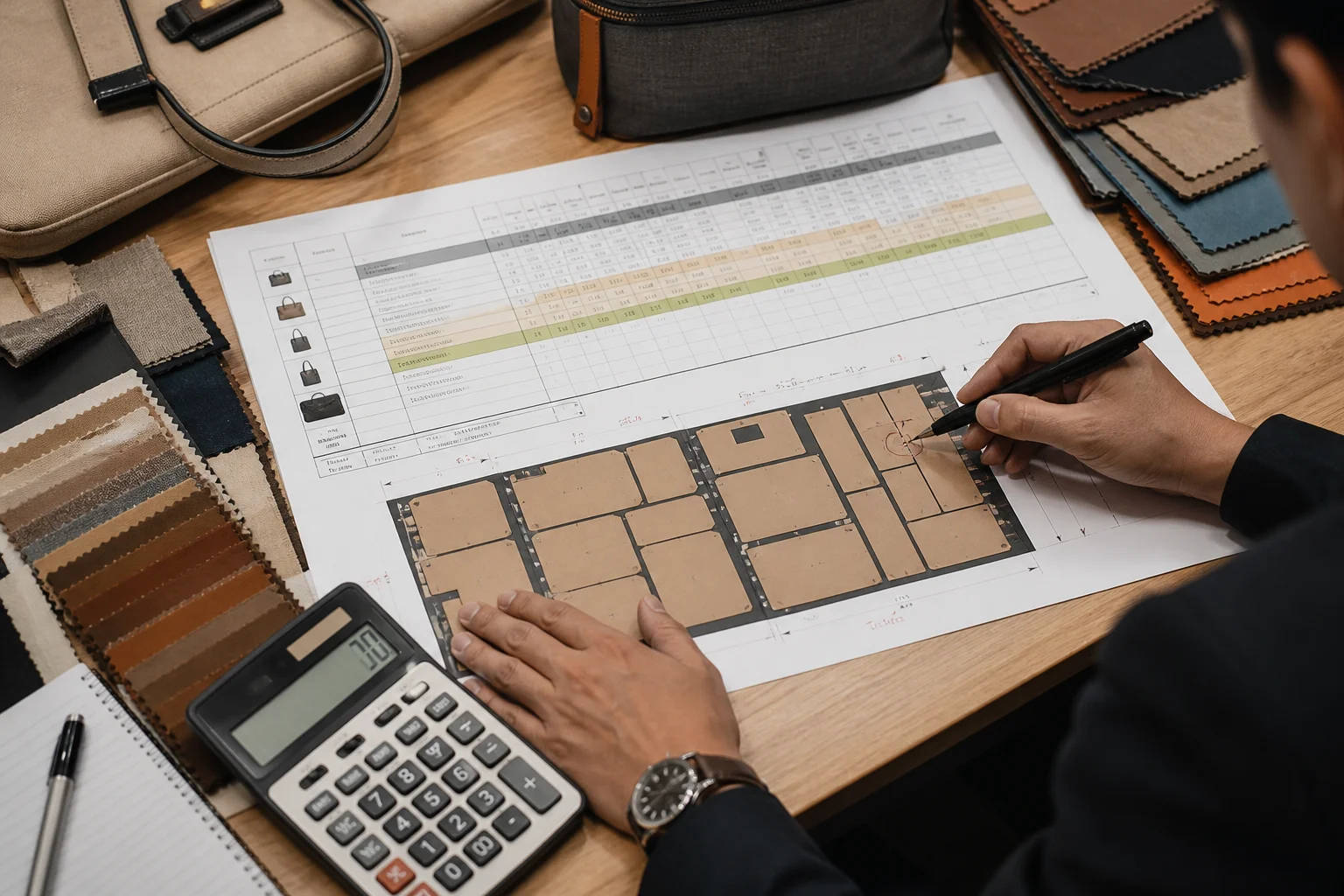
For a bag already in production, the audit runs in reverse: list every panel and operation, price each one, and mark which are visible to the customer. The invisible items form the candidate list.
Most mature products carry several legacy decisions that were sensible once and are simply habit now, which is exactly where a quiet saving sits.
Documenting the specification
A saving only persists if the specification records it. Without documentation, the next order reverts to the previous construction and the saving disappears.
This is the most common reason measured savings fail to hold across a season.
Supplier Selection as a Cost Lever
Choosing the right factory reduces cost before a single design decision is made. The wrong factory makes every subsequent lever harder to pull.
Specialisation and cycle time
A factory that makes your bag type every week has already solved the problems that a generalist will solve on your order. Familiarity with a construction reduces rework, which is one of the larger hidden costs.
Specialisation also shortens trial cycles, because patterns, jigs and machine settings are already close to what the design needs.
Scale versus attention
A very large factory offers lower unit prices but less attention on a small first order. A mid-sized specialist often delivers a better result at a slightly higher unit price.
On a first order, attention is worth more than the price difference, because the learning carries into every repeat.
Location and logistics cost
Unit price is only part of the landed cost. Inland transport, port access and consolidation options vary substantially between regions and can outweigh a small price advantage.
Comparing quotations from two regions on unit price alone is a frequent source of error.
Communication cost
A factory that responds slowly or imprecisely adds cost in the form of delayed decisions, misunderstood specifications and repeated sampling. This cost never appears in a quotation but always appears in the outcome.
| Selection factor | Cost impact | How to assess |
|---|---|---|
| Category specialisation | Lower rework | Ask what share of output is your bag type |
| Cycle time | Lower urgency premium | Ask for typical lead time by stage |
| Location | Lower inland freight | Compare landed cost, not unit price |
| Scale match | Better attention | Ask who handles your order size |
| Responsiveness | Fewer delays | Observe sampling communication |
| Material access | Better pricing | Ask about local material supply |
Why the cheapest quotation is rarely the cheapest supplier
The lowest quotation usually reflects either a different specification or an assumption that the order will be straightforward. When it is not, the difference returns as change orders and delay.
The useful comparison is total landed cost on the same specification, measured across two orders rather than one.
Cost Levers by Lifecycle Stage
Each stage of a product’s life offers different levers, and some close permanently once passed.
Design stage
Panel count, material specification, hardware selection and packaging format are all still open. This is where the largest and cheapest savings are available, because nothing has been committed.
A design review with cost as an explicit criterion, held before sampling, is the highest-return meeting in the whole process.
Sampling stage
Construction can still change, though patterns may need rework. Material substitutions can be tested physically rather than assumed.
Sampling is the last point where a structural change costs nothing beyond a few days.
First production run
Once tooling exists, changes carry implementation cost. What remains available is process-level saving: nesting efficiency, packaging, consolidation and scheduling.
These are still worth pursuing, but they are smaller and slower to realise.
Repeat orders
On repeat orders the levers are volume, rhythm and yield. Design is settled, so attention moves to how the same product is bought and shipped.
Buyers who treat repeat orders as purely administrative leave most of this saving unclaimed.
| Stage | Open levers | Closed levers | Typical saving size |
|---|---|---|---|
| Design | Panels, material, hardware, packaging | None | Largest |
| Sampling | Construction, material grade, trim | Broad concept | Large |
| First run | Nesting, packaging, freight | Tooling and patterns | Moderate |
| Repeat orders | Volume, rhythm, yield, consolidation | Design and construction | Moderate |
| End of life | Clearance planning | Most levers | Small |
The cost of arriving late
Buyers who begin a cost programme after the first order has shipped find most structural levers closed. What remains is negotiation and logistics, which are real but limited.
Starting at design stage is not a preference; it is the difference between a ten percent structural reduction and a two percent discount.
FAQ
What is usually the largest cost in a PU leather bag?
Material is typically the largest single line, with labour second. The proportions shift with design: hardware-heavy bags carry more component cost, and structured multi-panel bags carry more labour. Ask for a category-level breakdown rather than guessing.
Can I reduce cost without changing the design?
Yes. Material nesting, carton right-sizing, order consolidation and predictable release scheduling can all reduce landed cost with no change to the product. These are the safest levers because the customer experiences nothing different.
Is switching to a cheaper material ever a good idea?
On internal, hidden or structural panels, sometimes. On face material, coating or backing, rarely. The customer touches the face of the bag daily, so a downgrade there is experienced quickly and repeatedly.
How much can construction simplification actually save?
It depends on how many panels and operations can be removed. Merging panels and simplifying interiors removes cutting, preparation and stitching steps at once, which is where the compounding effect comes from. Ask the factory to quote the current and simplified builds side by side.
Does a larger order always mean a lower unit price?
Usually, but not linearly, and the curve flattens. A larger order of several styles can cost more per unit than a smaller order of one style, because styling complexity is a cost driver independent of volume.
Should I negotiate hard on the first order?
Aggressive price-only pressure on a first order tends to be recovered invisibly, often through material grade or inspection scope. Exchanging scope, committing volume or changing design produces savings that survive the second order.
How do I know a saving was real?
Compare landed cost for the same quantity and terms, then watch defect and return rates for a season. A saving that raises returns has moved cost rather than removed it.
Why do savings disappear on the next order?
Usually because the change was never written into the specification. The factory reverts to its standard construction, and the saving quietly reverses. Documenting the change is what makes it permanent.
Is reducing inspection a legitimate saving?
No. Inspection cost is small relative to the cost of escaped defects, which include rework, rejection, freight and reputational damage. Reducing inspection transfers cost downstream at a multiple.
What is the cheapest time to reduce cost?
Before the first sample is approved. At that stage panels, operations and materials can change at no cost. Once tooling exists and patterns are cut, the same change requires rework.
Does packaging really matter to cost?
Yes, in two ways. Packaging material is a direct cost, and packed volume affects freight through dimensional weight. Right-sizing cartons reduces both at once.
How many changes should I make at once?
One per order where possible. Changing several variables together makes attribution impossible, so you learn nothing about which change worked and which did not.
Want a cost breakdown before you commit to a design?
Send your drawings and target volume to info@gionar.com and we will set out where the cost actually sits, which levers protect quality, and which changes are worth making at design stage.