- Why Hardware Decides the Bag’s Reputation
- The Hardware Family Tree
- Choosing Zippers Like a Buyer
- Buckles, Clasps and Closures
- Rivets, Feet, Rings and Corners
- Materials and Finishes: The Look That Sells
- Hardware Quality: What Tests Catch
- Custom Hardware for Your Brand
- Working with Your Factory on Hardware
- FAQ
Why Hardware Decides the Bag’s Reputation
Hardware is the part of a bag your customer touches every time: the zipper they pull, the clasp they click, the buckle they adjust. When the hardware fails, the bag fails — no matter how good the leather underneath it is.
The silent quality signal
Buyers judge a bag in the first minutes: the weight of the zipper pull, the smoothness of the track, the solid click of a magnetic snap. That first impression is hardware, and it is the fastest way a customer decides whether a bag feels cheap or premium.
For wholesale buyers the stakes are higher. A hardware failure at retail becomes a return, a negative review and a reorder that never comes. The hardware spec is therefore a commercial decision, not just a production detail.
Hardware’s share of the bill
Hardware typically runs five to fifteen percent of a bag’s material cost, depending on the style. A simple tote with a drawstring sits at the low end; a structured handbag with a zipper, feet, a clasp and custom buckles sits at the top.
That share is small enough to feel minor and large enough to matter. Buying hardware up a grade adds a little cost per bag and removes a whole category of failure from your retail experience — the arithmetic most brands get wrong once.
The Hardware Family Tree
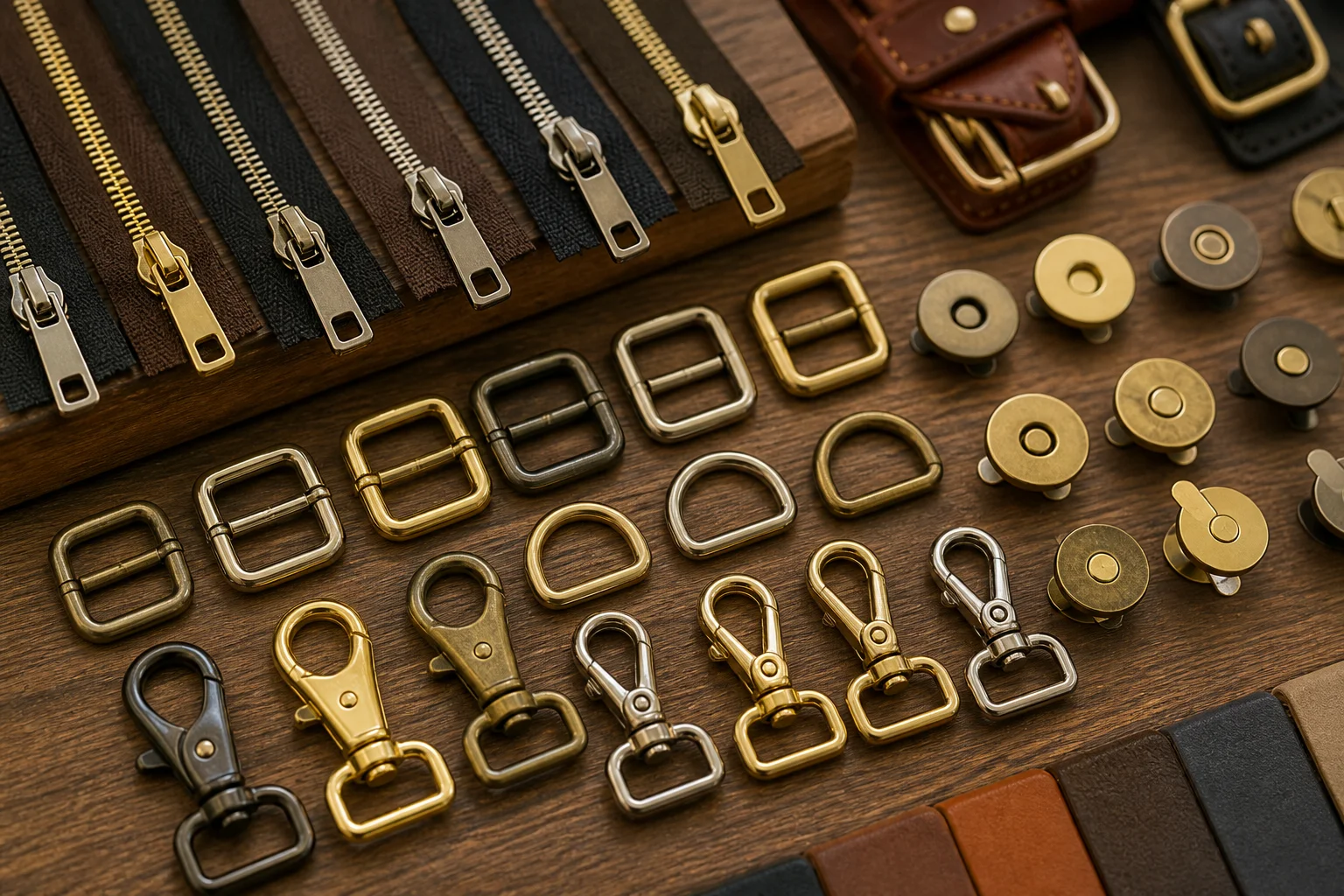
Before choosing, map the terrain. Bag hardware divides into five functional families, and every bag in your line uses at least three of them. Knowing the families makes the specification conversation with your factory far more precise.
The five families
| Family | Examples | Job in the bag |
|---|---|---|
| Openers | Zippers, magnetic snaps, flaps | Access and security |
| Connectors | Buckles, clasps, lobster hooks | Joining strap to body |
| Adjusters | Sliders, strap buckles, D-rings | Fit and carry position |
| Protectors | Feet, corner guards, zipper pulls | Wear and grip |
| Finishers | Rivets, studs, logo plates | Reinforcement and branding |
Each family has its own selection logic. Openers must cycle thousands of times; connectors carry the strap load; protectors absorb the wear that would otherwise reach the material. Specify each family deliberately and the bag behaves as designed.
Why the family view helps buyers
When a failure happens, the family view identifies the culprit fast. A strap that pulls loose is a connector problem; a zipper that jams is an opener problem; a worn bottom corner is a protector problem. The fix targets the family, not the whole bag.
It also structures the factory conversation. Instead of “use good hardware,” you specify per family: zippers to a cycle count, connectors to a load, feet to a material. The factory prices each line and the surprises disappear from the quotation.
Choosing Zippers Like a Buyer
The zipper is the most used piece of hardware on most bags, and the one buyers notice most when it misbehaves. Three construction types dominate bags, and the right choice follows the bag’s job rather than fashion.
Coil, molded and metal zippers compared
| Type | Best for | Strengths | Watch-outs |
|---|---|---|---|
| Nylon coil | Curved pockets, totes | Flexible, smooth, affordable | Lighter feel |
| Molded (plastic) | Backpacks, daily bags | Tough, color-matched options | Bulkier look |
| Metal | Handbags, premium lines | Weight, premium feel | Cost, tarnish care |
The zipper tape and slider matter as much as the teeth. A premium slider with a cheap coil zipper feels wrong; a good coil zipper with a flimsy slider jams. Specify the set together and test the pairing on the sample.
Sizes and specifications to write down
Zippers come in standard sizes — number 3, 5 and 8 cover most bags — where the number relates to the teeth width. Number 3 suits small pockets and pouches; number 5 is the everyday workhorse for main compartments; number 8 appears on heavy travel bags.
Write the size, the type, the length, the slider style and the tape color into the specification. Ambiguity here is how a factory delivers a beautiful zipper that is one size off the pocket it was made for.
What zipper testing reveals
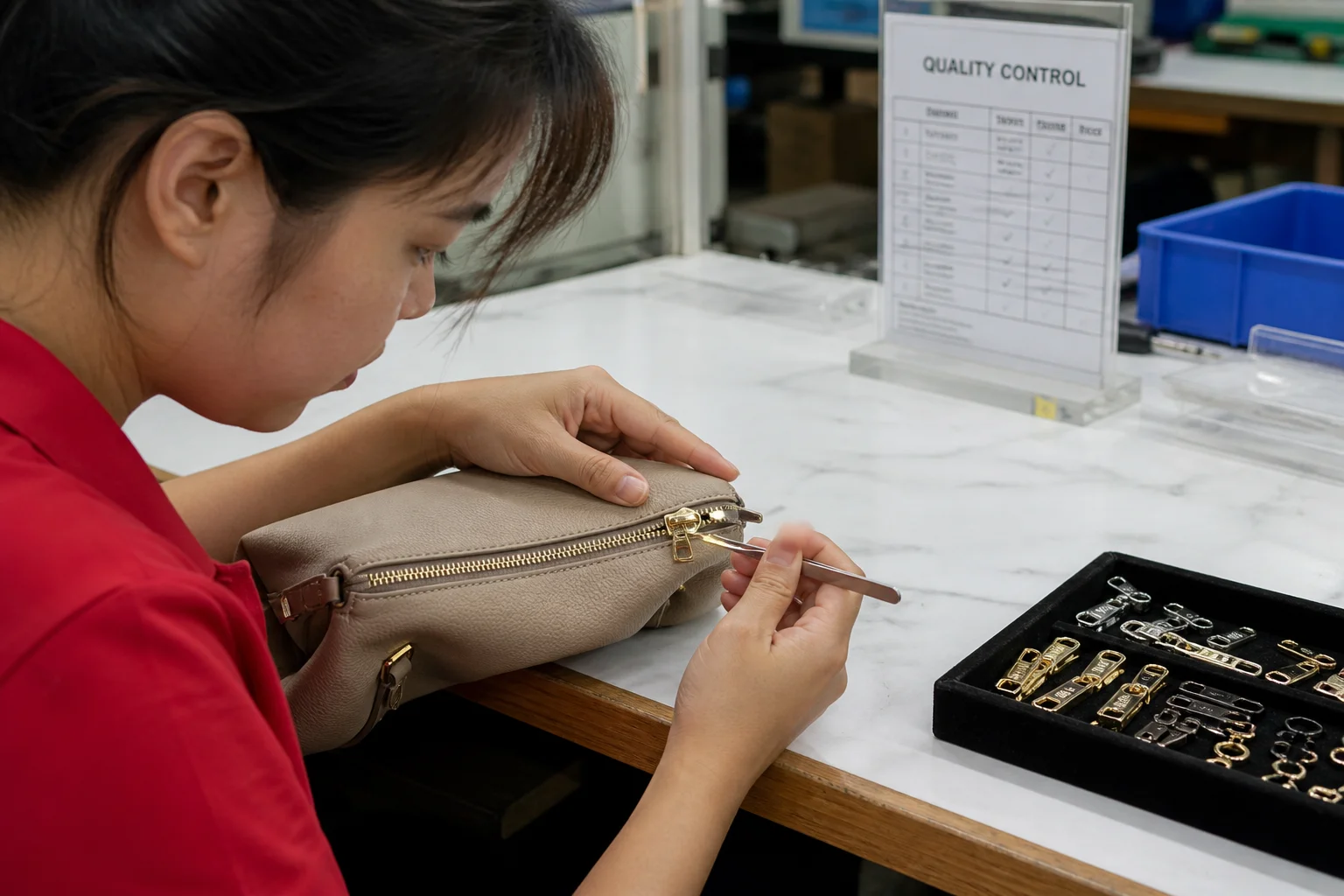
Zipper quality shows in the cycle test: opening and closing the zipper thousands of times to expose wear in the teeth, the slider and the stitching. A bag zipper that fails before the count is a design or sourcing problem, not bad luck.
Ask your factory for the zipper brand and grade it plans to use. Established brands publish their specifications and tests, which gives you a verifiable floor for quality instead of a promise.
Buckles, Clasps and Closures
Closures are where the bag’s personality meets its engineering. A magnetic snap on a flap bag, a clasp on an evening bag and a buckle on a casual tote each change the look and the mechanics of the product.
Magnetic snaps: speed with limits
Magnetic snaps offer one-hand access and a clean look, which is why flap bags and crossbodies use them constantly. The quality variables are the magnet strength, the housing and the stitch or rivet that holds the snap in place.
The failure mode to watch is the magnet separating from the housing or the snap pulling through the material after repeated use. Specify the snap diameter and strength, and reinforce the mounting on heavier materials.
Clasps, hooks and turn-locks
Metal clasps and turn-locks carry a more deliberate, secure feel. Turn-locks suit structured bags where a crisp click signals quality; lobster hooks and dog clips connect straps and change the bag’s character with the pull of a hand.
The common thread is load. A clasp holding a strap carries real weight, so the metal thickness, the spring and the hinge decide whether it lasts a season or a decade. Ask the factory for the load rating when the closure is structural.
Matching the closure to the bag type
| Bag style | Typical closure | Why it works |
|---|---|---|
| Flap crossbody | Magnetic snap or turn-lock | Fast access, secure enough |
| Tote | Zip top or magnetic tab | Open feel with security option |
| Backpack | Zip + optional buckle straps | Security and adjustability |
| Evening clutch | Frame clasp or flap | Elegance over capacity |
Buyers ordering across styles should confirm the closure spec per style rather than assuming one closure serves all. The table above is the starting pattern; your usage and your customer refine it.
Rivets, Feet, Rings and Corners
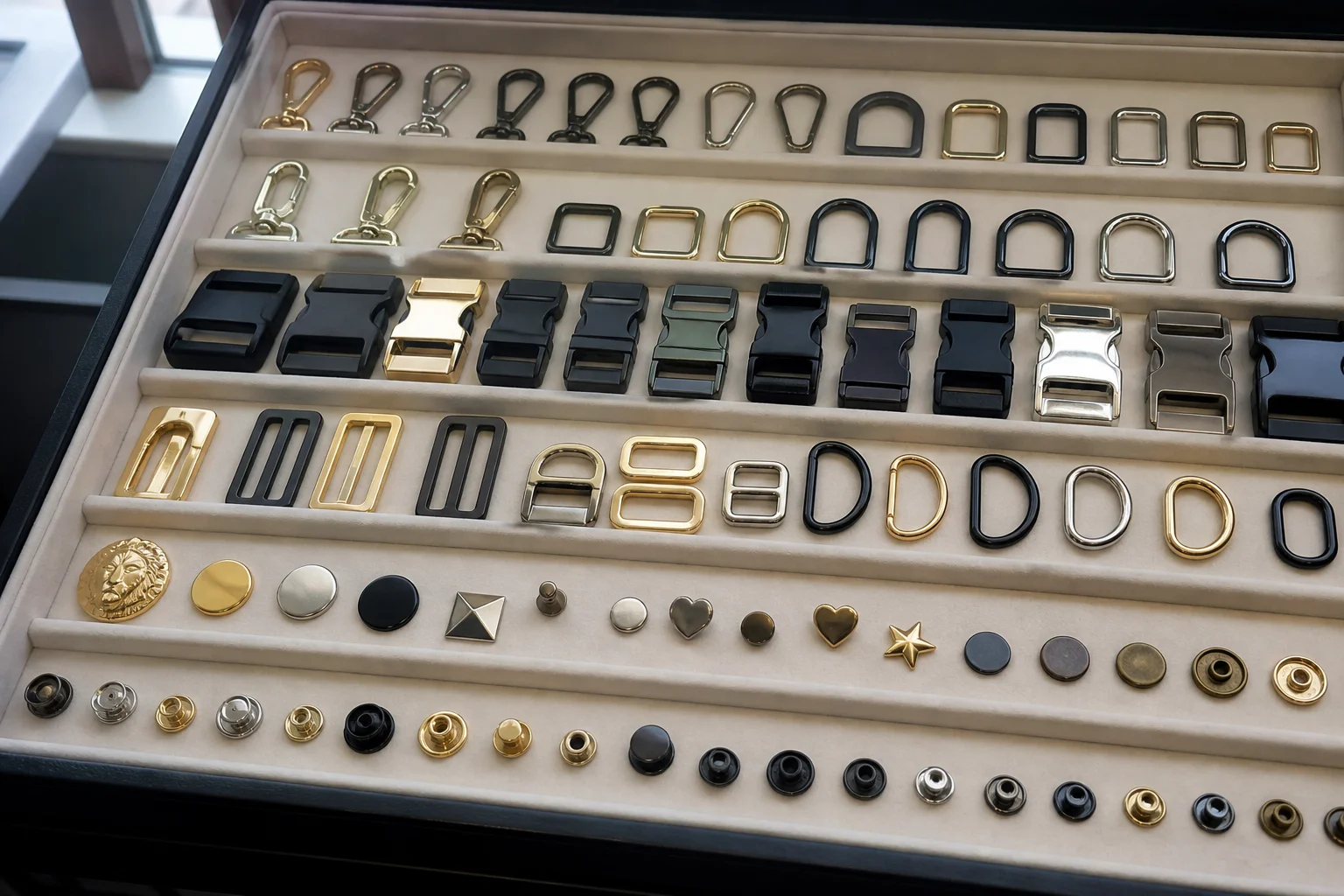
Small hardware earns its keep quietly. Rivets reinforce stress points, feet protect the bottom material, rings anchor straps and corner guards absorb the first impacts of a dropped bag.
What the small parts actually do
Rivets hold the points where stitching alone would tear: strap ends, handle bases and pocket corners. Feet raise the bag off the ground so the bottom material does not wear or stain. D-rings and O-rings give straps and accessories a solid anchor.
Each small part is a defense against a specific failure. When the sample review runs through the bag’s life — carried daily, set down hard, packed full — the small parts are where most long-term wear shows up first.
Choosing the small parts deliberately
Select rivets and feet in the same material family as the main hardware so the bag reads as one design. A nickel zipper with gold feet looks like a mistake; a consistent finish across every piece looks intentional and premium.
Confirm the fixing method too: rivets that require a visible back, feet that screw in versus press in, rings that are welded or merely closed. The method affects durability and repairability, and it belongs in the specification.
Materials and Finishes: The Look That Sells
Hardware metal and finish decide the visual character of the bag — bright or muted, classic or modern — and the finish is where counterfeit-quality products are easiest to spot.
Zinc alloy, stainless steel or plastic
| Material | Look and feel | Durability | Typical use |
|---|---|---|---|
| Zinc alloy | Weighty, detailed casting | Good with plating | Buckles, logo plates |
| Stainless steel | Clean, modern | Excellent, no tarnish | Feet, some clasps |
| Plastic (ABS etc.) | Light, color-matched | Varies by grade | Buckles on casual lines |
Zinc alloy casts into complex shapes, which makes it the default for custom buckles and branded plates. Stainless suits parts that must never corrode. Plastic keeps cost down and weight low but reads less premium at close inspection.
Finishes that survive daily use
The finish — plating, coating or treatment — determines how the metal looks and how long it keeps that look. Electroplated finishes in nickel, antique brass and gunmetal are the workhorses of the bag industry.
The finish’s enemy is abrasion: hardware rubbing against hardware, keys against a clasp, a bag floor against feet. Ask for the finish’s abrasion test result and choose a grade that matches the bag’s intended life.
Color consistency across the line
Hardware color must match across the same style and preferably across the season’s line. Ask for the factory’s hardware color standard and approve a physical sample under daylight — screen photos lie about metallic finishes.
Keep spare finished hardware pieces as the reference for reorders. When the next production run matches the reference, your customers see the same bag; when it drifts, they notice even if they cannot name why.
Hardware Quality: What Tests Catch
Hardware failure appears weeks after the sale, when the return window has closed and the review has been written. Testing at the factory stage is the only way to catch the failures that time would reveal.
The tests worth running
| Test | What it checks | Failure it prevents |
|---|---|---|
| Zipper cycle test | Teeth and slider wear | Jams and breaks in use |
| Load test | Strap and clasp strength | Straps pulling loose |
| Finish abrasion | Plating wear resistance | Faded or flaking metal |
| Salt spray (corrosion) | Metal corrosion resistance | Rust on hardware |
| Magnet strength | Snap holding force | Flaps that will not stay |
The tests map to the bag’s real life: daily opening, carried weight, surface contact and weather. Run them on the approval sample, not the production batch, so the fixes happen before the order rather than after it.
Reading a hardware test report
Ask for the test method and the pass criterion with the report. A zipper that “passed” means little without the cycle count; a finish that “passed” needs the abrasion cycles. The method is what makes the number meaningful.
Keep the reports with the style file. They become the standard for the next production run and the evidence when a factory proposes a cheaper substitute mid-order.
Custom Hardware for Your Brand
Custom hardware is the fastest shortcut to a distinctive bag: a logo zipper pull, a branded buckle or a signature clasp makes the product unmistakably yours. It also carries costs and lead times that need planning.
When custom hardware pays for itself
Custom hardware earns its investment when the brand has volume or premium positioning. A logo plate on a wholesale line signals the brand to every hand that carries it; a custom pull is photographed and shared more than a standard one.
For low-volume or price-driven lines, standard hardware with a tasteful finish usually makes better commercial sense. The rule: spend the custom tooling where the brand visibility is highest — the front closure or the main pull.
Molds, MOQs and lead times
Custom metal hardware starts with a mold — an investment that covers the design, the tooling and the sampling, with the cost per piece falling as volume rises. Plastic parts use similar tooling logic at lower cost.
Budget the timeline: mold making, first samples, adjustments and approval typically take several weeks before production can start. The mold belongs to you contractually in most agreements, which protects the design and the reorder path.
The branding options beyond molds
Not every branded piece needs a new mold. Debossed logos on existing shapes, engraved plates, printed pulls and branded rivets achieve the identity at a fraction of the cost. Ask the factory which of these fits your volume and budget.
Stack the branding options deliberately: one signature piece per bag keeps the identity strong without multiplying tooling costs across ten components.
Working with Your Factory on Hardware
The factory is your hardware partner whether it makes the parts or buys them. The relationship works when the specification is complete, the samples are approved and the substitutes are controlled.
Writing the hardware specification
For every hardware item write: the family, the type, the size, the material, the finish, the brand or grade where relevant and the fixing method. Attach photos and dimensions. The specification is the contract that prevents the mid-production surprise.
Share the hardware plan before sampling so the factory can flag availability and lead time while changes are still cheap. Hardware that must be imported or custom-made changes the schedule — better known in week one than week eight.
Approving hardware samples
Approve the hardware on the actual bag sample, in daylight, against your color standard. Check the function — the zip action, the clasp click, the snap hold — not just the look. Function failures hidden at approval become returns at retail.
Keep the approved hardware sample sealed as the production reference. When the bulk hardware arrives, compare it to the reference; drift in color or finish is the most common silent downgrade in the industry.
Controlling substitutions
Ask the factory to confirm in writing before substituting any hardware brand, grade or finish. Substitutions made silently at production time are how the premium zipper becomes the economy one and the antique brass becomes the flat gold.
The best hardware specification is the one that makes the factory’s job easy and the substitute’s job impossible. Write it fully, approve it physically and control every change.
The same discipline extends to every hardware item on the bag, from the zipper that opens a hundred times a day to the feet that never get noticed until they fail.
Hardware Cost Levers: Buying Smarter
Hardware pricing follows volume, standardization and finish — the same part costs differently depending on how you buy it. Understanding the levers lets a buyer hold quality while spending less per bag.
Volume and standardization
Hardware prices fall steeply with quantity because the tooling, plating runs and handling spread wider. Standard sizes and finishes buy at better rates than specials, so standardize where the design allows and spend the premium only where the customer sees it.
Consolidate hardware across your styles: the same zipper size, the same finish and the same feet across the line increase the order volume per item. One hardware family across the season also reads as a more coherent brand.
Finish choices and cost
The finish is a surprising share of hardware cost. Standard electroplated finishes cost little; textured, antique or multi-tone finishes add steps and price. Choose the finish that the design needs and avoid decorative finishes on parts that are rarely seen.
Ask the factory for finish options with their price differences before finalizing the spec. The visible difference between a standard nickel and a brushed antique may be smaller than the price difference between them.
Where the factory sources
Factories either make hardware in-house or buy from hardware suppliers. In-house production suits simple parts at volume; specialist suppliers dominate zippers and complex castings. Ask which parts are made and which are bought — the answer explains the price structure.
A factory with established hardware suppliers delivers better prices and steadier quality than one buying ad hoc. Ask for the supplier names and grades in use, and verify them on the first order rather than assuming.
Hardware Trends in Bag Design
Hardware moves with fashion: the size, the finish and the placement of metal on bags change with each season’s direction. Wholesale buyers who read the movement stock the look before it saturates.
Bigger, bolder statements
Oversized buckles, chunky zipper pulls and sculptural clasps have been pushing hardware into the foreground — the metal becomes the design, not the detail. The trend suits structured bags and reads strongly in photography and on the shelf.
For the manufacturer the implication is specification precision: a bolder part carries more weight and more cost, so the sample must carry the real part, not a stand-in that looks similar at a glance.
Mixed metals and warm tones
Designers are mixing metals — gold with silver, brass with gunmetal — in a single bag, moving past the old rule of one finish per product. The mix must still look deliberate, with the metals separated by material or by zone.
Warm finishes keep their pull: antique brass and champagne gold suit the earth-toned materials that dominate current ranges. Confirm the exact tone against your material, because “gold” spans a wide and unflattering range.
Hardware that hides or disappears
In contrast, some lines push hardware to disappear: concealed magnets, invisible closures and color-matched plastic parts that read as fabric. The look is clean and minimalist, and its quality bar sits in the mechanics rather than the shine.
The two directions — bold metal and invisible hardware — target different customers. Choose the direction for your line and resist mixing them within one style, where the result reads as indecision rather than range.
Hardware Failures and Consumer Returns
Retail returns are where hardware quality failures arrive with a price tag: the return, the refund, the shipping and the lost reorder. Mapping the common failures shows where the prevention budget belongs.
The failures that drive returns
The frequent offenders are zippers that jam or break, magnetic snaps that lose their hold, clasps that will not stay closed and finishes that flake or tarnish within weeks. Each maps to a test that would have caught it at the factory.
Track the return reasons by category. When one failure pattern repeats, fix the specification rather than the individual returns — the spec fix removes the whole class of problem for every future order.
The cost of a hardware return
A returned bag costs the brand more than the refund: the return shipping, the restocking, the inspection and the lost trust of a customer who will not reorder. At wholesale margins, one return can erase the profit of several sales.
That arithmetic justifies spending slightly more on hardware grade and testing at the source. The premium of a few cents per zipper buys protection that marketing spend cannot replace.
Preventing the class of failure
Prevention runs through the whole chain: specify the grade, test the sample, inspect the bulk and keep the reference. A factory that tests hardware on every production batch closes the loop between the approval sample and the shipped goods.
Ask your factory which hardware tests run on production versus only on samples. The difference marks the factories that prevent returns from those that simply hope for the best.
The pattern holds across categories: hardware quality decides whether a bag survives its first season in the customer’s hands. Invest the specification time once and every order that follows inherits the protection, quietly and permanently.
FAQ
Should hardware match across my whole bag line?
A consistent finish family across the line reads as a deliberate brand look and consolidates buying volume, which lowers cost. Mix metals within one style only as a designed statement, not as an accident of sourcing.
How do I know if a hardware supplier is reliable?
Ask the factory who supplies the hardware and whether established brands are in use — zipper brands publish specifications and tests. Check the supplier’s history, request certificates and verify the parts against the approved sample on the first order.
What is the most important hardware on a bag?
The zipper is the most-used piece, so its quality defines the daily experience. But the closure carries the brand feel and the small parts carry the long-term wear, so the honest answer is the whole specification done deliberately.
How much does hardware add to a bag’s cost?
Hardware typically runs five to fifteen percent of material cost depending on the style. Simple totes sit at the low end; structured handbags with zippers, feet, clasps and custom buckles sit higher.
Metal or plastic hardware for my line?
Zinc alloy and stainless steel suit premium and mid lines with their weight and durability; quality plastic keeps cost down for casual and price-driven products. Match the material to the bag’s positioning, not the factory’s convenience.
How do I choose between coil, molded and metal zippers?
Coil zippers flex and suit curved pockets; molded zippers are tough for daily bags and backpacks; metal zippers give premium feel for handbags. Choose by the bag’s use, then match the slider quality to the tape.
What does custom hardware cost and how long does it take?
Custom metal hardware requires a mold — a tooling investment that falls per piece as volume rises — plus several weeks for making, sampling and approval. For lower volume, debossing, engraving or printed pulls achieve branding at less cost.
Who owns the mold for custom hardware?
In most agreements the buyer owns the mold after paying the tooling cost, which protects the design and the reorder path. Confirm the mold ownership clause in writing before production starts.
Can I use the same hardware on different bag styles?
Yes, and it is often smart: standardizing sizes and finishes across styles consolidates volume, lowers price and keeps the line visually coherent. Reserve unique hardware for the styles where it earns its cost — the hero products of your range.
What should the hardware spec document include?
Include the family, type, size, material, finish, brand or grade, fixing method and mounting location for every piece, with photos and dimensions. Attach the supplier reference when known and note the test standard each piece must pass.
Why does my hardware finish fade quickly?
Fading or flaking points to a finish too light for the abrasion the part faces. Ask for the finish’s abrasion test result and match the plating grade to the bag’s use — hardware that rubs needs a heavier finish.
What should I check when approving hardware samples?
Check function first — zipper action, clasp click, snap hold — then look: color under daylight, finish consistency and feel. Approve on the actual bag sample and keep a sealed reference for production comparison.
Next Steps: Specify Hardware with Confidence
Hardware is learnable in one systematic pass: map the families, choose by the bag’s job, write the full specification, test the samples and control every substitution. The discipline costs an hour per style and saves the returns that hardware failures create, season after season.
A factory that stocks quality hardware and documents its sources makes the whole process simpler. That is the standard our factory works to — ask us how we specify, sample and test hardware on every order, from first sample to final inspection.
Planning a bag line and want hardware done right? Contact our team at info@gionar.com for hardware specification support on your next order.
Related reading: our custom bag manufacturing portfolio shows how hardware, materials and construction come together in production.