- Why Communication Decides the Outcome
- Know Who You Are Talking To
- Writing Specifications That Survive Translation
- Time Zones, Cadence and Meeting Rhythm
- Reading Yes, No and Everything Between
- Accountability Without Damaging the Relationship
- Quote, Order and Change Control
- Building Trust That Earns Better Slots
- Practical Pitfalls and How to Avoid Them
- FAQ
Why Communication Decides the Outcome
Most problems with an overseas bag order are not technical. The factory has the machines, the materials and the skills. What breaks down is the exchange of information between the buyer and the people making the product.
The gap that causes the problems
The buyer holds a mental picture of the product; the factory works from documents. Everything the factory knows about the bag comes from what was written, sent and confirmed, so any gap between the picture and the paperwork becomes a defect in production.
That is why a well-communicating buyer consistently receives better product from the same factory than a vague one. The factory is not withholding quality; it is building to the understanding it was given.
Where projects actually fail
| Failure point | Root cause | Prevention |
|---|---|---|
| Sample mismatch | Ambiguous specification | Written spec with measurements |
| Wrong material | No material reference | Reference codes and swatches |
| Late delivery | Assumptions about the calendar | Backwards plan with holidays |
| Cost creep | Changes without cost confirmation | Written change control |
| Defect disputes | No agreed quality standard | Documented acceptance criteria |
| Broken relationship | Escalation without evidence | Evidence-based issue reporting |
Not one of those rows is a manufacturing problem. Each is an information problem, which is why the playbook in this guide focuses on what you send, how you confirm it and how you handle the moments when something goes wrong.
What good communication looks like in practice
Good communication with a Chinese bag factory is characterised by short written messages with numbered points, measured specifications rather than adjectives, and confirmations that restate what was understood.
It is also characterised by consistency. A buyer who sends clear instructions once and then disappears creates confusion; one who sends a short weekly message keeps the order visible and the assumptions current.

Know Who You Are Talking To
A factory is not a single correspondent. Knowing who does what, and sending each question to the right person, is the fastest improvement most buyers can make.
The roles you will encounter
| Role | Responsibility | Ask them about |
|---|---|---|
| Sales | Enquiries, pricing, order intake | Quotes, MOQ, general availability |
| Merchandiser | Order follow-up, scheduling | Progress, documents, delivery dates |
| Sample technician | Sample construction | Construction detail, pattern questions |
| Pattern maker | Patterns and specifications | Dimensions, tolerances, feasibility |
| QC inspector | Inspection and standards | Defect levels, measurement results |
| Production planner | Capacity and line scheduling | Slot availability, lead times |
| Owner or manager | Decisions and exceptions | Escalations, commercial terms |
Your main contact will usually be sales or a merchandiser, but the technical answers come from the sample room and the pattern room. Getting a technical question to the right desk saves a week of relayed messages.
Getting a technical channel early
Ask during the sampling stage whether you can raise technical questions directly with the person building the sample. Many factories are happy to arrange this once they see the questions are specific rather than speculative.
A direct technical channel also raises the quality of feedback. A pattern maker can explain that a requested dimension would distort the shape, which is more useful than a sales answer that says it is possible.
Communication channels and their uses
Email remains the channel of record for specifications, approvals and commercial terms. Instant messaging is faster for progress questions and photographs, but it is a poor archive and a weak form of evidence.
Use both deliberately: send the decision by email and use messaging for the courtesy follow-up. When a dispute arises, the email thread is what both sides will rely on.
Who signs off
Establish early who on the factory side can approve a change, a deviation or a schedule shift. A merchandiser may manage the day-to-day while only the manager can move a delivery date.
Knowing the sign-off point prevents the common frustration of agreeing something with your contact and finding it has no weight with the production floor.
Writing Specifications That Survive Translation
Your specification will be read by people working in a second language, often under time pressure. Writing for that reality is the single highest-return change a buyer can make.
Short sentences, numbered points
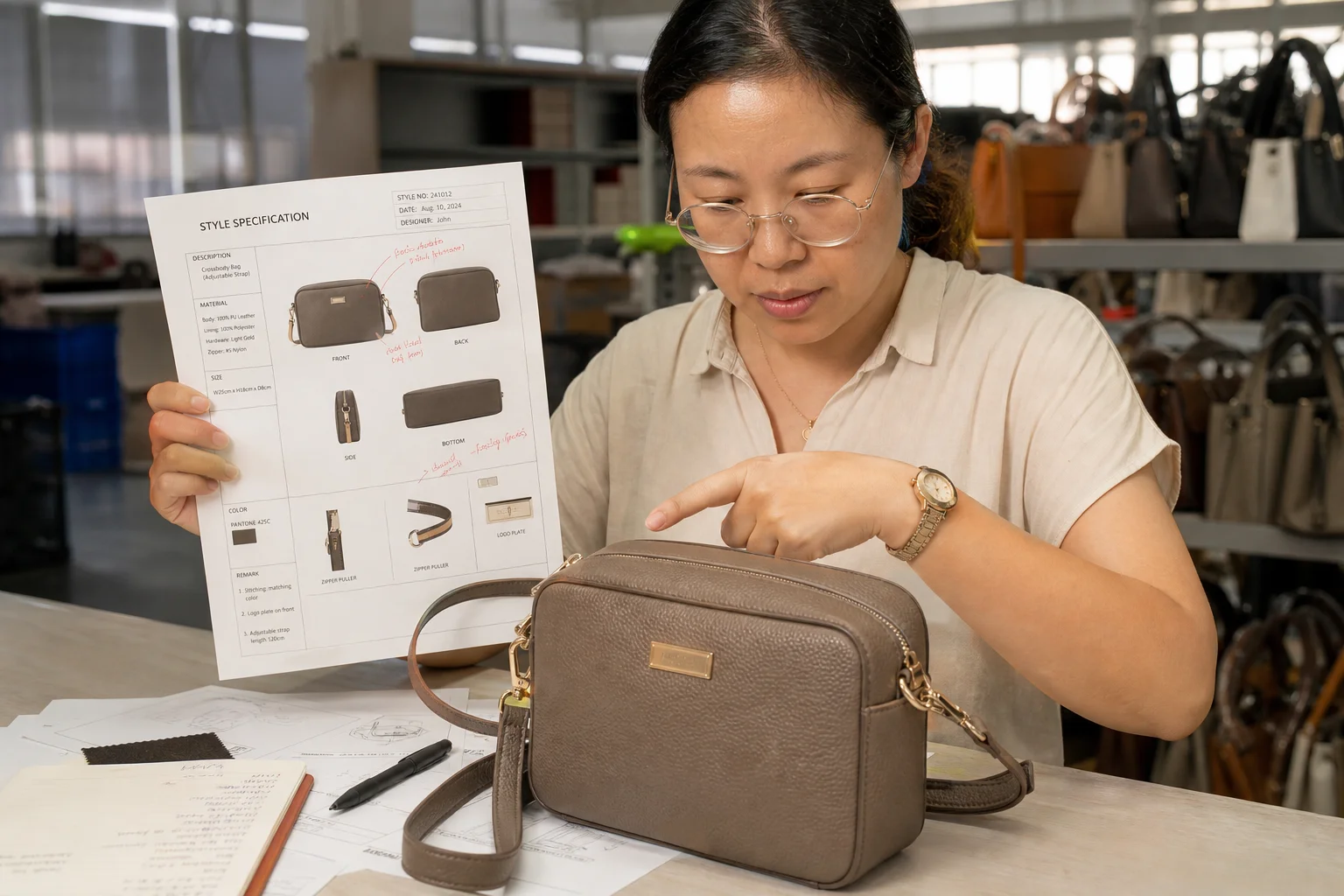
Write in short sentences with one instruction each, and number every point so it can be referenced. A paragraph containing four requirements will be read as one requirement by someone skimming it.
Avoid idioms, humour and culturally specific references. They are not merely ineffective; they can be actively misleading when translated literally.
Precise wording instead of adjectives
| Ambiguous | Precise |
|---|---|
| Good quality PU leather | PU leather, 0.9 mm thickness, matte finish, reference ABC-09 |
| Strong stitching | Nylon thread 20/3, 8 stitches per inch, double row |
| Nice hardware | Antique brass finish, No.5 zipper, alloy buckle |
| Reasonable size | 32 cm wide × 24 cm high × 12 cm deep |
| Similar to sample | Match approved sample Ref. S-2026-14 in colour and texture |
Adjectives are where substitution enters the product. Every adjective in a specification is an opening for an interpretation that meets the price instead of the intent.
Units, measurements and tolerance
State units explicitly for every dimension and avoid mixing systems within one document. Give each critical dimension with its tolerance, because a measurement without tolerance has no acceptance criterion.
Name the measurement point for dimensions that could be taken in more than one way: overall width against body width, height with or without the handle. Ambiguity here produces a technically compliant bag of the wrong size.
Visual references and photographs
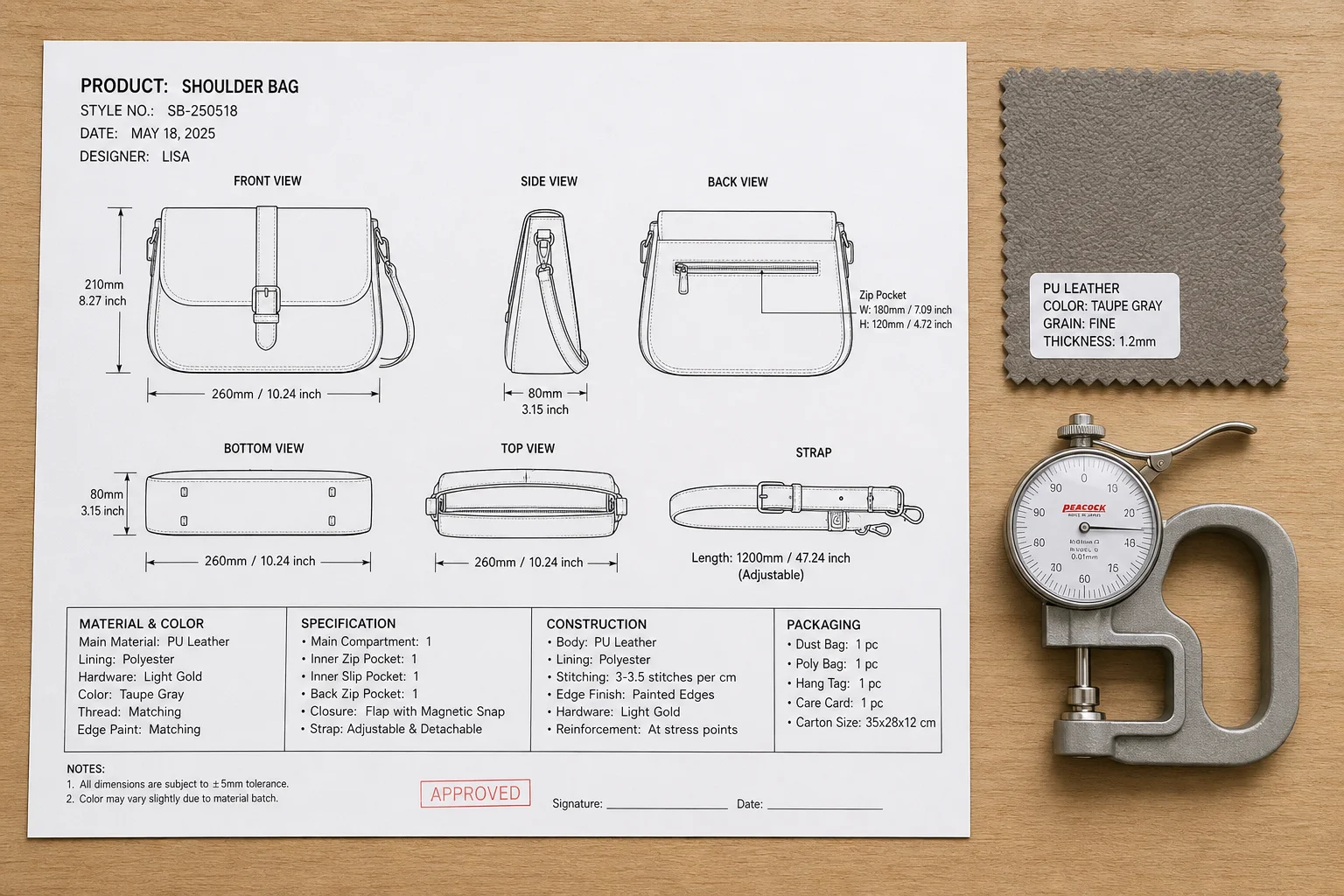
A specification benefits from photographs with marked dimensions and arrows pointing to the detail being discussed. A single annotated image often removes the need for three paragraphs of description.
Photograph the approved sample from every relevant angle and label the images in the same order as the specification. Both sides then refer to the same picture when a question arises.
Time Zones, Cadence and Meeting Rhythm
Communication with a factory works better as a rhythm than as a series of reactions. A predictable cadence keeps the order visible and reduces the number of urgent questions.
The working window
Most Chinese factories operate on China Standard Time, which is eight hours ahead of Central European Time and twelve to fifteen hours ahead of the United States, depending on the season.
The practical consequence is that a question sent at the end of your working day arrives at the start of theirs. Messages sent in your morning may sit unanswered until the following day, which is a normal delay rather than a sign of neglect.
A cadence that keeps orders on track
| Frequency | Purpose | Channel |
|---|---|---|
| Weekly progress note | Status, photos, next milestone | Email plus photos |
| Milestone confirmation | Materials in, production start, completion | |
| Ad hoc short questions | Quick clarifications | Messaging |
| Decision records | Approvals and changes | Email, always |
| Review call | Sampling and pre-production | Video where useful |
The weekly note is the single most effective habit. It costs a few minutes and repeatedly catches small misunderstandings before they become production problems.
Making meetings count
Schedule calls at a time that falls within the factory’s working day, and send the agenda and any documents the day before. A call without an agenda becomes a status conversation rather than a decision.
Where language support is needed, a video call with a sample in view is far more productive than a written exchange about the same detail, because both sides can point at the same thing.
Confirming what was understood
Close every significant exchange by asking the factory to restate the action, the owner and the date in writing. This convention is polite, quick and catches translation errors immediately.
Where the answer comes back wrong, you have found a misunderstanding at the cheapest possible moment. Where it comes back right, you have a written record that both sides accepted.
Reading Yes, No and Everything Between
Direct refusal is uncommon in Chinese business communication, so a literal reading of replies can mislead a buyer into thinking an issue is settled when it is not.
Indirect answers and what they signal
| Phrase | Likely meaning | Useful follow-up |
|---|---|---|
| We will try our best | Difficult; may not be achievable | Ask what specifically is difficult |
| Let me check with the factory | Answer is not yet known internally | Ask for a date for the answer |
| This may take more time | Schedule risk; a change of plan is needed | Ask for the revised date in writing |
| It is possible | Technically yes, conditions unknown | Ask about cost and lead time impact |
| No problem | Acknowledgement, not confirmation | Ask for the written detail |
| We suggest another way | A direct objection, politely framed | Take it seriously and evaluate |
The last row is the most valuable. When a factory proposes an alternative, it is usually solving a real production problem, and the suggestion is often better than the original instruction.
Asking questions that invite a real answer
Yes-or-no questions encourage agreement. Open questions such as “what is the difficulty with this specification?” or “what would you recommend instead?” produce information you can act on.
It also helps to make it easy to say no. Stating that a schedule change is acceptable if raised early removes the incentive to stay silent and hope the problem resolves itself.
Avoiding yes by default
A factory may agree to a request it cannot meet rather than disappoint a customer, especially when the request is urgent. The risk is carried by the buyer as a late shipment or a compressed quality standard.
Test important commitments by asking for the basis: which line, which dates, which materials. A commitment that comes with a plan is far more reliable than one that does not.
When you must have a clear answer
For critical points such as a hard delivery date, ask directly for a yes or no and explain why the clarity matters to your business. Framing the request as necessary information rather than as pressure usually produces a direct answer.
Where the answer is no, treat it as useful. A supplier that tells you the truth about a constraint is more valuable than one that agrees and fails.
Accountability Without Damaging the Relationship
Problems will occur. How you raise them determines whether they are resolved and whether the relationship survives with the supplier motivated to do better.
Report the issue with evidence
Describe the deviation, not the emotion: what was specified, what was received, the measurement or photograph showing the gap, and the impact on your business.
Factory managers respond to specifics because specifics point at a process. Complaints framed as disappointment produce apologies rather than corrective action.
The escalation ladder
| Step | Action | When to use |
|---|---|---|
| 1 | Ask the merchandiser to clarify a single point | Minor discrepancy |
| 2 | Send a written issue summary with evidence and the required remedy | Confirmed defect or delay |
| 3 | Request a corrective action response with root cause and prevention | Recurring or shipped defect |
| 4 | Escalate to the manager or owner in writing | No response or no remedy |
| 5 | Involve inspection records, payment milestones or contract terms | Commercial dispute |
Moving one step at a time preserves the relationship and demonstrates good faith. Escalating immediately to the owner for a small issue costs credibility that you will want later.
Separating the person from the process
Framing an issue as a process problem rather than a personal failure allows the factory to correct it without losing face, which increases the chance of a genuine fix.
A request for a corrective action response — what happened, why, and what will change — gives the factory a professional structure for solving the problem rather than defending against it.
Recognising good performance
Feedback works in both directions. A short note acknowledging an on-time shipment, a well-made batch or a helpful suggestion costs nothing and improves your standing when you next ask for a slot.
Factories are managed by people who remember which customers are fair. That memory is a real commercial asset when capacity is tight.
Quote, Order and Change Control
Changes are the most common source of cost and schedule disputes, and they are almost entirely preventable with a simple written convention.
Version control on documents
Give every specification a version number and date, and reference the version in all correspondence. When the factory confirms an order, confirm which version it is building to.
Multiple undated versions circulating by email is the single most common cause of a production error, because different people work from different copies.
Recording changes properly
| Element | Why it must be written |
|---|---|
| What changed | Removes later ambiguity about intent |
| Reason | Helps the factory propose a better alternative |
| Cost impact | Prevents disputes at invoicing |
| Schedule impact | Keeps the delivery date honest |
| Effective from | Defines which units are affected |
| Approved by both sides | Makes the change enforceable |
The rule that matters is that no change is actioned until the cost and schedule impact has been confirmed in writing. Verbal agreement to a change is how a fixed price becomes a variable one.
Freezing the specification
Set a date after which the specification is frozen for the current run. Changes requested after that point are treated as a new order or a paid rework, which is a normal and reasonable position for a factory to take.
Announcing the freeze date in advance gives the factory stability and gives your own team a deadline for final decisions.
Handling changes the factory proposes
Factories frequently suggest substitutions when a material is unavailable or a construction is problematic. Evaluate the proposal on its merits: what changes for the customer, the cost and the schedule.
A substitution that reduces cost and is invisible in the product is worth accepting; one that touches a visible or functional aspect needs the same scrutiny as a change from your side.
Building Trust That Earns Better Slots
Commercial relationships in manufacturing reward reliability. Buyers who are predictable receive better schedules, faster answers and more honest warnings.
What factories actually value
| Behaviour | Effect over time |
|---|---|
| Clear, complete specifications | Fewer sample rounds, faster starts |
| Decisions made on time | Keeps the line schedule stable |
| Payment on schedule | Priority in tight capacity |
| Realistic delivery expectations | Honest warnings instead of silence |
| Fair handling of problems | Willingness to absorb small issues |
| Some order predictability | Reserved slots and better pricing |
None of these requires scale. A small buyer who is organised and pays reliably is treated better than a larger one who is chaotic, because predictability is what allows a factory to plan.
Payment as a communication act
Paying on the agreed schedule is the clearest signal of a professional buyer. Late payment, unexplained delays and contested invoices all reduce a factory’s willingness to invest in your orders.
Where a payment must be delayed, communicating it early preserves more goodwill than letting the due date pass silently.
Professional boundaries
Gift-giving and hospitality are part of business culture in many markets, including China. Accepting and offering modest courtesies is normal; relying on them instead of clear written agreements is not.
Keep the commercial relationship grounded in documents. A supplier who knows your specifications, standards and expectations precisely does not need entertainment to perform.
Investing in the relationship
A factory visit, when practical, is worth more than months of correspondence. Seeing the line, meeting the sample room and understanding the constraints turns a supplier into a known partner.
Where travel is not possible, a scheduled video walk-through of the production area achieves much of the same familiarity at a fraction of the cost.
Practical Pitfalls and How to Avoid Them
The same practical errors recur across buyers and markets. Each has a straightforward countermeasure.
Channels and records
| Pitfall | Consequence | Countermeasure |
|---|---|---|
| Decisions only in chat messages | No evidence in a dispute | Restate decisions by email |
| Multiple contacts with different versions | Conflicting instructions | One file, versioned, one sender |
| Assuming silence means agreement | Wrong work proceeds | Require written confirmation |
| Ignoring the holiday calendar | Missed delivery dates | Plan around known closures |
| Agreeing changes verbally | Cost and schedule disputes | Written change record |
| No named sign-off | Approvals without authority | Identify the approver early |
Every row is administrative rather than technical, which is encouraging: the fix costs a few minutes of discipline rather than additional budget.
Cultural expectations worth knowing
Face matters in Chinese business communication. Public criticism of an individual, whether in a meeting or a group message, is likely to reduce cooperation rather than improve performance.
Raise concerns privately, in writing, with evidence and a constructive proposal. The same message delivered this way is usually acted on, because it lets the recipient solve the problem without losing standing.
When the relationship is not working
If a supplier repeatedly misses commitments, ignores specification and does not respond to documented issues, the communication playbook has done its job: it has shown you the supplier’s real capability early.
Switching suppliers is a legitimate outcome of a well-run process, not a failure of it. Keep your specification, sample and inspection records current so that a change is a transfer rather than a restart.
With a Chinese bag factory, the quality of the paperwork predicts the quality of the product. Write clearly, confirm in writing and keep one version of the truth.
Tracking Progress Without Micromanaging
There is a balance between visibility and interference. A buyer who asks for a status update every day slows the work; one who checks at the right milestones keeps control without becoming a burden.
The milestones worth tracking
| Milestone | What to confirm |
|---|---|
| Order confirmation | Specification version, quantity, price, date |
| Materials ready | Material reference and quantity received |
| Production start | Line allocation and start date |
| Mid-production | Photographs of work in progress |
| Production complete | Quantity produced and inspection date |
| Inspection | Results against the agreed standard |
| Shipping | Packing list, carton marks, documents |
Confirming these seven points gives a reliable view of the order without requiring daily contact. Each confirmation is short and each produces a document you can rely on later.
Photographs as a communication tool
Ask for dated photographs at each milestone showing the materials, the work in progress and the finished packing. Photographs catch visual deviations long before a shipment is complete.
Specify what the photographs should show rather than requesting them generally. A picture of a stack of cartons is far less useful than one of the carton markings with the quantity visible.
Using third-party inspection
Where the order value or the risk justifies it, a pre-shipment inspection by an independent agency gives an objective check against your specification. Introduce it during the commercial discussion rather than at the last moment.
Factories accustomed to professional buyers accept inspection as routine. Raising it late can be read as a lack of trust, while raising it early reads as standard practice.
FAQ
How often should I contact my factory during an order?
A weekly written progress note plus confirmation at each of the seven major milestones is usually sufficient. Daily contact slows the work and adds little information beyond noise.
What is the best way to send specifications to a Chinese factory?
By email, in a numbered list using short sentences, with explicit units, tolerances and material references, plus annotated photographs of the approved sample. Attach one versioned document rather than scattered messages.
Should I use email or a messaging app?
Email for specifications, approvals and commercial decisions; messaging for quick progress questions and photographs. When a dispute arises the email thread is the record both sides will rely on.
What does it mean when a factory says it will try its best?
It usually signals a real difficulty rather than a commitment. Ask what specifically is difficult, what would make it possible and what the impact on cost or schedule would be.
Why do factories avoid saying no directly?
Direct refusal can feel impolite and may disappoint a customer. Make it easy to say no by stating that an early warning is acceptable, and ask for the basis of any commitment so agreement comes with a plan.
How do I raise a quality problem without damaging the relationship?
Send a written issue summary with evidence: what was specified, what was received, the measurement or photograph showing the gap, and the remedy you require. Request a corrective action response for recurring issues.
Who should I escalate a serious problem to?
Work up the ladder one step at a time, ending with the manager or owner in writing if the merchandiser cannot resolve it. Immediate escalation for a small issue costs credibility you will need later.
How can I get better delivery slots from a factory?
Be predictable: send complete specifications, make decisions on time, pay on schedule and provide a rolling forecast. Factories reserve capacity for buyers whose schedules they can plan around.
Should I allow the factory to propose material substitutions?
Evaluate each proposal on its merits. A substitution that reduces cost and is invisible to the customer is often sensible; one affecting a visible or functional element needs the same review as a change from your side.
What documents should I keep for a dispute?
The versioned specification, the approved sample photographs, email confirmations of price and schedule, the written change records and the inspection report. These five items resolve almost every commercial disagreement.
Is a factory visit necessary?
Not strictly, but it is the fastest way to build mutual understanding. Where travel is impractical, a scheduled video walk-through of the production area and sample room achieves much of the same effect.
How do I confirm that a factory understood a complex instruction?
Ask it to restate the action, the owner and the date in writing. If the restatement matches your intent the point is settled; if it does not, you have found the misunderstanding before production begins.
What is the most common communication mistake buyers make?
Leaving decisions in chat messages and assuming silence means agreement. Restating every decision by email, with a version reference, prevents the majority of late-stage disputes.
Next Steps: Run the Playbook on Your Next Order
Communication with a Chinese bag factory is a process you control: know who does what, write specifications that survive translation, keep a steady cadence, read indirect answers accurately and manage changes in writing.
None of it requires scale or budget, and all of it compounds. A supplier that receives clear documents, prompt decisions and fair feedback will produce better bags for you than for the buyer who sends three paragraphs and a photograph.
A factory that answers technical questions precisely and confirms specifications in writing is telling you how the whole order will run. That is the standard our factory works to — send us your specification and see how we respond.
Starting a new bag programme? Contact our team at info@gionar.com for specification review and a written production plan.
Related reading: our custom bag manufacturing portfolio shows the specifications we build to, from simple totes to structured handbags.