Which Topics Belong in a Bag Pre-Production Quality Meeting?
A pre-production meeting is the last cheap moment in a bag programme. After the line starts, every change costs material, machine time and freight; before it starts, almost every change is a conversation and a revised sheet.
Most factories hold such a meeting. Far fewer hold one that decides anything. The difference is not the length of the agenda but whether each item ends in a recorded decision with an owner, or dissolves into a discussion that everyone leaves with a different understanding of what was agreed.
The cost of a vague kick-off
A single unresolved tolerance on a bag handle can produce a shipment that measures within the drawing but fails the buyer’s expectation. Because nothing was written down, the dispute becomes a matter of interpretation, and the goods are already made. Rework or a discount is the only remaining option, and both are more expensive than an hour of clarification.
What a pre-production meeting is not
It is not a price negotiation, not a factory tour and not a general relationship meeting. Those have their place, but mixing them into the quality kick-off is the most common reason the quality items get ten minutes at the end and no decisions.
What this article covers
The topics that belong on the agenda and the order they should follow, who needs to be in the room, what a finished decision looks like on paper, how to set the inspection standard before production, how to record the sealed sample, and the agenda items that are usually missing and later become claims.
- Why the Meeting Exists and What It Must Produce
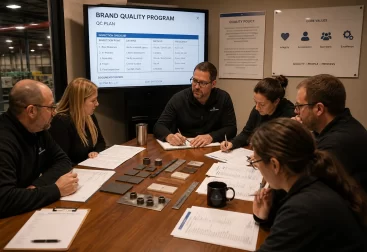
- Who Attends and When It Happens
- Confirming the Tech Pack Line by Line
- Material and Colour Approvals
- Hardware and Component Verification
- Construction and Reinforcement Decisions
- Tolerances, Measurements and Fit
- Setting the Inspection Standard
- The Golden Sample and the Sealed Standard
- Labelling, Packaging and Marking
- Compliance and Test Requirements
- Capacity, Line Assignment and Schedule
- The Risk Register
- Decisions That Must Be Closed
- Minutes, Sign-Off and Change Control
- Pilot Run and First Article Review
- Agenda Mistakes That Waste the Meeting
- One-Page Agenda Template
- Questions Buyers Usually Skip
- Splitting Responsibility Between Buyer and Factory
- Running It Across Factories or Languages
- FAQ

Why the Meeting Exists and What It Must Produce
The single deliverable
The meeting exists to produce one artefact: a signed production standard that describes the bag, the material, the tolerances, the inspection rules and the packaging, and that both sides accept as the reference for acceptance or rejection. Everything else on the agenda serves that document.
Decisions, not information
Information can be sent by email. A meeting earns its cost by forcing the decisions that email defers: which lining, which tolerance, which hardware finish, which defect is critical. If the agenda contains no decisions, the meeting is a status update dressed as a control.
Timing relative to sampling
The meeting is held after the sample is approved and before material is cut for production. Held earlier, there is nothing concrete to discuss. Held later, the first rolls are already cut and the decisions become change requests.
How to tell whether it worked
The test arrives at the first article review. If the article matches the sealed sample without discussion, the meeting transferred the standard. If the review turns into a negotiation about what was meant, the meeting recorded attendance rather than agreement.
Who Attends and When It Happens
The mandatory attendees
Factory side: production manager, quality manager, pattern maker, material purchaser and the line supervisor for the assigned line. Buyer side: the technical or quality contact and whoever owns the specification. Absence of the quality manager or the pattern maker is usually enough to reschedule.
Roles that must be present but rarely are
Two functions are consistently missing and consistently matter: the person who will inspect the goods, and the person who will pack them. Their constraints — lighting, measuring equipment, carton sizes, label positions — are exactly the details that generate claims later.
Duration and language
Ninety minutes is sufficient for a normal bag programme when the agenda is fixed. Where language is a barrier, the technical sheets should be bilingual or heavily illustrated, because a verbal agreement that depends on translation is not an agreement that survives the shop floor.
| Attendee | Decides on | Consequence if absent |
|---|---|---|
| Production manager | Line, capacity, schedule | Unrealistic commit date |
| Quality manager | AQL, defect classes | Inspection standard undefined |
| Pattern maker | Tolerances, construction | Measurement disputes later |
| Material purchaser | Supplier, batch, lead time | Colour mismatch on bulk |
| Line supervisor | Method, work instruction | Operator technique drift |
| Packing lead | Carton, marking, protection | Transit damage claims |
| Buyer technical lead | Specification acceptance | Unilateral factory choices |
Confirming the Tech Pack Line by Line
The tech pack is read aloud, clause by clause, and each clause is either confirmed or flagged. Reading it takes twenty minutes and prevents the most expensive category of error: the specification that was never actually read by the people who will build from it.
Dimensions and where they are measured
Every quoted dimension needs a defined measuring point, a tolerance and a method. Width at the top edge, width at the base, height excluding the handle and depth at the gusset are four different measurements that a drawing can easily blur into one.
Materials named by specification
The pack must state the coated fabric weight per square metre, the coating type, the backing, the lining composition and the thread specification. A generic description such as “PU leather, brown” is not a specification, and two suppliers will interpret it differently.
Construction details that change cost
Edge treatment, seam allowance, bar tacks at stress points, reinforcement board in the base and the type of interlining each carry a cost and a failure mode. The meeting confirms which are required rather than leaving them to the sample maker’s habit.
Who owns the pack after the meeting
The pack needs one owner on each side and a version number. Where three people hold copies and all three edit them, the line receives instructions from whichever copy arrived last, which is rarely the one the buyer approved.
Material and Colour Approvals
The approved standard, not a reference
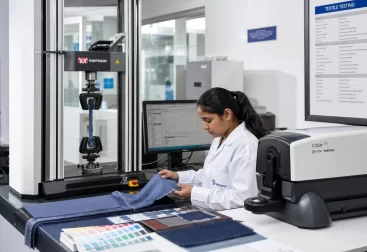
A colour is approved against a physical standard held by both parties, with a light source and a viewing procedure specified. Approving from a photograph is the single most reliable way to generate a shade dispute three months later.
Batch continuity
Where the order exceeds one material batch, the factory states how many batches will be used and whether a shade band has been agreed. Buyers who learn this after cutting have no remedy except accepting visible variation across a shipment.
Substitution rules in writing
The meeting records which substitutions are permitted and who may authorise them. Without that sentence, an unavailable lining becomes a silent substitution, and the first evidence of it is a customer complaint about a bag interior nobody recognises.
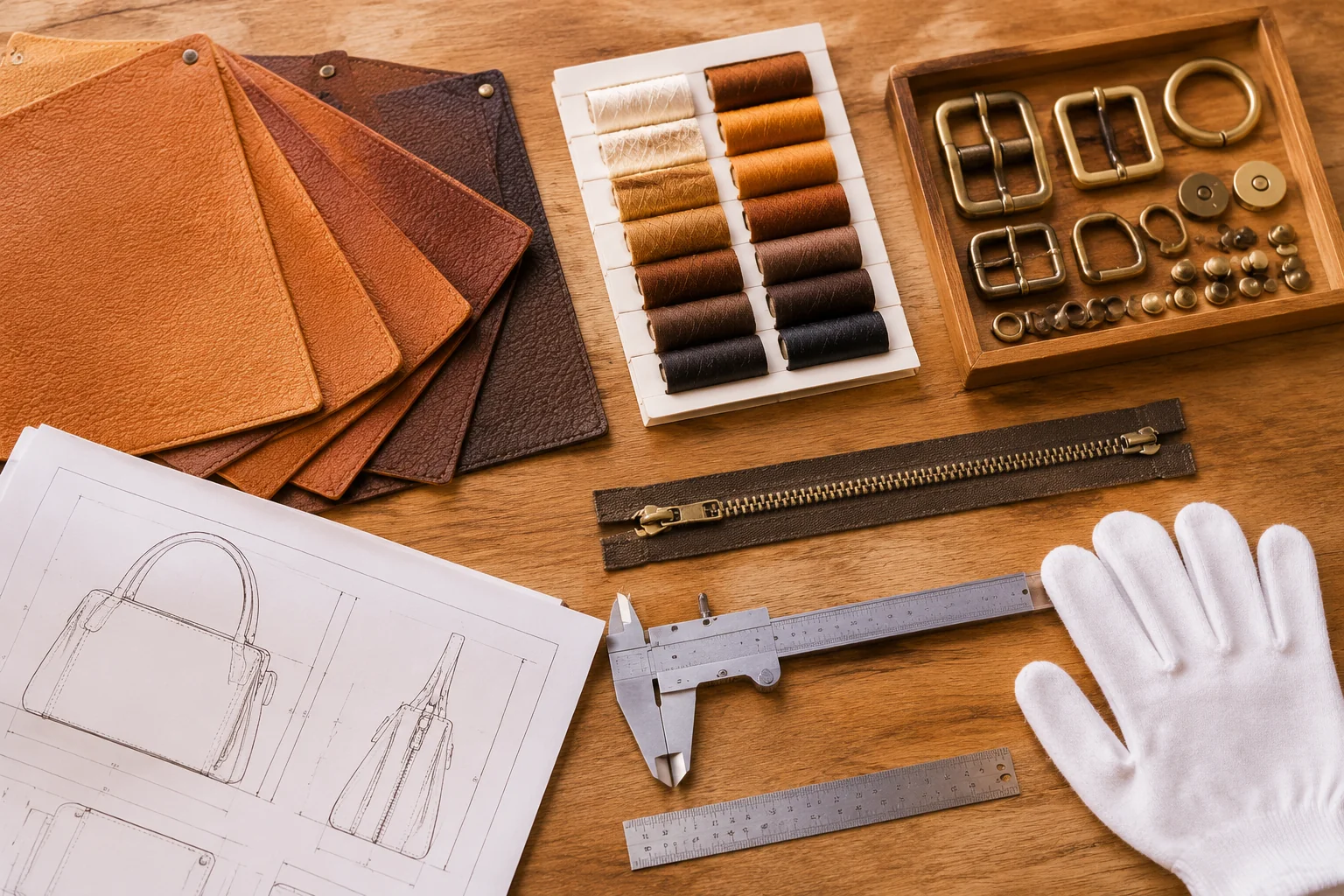
| Material item | What must be approved | Evidence |
|---|---|---|
| Coated fabric | Weight, grain, shade, hand feel | Signed swatch card |
| Lining | Composition, colour, weave | Swatch plus specification |
| Thread | Ticket size, colour, fibre | Thread card reference |
| Edge paint | Colour, gloss, film build | Sample strip |
| Interlining | Weight, stiffness | Material code |
| Adhesive | Type, open time | Technical data sheet |
Hardware and Component Verification
Finish, not just shape
Two buckles of identical shape can differ in plating thickness, colour temperature and corrosion resistance. The approved component is a physical sample with a stated finish, retained by both parties, and the specification names the plating standard rather than a trade colour.
Function testing before bulk
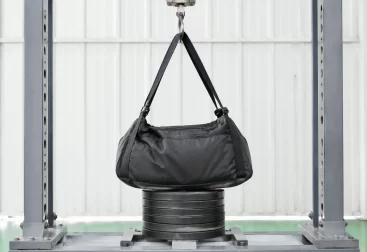
Magnetic snaps, zip sliders, swivel hooks and adjusters are cycled before production rather than after. A five-hundred-cycle test on a snap takes minutes and reveals the class of component that will generate returns in month four.
Component availability risk
Hardware is often the longest-lead item in a bag and the most likely to be silently substituted when stock runs short. The meeting records the ordered quantity, the delivery date and the approved alternative, if any.
Construction and Reinforcement Decisions
Stress points named explicitly
Handle anchors, strap attachments, zip ends, base corners and the point where the lining meets the top edge are where bags fail. Each is named, and the reinforcement for each is stated: bar tack, rivet, box stitch, webbing extension or extra interlining.
Stitch density and seam type
Stitches per inch, seam allowance and whether seams are bound, folded or taped are production decisions that affect both strength and appearance. Left unstated, they revert to whatever the line did last, which may be a different product entirely.
Where the sample and the drawing disagree
The approved sample usually wins, but only if the meeting says so. Where a drawing and a sample conflict and nobody records which governs, the factory will follow whichever is cheaper to produce, and the dispute arrives with the shipment.
A pre-production meeting is successful when a person who was not in the room could build the bag from the documents it produced.
Tolerances, Measurements and Fit
Every dimension needs a number after it
A dimension without a tolerance is an aspiration. Plus or minus three millimetres on a gusset and plus or minus ten on an overall height are both defensible, but they must be written, because the factory will produce to the wider end of whatever is unstated.
The measuring method belongs in the document
Laid flat under no tension, closed and zipped, stuffed to nominal capacity: each method produces a different number for the same bag. The meeting fixes the method and the equipment, which is usually a simple flat table and a steel tape rather than a flexible measure.
Fit and capacity claims
If the bag is sold as fitting a laptop, the internal measurement is a specification, not a marketing phrase. The meeting confirms the internal dimensions against the device it must hold, with the lining and padding included in the calculation.
Setting the Inspection Standard
Critical, major and minor defined in advance
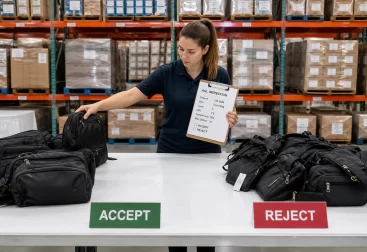
The inspection standard is agreed before production, with examples of each defect class attached. A hole in the lining, a broken zip and a loose thread cannot share one classification, and a vague standard gives the inspector no defensible basis for either passing or rejecting.
Sampling level and lot size
The meeting records the sampling plan, the acceptable quality level per defect class and what happens when a lot fails. The last item matters most: a failed lot needs a defined remedy, whether rework, sorting or rejection, or it will be shipped with a discount argument attached.
Where inspection happens
Whether inspection is at the factory, at a third-party facility or on arrival determines who bears the cost of finding defects. The meeting states the location, the timing and who is present, since inspection after loading is largely a formality.
Written so two inspectors would decide the same way
A standard is only a standard if it produces the same verdict from two different inspectors. Testing that at the meeting, by having both classify three sample defects, is faster than discovering the divergence during a rejected lot.
| Defect class | Example | Typical outcome |
|---|---|---|
| Critical | Sharp hardware point, mould | Lot rejected |
| Major | Open seam, broken zip, wrong hardware | Sort or rework |
| Minor | Uneven topstitch within tolerance | Accepted with note |
| Cosmetic | Faint handling mark | Cleaned before packing |
| Documentation | Wrong label position | Rework labels |
The Golden Sample and the Sealed Standard
One sample, sealed and signed
The approved sample is sealed, signed by both parties and dated, and it is the physical reference for appearance, hand feel and construction. Photographs accompany it, but the photograph never replaces it, because lighting and compression change what a material looks like.
How it is used during production
The sealed sample stays at the line, not in an office. It is compared against the first article, at mid-production and at final inspection. A sample that lives in a drawer is a legal exhibit, not a production control.
What happens when it is lost or damaged
The meeting records who holds the original and who holds the duplicate. If both copies live at the factory, the buyer has no reference during a dispute, which is precisely the situation in which a reference is worth most.
Labelling, Packaging and Marking
Label position and content
Country of origin, fibre content where applicable, care instructions and the internal lot code each have a defined position and a defined format. Position tolerances are small and the cost of correcting a mislabelled shipment is entirely avoidable.
Carton specification and protection
Carton size, board grade, units per carton and the interleaving used to protect hardware all belong on the agenda. Bags are soft goods that scuff against each other, and packaging decisions made at the last minute are the usual origin of transit damage claims.
Shipping marks and packing list alignment
The marks printed on the carton must match the packing list exactly, since a mismatch between mark and document is a routine cause of delay and inspection at destination.
Compliance and Test Requirements
Which tests, on which materials
The meeting confirms the tests required by the destination market, the materials they apply to and who arranges them. Azo colourants, cadmium, phthalates, lead in coatings and nickel release from metal parts are the recurring set for bags.
Sample selection for testing
Testing a swatch the factory selected is not the same as testing the production material. The meeting states that samples are drawn from the actual production batch and identifies who witnesses the draw.
Documentation timing
Reports are needed before shipment, not before arrival. Where a report takes three weeks, the meeting must schedule the material draw early enough that a failure can still be remedied without delaying the order.
Capacity, Line Assignment and Schedule
Which line, and what else is on it
The assigned line matters more than the total factory capacity. A factory with spare capacity on a line that has never run coated fabric will produce a different result from one whose line has run the same construction for years, and only the second belongs on the schedule.
Daily output and the honest completion date
Daily output per line, the number of working days and the effect of any public holiday produce a completion date that can be checked. A ship date agreed before the output figure is confirmed is a wish, and it becomes a claim for delay the moment the first week runs short.
Material arrival versus cutting start
Cutting cannot start before material, hardware and labels arrive together. The meeting records the arrival dates for each of the three, because the latest of them, not the earliest, determines when production actually begins.
The Risk Register
Naming the three most likely failures
Every bag programme has two or three failure modes that are more likely than the rest: a shade deviation, a hardware delay or a capacity conflict with a larger customer. Naming them in advance converts a future crisis into a monitored condition.
Owner and trigger for each risk
Each risk gets a person who watches it and a trigger that escalates it. A shade risk with a trigger of “second batch arrives” and an owner on the factory side produces an early conversation; the same risk without an owner produces a discovery at final inspection.
Contingency that is actually available
A contingency that requires a material nobody stocks is not a contingency. The meeting records what can genuinely be substituted, within what tolerance, and who may approve it, so the answer exists before the question is urgent.
| Risk | Trigger | Contingency |
|---|---|---|
| Shade deviation | Second batch arrives | Shade band and sorting rule |
| Hardware delay | Three days late | Approved alternative finish |
| Capacity conflict | Line reassigned | Written priority agreement |
| Test failure | Report not received | Early material draw |
| Label error | First carton | Pre-production label check |
| Transit damage | Carton test fail | Stronger board or interleaving |
Decisions That Must Be Closed
The list that ends the meeting
The meeting closes with a numbered list of decisions, each with a decision, an owner and a date. Items that remain open are listed separately with a date by which they must close, and open items block production start.
What a closed decision looks like
A closed decision is specific enough to be inspected: “lining is 210T polyester, colour matched to swatch L-14, approved 12 November by both parties” rather than “lining agreed”. The first can be checked against a shipment; the second cannot.
Who may change a decision later
Change authority is recorded. Where any of four people can alter the specification by message, the production standard stops being a standard. One named person per side, in writing, is the whole control.
How many open items are too many
More than three open items means the programme is not ready to cut. The three should be non-material to production, each with a closure date before the planned cutting date, and any item that would change a pattern or a material forces the date to move.
Minutes, Sign-Off and Change Control
Minutes as the production standard
The minutes are not a record of discussion. They are the production standard: the specification, the tolerances, the inspection rules, the packaging detail and the decision list. Written this way, they replace a dozen emails and settle arguments by reference rather than by memory.
Signed by both sides, dated, versioned
Two signatures, one date, one version number, and a distribution list that includes the line supervisor and the inspector. A document without a version number cannot be controlled, because nobody can tell whether the copy at the line is the current one.
Change control after the meeting
Any change after sign-off is issued in writing with a version increment, and the affected material, cutting or labelling is stated. Verbal adjustments from the shop floor are how a controlled standard quietly becomes an uncontrolled one, usually discovered only when a shipment is rejected.
Pilot Run and First Article Review
Why the first article matters more than the sample
The approved sample was made by the sample room, often by the most skilled operator on the site. The first article is made by the line that will produce the order. Comparing the two reveals whether the standard is transferable, which is the entire question.
What to check on the first article
Measurements against tolerance, stitch density, seam and edge appearance, hardware function, label position, and the bag’s behaviour when loaded. Each item is checked against the sealed sample and the signed standard, not against recollection.

Release only after written approval
Production continues past the first article only with written approval. Where the first article is approved informally to keep the schedule, the standard becomes whatever was produced, and every subsequent deviation is measured against the wrong reference.
Agenda Mistakes That Waste the Meeting
Starting with price and lead time
Commercial items consume the attention available for technical ones. Where price is discussed first, the tolerance discussion happens at the door, and tolerances agreed at the door are the ones that produce claims.
Reviewing a specification nobody has read
Circulating the tech pack five minutes before the meeting guarantees that it is skimmed rather than read. Sending it two working days in advance, with a request for written questions, changes the quality of the discussion more than any agenda redesign.
Inviting too many people
Above about eight attendees, the meeting becomes a presentation. The people who decide are the production manager, quality manager, pattern maker and the buyer’s technical lead; everyone else can receive the minutes.
Ending without the decision list
A meeting that ends with agreement in principle has produced nothing that can be inspected. The last ten minutes should be reserved for reading the decision list aloud and confirming each owner and date.
One-Page Agenda Template
The agenda fits on one page when each item is written as a question to be answered rather than a subject to be discussed. The questions below are the ones that close cleanly in a ninety-minute meeting.
Items in the order they should run
Specification first, then materials, then hardware and construction, then tolerances, then inspection, then packaging and compliance, then capacity and risk, and finally the decision list. Following the sequence means each decision rests on the one before it.
The time budget
Roughly fifteen minutes on the tech pack, twenty on materials and hardware, fifteen on construction and tolerances, fifteen on inspection and the sealed sample, ten on packaging and compliance, ten on capacity and risk, and the last five on reading the decision list.
| Agenda item | Question to close | Output |
|---|---|---|
| Tech pack | Is every dimension and material specified? | Confirmed sheet |
| Materials | Which physical standard governs colour? | Signed swatch card |
| Hardware | Which finish and which alternative? | Approved component |
| Construction | What reinforces each stress point? | Method note |
| Tolerances | What number applies to each dimension? | Tolerance table |
| Inspection | What is critical, major and minor? | AQL plan |
| Golden sample | Who holds the sealed reference? | Signed sample |
| Packaging | Which carton and which marks? | Packing spec |
| Compliance | Which tests, drawn when? | Test schedule |
| Capacity | Which line and which finish date? | Schedule |
| Risk | Who watches what, and what triggers? | Risk register |
| Decisions | Who owns what, by when? | Signed minutes |
Questions Buyers Usually Skip
What happens if the first lot fails inspection
Most agendas define the sampling plan and stop there. The remedy for a failed lot — sorting, rework, rejection, who pays for the re-inspection — belongs in the same conversation, because it is the remedy that determines whether the ship date survives.
Who signs the sealed sample, and where the duplicate lives
A single sealed sample held at the factory leaves the buyer without a reference. The duplicate, its storage location and the person responsible for it take thirty seconds to agree and remove an entire category of dispute.
What the packing line needs
Interleaving, hardware protection, carton grade and the stacking height in the container are decided by people who never attend the meeting. Bringing the packing lead in for ten minutes prevents the scuffing and crushing claims that arrive six weeks later.
How a change is authorised mid-production
One named person per side, in writing, with a version increment. Without that sentence, a message from a merchandiser becomes a change order, and the production standard stops being a standard.
Splitting Responsibility Between Buyer and Factory
What the buyer owns
The buyer owns the specification, the approved standards, the sealed duplicate, the compliance requirement for the destination market and the acceptance decision. Where a buyer cannot state a tolerance or produce a swatch, the factory cannot be held to a standard that was never defined.
What the factory owns
The factory owns conformity to that standard: material within the approved batch, method as written, measurement as specified, and inspection as planned. It also owns early warning, which is the obligation to report a deviation before cutting rather than after shipping.
The grey zone that causes most disputes
Design interpretation sits between the two. Whether a curve is softened, a pocket placed slightly higher or a seam finished inward is rarely specified in full, and it is exactly where expectations diverge. The meeting should name the three most subjective features and agree a reference for each.
Running It Across Factories or Languages
One standard, several production sites
Where a programme runs across two factories, the same sealed sample and the same tolerance table must govern both. Two slightly different standards produce two slightly different bags, and the difference becomes visible only when they sit on the same shelf.
Bilingual or illustrated documents
A specification that depends on translation is a specification that degrades on the shop floor. Numbers, diagrams, photographs and material codes survive translation; descriptive adjectives do not, and the operator reads the drawing rather than the paragraph.
Confirming understanding, not attendance
The test of a remote meeting is whether the line supervisor can restate the three critical requirements in their own words. If they cannot, the meeting was attended but not transferred, and the first article will show it.
FAQ
When exactly should the pre-production meeting be held?
After the sample is approved and before bulk material is cut. Held earlier, there is no approved sample to reference and the discussion stays abstract. Held later, the first rolls are already cut and every decision becomes a change request with a cost attached.
Who must attend for the meeting to be valid?
At minimum the production manager, the quality manager, the pattern maker, the material purchaser and the line supervisor, plus the buyer’s technical contact. The quality manager and pattern maker are the two whose absence should trigger a reschedule, because their decisions cannot be delegated to the minutes.
How long should it take?
Ninety minutes for a standard bag programme with a fixed agenda. Meetings that run to three hours usually contain a price discussion, a factory tour or an unresolved specification that should have been settled by email beforehand.
What is the single most important output?
A signed production standard that states the specification, the tolerances, the inspection rules, the packaging and the decision list, with a version number and two signatures. If the meeting produces only a discussion and a promise, it has not controlled anything.
Should the tech pack be read aloud in the meeting?
The key clauses should be, particularly dimensions, measuring points and material specifications. Reading forces the factory to confirm what it has understood, which is where the gap between a written specification and a production reality usually appears.
How are colour and material approved at this stage?
Against a physical standard held by both parties, with a stated light source and viewing procedure. Approving from a photograph or an email attachment is the most reliable way to produce a shade dispute on bulk, because screens and compression both change the colour.
What belongs in the tolerance table?
Every quoted dimension with a measuring point, a measuring method and a numeric tolerance. A dimension without a tolerance will be produced at whatever the factory finds convenient, and it will be defensible because nothing was written.
How should the inspection standard be set before production?
By defining critical, major and minor defect classes with physical examples, then stating the sampling plan and the acceptable quality level for each class. A standard without examples leaves the inspector without a defensible basis for either passing or rejecting a lot.
What is a golden sample and who keeps it?
A sealed, signed and dated sample that serves as the physical reference for appearance, hand feel and construction. The factory keeps one for the line and the buyer keeps a duplicate, because a single reference held by one party is not a reference during a dispute.
Which compliance tests should be agreed at the meeting?
The tests required by the destination market for the specific materials: azo colourants, cadmium, phthalates, lead in coatings and nickel release from metal parts are the recurring set for bags. The meeting should also fix who draws the samples and from which production batch.
How detailed should the capacity discussion be?
Specific enough to produce a checkable completion date: which line, what daily output, how many working days, and which public holidays fall inside the window. The arrival dates of material, hardware and labels should be recorded separately, because the latest of them sets the real start date.
What is a risk register in this context?
Two or three named failure modes with an owner and an escalation trigger for each — a shade deviation across batches, a hardware delivery delay, or a capacity conflict with a larger customer. Naming them converts a future crisis into a monitored condition.
How should the minutes be written?
As a production standard rather than a discussion record: specification, tolerances, inspection rules, packaging detail, and a numbered decision list with owners and dates. Version it, sign it from both sides, and distribute it to the line supervisor and the inspector.
Does a first article review replace final inspection?
No. The first article review tests whether the approved sample is transferable to the production line. Final inspection tests whether the whole lot conforms. They answer different questions, and both are needed when the sample was made by a different team than the production run.
What if the factory cannot attend in person?
A video meeting works if the sealed sample and the material swatches are physically present at the factory and the camera can show them being measured. Documents can be shared remotely; a colour or a hand feel cannot, so those approvals must rest on physical standards sent in advance.
Want a pre-production meeting that produces a usable standard?
Send your tech pack, target market and order volume to info@gionar.com. We return a completed agenda, a tolerance table, an inspection plan and a sealed sample protocol before your line is assigned, so the first article is measured against a document rather than a memory.