Colour is the defect customers notice before they notice anything else. A bag can be perfectly constructed, correctly dimensioned and made from the right material, and still be rejected because it does not match the sample on the shelf beside it. Unlike a loose stitch or a weak seam, a colour difference cannot be repaired, reworked or accepted with a discount.
For buyers sourcing PU leather bags, colour consistency is therefore a planning problem rather than a production problem. Most mismatches are decided long before the sewing line starts: when the material is ordered, when the lab dip is approved, and when the production run is scheduled. By the time the goods are cut, the outcome is largely fixed.
The commercial stakes are higher than they appear. A range that does not match cannot be merchandised together, which forces markdowns or split displays. A repeat order that arrives in a different shade undermines the customer’s confidence in the whole programme. And a colour claim is difficult to win retrospectively, because the evidence needed to make it must be gathered before production, not after.
This guide explains why colour behaves the way it does in coated materials, how lab dips and approval processes work, how to read colour measurement, how light sources distort judgement, and how to plan production so that batches match. It is written for buyers and product developers who need to specify colour in a way a factory can actually deliver.
Why Colour Is Hard in PU Leather
Colour in a coated material is produced by several layers acting together, and each introduces its own variation. Understanding the structure explains why matching is more difficult than it appears.
The layered structure of PU leather
PU leather consists of a backing fabric, a polyurethane coating, and usually a top surface treatment that sets the gloss and grain. Colour comes primarily from pigment dispersed in the coating, while the surface treatment determines how light reflects from it.
Two rolls can contain the same pigment and still appear different if the surface treatment varies, because the way light reflects changes the perceived hue and depth. This is why colour matching cannot be reduced to pigment formulation alone.
Grain, gloss and perceived colour
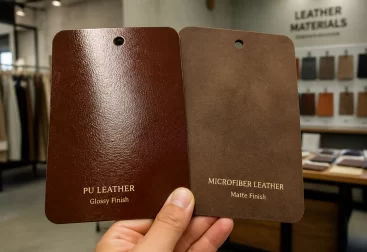
A grained surface scatters light and reads lighter and softer than a smooth surface carrying the same pigment. A glossy finish appears deeper and more saturated than a matte finish of identical colour.
This means texture and finish specifications are colour specifications. Changing grain or gloss after the dip is approved changes the appearance as surely as changing the pigment, and it invalidates the approval.
Where variation enters
Variation enters at several points: pigment batch differences at the coating stage, coating thickness control, backing fabric shade showing through, and surface treatment consistency. Each is separately controlled, and a failure in any one shows up as a colour defect.
| Source of variation | Effect on appearance | Controllable by |
|---|---|---|
| Pigment batch difference | Overall shift in hue or depth | Coating supplier |
| Coating thickness | Depth and saturation change | Coating line control |
| Backing fabric shade | Show-through, tone shift | Material supplier |
| Surface treatment | Gloss and perceived colour | Finishing process |
| Grain embossing | Lightness and softness | Embossing control |
Why visual assessment alone is unreliable
Human colour judgement is influenced by surroundings, memory and lighting. Two samples assessed minutes apart under different conditions will be judged differently even by the same person.
This is not a reason to abandon visual assessment, which remains the reference for how a product looks in a shop. It is a reason to combine it with measurement, so that visual judgement is applied to a sample that is already known to be within tolerance.
Substrate shading and show-through
The backing fabric beneath the coating is not always fully hidden. A light coating over a darker or warmer backing produces a different apparent colour from the same coating over a lighter backing, particularly at folds and edges where the coating is thinnest.
This is why a dip produced on one backing cannot be approved for a bulk order made on another. The backing specification belongs with the colour specification, and a change to either should trigger re-approval.
Lab Dips and the Approval Process
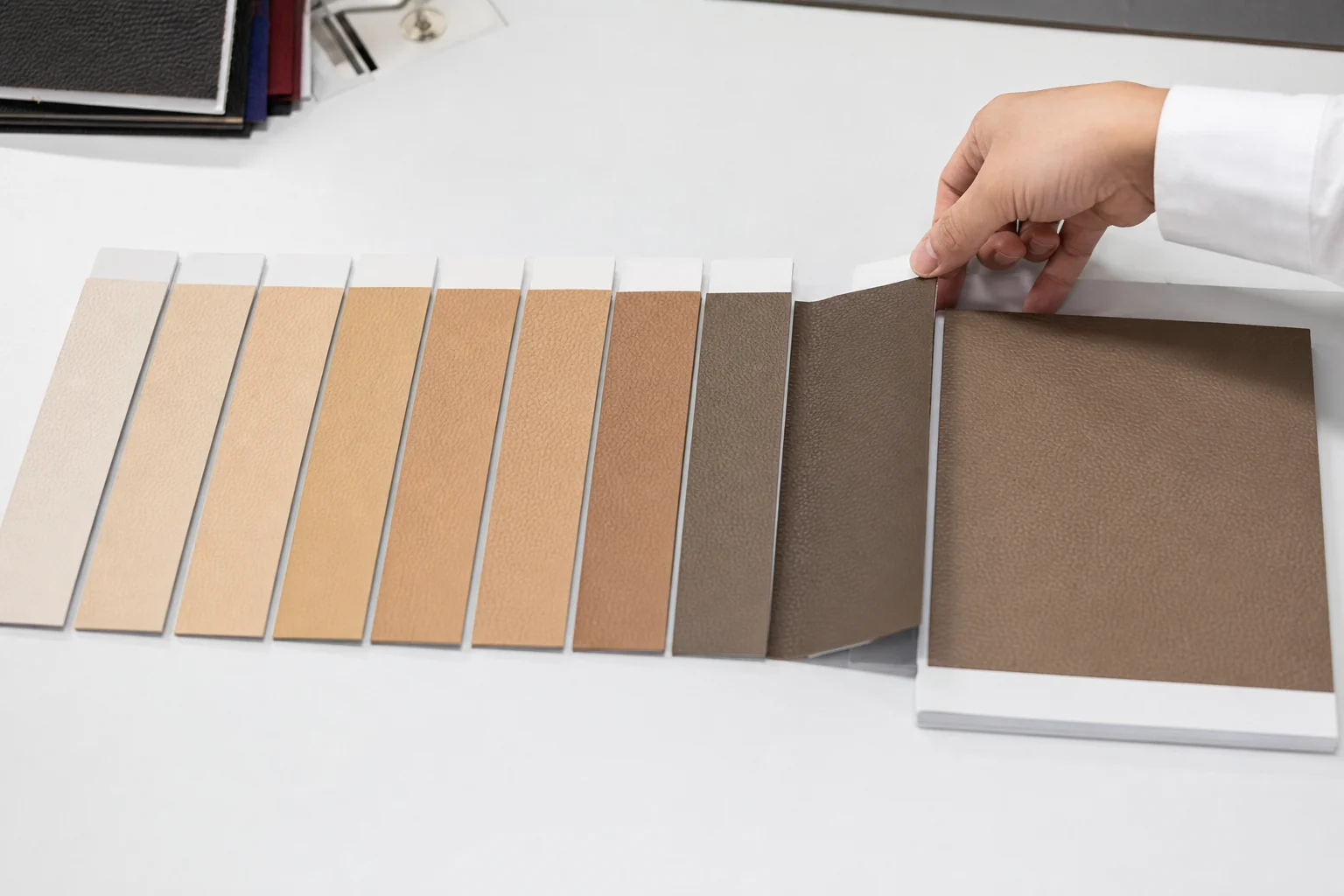
A lab dip is a small sample of material produced to demonstrate the colour that will be achieved in bulk. It is the central control in colour management, and how it is approved determines everything that follows.
What a dip represents
A dip shows the colour the coating line can produce, not the colour on a screen or in a digital file. It is produced with the intended pigment formulation, on the intended backing, with the intended surface treatment.
For this reason a dip produced on a different backing or with a different finish is not a valid reference. It may match numerically while the bulk material, made as specified, does not.
The dip approval round
Approval typically requires more than one round. The first dip is assessed against the target, adjustments are made, and a revised dip is submitted. Two to three rounds is normal for a new colour.
Each round costs time. For a colour that must be ready for a production window, the dip process should begin well before the material order is placed, not alongside it. Working backwards from the shipping date to the dip approval date is the planning step most often skipped.
Approving more than one
A single approved dip is insufficient for a range produced across a long period. Colour perception drifts, and a single sample assessed repeatedly over months becomes an unreliable reference.
The practical solution is to approve and retain several standard samples, distribute them to the parties who will assess production, and replace them on a defined cycle. Storing a standard in a drawer exposed to light and heat degrades it silently.
| Stage | What it establishes | Common failure |
|---|---|---|
| Colour target set | Reference definition and tolerance | Target given only as an image |
| First dip | Feasibility and starting point | Dip on wrong backing |
| Revision rounds | Convergence to target | No schedule allowance |
| Dip approval | Production reference fixed | Approved informally by message |
| Standard retention | Reference for later batches | Standard degrades in storage |
Recording the approval properly
A dip approval should be recorded in writing with the reference number, the date, the material specification and the measured values. An approval given verbally or by a message without the sample reference creates ambiguity that surfaces months later.
Retaining a physical piece of the approved dip, signed and dated, resolves most subsequent disagreements. Digital records alone cannot be re-measured against a batch if the original sample is unavailable.
Dip size and representativeness
A dip is only as useful as its resemblance to bulk material. A very small dip produced by hand may not reflect how the coating line behaves at production speed, where drying, tension and line conditions differ.
Where a colour is critical or technically difficult, requesting a slightly larger dip, or a bulk trial on a short run, gives a more reliable indication. The extra cost is small compared with the cost of a mismatched production order.
Reading Colour Measurements
Instrumental measurement removes the subjectivity that makes colour disputes difficult to resolve. Its value lies less in precision than in providing a shared, repeatable number that both parties accept.
What a spectrophotometer reports
A spectrophotometer measures how a sample reflects light across the visible spectrum and expresses the result in a defined colour space. The common commercial spaces allow differences to be expressed as a single numerical value.
In practice the most useful output for a bag programme is the set of difference values against a standard, expressed as lightness, and two colour axes. These separate the direction of a difference, which is what makes a corrective action possible.
Tolerance and its practical meaning
A tolerance states how much difference is acceptable. It should be agreed before the dip is approved, because a tolerance set after a batch arrives is a negotiation rather than a limit.
Tolerance depends on the product and the market. A tight tolerance is appropriate for a monochrome range where bags sit side by side. A looser tolerance may be acceptable for a single style deliberately kept apart from others.
| Measurement output | What it indicates | Practical use |
|---|---|---|
| Lightness difference | Lighter or darker than standard | Identifies coating weight issues |
| Red-green axis difference | Warmer or cooler cast | Points to pigment adjustment |
| Yellow-blue axis difference | Yellower or bluer cast | Points to pigment adjustment |
| Overall difference value | Combined magnitude | Single pass or fail figure |
| Reflectance curve | Spectral behaviour | Detects metameric matches |
Limits of measurement
Measurement is not infallible. A sample measured through a textured surface, at an inconsistent angle, or in a different instrument configuration can produce values that misrepresent how the material looks.
Because of this, measurement should support visual assessment rather than replace it. The useful sequence is to measure first to confirm the sample is within tolerance, then assess visually to confirm it is commercially acceptable.
Instrument settings and consistency
Measurements are only comparable if taken with the same instrument configuration, aperture size and number of readings averaged. A single reading on a textured surface is unreliable; averaging several positions gives a representative value.
Where buyer and supplier measure with different instruments, the difference between instruments should be established on a common sample before disputes arise. Two calibrated instruments can still report slightly different values, and knowing the offset prevents a false failure.
Light Sources and Metamerism
The same material appears different under different light. This is not a marginal effect; it is large enough to make a matched pair look mismatched in a shop window and a mismatched pair look identical in an office.
Why light changes colour
Light sources contain different mixtures of wavelengths. Daylight, a fluorescent tube, an incandescent lamp and a light-emitting diode deliver different spectral distributions, and a coloured surface reflects them differently.
A material that matches under one source can diverge under another. Since bags are assessed in factories, in warehouses, in shops and in daylight, a single-source assessment is incomplete by design.

Metamerism explained simply
Metamerism is the condition in which two samples match under one light source and differ under another. It occurs when the samples achieve their colour through different spectral means, even though the perceived colour under one source is the same.
Metamerism is a particular risk when a colour is matched by adjustment rather than by formulation. A pigment combination chosen to hit a target under a specific light may diverge badly under other conditions, even though the measured difference is small.
Assessing under multiple sources
The practical control is to assess colour under more than one source, and to agree which sources matter for the market. For most consumer products, daylight and a representative retail source are the two that matter most.
Recording which sources were used at approval prevents later disputes. If a batch is rejected under a source that was never part of the approval, the rejection is difficult to sustain.
| Light source | Typical setting | Why it matters |
|---|---|---|
| Daylight | Exterior, midday | How customers see the product |
| Retail fluorescent | Shop lighting | How the product is sold |
| Tungsten or warm white | Home interior | How the product is used |
| Cool white LED | Modern retail and office | Common current source |
| Ultraviolet | Window and sunlight | Reveals optical brighteners |
Optical brighteners and ageing
Some materials contain optical brighteners that react to ultraviolet light, appearing brighter in daylight than under indoor sources. This produces a difference between samples that can be mistaken for a colour fault.
Colour also shifts with age and light exposure. A standard sample stored in daylight will itself drift, so the reference used for assessment must be protected. Recording the standard’s date of approval allows an aged reference to be identified.
Viewing booths versus shop lighting
A viewing booth provides a controlled, repeatable environment for assessment, which makes it the right tool for approvals and disputes. It does not reproduce the lit shop floor, where multiple sources mix and the surrounding colours influence perception.
The two serve different purposes. Use the booth to decide whether a batch is within tolerance, and use a representative retail environment to decide whether it is commercially acceptable. Confusing them leads either to rejecting usable material or accepting material that will not sell.
Batch Matching and Production Planning
Most serious colour problems are planning failures rather than production failures. The material for an order is drawn from more than one production run, and the runs do not match closely enough to be merchandised together.
Why batches differ
Coating runs differ because pigment lots differ, because line conditions drift, and because the coating thickness achieved varies slightly from run to run. Each is normally within the supplier’s own tolerance, which is wider than a typical buyer’s requirement.
This is the crux of the problem. A material can be fully compliant with the supplier’s specification and still fail the buyer’s colour requirement, because the two tolerances were set for different purposes.

Reserving material from a single run
The most effective control is to reserve material for a whole order, or a whole season’s range, from one coating run. This eliminates batch variation within the order entirely, at the cost of committing to a volume in advance.
For ranges that must match closely, this commitment is usually the cheapest option available. The alternative is accepting that later deliveries may not match earlier ones, and planning the merchandising accordingly.
Splitting orders deliberately
Where a single run is impractical, the order can be split so that each colour batch corresponds to a distinct product or a distinct delivery. Bags within one style, one delivery or one display must still come from one batch.
The planning rule is simple: any two units that a customer might compare side by side must come from the same coating run. Everything else can be managed by separation.
| Approach | Colour risk | Planning implication |
|---|---|---|
| Single run for whole order | Lowest | Volume commitment in advance |
| Single run per style | Low within style | Requires per-style volume planning |
| Single run per delivery | Moderate | Accepts variation between deliveries |
| Mixed batches in one style | High | Not suitable for merchandised ranges |
| Unplanned sourcing | Highest | No control over matching |
Verifying on receipt
Material should be checked on receipt, before cutting, against the approved standard and the specified tolerance. Discovering a mismatch after cutting converts a material claim into a finished-goods loss.
Checking at receipt is also faster. A roll can be assessed in minutes; a completed batch of bags cannot, and rejecting it involves labour already spent.
Planning around coating lead times
Reserving a single coating run requires the volume to be forecast earlier than a mixed-batch approach, because the coating supplier needs lead time to schedule the run. Planning must start further ahead than the sewing schedule alone would suggest.
Where volume is uncertain, a common compromise is to commit to a range of volumes and agree how late the final figure can be adjusted. This preserves the single-run benefit without an unbounded commitment.
Controlling Colour on the Line
Once matched material is in production, the remaining risks come from mixing batches on the line and from contamination between colours. Both are process controls rather than material controls.
Keeping batches separate during cutting and sewing
If two coating runs are in the factory at once, panels from different runs can be assembled into a single bag. The result is a bag whose front and back differ slightly, which is more objectionable than either batch being uniformly off.
The control is physical separation: distinct storage locations, distinct cutting sequences, and clear identification on each bundle. Colour mixing is almost always a handling failure rather than a material failure.
Contamination between colours
Cutting tables, blades, guides and machine surfaces retain material traces. Running a light colour after a dark one without cleaning transfers pigment and produces a tonal shift that appears as a colour defect.
The control is a documented cleaning routine when changing colours, with particular attention to cutting surfaces and the presser feet and feed areas of machines. The lighter the incoming colour, the more thorough the cleaning needs to be.
| Risk | How it arises | Control |
|---|---|---|
| Mixed batches in one bag | Two runs in production together | Physical separation, bundle marking |
| Light after dark | Residual pigment on equipment | Documented colour-change cleaning |
| Surface marking | Handling and stacking | Interleaving, stacking limits |
| Fading from light | Extended exposure in the factory | Covered storage |
| Shade shift during pressing | Heat applied to a coated surface | Verify heat settings on the finish |
Heat and finish effects
Pressing, embossing and heat sealing can shift the appearance of a coated material. A shade that matches before pressing may not match afterwards if heat settings differ between units or batches.
This is worth testing at the sample stage rather than discovering in production. Pressing a colour sample and re-measuring it confirms whether the finishing step changes the appearance materially.
Training the inspection team
Colour assessment in production is usually performed by staff who have not been formally trained in it. Consistency improves markedly when a small number of people are designated to assess colour, given a clear standard and a documented procedure.
Designating assessors also concentrates accountability. When everyone assesses colour, no one owns the decision, and the same batch can be passed in the morning and questioned in the afternoon.
Rejecting Off-Colour Material
Colour claims are won or lost on documentation assembled before the goods were produced. A claim made without a standard, a tolerance and a receipt check has little to stand on.
What makes a colour claim defensible
Four elements are needed: an approved standard sample, an agreed tolerance with a stated assessment method, a measurement or assessment recorded at material receipt, and evidence that the material was stored and handled correctly afterwards.
The last element matters because a supplier can reasonably argue that damage occurred after delivery. Metered storage records, covered storage and prompt inspection close that argument.
Assessing and documenting the rejection
A rejection should record the measured difference against the standard, state the assessment conditions including light source, identify the roll or batch, and retain photographs taken under controlled conditions.
Photographs alone are weak evidence because cameras and screens alter colour. They support a claim but cannot replace a physical sample. Retaining a cut piece of the rejected material is far more persuasive than any image.
| Element | Purpose | Common omission |
|---|---|---|
| Approved standard | Defines the target | Standard not retained |
| Agreed tolerance | Defines pass and fail | Tolerance never stated |
| Receipt record | Shows defect present on delivery | No check performed |
| Measured values | Quantifies the difference | Described only as “different” |
| Retained sample | Evidence for later review | Sample discarded |
Working with the supplier rather than against them
Colour claims are more often resolved by agreeing a separation or a discounted use than by rejection. A material that is off-standard but consistently so can sometimes be used for a product that stands alone.
That option depends on knowing the difference early. Once material is cut into a merchandised range, the negotiating position narrows to a straight acceptance or rejection decision.
Writing Colour Into the Specification
Colour requirements belong in the written specification, not in an exchanged message. Anything not written cannot be enforced and cannot be measured against.
The elements a colour specification needs
A workable specification names the reference standard, states the tolerance and the method by which it is assessed, specifies the light sources used for visual assessment, and defines what happens if a delivery falls outside tolerance.
It should also address the finish and grain, since these change appearance as much as pigment does. A colour approved on one grain is not approved on another.
| Specification element | Why it is needed |
|---|---|
| Reference standard and its date | Defines the target objectively |
| Tolerance and colour space | Makes pass and fail measurable |
| Assessment method and light sources | Makes results repeatable |
| Grain and gloss specification | Prevents appearance drift |
| Single-run or per-batch rule | Controls batch matching |
| Non-conformance procedure | Removes ambiguity on rejection |
Simple language, unambiguous meaning
Descriptions such as “warm brown” or “as per sample” produce disputes. A reference number, a retained physical standard and a numerical tolerance leave nothing to interpretation.
The specification should also state who holds the standard sample and how it is stored. A standard that cannot be produced on request is not a standard, and a claim assessed against an aged sample is unreliable for both parties.
Colour is decided when the material is ordered. Everything after that is enforcement.
FAQ
What is a lab dip and why does it take several rounds?
A lab dip is a small sample produced to show the colour the coating line can actually achieve in bulk, using the intended pigment, backing and surface treatment. Several rounds are normal because the first dip establishes a starting point and each revision converges toward the target. Two to three rounds is typical for a new colour, so the process needs schedule allowance before the material order is placed.
Why do two rolls of the same colour not match exactly?
Because each coating run differs slightly. Pigment lots vary, line conditions drift, and coating thickness is never identical from run to run. Each roll can be fully compliant with the supplier’s own specification and still fail a buyer’s tighter colour requirement, because the two tolerances were set for different purposes.
How do I stop batches from not matching?
Reserve material for a whole order, or a whole season’s range, from a single coating run. That eliminates batch variation within the order entirely, at the cost of committing to a volume in advance. Where a single run is impractical, the rule to apply is that any two units a customer might compare side by side must come from the same run.
What is metamerism and why does it matter for bags?
Metamerism is when two samples match under one light source and differ under another. It happens when samples reach their colour through different spectral means. It matters because a colour adjusted to hit a target under one light can diverge badly in a shop window, even though the measured difference under the approval source is small.
Should I rely on visual assessment or on a spectrophotometer?
Use both, in sequence. Measure first to confirm the sample is within tolerance, then assess visually to confirm it is commercially acceptable. Measurement removes the subjectivity that makes disputes hard to resolve, but it cannot account for how a textured or glossy surface actually looks, so visual judgement remains the final reference.
What tolerance should I set for bag colour?
It depends on whether the bags will be compared side by side. A tight tolerance is appropriate for a monochrome range merchandised together, while a looser tolerance may be fine for a single style kept apart. Set the tolerance before the dip is approved; a tolerance agreed after a batch arrives is a negotiation rather than a limit.
Why does the same material look different in the shop than in the factory?
Because the light sources differ. Daylight, retail fluorescent, warm interior lighting and cool LED each deliver a different spectral distribution, and a coloured surface reflects them differently. Assessing under more than one source, and agreeing in advance which sources matter for the market, prevents later disagreement.
Can colour variation be corrected on the finished bag?
No. Unlike a loose stitch or a weak seam, a colour difference cannot be repaired or reworked, and accepting it at a discount still leaves a range that cannot be merchandised together. This is why colour has to be controlled at the material stage rather than inspected at the end.
What causes a light bag to pick up a dark cast?
Contamination between colours on the line. Cutting tables, blades, guides and machine surfaces retain traces of the previous material, which transfer to the next colour. The control is a documented cleaning routine when changing colours, applied more thoroughly the lighter the incoming shade.
Does pressing or embossing change the colour?
Yes. Pressing, embossing and heat sealing can shift the appearance of a coated material, so a shade matching before pressing may not match after it if heat settings differ. Test this at the sample stage by pressing a colour sample and re-measuring it, rather than discovering the shift in production.
How should I reject off-colour material?
With documented evidence gathered before cutting: the approved standard, the agreed tolerance, a measurement or assessment recorded at receipt, the assessment conditions including light source, and a retained physical sample of the rejected material. Photographs support a claim but cannot replace a sample, because cameras and screens alter colour.
What should a colour requirement in a specification contain?
The reference standard and its approval date, the tolerance expressed in a defined colour space, the assessment method and light sources, the grain and gloss specification, the rule on single-run or per-batch sourcing, and the procedure for non-conformance. Anything not written cannot be enforced or measured against.
Working with a PU leather bag manufacturer?
We manufacture PU leather bags in Guangzhou on OEM and ODM programmes, with lab dip approval, retained physical standards, instrumental colour measurement and single-run material planning built into every order. Send your requirements to info@gionar.com, or review our custom bag manufacturing capabilities.